
ISO 22301 Certification
Business Continuity Management Systems
Quick Answer
ISO 22301 is the international standard for business continuity management systems (BCMS), specifying requirements for planning, implementing, and improving an organization’s ability to recover critical functions during disruption. Certification is issued by an accredited certification body after an audit that includes reviewing evidence of a genuinely tested Business Impact Analysis (BIA), Recovery Time and Point Objectives (RTO/RPO), and exercised continuity plans. Most organizations complete implementation and certification in four to seven months, with cost driven by the number of critical functions and required exercise scope.
Introduction
Business continuity certification gets marketed heavily around disaster recovery, but ISO 22301 is more specific and more testable than that framing suggests. This page explains what the standard actually requires clause by clause, what a genuine Business Impact Analysis involves, the real difference between internal implementation and external certification, benefits, cost, and which organizations genuinely need it versus which can treat continuity planning informally. ShineCert has built continuity management systems for financial services and critical infrastructure-adjacent organizations from our operating offices in Riyadh, Lebanon, and India.
What Is ISO 22301? Understanding the Standard
ISO 22301:2019 specifies requirements for a business continuity management system that helps organizations prepare for, respond to, and recover from disruptive incidents, from cyberattacks and natural disasters to supply chain failures. It follows the Harmonised Structure shared with ISO 9001 and ISO 27001, but its technical core is distinct: it requires a Business Impact Analysis identifying which functions are genuinely critical and how quickly they need to resume. Certification doesn’t mean an organization can survive any conceivable disruption, it means the organization has systematically identified critical functions, built and tested plans to recover them, and demonstrably exercises those plans.
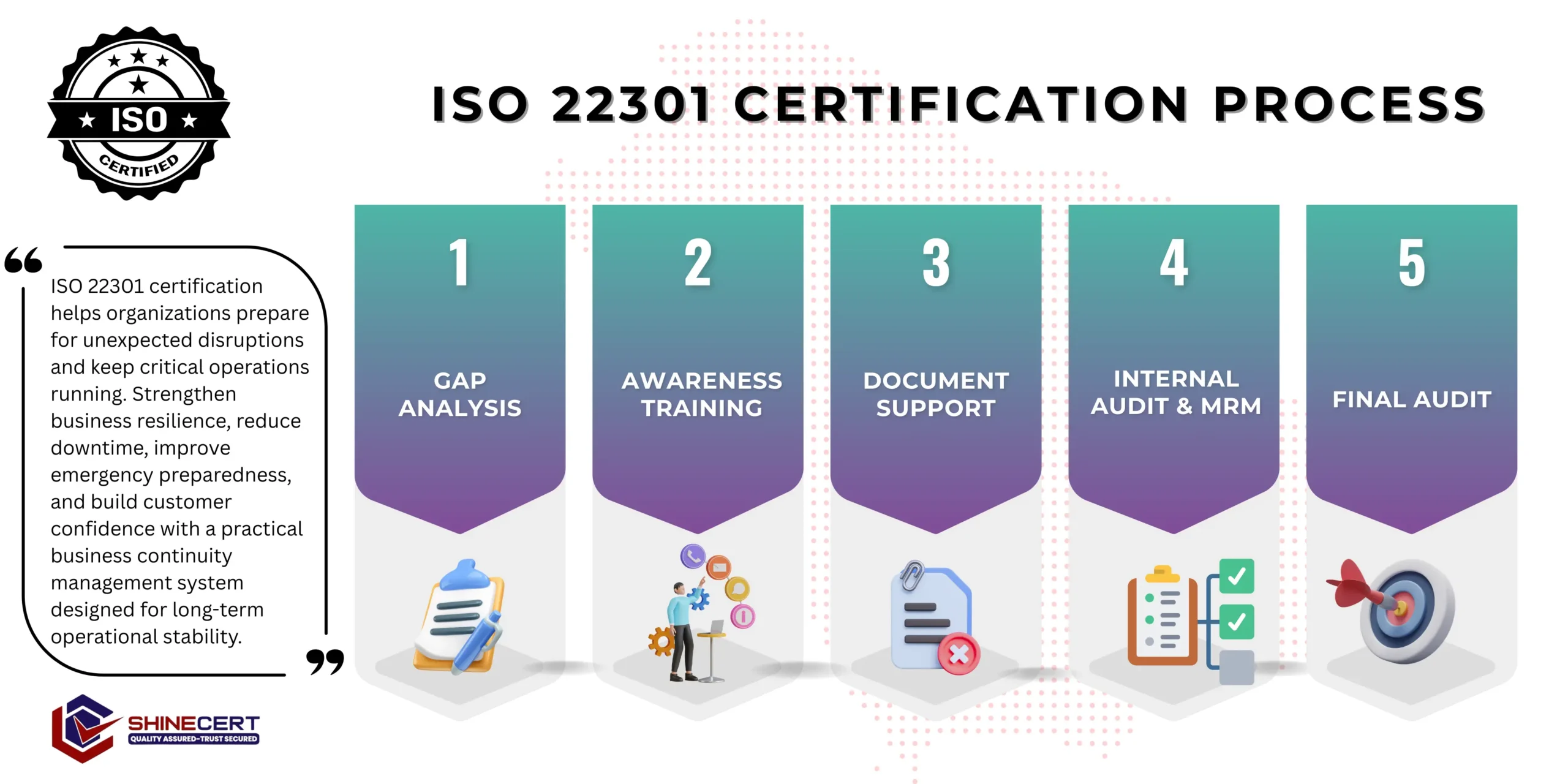
What are the steps to get ISO 22301 Certification?
our services
- ISO 9001 Certification
- ISO 14001 Certification
- ISO 27001 Certification
- ISO 22000 Certification
- ISO 45001 Certification
- ISO 13485 Certification
- ISO 17025 Certification
- CE Mark Certification
- GMP Certification
- Halal Certification
- SOC Certification
The ISO 22301 Implementation Process
Context, Leadership, and Scope
Define BCMS scope, identify interested parties' continuity expectations, and secure top management commitment via a business continuity policy.
BCMS scope statement and continuity policy.
Business Impact Analysis and Risk Assessment
Identify critical functions, their disruption impact over time, and RTOs and RPOs for each, paired with a threat and risk assessment.
Business impact analysis and risk assessment report.
Continuity Strategy and Plans
Develop strategies and detailed plans per critical function, addressing people, facilities, technology, and supplier dependencies, with clear activation criteria.
Continuity strategies and function-level continuity plans.
Exercising and Testing
Genuinely exercise plans — tabletop exercises, simulations, or full-scale tests — with lessons fed back into plan updates.
Exercise records and updated continuity plans.
Internal Audit and Management Review
Complete an internal audit cycle and management review with continuity-specific inputs before the certification audit.
Internal audit report and management review minutes.
Context, Leadership, and Scope
Define BCMS scope, identify interested parties' continuity expectations, and secure top management commitment via a business continuity policy.
BCMS scope statement and continuity policy.
Business Impact Analysis and Risk Assessment
Identify critical functions, their disruption impact over time, and RTOs and RPOs for each, paired with a threat and risk assessment.
Business impact analysis and risk assessment report.
Continuity Strategy and Plans
Develop strategies and detailed plans per critical function, addressing people, facilities, technology, and supplier dependencies, with clear activation criteria.
Continuity strategies and function-level continuity plans.
Exercising and Testing
Genuinely exercise plans — tabletop exercises, simulations, or full-scale tests — with lessons fed back into plan updates.
Exercise records and updated continuity plans.
Internal Audit and Management Review
Complete an internal audit cycle and management review with continuity-specific inputs before the certification audit.
Internal audit report and management review minutes.
The ISO 22301 Certification Process
Stage 1 Audit
Reviews BCMS documentation, scope, and readiness for Stage 2.
DocumentationStage 2 Audit
An on-site audit evaluating whether the BCMS is genuinely implemented, reviewing BIA quality, plan detail, and, critically, evidence that plans have actually been exercised, not just written.
Evidence sampledCertification Decision
Certification is issued once nonconformities are resolved, typically valid three years subject to surveillance.
Certificate issuedSurveillance and Recertification
Annual surveillance audits confirm ongoing exercising and improvement, with full recertification every three years.
Ongoing / every 3 yearsWhy ISO 22301 Certification Matters
Every organization faces disruption risk, but most manage it informally until an actual incident exposes the gaps, untested assumptions about vendor availability, outdated contact lists, or recovery times that sound reasonable on paper but prove unachievable in practice. ISO 22301 forces this testing to happen before a real incident does, and regulators in financial services and critical infrastructure increasingly require demonstrated operational resilience as a condition of operating, not an optional best practice.
ISO 22301 Certification Cost Explained
Cost depends on the number of critical functions identified, organizational complexity (site count, technology dependencies), and the scope of exercise testing required to demonstrate genuine plan viability, all of which influence the overall time, effort, and resources needed to build and validate a business continuity plan capable of withstanding real-world disruptions across various departments, locations, and technology systems the organization relies on daily.
Mandatory Documented Information for ISO 22301
At minimum: business continuity policy and objectives; Business Impact Analysis with RTOs and RPOs; risk assessment; documented continuity plans per critical function; exercise program and records; internal audit records; and management review records.
The Structure of ISO 22301: Clauses Explained
- Clause 4 — Context of the Organization : Requires understanding the organization’s continuity needs, interested parties’ expectations, and defining BCMS scope (which functions, sites, and processes are covered).
- Clause 5 — Leadership : Requires top management commitment expressed in a business continuity policy, with clear roles and responsibilities.
- Clause 6 — Planning : Requires identifying risks and continuity objectives, and planning changes to the BCMS in a controlled way.
- Clause 7 — Support : Covers resources, competence, awareness, communication, and control of documented information.
- Clause 8 — Operation : The technical core: Business Impact Analysis and risk assessment, business continuity strategies, and detailed continuity plans with defined Recovery Time Objectives (maximum acceptable time to resume) and Recovery Point Objectives (maximum acceptable data loss). This clause also requires an exercise and testing program, plans must be genuinely exercised, not just documented.
- Clause 9 — Performance Evaluation : Requires monitoring and measurement, internal audit, and management review with continuity-specific inputs (exercise results, incident history, threat landscape changes).
- Clause 10 — Improvement : Requires corrective action addressing nonconformities and gaps surfaced through exercises or real incidents, and continual improvement of the BCMS.
Clause 8’s BIA and exercise requirements are where ShineCert sees the most audit findings, plans that exist on paper but have never been genuinely tested reveal untested assumptions the moment a real disruption occurs.
Aligning ISO 22301 With National and Regulatory Continuity Expectations
- Many sectors and jurisdictions layer additional, more specific continuity or operational resilience expectations on top of base ISO 22301. Financial regulators in numerous markets require regulated firms to identify “important business services,” set impact tolerances for their disruption, and demonstrate through severe-but-plausible scenario testing that they can remain within those tolerances, a well-built ISO 22301-aligned BCMS supports this directly, since the underlying BIA and exercise program map closely onto what these frameworks expect.
- Critical infrastructure operators frequently face sector-specific continuity regulation with mandatory incident reporting obligations that a mature BCMS needs to interface with directly. Organizations operating across multiple jurisdictions generally benefit from building one BCMS flexible enough to satisfy the most stringent applicable requirement, rather than maintaining separate frameworks per jurisdiction.
Benefits of ISO 22301 Certification
Financial regulators and critical infrastructure authorities increasingly require demonstrated continuity capability; a well-built BCMS supports these requirements directly.
Enterprise buyers increasingly request evidence of supplier continuity capability in vendor due diligence, particularly for critical suppliers, often alongside ISO 27001.
Systematic BIA and exercising surface gaps, untested vendor dependencies, unrealistic RTOs, stale contact lists, before a real incident forces the discovery.
A genuinely exercised BCMS builds institutional muscle memory for crisis response that a paper plan alone never develops.
Building a Business Impact Analysis That Actually Holds Up
- A genuinely useful BIA goes beyond listing departments and assigning them a priority label. It requires quantifying, for each candidate critical function, the actual financial, operational, regulatory, and reputational impact of disruption at defined time intervals, one hour, one day, one week, because impact rarely scales linearly with time, and a function that’s merely inconvenient to lose for an hour can become genuinely critical if the outage stretches to a full day.
- This time-banded impact analysis is what allows an organization to set RTOs that reflect real business consequence rather than a generic “as fast as possible” aspiration that isn’t grounded in anything measurable. Interviewing the actual process owners, rather than relying solely on senior management’s assumptions about what’s critical, consistently surfaces dependencies that leadership didn’t know existed, a payment process that quietly depends on a single spreadsheet maintained by one person, for instance.
Who Needs ISO 22301? Industries and Reverse Suitability
- Financial services and banking, critical infrastructure and utilities, and any organization with genuine single points of failure in its operations are the strongest fits, given the societal or regulatory consequence of disruption. Enterprise buyers requiring supplier resilience assurance are increasingly extending this requirement down their supply chains.
- The reverse question: organizations with low disruption consequence, high redundancy already built in, or no regulatory continuity pressure may find a lighter-weight, non-certified continuity plan sufficient rather than a full ISO 22301 certification project, ShineCert will tell you honestly during scoping if a certified BCMS isn’t proportionate to your actual risk profile.
Integrating ISO 22301 With Cyber Incident Response
- Cyberattacks particularly ransomware, have become one of the most common triggers for invoking business continuity plans, and organizations that treat cyber incident response and business continuity as entirely separate disciplines often discover the gap between them at the worst possible time. A ransomware event, for instance, is simultaneously a security incident (requiring the technical containment, investigation, and eradication work covered under ISO 27001) and a continuity event (requiring the business functions affected to recover within their defined RTOs, potentially without their normal systems).
- Organizations that have built ISO 22301 and ISO 27001 together typically maintain a single escalation path that triggers both the security incident response team and the business continuity team simultaneously, with clearly defined handoff points, who decides when a security incident has become severe enough to activate continuity plans, and who has authority to make that call during an active incident, are the two questions ShineCert always confirms are answered explicitly, in writing, before an organization’s first joint exercise.
Common Continuity Strategies by Disruption Type
Technology-dependent functions typically rely on redundant infrastructure and failover systems with RPOs matched to actual backup frequency. People-dependent functions rely on cross-training and tested remote work capability. Facility-dependent functions rely on alternate site arrangements, and supplier-dependent functions rely on alternate suppliers or buffer capacity, frequently the least mature category, since it requires visibility into a supplier’s own continuity capability, not just a contract clause.
Testing Cadence: How Often Should Plans Be Exercised?
A reasonable cadence involves a full annual exercise cycle for the most critical functions, supplemented by smaller tabletop exercises for specific scenarios, and triggered exercises whenever a significant change occurs. Certification bodies expect a structured, risk-based exercise schedule, not a single annual event treated as a compliance checkbox.
Ready to scope your ISO 22301 certification project? Book your free consultation or contact ShineCert directly.
Book Free ConsultationReady to scope your ISO 22301 certification project? Book your free consultation or contact ShineCert directly.
Book Free ConsultationChoosing an Accredited Certification Body
Confirm current IAF-recognized ISO 22301 accreditation and sector experience relevant to your critical function profile, and confirm the auditor will review actual exercise records, not just plan documents.
ISO 22301 Certification Timeline
Phase | Typical Duration |
Gap assessment and scoping | 1–2 weeks |
Business Impact Analysis and risk assessment | 4–8 weeks |
Continuity strategy and plan development | 4–8 weeks |
Exercise program execution | 2–4 weeks minimum |
Stage 1 and Stage 2 audits | 2–3 days combined |
Certificate issuance | 2–6 weeks after Stage 2 |
Why Choose ShineCert for ISO 22301 Certification?
ShineCert has guided more than 10,000 organizations through ISO certification from genuine operating offices in Riyadh, Lebanon, and India, with meaningful business continuity experience across financial services and critical infrastructure-adjacent sectors. We insist on genuine exercising before certification, not just plan documentation.
Common Implementation Challenges
- A BIA that identifies too many functions as critical : Dilutes focus from the functions that genuinely need the fastest recovery.
- Plans that have never been exercised : Untested assumptions about vendor availability or contact information are common gaps a real exercise reveals.
- RTOs are set aspirationally rather than realistically : Undermines confidence in the plan once tested against reality.
- Supplier dependencies under-assessed : Many organizations plan continuity for their own operations without assessing whether critical suppliers have comparable capability.
Frequently Asked Questions
It certifies a business continuity management system against an internationally recognized standard for recovering critical functions during disruption. It’s typically essential for financial services, critical infrastructure, and organizations with genuine single points of failure.
It depends on the number of critical functions, complexity, and exercise scope. ShineCert provides a fixed quote after scoping.
Most organizations move from kickoff to certificate in four to seven months.
RTO is the maximum acceptable time to resume a function; RPO is the maximum acceptable data loss, measured in time.
A continuity policy, Business Impact Analysis with RTOs/RPOs, risk assessment, continuity plans, exercise records, and management review records.
Financial services, critical infrastructure, and any organization with genuine single points of failure.