
ISO 14001 Certification in India
Quick Answer
ISO 14001 certification is an internationally recognized Environmental Management System credential confirming an organization identifies, controls, and continually reduces its environmental impact. In India it isn’t a blanket legal requirement, but it directly supports compliance obligations under Ministry of Environment, Forest and Climate Change (MoEFCC) and Central Pollution Control Board (CPCB) rules, and it’s increasingly expected by multinational buyers and export markets. Certification typically takes two to six months depending on business size and current compliance standing.
About ISO 14001
ISO 14001 is the world’s leading Environmental Management System standard, published by the International Organization for Standardization. It requires organizations to identify the environmental aspects of their activities, understand which legal and other obligations apply, and build a system to control impact and drive continual improvement, not simply to write an environmental policy and file it away.
Certification means an independent, accredited certification body has audited your actual site operations, waste handling, emissions, and resource use, and confirmed they genuinely meet the standard’s requirements. It runs on a three-year cycle with annual surveillance audits, so it reflects an ongoing system rather than a one-time inspection.
A brief history of the standard : ISO 14001 was first published in 1996, building on the British BS 7750 environmental management standard from the early 1990s. It was substantially revised in 2004 and again in 2015, the current edition, which introduced life-cycle thinking and aligned the standard’s structure with ISO 9001 and other management-system standards, making integrated audits considerably more practical for businesses holding multiple certifications.
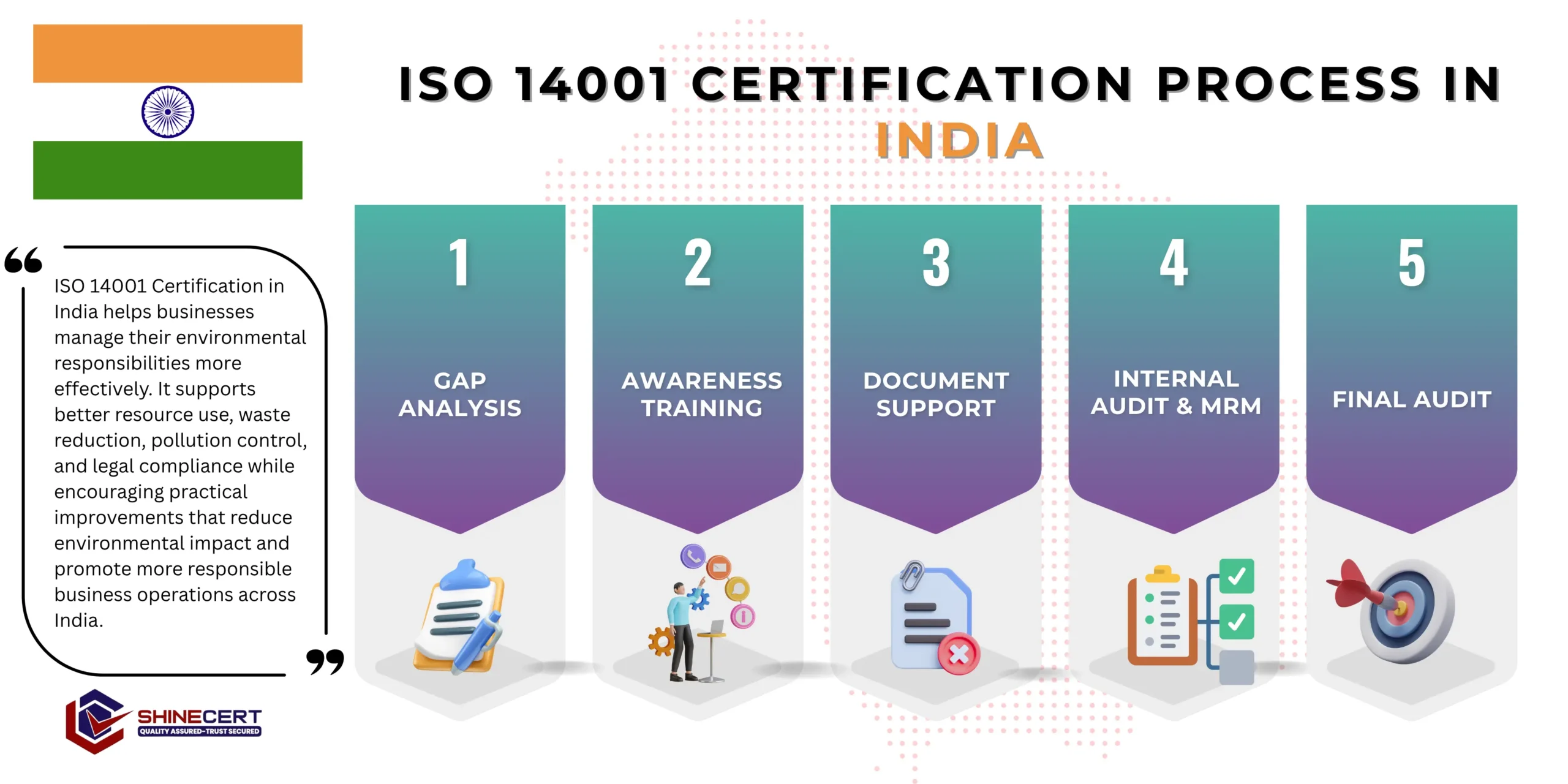
What are the steps to get ISO 14001 Certification in India?
our services
- ISO Certification India
- ISO 9001 Certification India
- ISO 14001 Certification India
- ISO 27001 Certification India
- ISO 22000 Certification India
- ISO 27701 Certification India
- ISO 45001 Certification India
- ISO 20000-1 Certification India
- ISO 13485 Certification India
- ISO 17025 Certification India
- ISO 31000 Certification India
- ISO 42001 Certification India
- ISO 37001 Certification India
- ISO 22301 Certification India
- ISO 50001 Certification India
- CE Mark Certification India
- GDPR Certification India
- GMP Certification India
- Halal Certification India
The Certification Process
Gap Assessment
We walk your actual site, factory floor, warehouse, or office, and map every environmental aspect, emissions, effluent, waste streams, energy use, against both the standard's requirements and your existing CPCB or state board consent conditions, identifying exactly where documentation already exists and where genuine gaps remain.
Documentation Development
We build the environmental policy, aspects and impacts register, and compliance obligations register, written around your actual site conditions and consent terms rather than generic language that won't survive a real audit.
Implementation and Training
The system goes live and staff, particularly those handling waste, effluent, or emissions-generating processes directly, are trained on their specific responsibilities under the new system, not just handed a policy to sign.
Internal Audit and Management Review
We run a structured internal audit against the same criteria the certification auditor will use, and complete a formal management review with leadership, catching gaps while they're still inexpensive and quiet to fix.
Certification Audit
An accredited certification body audits your actual site operations and records, and issues the certificate once satisfied you genuinely meet the standard's requirements.
How Long Does Certification Take?
| Business Size | Typical Timeline | Why |
|---|---|---|
| Small, single site | 2–3 months | Fewer environmental aspects to document and control |
| Medium, multiple processes or a larger site | 3–5 months | More aspects, consents, and staff training coordination |
| Large or multi-site industrial operations | 5–6 months | Multiple sites, consent conditions, and processes to align |
- Small, single-site businesses (2 to 3 months) : With one location and a narrower range of environmental aspects, there’s simply less to map and document, and existing CPCB consent conditions usually already describe most of what needs to be tracked.
- Medium businesses with more complex processes or a larger site (3 to 5 months) : More production lines, more effluent or emission points, and more consent conditions to reconcile mean documentation and staff training take longer, particularly where different shifts or departments currently handle environmental controls inconsistently.
- Large or multi-site industrial operations (5 to 6 months) : Reconciling different sites’ environmental practices, consent conditions, and monitoring records into one certifiable system typically requires more site visits and coordination than a single-location business ever needs.
- The variable that matters most: how complete your existing CPCB/state board compliance records already are : A business with organized consent documents and monitoring logs moves faster through the gap assessment and documentation phases than one that’s technically compliant but has never consolidated its records in one place.
A real example : A textile processing unit near Tiruppur had solid effluent treatment practices but had never formally consolidated its state pollution control board consent conditions into one document; pulling this together before documentation could even begin added roughly four weeks beyond a comparable unit with organized records from the outset.
Why It Matters in India?
India’s environmental regulatory framework runs through the Ministry of Environment, Forest and Climate Change and the Central Pollution Control Board, the technical and statutory advisory body that sets national standards for air, water, and noise, alongside the state pollution control boards that handle day-to-day consent and monitoring. ISO 14001’s Clause 6.1.3, “compliance obligations,” maps directly onto this framework, requiring your organization to identify exactly which CPCB and state-level consents, limits, and reporting obligations apply to your operations and to demonstrate you’re actually meeting them.
- What not being certified actually costs you. You’re more exposed during CPCB and state pollution board inspections, since without a documented system, compliance often depends on institutional memory rather than records anyone can produce on demand. You’re also a weaker candidate for multinational supply chains and export markets that increasingly treat environmental certification as a standard vendor pre-qualification filter, particularly in textiles, chemicals, and manufacturing. And without structured monitoring, environmental incidents tend to surface as regulatory notices rather than being caught and corrected internally first.
- Why this is happening in India right now? With over 12,500 Indian organizations already certified, environmental management has moved from a niche differentiator to something increasingly assumed by larger domestic buyers and nearly all international ones, and CPCB enforcement activity has grown more data-driven, making a documented system a genuine practical advantage during inspections rather than just a certificate on the wall.
What Affects the Cost?
- Business size and number of sites. More locations and processes mean more environmental aspects to document and audit.
- Current compliance documentation state. A business with organized CPCB/state board records starts from a stronger position than one relying on informal knowledge.
- Industry environmental complexity. Chemicals and heavy manufacturing typically involve more controls than a straightforward service business.
- Certification body fees. Separate from consulting fees, and worth confirming accreditation before comparing quotes.
Required Documentation
The scope statement defines exactly what the certification covers. The environmental policy sets top management’s commitment and links directly to your compliance obligations.
The environmental aspects and impacts register documents what your operations actually affect, and the compliance obligations register lists every CPCB, state board, and other legal requirement that applies to you specifically.
Competence and training records prove staff handling environmental-sensitive processes are genuinely qualified. The document control procedure governs how procedures are created and updated.
Operational control procedures describe how waste, effluent, and emissions are actually managed. Emergency preparedness procedures document your response to spills or environmental incidents.
Monitoring and measurement records, internal audit reports, and management review minutes demonstrate ongoing oversight, not a one-time setup. Corrective action records show how you respond when something goes wrong.
Who Actually Needs This?
Manufacturers in chemicals, textiles, and heavy industry
Manufacturers in chemicals, textiles, and heavy industry, where environmental aspects are significant and CPCB/state board scrutiny is routine.
Read moreExporters supplying multinational buyers
Exporters supplying multinational buyers, where environmental certification is often a stated vendor requirement, particularly in the EU and North American markets.
Read morePharmaceutical manufacturers
Pharmaceutical manufacturers, where environmental controls increasingly overlap with broader quality and regulatory expectations.
Read moreBusinesses operating near ecologically sensitive zones
Businesses operating near ecologically sensitive zones, where compliance obligations and community relations both benefit from a documented system.
Read moreBusinesses preparing to add ISO 9001 or ISO 45001
Any business preparing to add ISO 9001 or ISO 45001, since building an integrated system across all three from the outset is considerably more efficient than certifying each separately.
Read moreBenefits of ISO 14001 Certification
Documented compliance obligations and monitoring records replace scrambling to reconstruct history when inspectors arrive.
Certification is an increasingly standard vendor pre-qualification filter, especially in textiles, chemicals, and manufacturing.
Structured monitoring catches problems while they’re still internal issues, not violation notices.
Systematic energy, water, and waste tracking frequently surfaces genuine efficiency savings alongside compliance benefits.
ISO 14001 shares its High-Level Structure with ISO 9001 and ISO 45001, making a combined management system considerably easier to build and audit.
Sustainability increasingly factors into Indian corporate procurement decisions, not just export relationships.
Common Mistakes We See
- Treating the environmental policy as a document rather than a genuine commitment : Auditors interview staff directly, and a policy nobody can explain in their own words is a common finding.
- Not reconciling ISO 14001 documentation with existing CPCB/state board consent conditions : Building two parallel, disconnected sets of records creates confusion and doubles the maintenance burden.
- Underestimating emergency preparedness requirements : Businesses often document routine operations well but skip realistic incident-response planning, which auditors specifically probe.
- Choosing a certification body without confirming accreditation : An unaccredited certificate carries no real recognition with export buyers or multinational supply chains.
Standards and Clauses: What ISO 14001 Actually Requires
- Context of the Organization (Clause 4) : requires identifying environmental conditions and interested parties’ expectations relevant to your operations, including regulators, communities, and buyers.
- Leadership (Clause 5) : requires top management to set an environmental policy and take visible ownership, not delegate it entirely to a compliance officer.
- Planning (Clause 6) : requires identifying environmental aspects, compliance obligations, and risks, operationalizing environmental risk management rather than purely reactive handling.
- Support (Clause 7) : covers competence, training, and documented information needed to run the system.
- Operation (Clause 8) : covers operational controls over environmentally significant activities and emergency preparedness and response.
- Performance Evaluation (Clause 9) : requires monitoring actual environmental performance, internal audits, and management review.
- Improvement (Clause 10) : requires acting on nonconformities and continually improving environmental performance over time.
Case Study: A Textile Processing Unit Near Tiruppur
- A textile processing unit needed ISO 14001 certification to satisfy a European buyer’s supply chain sustainability requirement ahead of a renewed sourcing agreement.
- Our gap assessment found the unit’s effluent treatment practices were genuinely solid, but its state pollution control board consent conditions had never been consolidated into a single reference document, spread instead across years of individual approval letters.
- Over roughly five months, we built the environmental aspects register, consolidated compliance obligations into one document, and trained shift supervisors on monitoring responsibilities. The certification audit found only minor nonconformities, corrected before the certificate was issued.
- The buyer renewed the sourcing agreement and specifically cited the unit’s documented environmental controls as a factor in the decision.
Answering the Objections Every Owner Has
“We already comply with CPCB rules, isn’t that enough?”
Compliance and a management system are different things; ISO 14001 requires you to document that compliance systematically and continually review it, which is exactly what protects you when an inspector asks for evidence rather than an assurance.
“This feels like it’s mainly for heavy industry.”
Environmental aspects exist in offices and service businesses too, energy use, waste, water, even if less dramatic than a factory’s, and the standard scales its documentation expectations to your actual footprint.
“We’re a small business, this seems disproportionate.”
Smaller businesses typically have fewer environmental aspects to document and control, which usually means a faster, lighter certification process, not a disproportionate one.
“Can’t we build this ourselves from a template?”
You can attempt it, but a template rarely reflects your specific CPCB consent conditions or site-specific aspects, and a system that doesn’t match your real operations tends to fail exactly when an auditor or inspector tests it.
Choosing the Right Partner?
| DIY | Generic Consultant | ShineCert | |
|---|---|---|---|
| CPCB/state board integration | Often built as a separate, disconnected system | Sometimes overlooked entirely | Directly reconciled with your existing consent conditions |
| Site-specific aspects | Frequently generic and template-based | Templated, often disconnected from your real site | Mapped specifically to your actual operations |
| Accreditation verification | Often overlooked | Sometimes assumed rather than confirmed | Verified explicitly before you commit |
| Post-certification support | None | Often ends at the certificate | Built to support your ongoing surveillance audits |
Which Certification Body Should You Choose?
Confirm the certification body is accredited by NABCB or another IAF-member accreditation authority. Ask whether the consultant understands your specific CPCB or state board consent conditions, not just the generic standard. Confirm the certification audit includes an actual site visit, not a desk review alone.
Why Businesses Choose ShineCert in India?
We’ve spent 10 years helping more than 10,000 businesses worldwide get certified, coordinated through our Riyadh and India offices with work delivered remotely or on-site as needed. Our consultants, with ShineCert as the best ISO 14001 consultant in India, reconcile your ISO 14001 system directly with your existing CPCB and state pollution control board obligations, rather than building a parallel set of documents you’d have to maintain twice. We only work with accredited certification bodies, never unaccredited shortcuts.
Frequently Asked Questions
No, but it directly strengthens your compliance position with CPCB and state pollution control boards and is increasingly expected by multinational buyers and export markets.
It depends on business size, number of sites, and current compliance documentation. We quote individually.
Usually two to six months depending on business size, with existing compliance record quality mattering more than headcount alone.
No, it doesn’t replace legal consent requirements; it gives you a documented system to demonstrate and maintain compliance with them.
Confirm accreditation by NABCB or another IAF-member authority, and confirm the audit includes a genuine site visit.