
In Saudi Arabia, ISO 22000 certification assists food-related companies in establishing an effective Food Safety Management System (FSMS) to manage food safety risks throughout the entire supply chain, from production to consumption. It aids in meeting SFDA regulatory requirements, enhances access to markets, and builds trust with consumers. The process of certification involves gap analysis, the implementation of systems, internal auditing, and third-party certification auditing. Consultants and trainers based in Riyadh, Jeddah, and Dammam provide complete support for the initial certification and subsequent compliance.
What is ISO 22000 Certification in Saudi Arabia?
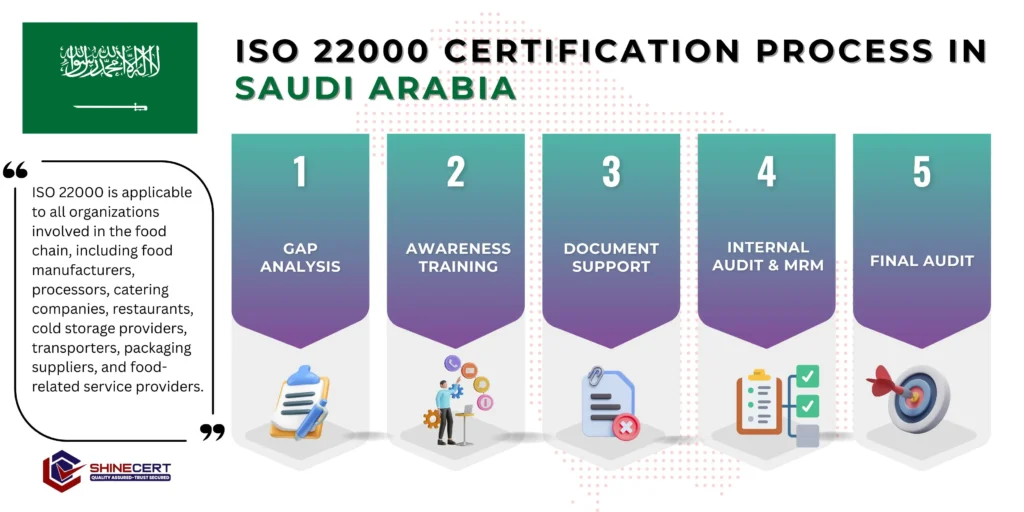
ISO 22000 certification in Saudi Arabia allows organizations to set up a Food Safety Management System (FSMS) to help safeguard food safety throughout the total food supply chain. A business can avoid, control, and minimize food safety risks while meeting regulatory and customers’ needs.
ISO 22000 can be implemented in all organizations of the food chain, including food manufacturers, food processors, catering and restaurant service providers, cold storage and transportation providers, packaging suppliers, and other food-related services.
In Saudi Arabia’s food sector’s strict regulations, the ISO 22000 certification enhances compliance, food safety control, and trust with regulators, customers, and other countries.
ISO 22000 Certification in Saudi Arabia – What Does It Mean and Where Is It Most Commonly Used?
ISO 22000 is an internationally recognized standard that integrates:
- Food safety principles
- HACCP methodology
- Risk-based thinking
- Management system controls
Organizations in Saudi Arabia commonly pursue ISO 22000 to:
- Ensure safe food production and handling
- Meet SFDA and customer expectations
- Reduce food safety incidents and recalls
- Improve operational control and hygiene
- Enhance credibility in local and export markets
ISO 22000 is not legally mandatory, but it is often commercially essential for food-related businesses in Saudi Arabia.
What are the steps to get ISO 22000 Certification in Saudi Arabia?

What is ISO 22000 and Why Does it Matter for Businesses in Saudi Arabia?
The components of an effective Food Safety Management System (FSMS) can be described as per ISO 22000 standards:
- Control and assess hazards
- Prerequisite Programs (PRPs)
- Operational PRPs (OPRPs)
- HACCP (Hazard Analysis and Critical Control Points) Plans
- Ongoing monitoring and improvement
For businesses in Saudi Arabia, ISO 22000 is useful in proving compliance with food safety regulations, minimizing risks, and meeting the global standards applicable to food safety. This is particularly relevant when dealing with exports, major retailers, catering agreements, and government contracts.
- ISO Certification Saudi Arabia
- ISO 9001 Certification
- ISO 14001 Certification
- ISO 45001 Certification
- ISO 27001 Certification
- ISO 22000 Certification
- ISO 13485 Certification
- ISO 17025 Certification
- ISO 20000-1 Certification
- ISO 22301 Certification
- ISO 31000 Certification
- CE Mark Certification
- Halal Certification
- GDPR Certification
- HIPPA Certification
We Are in Major City's
Step-by-Step ISO 22000 Certification Process in Saudi Arabia
Shinecert evaluates your current food safety practices against ISO 22000 requirements, identifies gaps, and defines the certification scope. Common gaps include:
- Incomplete hazard analysis
- Weak PRPs or hygiene controls
- Missing food safety records
Customized ISO 22000 documentation is developed, including:
- Food safety policy and objectives
- Hazard analysis and HACCP plans
- PRPs and OPRPs
- Procedures, records, and monitoring formats
Documentation is tailored to match actual operations,no generic templates.
Your team implements the documented FSMS in daily operations.Shinecert supports:
- Practical implementation guidance
- Employee food safety training
- Hygiene and process alignment with ISO 22000
This step ensures real, auditable compliance.
An internal audit verifies ISO 22000 compliance and readiness.
- Nonconformities are identified and corrected
- Management reviews FSMS performance and effectiveness
An accredited certification body conducts:
- Stage 1 Audit – FSMS documentation and readiness
- Stage 2 Audit – Implementation and effectiveness
After successful closure of findings, the ISO 22000 certificate is issued. The certificate is valid for 3 years, with annual surveillance audits.
Benefits of ISO 22000 Certification in Saudi Arabia
Organizations certified to ISO 22000 typically achieve:
- Improved food safety control and consistency
- Reduced contamination and food safety risks
- Stronger compliance with regulatory requirements
- Increased customer and consumer confidence
- Better traceability and recall readiness
- Enhanced market access and international acceptance
- Improved employee awareness of food safety practices
How Long Does ISO 22000 Certification Take in Saudi Arabia?
Typical certification timelines range from 4 to 8 weeks, depending on:
- Existing food safety systems
- Management involvement
- Employee awareness and training
- Scope and operational complexity
Organizations with existing HACCP or structured hygiene systems may complete certification faster.
ISO 22000 Certification Requirements in Saudi Arabia
To achieve ISO 22000 certification, organizations must demonstrate:
- Documented FSMS and food safety policy
- Hazard analysis and control measures
- Implemented PRPs, OPRPs, and HACCP plans
- Monitoring, corrective actions, and records
- Internal audit and management review
- Compliance during certification audits
Strong leadership commitment and employee involvement are critical to success.
ISO 22000 Certification Cost in Saudi Arabia
The cost of ISO 22000 certification depends on:
- Organization size and number of employees
- Food activities and process complexity
- Number of sites and scope
- Certification body audit duration
Costs typically include consulting support and certification body audit fees.
Shinecert offers transparent pricing and a free consultation to assess requirements and provide an accurate quotation.
Why Choose Shinecert for ISO 22000 Certification in Saudi Arabia?
Shinecert ISO Consulting and Certifications provides end-to-end ISO 22000 support tailored for Saudi Arabia’s food industry.
We offer:
- Practical, consultant-led FSMS implementation
- Experience across food manufacturing, catering, logistics, and trading
- Local regulatory and market understanding
- Support from gap analysis to certification audit
- Ongoing guidance for surveillance audits
Our focus is real food safety compliance, not just certificates.
Let’s Collaborate with Us!
FAQs
Some frequently asked questions about the service that you may have questions about
No. It is not legally mandatory, but many customers, regulators, and tenders require ISO 22000-certified FSMS.
Certificates are issued by accredited certification bodies. Consultants like Shinecert support implementation and audit readiness.
Yes. ISO 22000 is globally accepted and recognized across the food industry.
Yes. ISO 22000 is scalable and suitable for small, medium, and large organizations.
The certificate is valid for three years, subject to annual surveillance audits.
No. Certification depends on audit results by an accredited body. Shinecert ensures full preparation and compliance.
Get ISO 22000 Certified in Saudi Arabia with Shinecert
If you are planning to implement a reliable Food Safety Management System, Shinecert ISO Consulting and Certifications can guide you at every stage,from gap analysis to certification audit readiness.
Contact Shinecert today for a free ISO 22000 consultation in Saudi Arabia.
Request Free Consultation
