
ISO 14001 Certification in UAE
Quick Answer
The UAE was the first country in the Middle East to commit to a Net Zero by 2050 target, and that national ambition has started trickling down into how businesses here are expected to demonstrate environmental responsibility, not just talk about it. ISO 14001 is the international environmental management standard, and it gives UAE businesses a structured, independently verified way to show they’re managing environmental impact seriously, whether that’s for a government tender, an investor, or a giga-development contract. Get certified through a body accredited by the Emirates International Accreditation Centre (EIAC) or another IAF-recognized body. One thing worth knowing before you start: ISO 14001 was substantially revised in April 2026, with existing certificate holders getting until May 2029 to transition. Costs typically run AED 18,000 to AED 90,000, and expect three to six months from kickoff to certificate.
What ISO 14001 Actually Does?
ISO 14001 gives you a repeatable system for figuring out how your operations affect the environment, water use, waste, emissions, resource consumption, and then actually doing something about the parts that matter most, on an ongoing basis rather than as a one-off audit. It’s not a checklist of green initiatives; it requires a genuine environmental aspects and impacts assessment specific to your business, documented objectives tied to that assessment, and evidence that you’re tracking progress over time. Certification means an independent auditor has confirmed the system genuinely functions, not just that someone wrote an environmental policy once and moved on.
Why This Is Gaining Real Traction in the UAE?
- The UAE’s Net Zero by 2050 Strategic Initiative, alongside Dubai’s own Clean Energy Strategy and the broader Dubai Economic Agenda D33’s sustainability commitments, has shifted environmental performance from a nice-to-have talking point into something government entities and major developers increasingly expect contractors to demonstrate with real evidence. DEWA’s own sustainability push and RTA’s environmental requirements for transport and infrastructure projects have started referencing formal environmental management credentials in contractor evaluation, particularly for larger infrastructure and construction tenders.
- There’s also a genuinely practical angle: UAE free zones and mainland authorities have been tightening environmental permitting and reporting requirements over recent years, and businesses that already run a functioning ISO 14001 system find these regulatory interactions considerably less disruptive than those scrambling to produce environmental documentation on request.
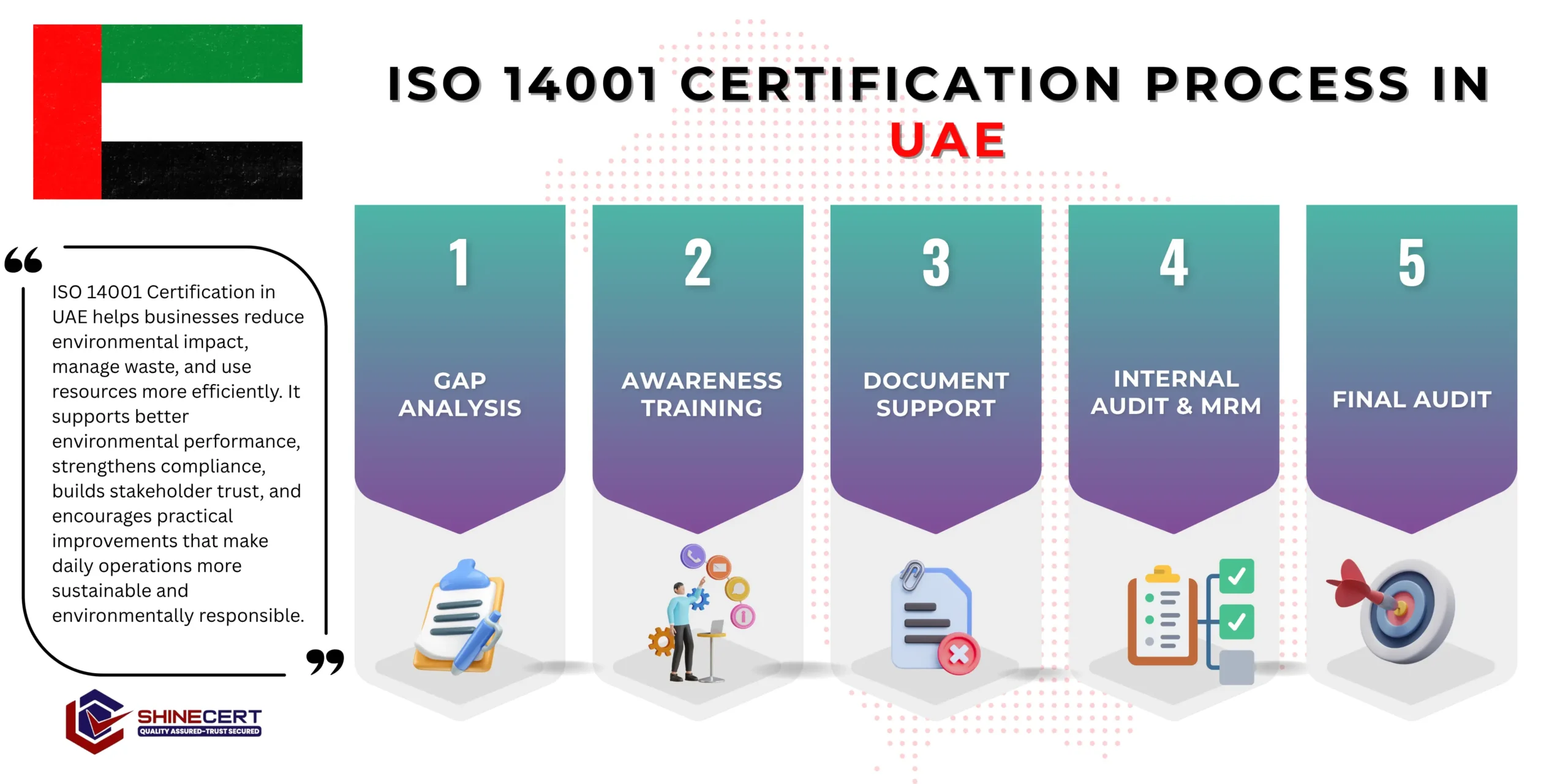
What are the steps to get ISO 14001 Certification in UAE?
our services
- ISO Certification UAE
- ISO 9001 Certification UAE
- ISO 14001 Certification UAE
- ISO 27001 Certification UAE
- ISO 22000 Certification UAE
- ISO 27701 Certification UAE
- ISO 45001 Certification UAE
- ISO 20000-1 Certification UAE
- ISO 13485 Certification UAE
- ISO 17025 Certification UAE
- ISO 31000 Certification UAE
- ISO 42001 Certification UAE
- ISO 37001 Certification UAE
- ISO 22301 Certification UAE
- ISO 50001 Certification UAE
- CE Mark Certification UAE
- GDPR Certification UAE
- GMP Certification UAE
- Halal Certification UAE
How We Handle This?
Gap analysis and environmental aspects identification
We assess your current practices and run a structured environmental aspects assessment specific to your operations, a manufacturing facility’s emissions and waste streams look very different from a construction contractor’s site-level footprint.
A gap analysis and environmental aspects register scoped to your business.
Documentation
Your environmental policy, objectives, and procedures get built with your specific permitting obligations and any project-level sustainability commitments explicitly addressed.
A complete EMS documentation set, including your compliance obligations register.
Implementation and training
Operational controls get rolled out and staff trained on environmentally significant activities relevant to their actual roles.
Training records and evidence operational controls genuinely function.
Internal audit and management review
A rigorous internal audit covering environmental performance and compliance, followed by a management review addressing objectives progress and any findings.
An internal audit report and management review minutes showing real leadership engagement.
Certification audit
We coordinate Stage 1 and Stage 2 with an EIAC-accredited or IAF-recognized body, and help you plan for the ISO 14001:2026 transition if that’s relevant to your certification scope.
Your ISO 14001 certificate and a surveillance audit plan.
What UAE Businesses Actually Get From This?
- Net Zero 2050 alignment gives businesses a structured way to demonstrate genuine environmental management maturity, not just a sustainability statement on a website.
- Government and major developer tenders increasingly factor environmental credentials into contractor evaluation, particularly for larger infrastructure work.
- Regulatory interactions with free zone authorities and environmental permitting processes get noticeably smoother once you’ve got real documentation already in place.
- Resource costs often drop once a genuine aspects assessment surfaces waste and inefficiency nobody was tracking before.
- International joint venture partners increasingly expect environmental credentials alongside quality certification as standard practice.
- Combining this with ISO 9001 and ISO 45001 later is considerably more efficient given the shared Harmonised Structure across all three.
What It Costs?
Quick answer: ISO 14001 certification in the UAE typically runs AED 18,000 to AED 90,000, with industrial facilities generally costing more than office-based operations given more extensive aspects assessment work.
An industrial facility with complex emissions costs considerably more than a similarly sized office operation.
Companies already tracking permitting obligations need less foundational work.
Distinct from ShineCert’s implementation support.
Each site typically needs its own aspects assessment.
The shared Harmonised Structure makes combined certification more efficient.
Where Companies Usually Trip Up?
- Treating the aspects assessment as a formality : A superficial register that doesn’t reflect real operations doesn’t support real compliance tracking.
- Letting the compliance obligations register go stale : It needs to stay a living document actively used during permit interactions.
- Underestimating industrial complexity : Manufacturing facilities often need more detailed documentation than initially expected.
- Ignoring the ISO 14001:2026 transition : More on that below, don’t wait until the last minute.
Where This Shows Up Most?
Construction and Infrastructure
Major developments and RTA-related infrastructure work increasingly factor environmental credentials into contractor evaluation.
Read moreManufacturing
The UAE’s push to build domestic industrial capacity has raised environmental compliance expectations correspondingly.
Read moreEnergy and Utilities
DEWA’s sustainability initiatives and the UAE’s growing renewable energy sector both rely on demonstrated environmental management maturity.
Read moreFree Zone Operators and Logistics
DP World and other major operators increasingly reference environmental credentials in their own supply chain expectations.
Read moreHospitality and Tourism
Large-scale developments supporting UAE tourism ambitions increasingly consider environmental performance for both regulatory and brand reasons.
Read moreThe ISO 14001:2026 Revision, Explained
ISO 14001 just went through its first major revision since 2015, published as ISO 14001:2026 on April 15, 2026. If you’re already certified under the older edition, your certificate stays valid until May 2029, that’s your transition window, and it’s worth treating it as a genuine deadline rather than something to deal with later. The revised standard puts more explicit weight on climate change, biodiversity, and resource efficiency as factors organizations need to actively analyze, which lines up closely with where the UAE’s own Net Zero 2050 direction is heading anyway. If you’re starting certification fresh right now, ask directly whether to certify against the new 2026 edition immediately rather than the outgoing one, since certifying against the old edition now just means transitioning again shortly afterward.
What the Standard Actually Requires?
- Context of the Organization : Beyond the general business context requirements, this clause specifically asks you to identify environmental conditions relevant to your operations, water scarcity is a genuinely significant factor across much of the UAE, and the interested parties whose environmental expectations matter, which increasingly includes free zone authorities, DEWA, and for major developments, project-level sustainability commitments set by the developer. Getting your scope right matters if you’re running operations across multiple emirates, since a facility in an industrial zone faces different environmental obligations than an office-based operation in a DIFC tower.
- Leadership : Top management has to set a real environmental policy and make sure responsibility for it is genuinely assigned, not left to whoever happens to handle facilities management. UAE manufacturers pursuing this for the first time often already have some informal environmental practices in place, driven by permitting requirements, but formal leadership engagement with documented environmental objectives is a distinct, separate step auditors specifically look for.
- Planning : This is where the environmental aspects and impacts assessment lives — identifying every way your operations touch the environment and figuring out which of those actually matter enough to require action. For UAE industrial operations, this assessment needs to explicitly address any compliance obligations tied to your specific emirate’s environmental permitting requirements, not generic environmental risk categories lifted from a template.
- Support : Resources, competence, and communication specific to environmental management, including making sure staff handling environmentally significant activities have real, documented training, distinct from general safety or quality training.
- Operation : Documented operational controls for your significant environmental aspects, plus emergency preparedness for things like chemical spills at an industrial facility or dust management on a construction site near residential areas. UAE construction contractors working on major developments increasingly need to show specific controls addressing desert ecosystem impact and water conservation, given the climate everyone here is operating in.
- Performance Evaluation : Monitoring and measuring environmental performance against your objectives, plus systematically evaluating ongoing compliance with legal requirements, meaning you’re actually tracking your permit conditions and reporting obligations, not treating regulatory compliance as background noise you assume is fine.
- Improvement : A structured response to environmental nonconformities, whether that’s an internal deviation from your own targets or an external compliance finding, plus genuine continual improvement over time.
ISO 14001 vs UAE Free Zone Environmental Requirements
We hear this question a lot from UAE clients: if my free zone authority already has environmental compliance requirements, do I actually need ISO 14001 on top of that? Generally, yes, free zone-specific requirements confirm you’re meeting a particular authority’s minimum conditions at a point in time, while ISO 14001 requires an ongoing, systematic approach that identifies risks before they become compliance problems. We’ve seen companies relying solely on free zone compliance struggle when requirements tighten, since they never built the structured aspects assessment process that would have flagged emerging issues early. Companies with a genuine ISO 14001 system in place tend to sail through permit renewals considerably more smoothly, since most of what’s requested already exists in organized, audit-ready form.
Timeline
Quick answer: ISO 14001 certification in the UAE typically takes three to six months, similar to ISO 9001, though complex industrial facilities sometimes need longer.
Phase | Typical Duration |
Gap analysis and aspects identification | 2–4 weeks |
Documentation development | 4–6 weeks |
Implementation and training | 3–5 weeks |
Internal audit and management review | 1–2 weeks |
Certification audit (Stage 1 + Stage 2) | 3–4 weeks |
Total | 3–6 months |
Documentation You’ll Need
Quick answer : ISO 14001 requires an environmental policy, environmental objectives, an aspects and impacts register, a compliance obligations register, and records covering monitoring, internal audits, and management review.
Genuine top-management commitments, not copied boilerplate.
A documented assessment of every significant way your operations touch the environment.
A tracked list of applicable environmental requirements specific to your emirate and permit conditions.
Measurable targets with documented plans behind them.
Documentation covering significant aspects and emergency preparedness.
Evidence of ongoing environmental performance tracking.
The evidence trail showing the system is actually reviewed.
UAE manufacturers and contractors should note that free zone authorities increasingly request documented compliance evidence during permit renewals, making a well-maintained obligations register useful well beyond certification audits.
Why ShineCert?
We coordinate UAE engagements from ShineCert’s Riyadh and Lebanon offices, with direct familiarity with UAE environmental permitting across multiple emirates. Our team has guided more than 10,000 organizations through ISO certification globally, and as the best ISO 14001 Consultant in UAE, we bring specific depth in the UAE’s growing sustainability regulatory landscape.
Choosing a Certification Body?
What to Check | Why It Matters |
EIAC accreditation, or another IAF-recognized body | Confirms genuine international recognition |
ISO 14001:2026 transition experience | Essential if you’re currently certified under the 2015 edition |
Industrial sector audit experience | Matters for manufacturing or energy facilities with complex environmental risks |
Familiarity with UAE free zone permitting | Helps ensure your system genuinely supports regulatory interactions |
Ready to Get Certified?
ShineCert supports UAE businesses from environmental aspects assessment through certification audit, including ISO 14001:2026 transition planning. Book a free consultation or contact us directly, and we’ll review your operations before proposing a fixed-scope plan.
Frequently Asked Questions
Typically AED 18,000 to AED 90,000, depending on environmental complexity and company size.
No, it’s voluntary, though major developer and government tenders increasingly treat it as a practical advantage.
Typically three to six months.
Published April 15, 2026, with stronger focus on climate change, biodiversity, and resource efficiency, and a transition window ending May 2029.
No, it complements it with a systematic management approach, but specific legal obligations must still be independently met.
Yes, both share the same Harmonised Structure, making combined certification more efficient.
We coordinate UAE engagements from our Riyadh and Lebanon offices, with consultants traveling on-site as needed.