
ISO Certification in UAE
Quick Answer
ISO 9001 remains the standard most UAE businesses pursue first, since Dubai and Abu Dhabi government tenders and free zone vendor registrations check it routinely. Add ISO 45001 if you’re in construction, logistics, or industrial operations, and ISO 27001 if you handle customer data, given the UAE’s expanding data protection enforcement. Confirm your certification body is accredited by EIAC (or another IAF MLA signatory), budget somewhere in the range of AED 8,000 to AED 35,000 for a small or mid-sized company pursuing a single standard, and plan for three to six months from kickoff to certificate.
Why ISO Certification Has Become Difficult to Avoid in the UAE?
Dubai and Abu Dhabi built their reputations on being easy places to do business, and that reputation still holds, but “easy” increasingly means “internationally credentialed” rather than “informal.” The free zones (DMCC, JAFZA, DIFC, ADGM, and dozens of smaller sector-specific zones) each maintain their own vendor and licensing expectations, and a growing number now list ISO 9001 or sector-specific standards as a soft or hard requirement for certain license categories and government-adjacent contracts. Meanwhile, mainland government procurement, particularly in Abu Dhabi’s oil and gas-adjacent supply chain and Dubai’s construction sector, treats certification as close to a baseline filter for larger tenders.
The UAE’s Federal Decree-Law on Personal Data Protection (PDPL) has also changed the calculus for anything touching customer information, the law itself doesn’t mandate ISO 27001, but it creates a genuine incentive to have a documented, auditable security framework rather than an ad hoc one, particularly for companies operating across DIFC or ADGM, where UAE federal law interacts with each free zone’s own separate data protection regime.
Regulatory and Accreditation Landscape in the UAE
Three federal bodies matter most, each with a distinct role. ESMA sets and enforces UAE national standards and runs the ECAS and EQM conformity marking schemes for regulated products, this is product conformity, not management system certification, and businesses sometimes confuse the two. MOIAT, which absorbed several of the Ministry of Economy’s industrial and standards functions, issues conformity certificates for regulated product categories and oversees UAE industrial policy more broadly. EIAC is the body that specifically accredits the certification bodies issuing ISO 9001, 14001, 45001, 22000, 27001, and other management system certificates, it’s the one to check when your question is “is my ISO certificate actually going to be recognized.”
Beyond these three, sector regulators shape how certification gets used in practice: the Dubai Health Authority and Department of Health Abu Dhabi reference ISO 13485 and related quality frameworks in healthcare facility licensing; the UAE Central Bank’s cybersecurity expectations for financial institutions map closely to ISO 27001’s control structure; and DIFC and ADGM each maintain their own data protection regimes that interact with, but don’t replace, UAE federal PDPL obligations.
What are the steps to get ISO Certification in UAE?
our services
- ISO Certification UAE
- ISO 9001 Certification UAE
- ISO 14001 Certification UAE
- ISO 27001 Certification UAE
- ISO 22000 Certification UAE
- ISO 27701 Certification UAE
- ISO 45001 Certification UAE
- ISO 20000-1 Certification UAE
- ISO 13485 Certification UAE
- ISO 17025 Certification UAE
- ISO 31000 Certification UAE
- ISO 42001 Certification UAE
- ISO 37001 Certification UAE
- ISO 22301 Certification UAE
- ISO 50001 Certification UAE
- CE Mark Certification UAE
- GDPR Certification UAE
- GMP Certification UAE
- Halal Certification UAE
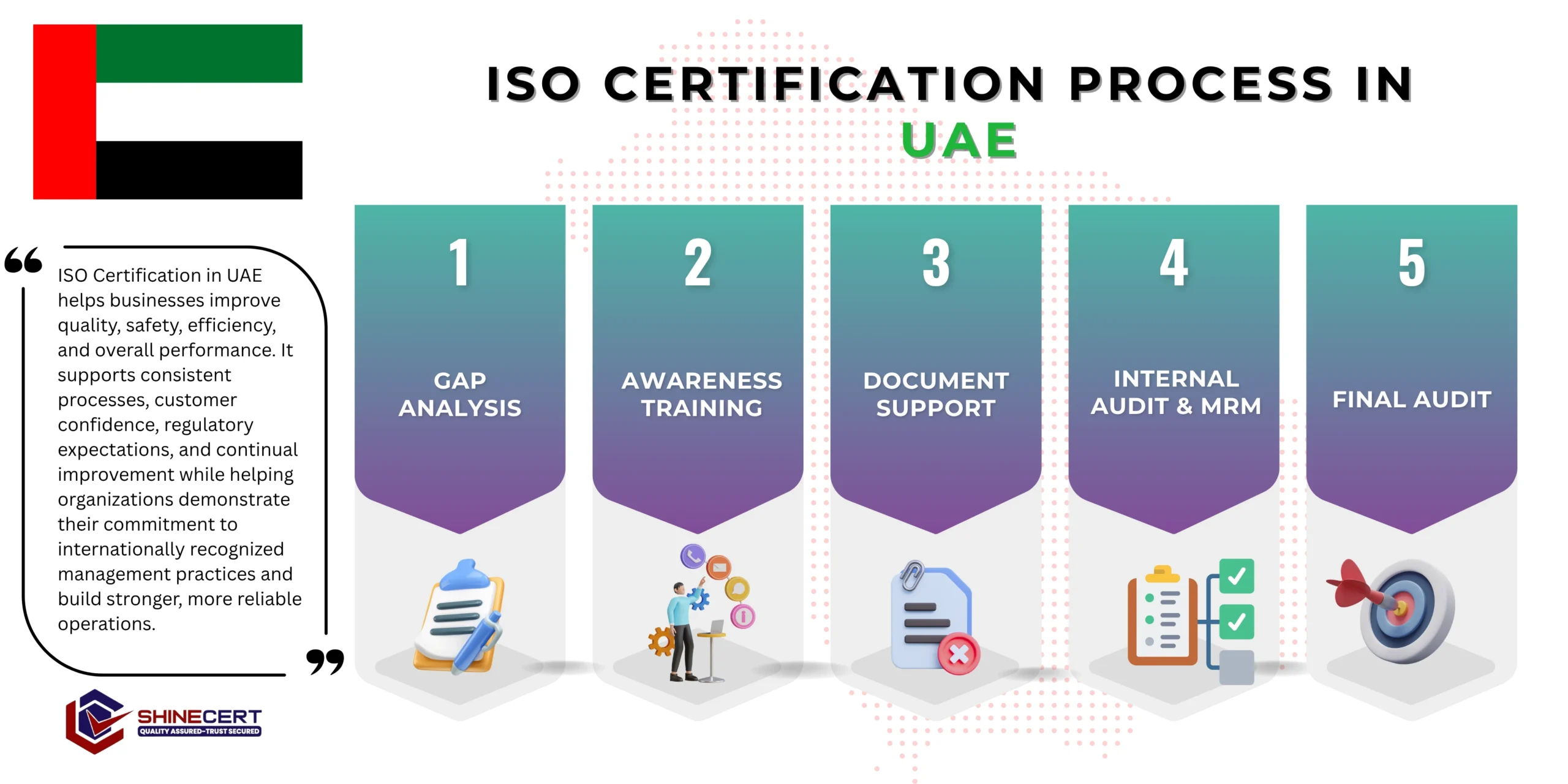
ShineCert’s UAE Certification Process
Discovery and Gap Analysis
We assess your current documentation, processes, and controls against your target standard, and separately map how ESMA, MOIAT, or sector regulator requirements intersect with your operations, free zone companies in particular often have license conditions worth checking against before we scope the project.
Documentation Build
We develop your management system documentation with your team rather than issuing a generic template, typically in English with Arabic available where your workforce or regulator interactions require it.
Rollout and Training
For UAE businesses with staff spread across multiple emirates or free zones, we make sure training reaches every site, not just head office, using scenario-based sessions rather than a slide deck read-through.
Internal Audit and Management Review
We run an internal audit designed to surface genuine gaps before your external auditor ever sees your system, followed by a formal management review where leadership signs off on corrective actions.
Certification Audit and Ongoing Surveillance
We coordinate Stage 1 and Stage 2 audits with an EIAC-accredited (or other recognized) certification body, support your team through the audit itself, and set up a surveillance schedule so the system stays current rather than lapsing after year one.
ISO Certification Cost in the UAE
Costs typically fall between AED 8,000 and AED 35,000 for a single standard at a small or mid-sized company, split between consultancy fees for building your management system and certification body audit fees. Company size and site count drive most of the variation, since audit duration scales with headcount and locations. Free zone companies with lean, single-site operations sit at the lower end; multi-site mainland operators with more complex risk profiles sit higher. Bundling ISO 9001 and 45001, or 9001 and 27001, into one integrated project is consistently more cost-efficient than running them as separate engagements, since a meaningful share of the documentation and audit work overlaps under the shared management system structure.
Benefits UAE Businesses See From Certification
- Free zone and mainland tender eligibility : Certification increasingly determines whether you’re even shortlisted for government and large developer contracts across Dubai and Abu Dhabi, rather than being a minor scoring bonus.
- Credibility with international partners : For a UAE company trading regionally or globally, an internationally recognized certificate closes conversations that would otherwise require lengthy custom due diligence from a new overseas partner.
- Operational discipline during rapid growth : Fast-scaling Dubai businesses frequently outgrow the informal processes that worked at ten employees; certification forces a structured look at what’s actually still working at fifty or a hundred.
- A defensible answer to data protection questions : ISO 27001 gives UAE companies handling customer or financial data a structured way to demonstrate security maturity to regulators, partners, and increasingly cautious customers.
- Reduced insurance and liability friction : Certified safety and quality management, particularly ISO 45001, can ease conversations with insurers and reduce the frequency of costly incidents in construction and industrial operations.
- A genuine edge in competitive bidding : In construction, logistics, and professional services. sectors with dense competition across the UAE’s many free zones, certification is one of the few objectively verifiable differentiators available to a mid-sized bidder.
- Smoother free zone license renewals : Some free zone authorities factor certification status into vendor standing reviews, making renewals and expansions less friction-heavy.
- A single system instead of scattered compliance efforts : UAE businesses juggling ESMA, MOIAT, PDPL, and sector-specific requirements benefit from folding them into one auditable management system rather than tracking each separately.
ISO Standards Most Relevant to UAE Businesses
ISO 9001 Quality Management
The default starting point across every emirate and free zone, since it’s the standard most government tenders and vendor registration portals check first, and the one most buyers recognize without explanation. It gives companies instant credibility and simplifies vendor onboarding.
ISO 14001 Environmental Management
Dubai’s Clean Energy Strategy 2050 and Abu Dhabi’s sustainability commitments have pushed environmental expectations into supply chains that ignored them, for contractors and manufacturers near industrial zones like Jebel Ali or Ruwais.
ISO 45001 Occupational Health and Safety
With construction activity continuing across Dubai South, Abu Dhabi’s Al Reem and Yas Island developments, and infrastructure expansion, safety certification has become close to a prequalification requirement for contractors bidding on developer and government projects.
ISO 27001 Information Security Management
Between UAE PDPL, DIFC and ADGM’s data protection frameworks, and Central Bank cybersecurity expectations for financial entities, this has become one of the fastest-growing certification requests we see from Dubai’s fintech and professional services sectors.
ISO 22000 Food Safety Management
Dubai’s role as a regional food trading and re-export hub, combined with ESMA’s food safety conformity requirements, makes this close to essential for food manufacturers, importers, and hospitality operators, helping them meet regulatory standards, protect consumers, and earn buyer trust.
ISO 42001 AI Management
The UAE’s AI strategy and Dubai’s “AI capital” ambitions have pushed public and private sector buyers toward asking vendors how they govern AI risk, not just whether they use AI, ISO 42001 is becoming the recognized answer to that question for government-adjacent technology vendors.
ISO 13485 Medical Devices Quality Management
Dubai Healthcare City and Abu Dhabi’s growing medical tourism and device manufacturing sector have made this a frequent requirement for device suppliers and healthcare facility vendors, helping vendors satisfy regulators and win hospital trust.
ISO 50001 Energy Management
Dubai Electricity and Water Authority’s efficiency programs and the UAE Net Zero 2050 strategy have started pulling industrial energy consumers toward formal energy management certification, particularly manufacturing and hospitality operators with utility loads.
ISO Certification Timeline in the UAE
Phase | Typical Duration |
Gap analysis | 2–3 weeks |
Documentation development | 4–7 weeks |
Rollout and training | 4–6 weeks |
Internal audit and management review | 1–2 weeks |
Certification audit (Stage 1 + Stage 2) | 3–4 weeks |
Total, single standard | 3–6 months |
A Familiar Pattern
- A composite scenario reflecting engagements we handle often, not any single named client: a Dubai-based logistics company with roughly 60 staff across two warehouse sites has operated successfully for years on strong client relationships, without ever holding formal certification.
- A new contract with a multinational retailer then makes ISO 9001 a condition of the vendor agreement, with a five-month deadline. Gap analysis in situations like this typically finds solid underlying operational discipline, the real work is documenting it consistently across both sites and training staff who’ve been doing things the right way informally for years to do it the same way on paper.
- Four to five months is realistic here, assuming management engagement stays consistent through the busier logistics season.
Common Challenges We See in the UAE
- Confusing ESMA/MOIAT product conformity with ISO management system certification : These are different schemes serving different purposes, and pursuing the wrong one wastes time and money.
- Free zone license conditions that shift certification scope : Some free zones impose sector-specific requirements that a generic ISO 9001 rollout doesn’t automatically cover.
- Staff turnover diluting documented processes : The UAE’s high expatriate workforce mobility means training has to be treated as ongoing, not a one-time rollout event.
- Assuming PDPL compliance and ISO 27001 certification are the same thing : They’re related but distinct, certification supports a PDPL compliance case, it doesn’t complete it on its own.
Where We Support Clients Across the UAE?
We coordinate UAE engagements from ShineCert’s Riyadh and Lebanon offices, with consultants traveling for on-site audits, gap analysis visits, and staff training across Dubai, Abu Dhabi, Sharjah, and the wider Emirates, including free zone clusters like DMCC, JAFZA, and DIFC.
Choosing a Certification Body in the UAE?
What to Check | Why It Matters |
EIAC accreditation, or another IAF MLA signatory | Confirms your certificate carries genuine recognition with UAE government and free zone authorities |
Understanding of free zone-specific license conditions | DMCC, JAFZA, DIFC and other zones each have their own vendor and compliance nuances |
Familiarity with UAE PDPL and sector data rules | Matters directly for ISO 27001 scoping and audit accuracy |
Willingness to audit across multiple emirates or sites | Reduces logistical friction for multi-location UAE operations |
Why Choose ShineCert in the UAE?
We manage ISO consulting, documentation, training, internal audits, and certification body coordination end to end for UAE businesses across construction, logistics, technology, and healthcare. Our team has guided more than 10,000 organizations through international certification globally, with ShineCert as the best ISO consultant in UAE, and stays current on UAE-specific nuances like EIAC’s 2026 governance changes and the layered ESMA/MOIAT/EIAC landscape that trips up businesses working with less specialized consultancies.
Start Your ISO Certification Journey in the UAE
ShineCert supports ISO certification end to end for businesses across Dubai, Abu Dhabi, and every emirate in between. Book a free consultation or contact us directly, and we’ll review your sector, free zone or mainland status, and target standard before proposing a fixed-scope plan.
Frequently Asked Questions
Typically AED 8,000 to AED 35,000 for a single standard at a small or mid-sized company, covering both consulting and certification body audit fees.
No, it remains voluntary outside specific regulated sectors, though free zone vendor registration and government tenders increasingly treat it as a practical requirement.
EIAC installed new governance leadership ahead of a restructured operational launch effective January 1, 2026, worth confirming your chosen certification body’s accreditation status directly through EIAC given the transition.
No, ESMA and MOIAT run product conformity schemes (ECAS, EQM) for specific regulated goods, while EIAC accredits the certification bodies that issue ISO management system certificates like ISO 9001.
Typically three to six months from kickoff to certificate, depending on company size and how mature existing processes already are.
Our consultants travel to the UAE for on-site work from our Riyadh and Lebanon offices; we don’t currently maintain a standalone UAE office.