
GDPR Certification in Qatar
Quick Answer
GDPR isn’t a Qatar law, but it applies directly to Qatar businesses that offer goods or services to, or monitor the behavior of, individuals in the EU, regardless of where the business itself is located, and regardless of whether that business has any physical EU presence. ShineCert provides compliance advisory support helping Qatar businesses meet this extraterritorial obligation alongside their domestic PDPPL requirements, since the two frameworks are genuinely different and neither automatically satisfies the other. Budget QAR 20,000 to QAR 90,000 for advisory support depending on the scope of EU-facing processing activity, and plan for three to six months.
What Is GDPR and Why Does It Reach Qatar Businesses?
The EU General Data Protection Regulation is the European Union’s comprehensive data protection law, and its Article 3 extraterritorial scope provision extends it to any organization worldwide that offers goods or services to EU residents or monitors their behavior, even without a physical EU presence. This is fundamentally different from Qatar’s own Personal Data Privacy Protection Law, which doesn’t contain equivalent extraterritorial provisions and focuses primarily on processing activities within Qatar itself. A Qatar-based e-commerce business selling to EU customers, a SaaS company with EU users, or a hospitality business marketing to EU travelers can all fall squarely within GDPR’s scope even though they’re headquartered entirely outside the EU.
Why This Matters So Much for Qatar Businesses Specifically?
Qatar’s international-facing sectors, hospitality, tourism, financial services, technology, and export-oriented businesses, increasingly interact with EU customers, partners, and website visitors as a normal part of doing business, and each of these interactions can trigger genuine GDPR obligations regardless of the business’s Qatar headquarters. This creates a compliance picture meaningfully more complex than domestic PDPPL compliance alone: cross-border data transfer from the EU to Qatar is restricted unless specific safeguards, such as Standard Contractual Clauses, are in place, since Qatar does not hold an EU adequacy determination confirming its data protection framework as equivalent to the EU’s own standard.
For Qatar businesses genuinely serving EU markets, this means PDPPL compliance domestically and GDPR compliance for EU-facing activity are two separate, parallel obligations, not one unified compliance exercise, a business can be fully PDPPL compliant in Qatar and still be in breach of GDPR for how it handles EU customer data, since the two frameworks’ requirements, particularly around cross-border transfer mechanisms and data subject rights, genuinely differ.
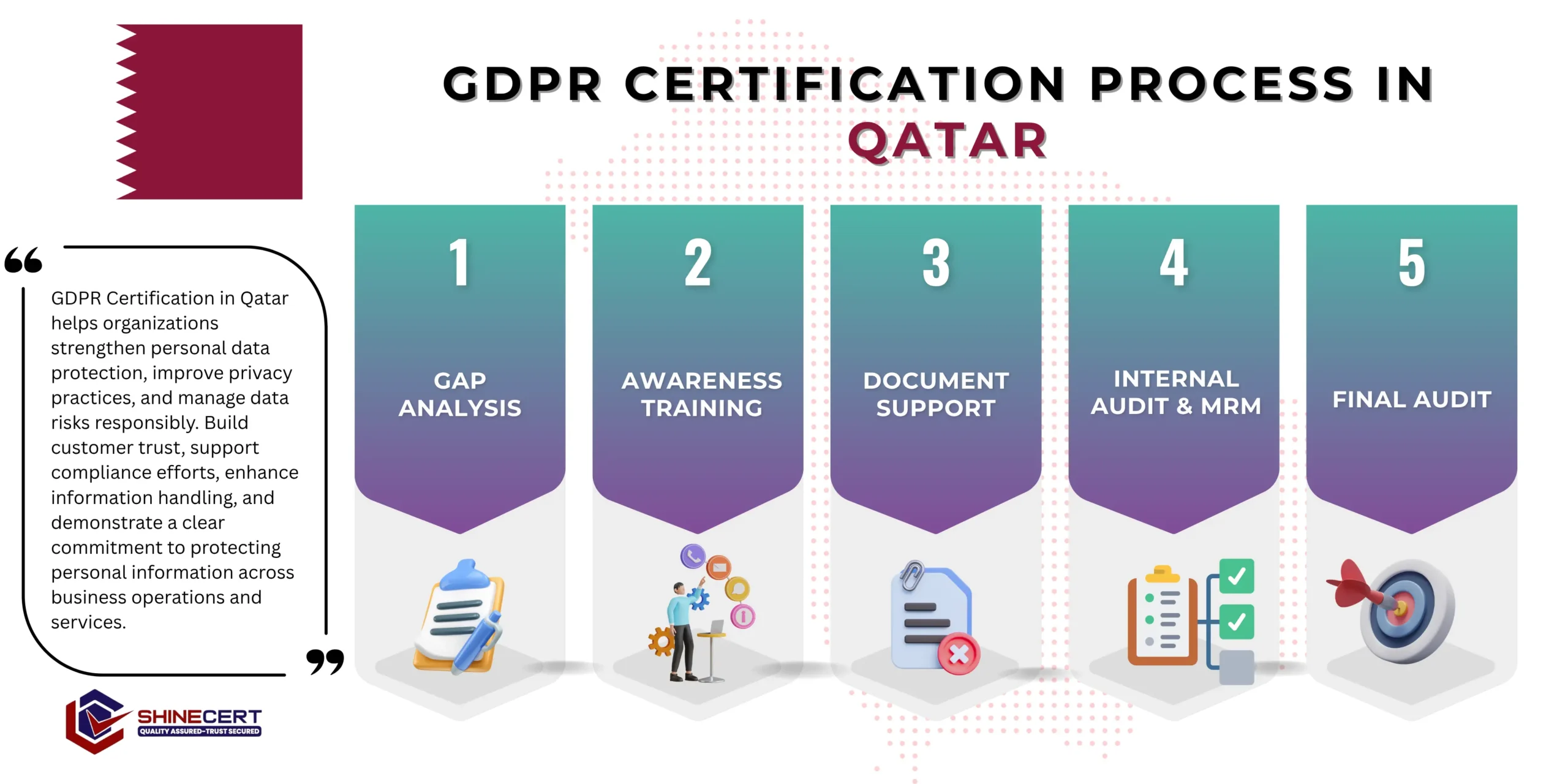
What are the steps to get GDPR Certification in Qatar?
our services
- ISO Certification Qatar
- ISO 9001 Certification Qatar
- ISO 14001 Certification Qatar
- ISO 27001 Certification Qatar
- ISO 22000 Certification Qatar
- ISO 27701 Certification Qatar
- ISO 45001 Certification Qatar
- ISO 20000-1 Certification Qatar
- ISO 13485 Certification Qatar
- ISO 17025 Certification Qatar
- ISO 31000 Certification Qatar
- ISO 42001 Certification Qatar
- ISO 37001 Certification Qatar
- ISO 22301 Certification Qatar
- ISO 50001 Certification Qatar
- CE Mark Certification Qatar
- GDPR Certification Qatar
- GMP Certification Qatar
- Halal Certification Qatar
Our Five-Step Compliance Advisory Process
EU Exposure Assessment
We determine exactly which of your business activities, website traffic, EU customers, EU partners, EU employee data, genuinely trigger GDPR's extraterritorial scope.
A documented assessment of your actual GDPR exposure, distinct from general PDPPL compliance.
Gap Assessment Against GDPR Requirements
We assess your current data handling practices against GDPR's specific requirements, distinct from your existing PDPPL compliance posture.
A gap assessment identifying exactly what's needed for genuine GDPR compliance.
Documentation and Transfer Mechanism Development
We help build GDPR-compliant privacy notices, data subject rights procedures, and cross-border transfer safeguards such as Standard Contractual Clauses.
A complete GDPR compliance documentation set addressing your specific EU-facing activities.
EU Representative Arrangement (where applicable)
Where required under Article 27, we help arrange a formal EU Representative for your organization.
A confirmed EU point of contact meeting GDPR's representative requirement.
Implementation and Ongoing Compliance Support
We support rollout of GDPR-compliant processes and establish ongoing monitoring as your EU-facing activities evolve.
A functioning GDPR compliance program with a clear ongoing maintenance plan.
What It Costs: The Factors That Actually Drive Price
- Scope of EU-facing activity : Businesses with extensive EU customer bases or EU data processing need considerably more comprehensive gap assessment and documentation than those with minimal, incidental EU contact.
- Existing privacy governance maturity : Businesses already ISO 27701 certified or with mature PDPPL compliance typically need less foundational work, since underlying privacy governance infrastructure already exists.
- Cross-border transfer complexity : Businesses with extensive EU-to-Qatar data flows need more thorough Standard Contractual Clauses implementation and transfer impact assessment.
- EU Representative requirement : Businesses needing to appoint a formal EU Representative face additional ongoing cost for this service.
- Industry-specific requirements : Financial services and healthcare businesses handling EU customer data typically need more extensive documentation given the sensitivity of the data categories involved.
- Quick answer : Budget QAR 20,000 to QAR 90,000 for advisory support, with the low end reflecting a business with limited, incidental EU contact and the high end reflecting a business with substantial EU customer data processing requiring comprehensive transfer safeguards and EU Representative arrangement.
What Happens If a Qatar Business Assumes PDPPL Compliance Is Enough?
- This is worth walking through concretely, because it’s one of the most common and consequential misunderstandings Qatar businesses have about EU-facing data handling. A Qatar hospitality company marketing directly to EU travelers, collecting booking and payment data from EU residents, and processing that data entirely on PDPPL-compliant systems within Qatar can still be in genuine breach of GDPR, because PDPPL compliance addresses Qatar’s own legal requirements, not GDPR’s extraterritorial obligations toward EU data subjects specifically. The company’s Qatar-based systems and PDPPL-aligned practices simply don’t address GDPR’s specific requirements around lawful basis documentation, EU data subject rights response timeframes, or cross-border transfer safeguards.
- We generally recommend Qatar businesses with any meaningful EU-facing activity, an EU-targeted website, EU customer base, or EU business partnerships, treat GDPR assessment as a distinct exercise from domestic PDPPL compliance, not an assumed byproduct of it. The two frameworks share some underlying privacy principles, but genuine GDPR compliance requires its own documented gap assessment and, typically, its own specific documentation set addressing EU data subjects.
Benefits: What Proper GDPR Compliance Actually Changes
GDPR fines can reach up to 4% of global annual turnover or €20 million, whichever is higher, for serious violations, a genuine financial exposure for any Qatar business processing meaningful volumes of EU personal data.
European businesses increasingly conduct genuine due diligence on data protection practices before entering partnerships or vendor relationships with non-EU companies.
Properly implemented transfer safeguards remove the legal uncertainty around moving EU customer or partner data into Qatar-based systems.
Much of the GDPR compliance work, data mapping, consent management, breach procedures, strengthens overall privacy governance beyond EU-specific obligations alone.
EU businesses and platforms increasingly restrict working with non-compliant vendors, making GDPR compliance a genuine commercial enabler, not just a legal formality.
Documentation Typically Required
Documented, specifically identifying which processing activities involve EU personal data.
Documented, distinct from domestic PDPPL notices, meeting GDPR’s specific transparency requirements.
Documented, governing the lawful transfer of EU personal data into Qatar-based systems.
Documented, addressing GDPR’s specific response timeframes for EU data subjects.
Documented, addressing GDPR’s 72-hour EU supervisory authority notification requirement.
Documented, where Article 27 requires formal representation.
Industries With the Most Direct GDPR Exposure
Hospitality and tourism
Hotels and travel businesses marketing directly to EU travelers and processing EU booking and payment data face among the most direct and common GDPR exposure.
Read moreE-commerce and retail
Qatar businesses selling products or services to EU consumers online trigger GDPR through the extraterritorial “offering goods or services” provision.
Read moreTechnology and SaaS
Software and platform businesses with EU users, even a relatively small number, fall within GDPR’s scope for those specific users’ data.
Read moreFinancial services
Firms handling EU client data, including QFC-regulated entities with EU customers or counterparties, face GDPR exposure alongside their existing QFC or PDPPL obligations.
Read moreProfessional services and consulting
Firms with EU clients or EU-based project data need GDPR-compliant handling of that specific client information.
Read moreA Scenario: How a Qatar Hospitality Business Might Approach EU Booking Data
- Concrete examples clarify how General Data Protection Regulation (GDPR) exposure actually arises in practice. Picture a Doha-based hotel group with a booking website marketing actively to European travelers, processing names, payment details, and travel preferences for EU guests as a routine part of business. Without a specific GDPR assessment, the hotel group might reasonably assume its PDPPL-compliant Qatar operations already cover this activity adequately, when in fact GDPR’s extraterritorial scope applies directly to this EU-guest-facing booking activity regardless of where the hotel itself operates.
- Building genuine GDPR compliance means the hotel group needs a GDPR-specific privacy notice for EU guests, documented lawful basis for processing their booking data, a data subject rights process meeting GDPR’s specific response timeframes, and, since guest payment and booking data moves from the EU into Qatar-based hotel systems, an appropriate transfer safeguard mechanism. We generally recommend hospitality businesses with genuine EU guest volume treat this as core operational compliance, not a peripheral legal formality, given how directly EU travelers’ data flows through everyday booking operations.
What GDPR Compliance Actually Requires?
- Lawful basis for processing : Documented justification, consent, contract necessity, legitimate interest, or another recognized basis, for every category of EU personal data processed.
- Data subject rights procedures : Documented processes for handling EU data subjects’ access, correction, deletion, and portability requests within GDPR’s specific response timeframes.
- Cross-border transfer safeguards : Since Qatar lacks an EU adequacy determination, transfers of EU personal data to Qatar need a recognized safeguard mechanism, most commonly Standard Contractual Clauses.
- Privacy notices and transparency : Documented, EU-facing privacy notices meeting GDPR’s specific transparency requirements, distinct from any domestic PDPPL notice already in place.
- Breach notification procedures : Documented process for notifying the relevant EU supervisory authority within 72 hours of becoming aware of a breach affecting EU personal data, a considerably tighter and more specific requirement than typical domestic breach procedures.
- EU Representative appointment (where applicable) : For non-EU businesses processing EU personal data at scale without an EU establishment, GDPR’s Article 27 requires appointing a formal EU Representative.
GDPR vs PDPPL: Key Practical Differences for Qatar Businesses
- This distinction matters considerably because it shapes exactly what a Qatar business needs to do differently for its EU-facing activity versus its domestic operations. GDPR applies extraterritorially by design, reaching any organization worldwide offering goods or services to, or monitoring, EU residents, Qatar’s PDPPL doesn’t contain equivalent extraterritorial provisions and focuses on processing activities within Qatar. GDPR also prescribes specific, well-defined cross-border transfer mechanisms, most notably Standard Contractual Clauses, while PDPPL doesn’t prescribe an equivalent specific mechanism, instead assessing cross-border transfers against its general processing principles and requiring case-by-case approval or adequacy assessment.
- We generally recommend Qatar businesses treat these as two genuinely separate compliance programs sharing some common privacy governance infrastructure, data mapping, breach response planning, staff training, rather than assuming a single unified privacy policy can satisfy both frameworks’ distinct and, in places, meaningfully different specific requirements.
Two Myths About GDPR for Qatar Businesses
- GDPR only applies to companies with an actual office in the EU : This is the single most consequential misunderstanding Qatar businesses have about GDPR. Article 3’s extraterritorial scope applies based on whether you offer goods or services to, or monitor, individuals in the EU, a Qatar company with zero physical EU presence but an EU-targeted website or EU customer base falls squarely within scope regardless of where it’s headquartered.
- Our PDPPL compliance already covers our EU customers : It doesn’t, or at least not fully. PDPPL and GDPR are separate legal frameworks with meaningfully different specific requirements, particularly around cross-border transfer mechanisms and EU data subject rights response timeframes, genuine GDPR compliance requires its own dedicated assessment and documentation, not an assumption that domestic compliance transfers automatically.
Why ShineCert?
We coordinate Qatar engagements from ShineCert’s Riyadh and Lebanon offices, with direct familiarity with GDPR’s extraterritorial reach and genuine experience helping Qatar businesses distinguish their EU-facing GDPR obligations from their domestic PDPPL compliance. Our team has guided more than 10,000 organizations through certification and compliance advisory globally, and as the best GDPR consultant in Qatar, we build every GDPR advisory engagement around your organization’s actual EU-facing activities rather than a generic privacy checklist.
Choosing a GDPR Compliance Advisory Partner?
What to Check | Why It Matters |
Genuine understanding of GDPR’s extraterritorial scope and how it applies to non-EU businesses | Many advisors conflate domestic privacy compliance with genuine GDPR-specific obligations |
Experience distinguishing GDPR from PDPPL requirements | The two frameworks have meaningfully different specific requirements, not just different names for similar rules |
Ability to implement Standard Contractual Clauses or other transfer mechanisms | A specific, technical compliance step that generic privacy advice often overlooks |
Familiarity with your specific industry’s EU-facing data flows | Hospitality, e-commerce, and financial services each involve genuinely different EU exposure patterns |
Ready to Get Started?
ShineCert supports Qatar businesses genuinely exposed to GDPR through EU customers, partners, or website traffic, from exposure assessment through full compliance implementation. Book a free consultation or contact us directly, and we’ll review your EU-facing activities before proposing a fixed-scope plan.
Frequently Asked Questions
Yes, if the business offers goods or services to, or monitors the behavior of, individuals in the EU, regardless of where the business itself is located.
No, ShineCert provides compliance advisory support helping Qatar businesses meet GDPR’s requirements, GDPR compliance itself is a legal obligation assessed by EU supervisory authorities, not a certificate we issue.
Typically QAR 20,000 to QAR 90,000, depending on the scope of EU-facing activity.
No, the two frameworks have meaningfully different requirements, particularly around extraterritorial scope and cross-border transfer mechanisms, PDPPL compliance doesn’t automatically satisfy GDPR obligations.
Typically three to six months, depending on the complexity of EU-facing data flows.
No, only those genuinely offering goods or services to, or monitoring, individuals in the EU, a purely domestic Qatar business with no EU-facing activity generally falls outside GDPR’s scope.
Fines can reach up to 4% of global annual turnover or €20 million, whichever is higher, for serious violations.
No, meaning transfers of EU personal data to Qatar need a specific safeguard mechanism, most commonly Standard Contractual Clauses.
No, GDPR’s extraterritorial scope applies based on offering goods or services to, or monitoring, individuals in the EU, regardless of physical presence.
Yes, GDPR’s scope isn’t based on customer volume, even a small number of EU customers whose data you process brings that specific processing within GDPR’s scope.
No, we support Qatar businesses from our Riyadh and Lebanon offices and coordinate with EU-based partners as needed for Representative and legal support.