
ISO 14001 Certification in Qatar
Quick Answer
Qatar’s Ministry of Environment and Climate Change (MoECC) isn’t a passive regulator, its Department of Land Protection alone ran 100 inspection campaigns and documented hundreds of violations in a recent enforcement period, spanning illegal waste disposal, unauthorized excavation, and dust pollution. ISO 14001 is the international environmental management system standard, and against this genuinely active enforcement backdrop, it gives Qatar businesses a structured, independently verified way to demonstrate real environmental control rather than reactive compliance. Get certified through a body accredited by the Global Accreditation Bureau (GAB) or another body recognized under the new Global Accreditation Cooperation (GAC) framework. Budget QAR 16,000 to QAR 60,000 depending on facility complexity, and plan for two to five months from kickoff to certificate.
What Is ISO 14001?
ISO 14001 is the international standard for environmental management systems, first published in 1996 and now the most widely adopted environmental certification globally. It doesn’t set specific pollution limits or environmental performance targets itself, instead, it requires organizations to identify their genuine environmental aspects and impacts, comply with applicable legal requirements, and build a structured system for continually improving environmental performance over time. Like ISO 9001, it follows the Plan-Do-Check-Act cycle and shares the same high-level management system structure, which makes it genuinely efficient to implement alongside other ISO certifications an organization already holds or is pursuing.
Why This Matters So Much in Qatar Specifically?
Qatar National Vision 2030 explicitly names environmental development as one of its four core pillars, alongside economic, social, and human development, and the Ministry of Environment and Climate Change’s 2024-2030 Strategy translates that vision into active, ongoing enforcement rather than aspirational policy language. Recent inspection data tells the story clearly: hundreds of documented violations across land protection, natural reserves, and general environmental oversight in a single enforcement period, covering everything from illegal grazing and unauthorized tree cutting to unlawful landfilling and quarrying. For construction and industrial companies operating in this environment, a documented, certified environmental management system isn’t a marketing nicety, it’s genuine protection against the kind of inspection findings that MoECC’s active field presence makes a real, recurring possibility.
Beyond direct regulatory exposure, Qatar’s major infrastructure and energy projects increasingly specify environmental management certification as a supplier and contractor prequalification requirement, reflecting both government policy direction and the reputational stakes major project owners face around environmental performance.
What are the steps to get ISO 14001 Certification in Qatar?
our services
- ISO Certification Qatar
- ISO 9001 Certification Qatar
- ISO 14001 Certification Qatar
- ISO 27001 Certification Qatar
- ISO 22000 Certification Qatar
- ISO 27701 Certification Qatar
- ISO 45001 Certification Qatar
- ISO 20000-1 Certification Qatar
- ISO 13485 Certification Qatar
- ISO 17025 Certification Qatar
- ISO 31000 Certification Qatar
- ISO 42001 Certification Qatar
- ISO 37001 Certification Qatar
- ISO 22301 Certification Qatar
- ISO 50001 Certification Qatar
- CE Mark Certification Qatar
- GDPR Certification Qatar
- GMP Certification Qatar
- Halal Certification Qatar
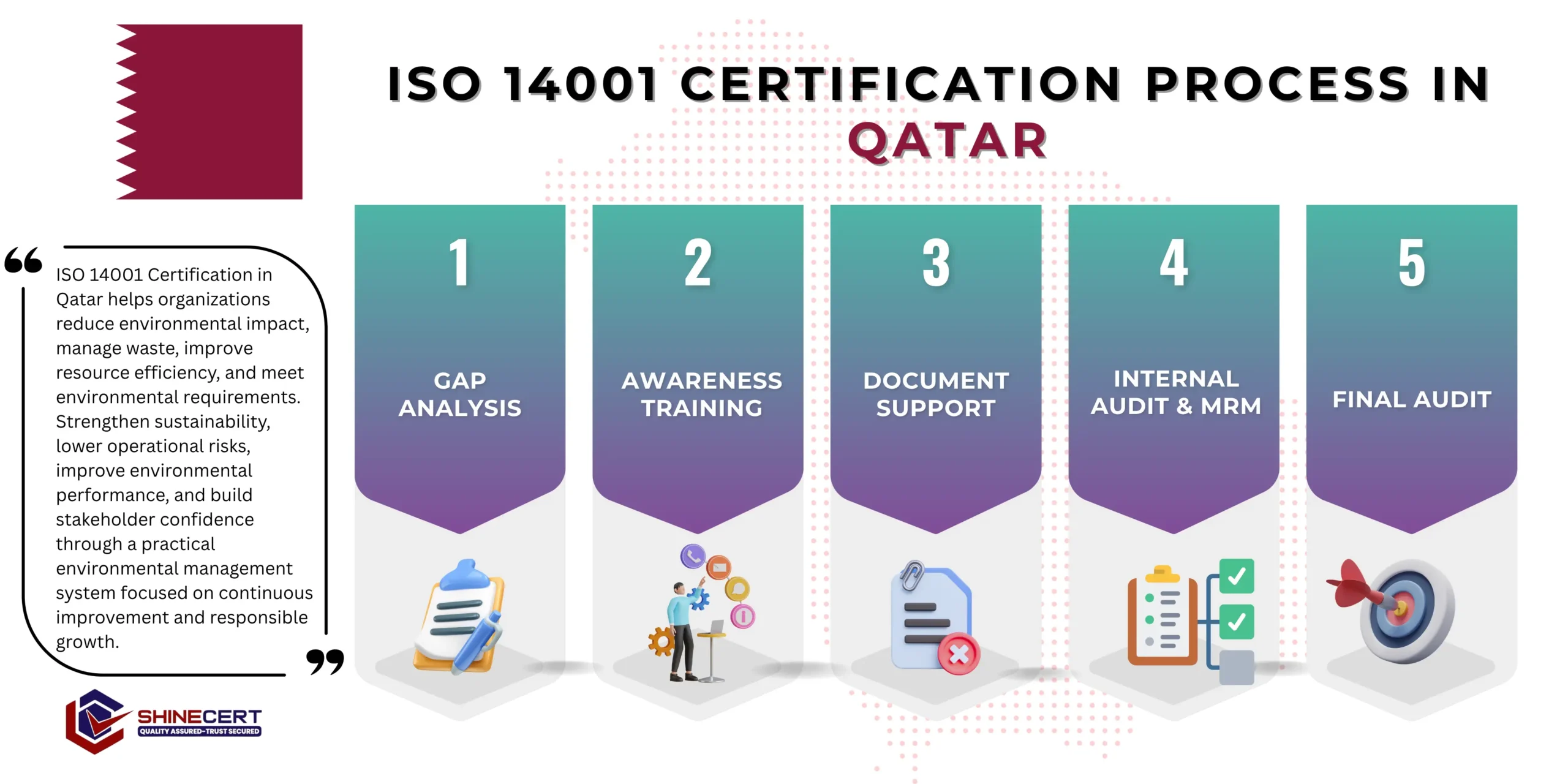
Our Five-Step ISO 14001 Certification Process
Environmental Aspects Assessment
We identify your organization's genuine environmental aspects and impacts, calibrated to your specific operations, and map the applicable MoECC regulations and permit conditions relevant to your sector.
An environmental aspects and impacts register, plus a legal and regulatory compliance obligations register specific to Qatar.
Documentation Development
Your environmental policy, operational control procedures, and legal compliance evaluation process get built around your actual operations and identified aspects, not a generic template.
A complete ISO 14001 documentation set addressing your specific environmental aspects and Qatar regulatory obligations.
Implementation and Training
Operational controls get rolled out across your sites, with staff trained by role on waste handling, spill response, and other environmental procedures relevant to their work.
Training records and evidence of functioning operational controls, including waste segregation and emissions management practices.
Internal Audit and Management Review
A genuine internal audit tests whether your environmental controls actually function under real conditions, with findings feeding into a management review where leadership commits to specific corrective actions.
An internal audit report with real findings and management review minutes demonstrating genuine leadership engagement with environmental performance.
Certification Audit
We coordinate Stage 1 and Stage 2 with a GAB-accredited or GAC-recognized certification body experienced in Qatar's regulatory environment.
Your ISO 14001 certificate and a clear surveillance audit schedule.
Environmental Aspects Assessment
We identify your organization's genuine environmental aspects and impacts, calibrated to your specific operations, and map the applicable MoECC regulations and permit conditions relevant to your sector.
An environmental aspects and impacts register, plus a legal and regulatory compliance obligations register specific to Qatar.
Documentation Development
Your environmental policy, operational control procedures, and legal compliance evaluation process get built around your actual operations and identified aspects, not a generic template.
A complete ISO 14001 documentation set addressing your specific environmental aspects and Qatar regulatory obligations.
Implementation and Training
Operational controls get rolled out across your sites, with staff trained by role on waste handling, spill response, and other environmental procedures relevant to their work.
Training records and evidence of functioning operational controls, including waste segregation and emissions management practices.
Internal Audit and Management Review
A genuine internal audit tests whether your environmental controls actually function under real conditions, with findings feeding into a management review where leadership commits to specific corrective actions.
An internal audit report with real findings and management review minutes demonstrating genuine leadership engagement with environmental performance.
Certification Audit
We coordinate Stage 1 and Stage 2 with a GAB-accredited or GAC-recognized certification body experienced in Qatar's regulatory environment.
Your ISO 14001 certificate and a clear surveillance audit schedule.
The ISO 14001:2026 Revision
- ISO 14001 was substantially revised and republished in April 2026, replacing the 2015 edition with a three-year transition period running to May 2029. The revision places considerably stronger emphasis on climate change and biodiversity considerations within the environmental aspects assessment, requiring organizations to genuinely evaluate climate-related risks and opportunities rather than treating environmental management purely as a pollution and waste control exercise.
- For Qatar companies, this update aligns naturally with the Ministry of Environment and Climate Change’s own 2024-2030 Strategy, which explicitly folds climate change considerations into its broader environmental enforcement priorities, meaning the ISO 14001:2026 update and Qatar’s own regulatory direction are, for once, pointing the same way rather than requiring separate, disconnected compliance efforts. Companies newly pursuing certification should build directly to the 2026 edition rather than certifying to the outgoing 2015 edition and transitioning later, since the transition work involved is genuinely minor when built in from the start.
What It Costs: The Factors That Actually Drive ISO 14001 Price
- Number and complexity of environmental aspects : Facilities with more waste streams, emissions sources, or resource-intensive processes need more extensive assessment and control documentation.
- Number of sites : Each additional facility or project site typically needs its own environmental aspects assessment.
- Existing compliance maturity : Companies with informal but functioning environmental practices already in place need less foundational work than those starting from scratch.
- Sector risk profile : Construction and industrial operations generally need more extensive operational controls than office-based or professional services businesses.
- Bundling with ISO 9001 or ISO 45001 : Meaningful cost efficiency is available for companies pursuing multiple management system certifications together, given shared documentation infrastructure.
- Quick answer : Budget QAR 16,000 to QAR 60,000, with the low end reflecting a smaller, lower-impact operation and the high end reflecting a larger, multi-site industrial or construction operation.
ISO 14001 vs Project-Specific Environmental Permits
- These are complementary, not substitutes, and Qatar construction and industrial companies benefit from understanding the distinction clearly. A project-specific environmental permit from MoECC authorizes specific activities at a specific site, with conditions tailored to that project’s particular environmental risk profile.
- ISO 14001 certifies your organization’s broader environmental management system, the ongoing discipline of identifying, controlling, and improving environmental performance across your operations generally, not tied to any single project or site. We generally recommend Qatar companies treat ISO 14001 as the organizational backbone that makes obtaining and maintaining individual project permits considerably more straightforward, since a functioning environmental management system produces exactly the documentation and monitoring evidence MoECC typically requests during permit applications and site inspections.
Benefits: What Certification Actually Changes
A functioning environmental management system directly reduces the likelihood of MoECC inspection findings, given how active field enforcement currently is.
Government and energy-sector project owners increasingly specify environmental certification as a contractor prequalification requirement.
Waste reduction and resource efficiency measures required by the standard often reduce operating costs directly, not just environmental risk.
Structured environmental controls reduce the likelihood of costly incidents requiring remediation or triggering regulatory penalties.
Multinational joint venture partners and clients increasingly expect certified environmental management as standard practice, not an exception.
Companies already pursuing or holding ISO 9001 find the shared management system structure makes ISO 14001 implementation meaningfully faster.
Mandatory Documents Required for Implementation
Genuine leadership commitment addressing your specific environmental aspects.
Documented, specific to your operations, not a generic industry list.
Documented obligations under MoECC and any project-specific environmental commitments.
Covering waste handling, emissions, and resource use specific to your significant aspects.
Documented plans for environmental incidents, genuinely tested where feasible.
Evidence of genuine, ongoing oversight.
Real data demonstrating environmental performance, not estimated impressions.
Applicable Standards by Industry
Construction
Beyond ISO 14001, Qatar construction companies typically need to demonstrate compliance with specific MoECC permit conditions, including waste management and dust control plans.
Read moreEnergy and Industrial Services
Companies supporting Qatar's energy sector frequently face additional client-specific environmental requirements beyond ISO 14001 as part of supplier qualification.
Read moreHospitality
Hotels and resorts increasingly pursue ISO 14001 alongside broader sustainability certifications that support international guest expectations and corporate commitments.
Read moreManufacturing
Industrial producers typically need ISO 14001 alongside specific MoECC emissions and waste discharge permits calibrated to their production processes.
Read moreReal Estate and Facilities Management
Large developments increasingly reference environmental management certification during both construction phases and ongoing operational contractor requirements.
Read moreSurveillance Audits: Staying Certified After Year One
- Certification isn’t a one-time event, and this trips up organizations that treat the initial certification audit as the finish line. After your ISO 14001 certificate is issued, your certification body conducts surveillance audits, typically annually, to confirm your environmental management system is still genuinely functioning, not just filed away and forgotten. A recertification audit, more thorough than a surveillance visit, happens every three years to renew the certificate for another cycle.
- In our experience, the organizations that struggle most at the surveillance stage are the ones where the environmental management system was built quickly to pass Stage 2 and then left largely untouched, aspects registers that were never updated after a process changed, training records that stopped being logged, monitoring data that quietly lapsed. Given how actively MoECC inspects in Qatar, letting your certified system drift between surveillance visits carries real regulatory exposure, not just the risk of a certification body finding. We generally advise clients to treat the internal audit and management review cycle as a genuine annual discipline, not a pre-surveillance scramble, since that’s what keeps the certificate, and your actual environmental compliance posture, both intact.
Environmental Requirements, Clause by Clause
- Context of the Organization : Identify your genuine environmental aspects, emissions, waste generation, resource consumption, and the interested parties who care about them, including MoECC directly if your operations fall within its active inspection scope.
- Leadership : Top management commitment to environmental performance that goes beyond a signed policy statement, with resources genuinely allocated to environmental management, not treated as an unfunded mandate handed to whoever happens to be available.
- Planning : A genuine environmental aspects and impacts assessment, plus identification of applicable legal requirements, MoECC’s own regulations, permit conditions, and any project-specific environmental commitments made to clients or government bodies.
- Support : Competence and awareness training specific to environmental responsibilities, calibrated by role, a site supervisor overseeing waste handling needs meaningfully different training than office-based administrative staff.
- Operation : Operational controls over your significant environmental aspects, waste segregation and disposal, emissions control, resource use, documented and genuinely followed, not just described in a procedure nobody references.
- Performance Evaluation : Monitoring and measurement of actual environmental performance, with internal audits specifically testing whether operational controls function as designed, not just whether documentation exists.
- Improvement : A structured response to environmental incidents or nonconformities, including genuine root-cause investigation, and a repeated MoECC citation for the same issue is itself evidence the corrective action process isn’t working.
A Certification Audit Is Not the Same as a MoECC Inspection
- It’s worth being genuinely clear about this distinction, since we see it confused often. An ISO 14001 certification audit is a scheduled, planned assessment against the ISO 14001 standard, conducted by your chosen certification body, with advance notice and an agreed scope. A MoECC field inspection is a regulatory enforcement activity, often unannounced, checking compliance against Qatari environmental law and your specific permit conditions, a genuinely different exercise with genuinely different consequences for failure. Passing your ISO 14001 certification audit doesn’t automatically mean you’ll pass every MoECC inspection, and vice versa, since the certification audit tests your management system’s overall functioning while a MoECC inspection tests specific, real-time operational compliance on the day the inspector arrives.
- That said, the two are far from unrelated. A genuinely functioning ISO 14001 system, with real operational controls, trained staff, and documented monitoring, is exactly what makes your operations consistently ready for an unannounced MoECC inspection, rather than only being “audit-ready” in the narrow window before a scheduled certification visit. We’ve generally recommended that Qatar companies treat MoECC inspection readiness as an ongoing state their ISO 14001 system should maintain continuously, not a separate preparation exercise conducted only when a certification or surveillance audit approaches. Companies that build this genuine continuity tend to face considerably fewer surprises when field inspectors show up unannounced, which, given MoECC’s current enforcement volume, is a genuinely realistic scenario for most operating businesses in relevant sectors.
Three Myths About ISO 14001 in Qatar
- Environmental certification is only relevant for heavy industry : In practice, MoECC’s active enforcement touches construction, hospitality, and general commercial operations directly, particularly around waste disposal and land use, this isn’t a heavy-industry-only concern.
- A green policy statement is basically the same as certification : A policy statement without genuine operational controls and monitoring behind it provides no protection during an actual MoECC inspection, and doesn’t survive a certification audit either.
- Once certified, environmental compliance takes care of itself : MoECC’s regulations and enforcement priorities evolve, and a certified system that isn’t actively maintained between surveillance audits tends to drift out of genuine compliance even while the certificate technically remains valid.
Why ShineCert?
We coordinate Qatar engagements from ShineCert’s Riyadh and Lebanon offices, with direct familiarity with MoECC’s regulatory framework and enforcement priorities. As the best ISO 14001 consultant in Qatar, our team has guided more than 10,000 organizations through ISO certification globally.
Choosing a Certification Body in Qatar?
What to Check | Why It Matters |
GAB accreditation, or another GAC-recognized body | Confirms genuine, internationally recognized certification |
Sector-relevant environmental audit experience | Construction and industrial environmental risk differs meaningfully from office-based operations |
Familiarity with MoECC’s regulatory framework | Helps ensure certification genuinely supports your compliance posture, not just an abstract credential |
Realistic audit scoping for multi-site operations | Each significant site typically needs genuine on-site audit attention |
Ready to Get Started?
ShineCert supports Qatar businesses end to end, from environmental aspects assessment through certification audit, with direct experience navigating MoECC’s regulatory environment. Book a free consultation or contact us directly, and we’ll review your operations before proposing a fixed-scope plan.
Frequently Asked Questions
It’s the international standard for environmental management systems, requiring organizations to identify their environmental impacts, comply with applicable regulations, and continually improve environmental performance.
Typically QAR 16,000 to QAR 60,000, depending on facility complexity and number of sites.
No, it’s voluntary, though it increasingly supports major project tender prequalification and provides genuine protection given MoECC’s active enforcement environment.
Typically two to five months.
ISO 14001:2026 has already been published, so new certifications should build directly to the 2026 edition rather than the outgoing 2015 version.
No, permits authorize specific project activities, while ISO 14001 certifies your organization’s broader environmental management system, the two are complementary.
No, they’re genuinely different exercises, certification audits assess your overall management system, while MoECC inspections check real-time compliance against specific permits and regulations, though a well-functioning ISO 14001 system makes both considerably more likely to go well.
No, certification isn’t permanent or passive, your certification body conducts annual surveillance audits and a full recertification audit every three years to confirm your environmental management system stays genuinely functional.
We coordinate Qatar engagements from our Riyadh and Lebanon offices, with consultants traveling on-site as needed.
Formal publication is expected in September 2026, with a three-year transition period running to approximately September 2029; existing ISO 9001:2015 certificates remain fully valid throughout that window.
We coordinate Qatar engagements from our Riyadh and Lebanon offices, with consultants traveling on-site as needed.