
CE Mark Certification in Qatar
Quick Answer
CE marking isn’t a Qatar certification, it’s an EU marking that Qatar manufacturers and exporters need if they want to sell products covered by harmonized EU rules into the European market, and ShineCert provides compliance advisory support to help Qatar-based businesses navigate that EU requirement rather than issuing the mark itself. 2026 has meaningfully expanded CE marking’s scope: new rules under the EU AI Act, the Machinery Regulation, and the Battery Regulation now bring entirely new product categories into scope, and the EU Digital Product Passport requirement now applies to certain products like batteries and textiles. Budget QAR 15,000 to QAR 70,000 for advisory support depending on product category and complexity, and plan for three to six months.
What Is CE Marking?
CE marking, standing for Conformité Européenne, is a marking manufacturers affix to products to indicate conformity with applicable EU health, safety, and environmental protection requirements, allowing the product to move and be marketed freely across the European Economic Area regardless of where it was actually manufactured. It applies only to products covered by specific EU harmonized legislation, not every product needs it, and the process involves identifying every applicable EU directive or regulation, running the required conformity assessment, compiling technical documentation, signing an EU Declaration of Conformity, and physically affixing the mark to the product before it can be sold in the EU.
Why This Matters for Qatar Exporters Specifically?
Qatar manufacturers and exporters targeting the European market face the same CE marking obligations as any other non-EU manufacturer, but 2026 has raised the stakes considerably. New EU rules under the AI Act, the Machinery Regulation, and the Battery Regulation have expanded CE marking obligations to entirely new categories of products, meaning products that may not have required CE marking in prior years now genuinely do, and Qatar businesses exporting into these newly covered categories need to reassess their compliance status rather than assume prior export experience still applies. Additionally, the EU Digital Product Passport requirement, now applying to categories including batteries and textiles, means qualifying products need a digital record of compliance data alongside the physical CE mark itself.
Since a CE-marked product effective July 2021 must carry a label identifying a point of contact within the EU for customs and market surveillance authorities, Qatar exporters without an existing EU-based importer or distributor able to fill that role need to appoint a formal EU Authorized Representative, a genuine operational requirement, not paperwork that can be skipped for a first shipment.
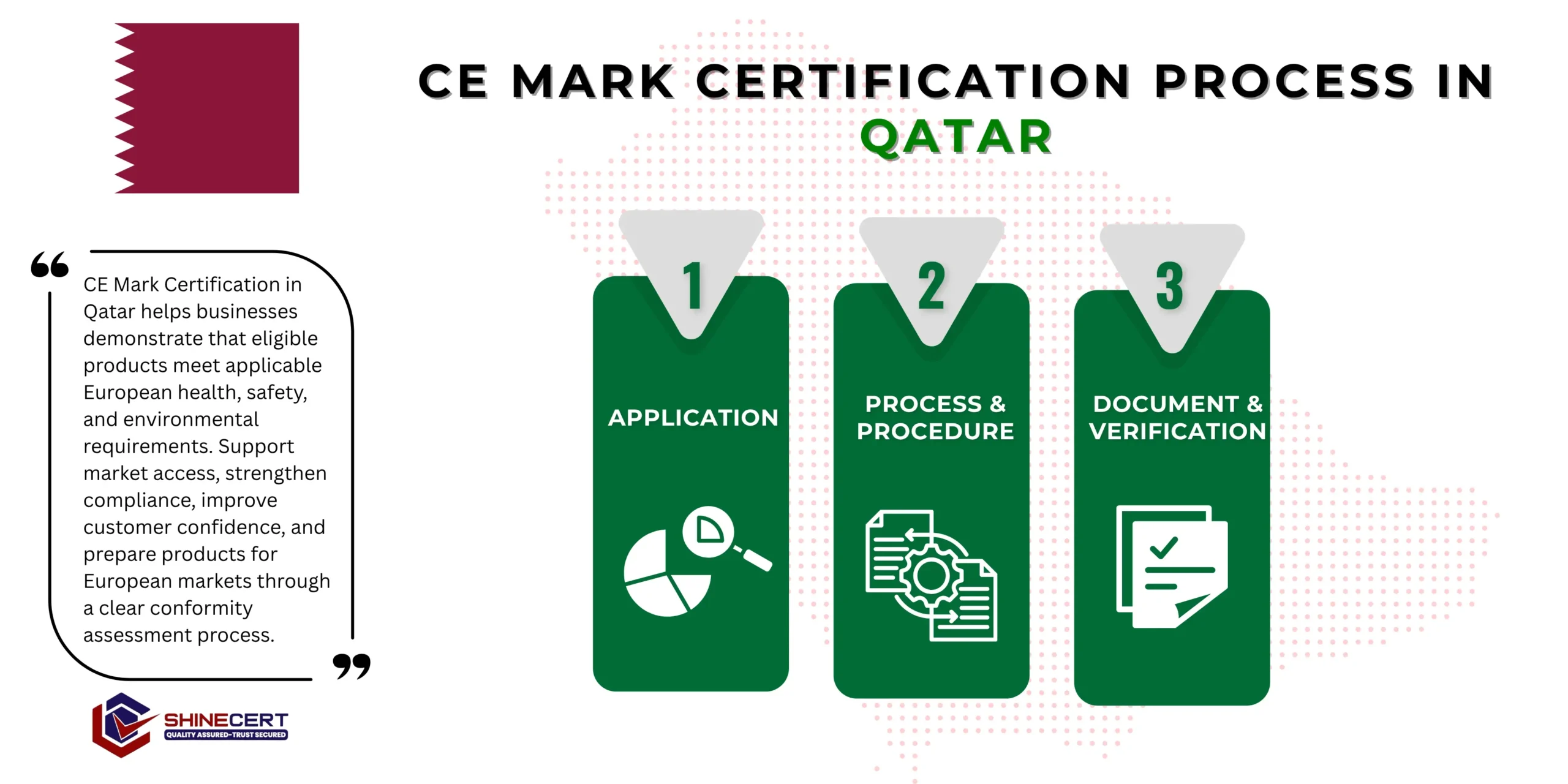
What are the steps to get CE Mark Certification in Qatar?
our services
- ISO Certification Qatar
- ISO 9001 Certification Qatar
- ISO 14001 Certification Qatar
- ISO 27001 Certification Qatar
- ISO 22000 Certification Qatar
- ISO 27701 Certification Qatar
- ISO 45001 Certification Qatar
- ISO 20000-1 Certification Qatar
- ISO 13485 Certification Qatar
- ISO 17025 Certification Qatar
- ISO 31000 Certification Qatar
- ISO 42001 Certification Qatar
- ISO 37001 Certification Qatar
- ISO 22301 Certification Qatar
- ISO 50001 Certification Qatar
- CE Mark Certification Qatar
- GDPR Certification Qatar
- GMP Certification Qatar
- Halal Certification Qatar
Our Five-Step CE Mark Certification Process
Applicability Assessment
We determine exactly which EU directives and regulations apply to your specific product, including the newly expanded scope under the AI Act, Machinery Regulation, and Battery Regulation.
A documented applicability assessment specific to your product category.
Conformity Assessment Route Determination
We identify whether your product qualifies for manufacturer self-declaration or requires third-party assessment through a Notified Body, based on its risk classification.
A defined conformity assessment pathway and, where needed, Notified Body coordination.
Technical Documentation Development
We help compile the technical file and supporting evidence demonstrating your product's conformity with applicable requirements.
A complete technical documentation file ready for EU market surveillance review if requested.
EU Authorized Representative Arrangement
Where no existing EU importer or distributor can serve this role, we help arrange a formal EU Authorized Representative for your product.
A confirmed EU point of contact meeting the labeling requirement.
Declaration of Conformity and Market Entry Support
We support finalizing your EU Declaration of Conformity and affixing the CE mark correctly before market entry.
A complete compliance package ready for EU market entry.
What It Costs: The Factors That Actually Drive CE Mark Certification Price
- Product category and risk classification : Products requiring third-party Notified Body assessment involve considerably more cost and complexity than those eligible for manufacturer self-declaration.
- Newly expanded scope under 2026 rules : Products newly brought into CE marking scope under the AI Act, Machinery Regulation, or Battery Regulation need a full compliance assessment built essentially from scratch.
- Digital Product Passport requirements : Qualifying product categories, including batteries and textiles, need additional digital compliance infrastructure beyond traditional physical documentation.
- EU Authorized Representative arrangement : Exporters needing a dedicated Authorized Representative, rather than relying on an existing EU distributor relationship, face additional ongoing cost for this service.
- Number of distinct product lines : Companies seeking CE marking compliance for multiple distinct products need separate applicability assessment and documentation for each.
- Quick answer : Budget QAR 15,000 to QAR 70,000 for advisory support, with the low end reflecting a single product eligible for self-declaration and the high end reflecting a more complex product requiring Notified Body assessment and Digital Product Passport compliance.
What Happens If a Qatar Exporter Ships Without an EU Authorized Representative?
- This is worth understanding clearly, because it’s a genuinely common gap for exporters new to the EU market. Since July 2021, CE-marked products have needed a label identifying a specific point of contact within the EU for customs and market surveillance authorities, typically an importer or distributor already established in the EU, or, where no such party exists, a formally appointed EU Authorized Representative. Shipping a product without this contact information properly established isn’t a minor paperwork gap; it can result in the shipment being held at EU customs or the product being deemed non-compliant regardless of the underlying product’s actual conformity.
- Qatar exporters working through an established EU distributor or importer may already satisfy this requirement through that relationship, but exporters selling more directly, including through e-commerce channels reaching EU consumers without a formal EU-based intermediary, generally need to appoint a dedicated Authorized Representative before their first shipment, not after a compliance issue surfaces. We generally recommend confirming this specific requirement early in export planning, since arranging a genuine Authorized Representative relationship takes real lead time.
Benefits: What Proper CE Marking Compliance Actually Changes
Properly CE-marked products move freely across the European Economic Area without additional national-level conformity requirements in each member state.
Products found non-compliant at EU customs or through market surveillance face seizure, forced withdrawal, or significant fines, proper compliance avoids this considerable business risk.
European distributors and retailers increasingly verify CE marking compliance rigorously before agreeing to carry products from new suppliers.
Qatar exporters who proactively assess their exposure to the AI Act, Machinery Regulation, and Battery Regulation’s expanded scope avoid discovering a compliance gap only after a shipment is already rejected.
Many of the technical documentation and conformity assessment disciplines built for CE marking transfer usefully to other international market access requirements.
Documentation Typically Required
Documented evidence of product conformity, including design, manufacturing, and testing data specific to applicable EU requirements.
A signed document declaring conformity with all applicable directives and regulations.
Documented, whether self-declared or issued by a Notified Body depending on the product’s classification.
Documented, where an EU-based importer or distributor cannot fulfill this role.
Documented compliance data for qualifying product categories under 2026 requirements.
Documented, meeting EU-specific labeling, language, and safety instruction requirements.
Product Categories Most Affected by 2026’s Expanded Requirements
Electronics and connected devices
Products incorporating AI functionality face newly expanded scrutiny under the EU AI Act’s CE marking implications.
Read moreIndustrial machinery
Equipment manufacturers face the Machinery Regulation’s updated and expanded requirements, replacing the prior Machinery Directive framework.
Read moreBatteries and energy storage products
Products face both the Battery Regulation’s new requirements and, for qualifying categories, Digital Product Passport obligations.
Read moreTextiles
Products face emerging Digital Product Passport requirements as this framework’s scope continues expanding.
Read moreConsumer electronics with embedded software or AI features
Products increasingly need assessment against both traditional safety directives and the newer AI-specific requirements.
Read moreCE Marking vs Other Qatar Export Compliance Requirements
- This distinction is worth understanding because CE marking is often the first EU-specific requirement Qatar exporters encounter, but it typically isn’t the only one relevant to a given product. Depending on the product category, EU market entry may also involve REACH chemical registration for products containing certain substances, packaging and labeling rules specific to individual member states, and, for food and consumer products, additional EU food safety or general product safety requirements layered on top of CE marking itself where applicable. CE marking addresses the specific harmonized product safety directives it covers, it doesn’t automatically satisfy every other EU market entry requirement a given product might trigger.
- We generally recommend Qatar exporters map their full EU compliance picture early, rather than treating CE marking in isolation, since a product can be fully CE marking compliant and still face a separate market entry obstacle under a different EU framework entirely. This is particularly relevant for exporters newly expanding beyond markets where CE marking alone was historically the primary compliance concern.
What CE Marking Compliance Actually Involves?
- Directive and regulation identification : Determining exactly which EU harmonized legislation applies to your specific product, since CE marking requirements vary considerably by product category.
- Conformity assessment : Running the specific assessment procedure, which may be self-declaration or third-party assessment via a Notified Body, depending on the product’s risk classification, required under the applicable directive.
- Technical documentation : Compiling a technical file demonstrating how the product meets applicable requirements, maintained and available for EU market surveillance authorities on request.
- EU Declaration of Conformity : A signed, legally binding document declaring the product’s conformity with all applicable requirements.
- Authorized Representative appointment : Where no EU-based importer or distributor can serve this role, appointing a formal EU Authorized Representative to serve as the point of contact for customs and market surveillance.
- Digital Product Passport compliance (where applicable) : For qualifying product categories under 2026 rules, maintaining a digital record of compliance and product data accessible to relevant parties.
Two Myths About CE Marking for Qatar Exporters
- CE marking is a certification issued by an authority, like an ISO certificate : It isn’t. For most product categories, CE marking is a manufacturer’s own declaration of conformity, based on self-assessment against applicable EU requirements, only certain higher-risk product categories require third-party assessment by a Notified Body. Qatar exporters sometimes assume every product needs external certification, when in practice many qualify for manufacturer self-declaration provided the underlying technical documentation and conformity assessment are genuinely sound.
- Once a product is CE marked, it’s CE marked permanently : This significantly undersells how CE marking obligations actually work. As 2026’s expanded requirements under the AI Act, Machinery Regulation, and Battery Regulation demonstrate, the underlying EU legislation changes over time, and a product’s compliance basis needs periodic reassessment against current rules, not a one-time assumption that an earlier compliance exercise remains valid indefinitely.
A Scenario: How a Qatar Manufacturer Might Navigate the Machinery Regulation’s Expanded Scope
- Concrete examples clarify what this shift actually means in practice. Picture a Qatar-based manufacturer of industrial equipment with an established, compliant CE marking history under the prior Machinery Directive, now preparing a new shipment to an EU distributor under the assumption that its existing compliance documentation remains sufficient. Because the Machinery Regulation replaced the prior directive with updated and, in several respects, expanded requirements, documentation and conformity assessment approaches that satisfied the old framework may not automatically satisfy the new one, particularly for equipment incorporating any degree of autonomous or AI-driven functionality.
- A manufacturer that proactively reassesses its compliance status against the current Machinery Regulation, rather than assuming its prior CE marking history transfers automatically, identifies exactly what’s changed and addresses any gaps before a shipment is time-sensitive. We generally recommend Qatar manufacturers with any existing CE-marked product line treat 2026’s regulatory changes as a genuine trigger for reassessment, not just new products entering the EU market for the first time.
Why ShineCert?
We coordinate Qatar engagements from ShineCert’s Riyadh and Lebanon offices, with direct familiarity with the EU’s evolving CE marking landscape, including 2026’s AI Act, Machinery Regulation, and Battery Regulation expansions, and genuine experience helping non-EU manufacturers navigate EU market access requirements. As the best CE Mark consultant in Qatar, our team has guided more than 10,000 organizations through certification and compliance globally.
Choosing a Compliance Advisory Partner for CE Marking?
What to Check | Why It Matters |
Genuine familiarity with 2026’s AI Act, Machinery Regulation, and Battery Regulation changes | Ensures your assessment reflects current EU requirements, not outdated pre-2026 rules |
Experience with your specific product category’s conformity assessment route | Self-declaration and Notified Body assessment involve meaningfully different processes and cost |
Ability to arrange or coordinate EU Authorized Representative services | A genuine operational requirement for exporters without an existing EU distributor relationship |
Understanding of Digital Product Passport requirements where applicable | Relevant for battery, textile, and other qualifying product categories under 2026 rules |
Ready to Get Started?
ShineCert supports Qatar manufacturers and exporters navigating CE marking’s 2026 expanded requirements, from applicability assessment through EU market entry. Book a free consultation or contact us directly, and we’ll review your product category before proposing a fixed-scope plan.
Frequently Asked Questions
It’s an EU marking indicating a product conforms with applicable EU health, safety, and environmental requirements, allowing free movement across the European Economic Area.
No, ShineCert provides compliance advisory support helping Qatar manufacturers navigate the EU’s CE marking requirements, CE marking itself is a manufacturer declaration, sometimes combined with third-party Notified Body assessment depending on product classification.
Typically QAR 15,000 to QAR 70,000, depending on product category and conformity assessment route.
New rules under the EU AI Act, Machinery Regulation, and Battery Regulation expanded CE marking obligations to new product categories, and the Digital Product Passport requirement now applies to categories including batteries and textiles.
No, only products covered by specific EU harmonized legislation require it, not every product category is in scope.
Often yes, CE-marked products need an EU point of contact for customs and market surveillance, which an existing EU distributor may provide, or which may require a formally appointed Authorized Representative.
Typically three to six months, longer for products requiring Notified Body assessment or Digital Product Passport compliance.
Not automatically, products affected by the Machinery Regulation, AI Act, or Battery Regulation’s expanded scope may need reassessment even with an established prior compliance history.
No, for most product categories it’s a manufacturer self-declaration based on conformity assessment, though certain higher-risk categories require third-party Notified Body assessment.
No, depending on the product, additional requirements like REACH chemical registration or general product safety rules may apply alongside CE marking.
No, we support Qatar exporters from our Riyadh and Lebanon offices and coordinate with EU-based partners and Notified Bodies as needed for your specific product.