
ISO 20000-1 Certification in Qatar
Quick Answer
ISO 20000-1 is the international standard for IT service management systems, and it arrives in Qatar at a moment of genuine digital transformation momentum, the Ministry of Communications and Information Technology published Qatar’s National Digital Agenda 2030 in April 2024, and government entities are actively migrating infrastructure to platforms like Qatar Cloud and newly established hyperscale data centers under programs such as MCIT’s Voyager repatriation initiative. Get certified through a body accredited by the Global Accreditation Bureau (GAB) or another body recognized under the new Global Accreditation Cooperation (GAC) framework. Budget QAR 20,000 to QAR 90,000 depending on service scope and organizational complexity, and plan for four to six months.
What Is ISO 20000-1?
ISO 20000-1 is the international standard for IT service management systems (ITSM), providing a structured framework for planning, delivering, monitoring, and improving IT services to meet both business and customer requirements. It covers service design and transition, incident and problem management, capacity and availability management, service level management, and continual service improvement. Unlike ITIL, which is a best-practice framework offering guidance and vocabulary, ISO 20000-1 is a certifiable management system standard against which an organization’s actual service delivery can be independently audited.
Why This Matters So Much in Qatar Specifically?
Qatar’s digital transformation is genuinely accelerating rather than plateauing. MCIT’s National Digital Agenda 2030, published in April 2024, sets the national direction for digital economy growth, and government infrastructure has been moving in step: more than 70 public entities have migrated existing on-premises infrastructure to cloud platforms, and MCIT’s Voyager Program is actively repatriating applications to a newly established hyperscale data center in Qatar. National infrastructure like Qatar Cloud, the Government Data Center, the Tawtheeq national authentication system, and GOVNET’s secure government telecommunications backbone all depend on IT service providers capable of demonstrating genuinely reliable, structured service delivery.
For managed service providers, systems integrators, and IT contractors serving government and large enterprise clients in Qatar, this creates real pressure to demonstrate service management maturity beyond informal, relationship-based delivery. ISO 20000-1 certification gives you an internationally recognized, independently verified way to prove that your incident response, service levels, and continual improvement processes are genuinely structured, not just described in a sales pitch.
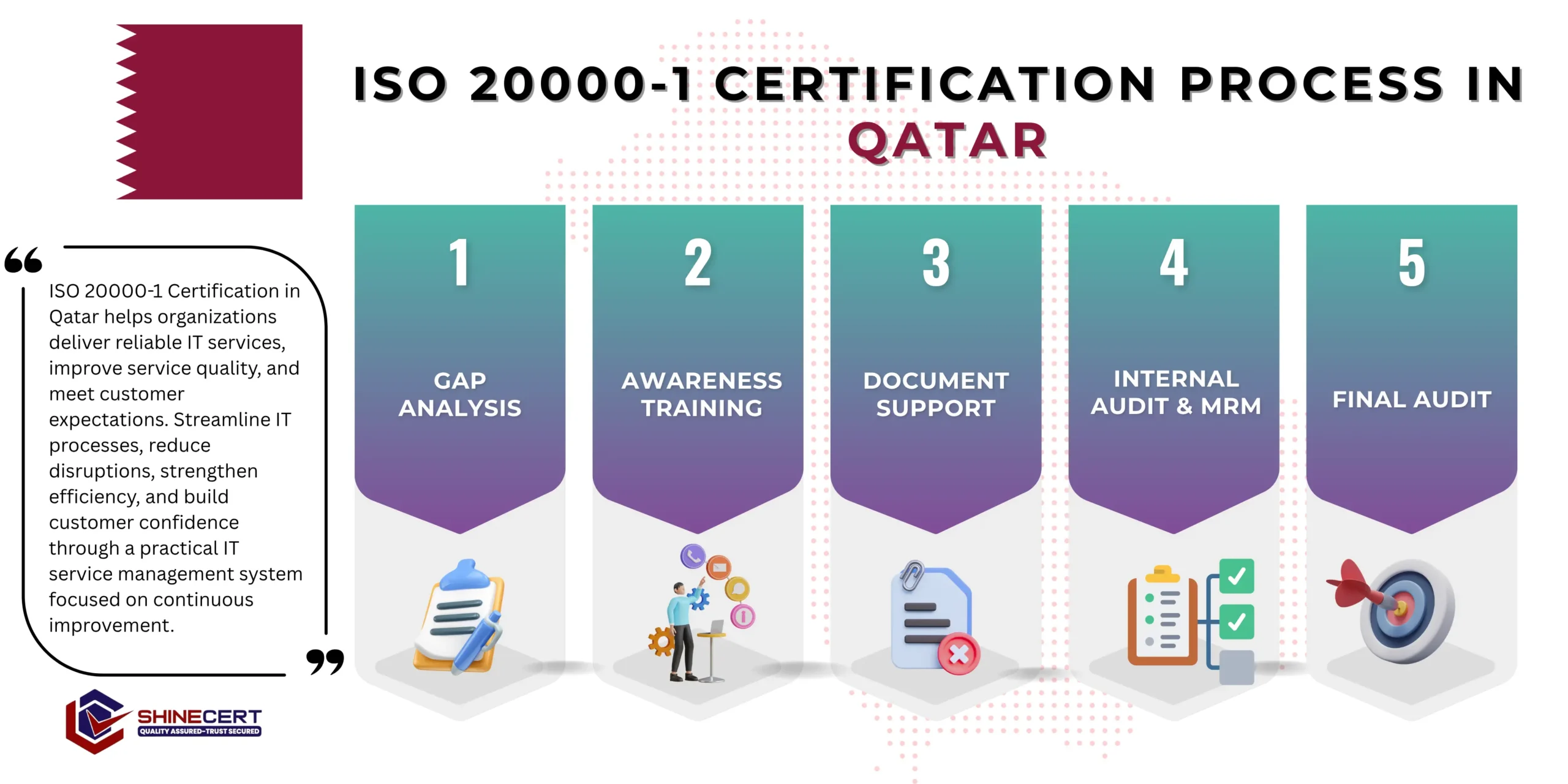
What are the steps to get ISO 20000-1 Certification in Qatar?
our services
- ISO Certification Qatar
- ISO 9001 Certification Qatar
- ISO 14001 Certification Qatar
- ISO 27001 Certification Qatar
- ISO 22000 Certification Qatar
- ISO 27701 Certification Qatar
- ISO 45001 Certification Qatar
- ISO 20000-1 Certification Qatar
- ISO 13485 Certification Qatar
- ISO 17025 Certification Qatar
- ISO 31000 Certification Qatar
- ISO 42001 Certification Qatar
- ISO 37001 Certification Qatar
- ISO 22301 Certification Qatar
- ISO 50001 Certification Qatar
- CE Mark Certification Qatar
- GDPR Certification Qatar
- GMP Certification Qatar
- Halal Certification Qatar
Our Five-Step ISO 20000-1 Certification Process
Service Scope Assessment
We identify exactly which IT services fall within your management system scope and assess your current service delivery maturity against ISO 20000-1.
A service scope statement and gap assessment specific to your service portfolio.
Documentation Development
Your service management policy, service level objectives, and operational procedures get built around the services you actually deliver, not a generic IT framework.
A complete ISO 20000-1 documentation set aligned to your service scope.
Implementation and Training
Service management processes roll out across your organization, with staff trained on incident management, change control, and their specific role in service delivery.
Training records and evidence of functioning service management processes in daily operations.
Internal Audit and Management Review
We test whether your service levels genuinely meet documented commitments, with findings feeding into a management review where leadership commits to specific improvement actions.
An internal audit report and management review minutes demonstrating genuine engagement with service performance data.
Certification Audit
We coordinate Stage 1 and Stage 2 with a GAB-accredited or GAC-recognized certification body experienced in IT service management audits for government and enterprise IT providers.
Your ISO 20000-1 certificate and a clear surveillance audit schedule.
What It Costs: The Factors That Actually Drive ISO 20000-1 Price
- Number and complexity of services in scope : Organizations delivering more distinct IT services, especially across multiple customer relationships, need more extensive documentation and monitoring infrastructure.
- Existing service management maturity : Organizations already using ITIL or similar frameworks internally typically implement considerably faster than those building service management discipline from scratch.
- Number of customer relationships and SLAs : Providers managing numerous distinct service level agreements need broader service level monitoring and reporting infrastructure.
- Government or enterprise contract requirements : Organizations serving government clients often need more extensive security and availability controls, adding to implementation scope.
- Bundling with ISO 27001 : Meaningful cost efficiency is available for IT providers pursuing information security and service management certification together, given shared incident management infrastructure.
- Quick answer : Budget QAR 20,000 to QAR 90,000, with the low end reflecting a smaller provider with a narrow service scope and the high end reflecting a larger systems integrator managing multiple complex government or enterprise service relationships.
What Happens When a Service Incident Occurs Without Documented Escalation Paths?
- This is worth walking through concretely, because it’s exactly the scenario that separates providers with genuine service management discipline from those relying on informal, relationship-based delivery. When a service incident occurs at an organization without documented incident management procedures, the response typically depends entirely on which staff member happens to notice first, whether they know who to escalate to, and whether that escalation path is even staffed at the time. Government and enterprise clients evaluating IT providers increasingly ask directly about incident response times and escalation structure, and a provider without documented answers is left improvising in front of a client during exactly the conversation where credibility matters most.
- A provider with a certified ITSM system has documented incident classification criteria, clear escalation paths tied to severity, and defined response time targets that staff are trained against, meaning the response to a genuine incident is consistent regardless of which individual happens to be on shift. We generally recommend IT providers treat this documented consistency as the core value proposition of ISO 20000-1 certification, since it is precisely the gap that surfaces during a real service failure, not during a sales conversation when everything is working smoothly.
Benefits: What Certification Actually Changes
A certified ITSM system produces exactly the structured, measurable service delivery evidence that government and enterprise clients increasingly expect from IT partners.
Public sector and major enterprise procurement teams increasingly view demonstrable ITSM maturity as a genuine differentiator among competing IT service providers.
A functioning ITSM system genuinely reduces the frequency and duration of service incidents, since structured processes catch problems before they escalate.
Documented, monitored service level objectives give clients and your own team a shared, measurable standard for what “good service” actually means.
Multinational technology partners increasingly expect demonstrable service management maturity from local delivery partners and systems integrators.
Companies already pursuing ISO 27001 find the shared incident management and risk infrastructure makes ISO 20000-1 implementation considerably faster to build.
Mandatory Documents Required for Implementation
Genuine leadership commitment addressing your specific service scope and delivery objectives.
Documented, defining exactly which IT services and customer relationships fall within the management system.
Documented, measurable targets specific to each service you deliver.
Documented processes for detecting, responding to, and resolving service incidents within defined timeframes.
Documented controls governing how changes to services and infrastructure are assessed and implemented.
Documented approach to ensuring services can meet current and anticipated demand.
Evidence of genuine, ongoing oversight of service performance.
Applicable Standards by Industry
Managed service providers and systems integrators
Companies delivering outsourced IT infrastructure and support services face the most direct alignment with ISO 20000-1’s core scope.
Read moreTelecommunications
Operators providing business connectivity and cloud services need ITSM discipline addressing both technical delivery and customer-facing service level commitments.
Read moreGovernment IT contractors
Companies supporting MCIT’s digital transformation initiatives, Qatar Cloud, or government data center operations face direct exposure to the service reliability expectations behind national digital infrastructure.
Read moreFinancial services technology
Banks and QFC-regulated firms need ITSM discipline supporting both internal IT operations and vendor-delivered technology services.
Read moreHealthcare IT
Providers of clinical and administrative IT systems need service management addressing the particular availability and incident response demands of healthcare environments.
Read moreISO 20000-1 vs ITIL: A Distinction Worth Understanding
- This is one of the more common points of confusion for IT service providers considering certification, and it’s worth addressing directly. ITIL is a best-practice framework: a comprehensive body of guidance, terminology, and process recommendations for IT service management, widely used to train staff and structure internal thinking about service delivery. It is not, itself, something an organization can be certified against, individuals earn ITIL certifications, but organizations don’t.
- ISO 20000-1, by contrast, is a certifiable management system standard. An organization builds its service management system, which may well be informed by ITIL concepts and vocabulary, and then that system is independently audited and certified by a third-party accredited body. We generally recommend organizations already using ITIL as an internal framework treat ISO 20000-1 certification as the natural next step: the ITIL-trained staff and process thinking typically make building the certifiable management system considerably faster than starting from an organization with no structured service management culture at all.
IT Service Management Requirements, Clause by Clause
- Context of the Organization : Understand your genuine service scope, the specific IT services you deliver, and the interested parties, customers, government clients, regulators, who depend on that service.
- Leadership : Top management commitment to service management as a genuine organizational priority, with a documented service management policy and clearly assigned accountability.
- Planning : A service management plan addressing risk to service delivery, plus documented service level objectives specific to what you actually deliver.
- Support : Competence and resourcing for service delivery, including genuine capacity planning rather than reactive staffing decisions made under pressure.
- Operation : Service design and transition procedures, incident and problem management, change management, and configuration management, all functioning as an integrated system rather than disconnected processes.
- Performance Evaluation : Monitoring of service levels against defined targets, with internal audits testing whether incident response and service delivery actually meet documented commitments.
- Improvement : A structured continual service improvement process, feeding genuine lessons from incidents and service reviews back into how services are delivered.
A Scenario: How a Managed Service Provider Might Support a Government Cloud Migration
- Concrete examples clarify what genuine service management maturity looks like during a real, high-stakes engagement. Picture a Qatar-based managed service provider supporting a government entity’s migration of on-premises infrastructure to Qatar Cloud under MCIT’s broader digital transformation push, a project involving multiple service handoffs, tight availability requirements during cutover, and considerable scrutiny given the sensitivity of government workloads. Without a structured ITSM system, the provider’s incident response during a cutover problem would likely be improvised, with unclear escalation paths and no documented record of what was changed, when, or by whom.
- A provider with a certified ISO 20000-1 system approaches this differently, because change management procedures already require documented risk assessment and rollback planning before any cutover change, incident management procedures define clear escalation paths and response time targets, and configuration management maintains an accurate record of what’s actually running where. When a cutover issue does arise, the provider can trace it quickly through documented configuration records rather than relying on institutional memory, and the government client receives a documented incident report rather than an informal explanation. Given how closely government digital transformation projects are now scrutinized, we generally recommend IT providers treat this kind of documented service discipline as a genuine competitive requirement, not an optional add-on.
Two Myths About IT Service Management Certification in Qatar
- We already have SLAs written into our client contracts, so we don’t need ISO 20000-1 : A contractual SLA is a promise; ISO 20000-1 certification is independently verified evidence that you have the structured processes actually capable of meeting that promise consistently, including incident management, capacity planning, and continual improvement. Many providers with well-written SLAs still fail an ISO 20000-1 gap assessment because the operational discipline behind the promise was never built.
- ISO 20000-1 is only relevant for large systems integrators : This significantly undersells the standard’s relevance. Smaller, specialized IT providers serving even a handful of enterprise or government clients benefit from the same structured incident response and service level discipline, and often find it a meaningful differentiator precisely because larger competitors assume it’s unnecessary at a smaller scale.
Why ShineCert?
We coordinate Qatar engagements from ShineCert’s Riyadh and Lebanon offices, with direct familiarity with the service reliability expectations behind MCIT’s National Digital Agenda 2030 and genuine experience helping IT providers build service management systems that hold up under real government and enterprise scrutiny. Our team has guided more than 10,000 organizations through ISO certification globally, and as the best ISO 20000-1 consultant in Qatar, we build every ITSM system around the services you actually deliver rather than a generic IT framework.
Choosing a Certification Body in Qatar?
What to Check | Why It Matters |
GAB accreditation, or another GAC-recognized body | Confirms genuine, internationally recognized certification |
Genuine IT service management audit experience | ITSM auditing requires distinct competence in incident, change, and capacity management evaluation, not general IT security review |
Familiarity with government and enterprise IT contracting in Qatar | Helps ensure certification genuinely supports the service reliability expectations behind Qatar’s digital transformation initiatives |
Experience auditing managed service providers or systems integrators | Sector-specific service delivery patterns need auditors who understand the practical operational risk profile |
Ready to Get Started?
ShineCert supports Qatar’s IT service providers building service management systems that hold up under real government and enterprise scrutiny, from scope assessment through certification audit. Book a free consultation or contact us directly, and we’ll review your service portfolio before proposing a fixed-scope plan.
Frequently Asked Questions
It’s the international standard for IT service management systems, providing a structured framework for planning, delivering, and continually improving IT services.
Typically QAR 20,000 to QAR 90,000, depending on service scope and organizational complexity.
It’s not universally legally mandatory, but it’s increasingly expected for IT providers serving government and large enterprise clients.
Typically four to six months.
ITIL is a best-practice framework and training vocabulary that individuals get certified in, while ISO 20000-1 is a certifiable management system standard that organizations get audited and certified against.
No, but organizations already using ITIL as an internal framework typically implement ISO 20000-1 considerably faster.
Yes, and we generally recommend it where both are relevant, since service management and information security share overlapping incident management infrastructure.
No, an SLA is a promise, while ISO 20000-1 certification is independently verified evidence of the structured processes capable of meeting that promise.
No, smaller specialized IT providers serving even a handful of enterprise clients benefit equally from structured service management discipline.
It doesn’t directly certify a specific migration, but it demonstrates the structured incident, change, and capacity management discipline that government clients increasingly expect from providers supporting sensitive cloud migration work.
We coordinate Qatar engagements from our Riyadh and Lebanon offices, with consultants traveling on-site as needed.