
ISO 22000 Certification in Qatar
Quick Answer
ISO 22000 is the international standard for food safety management systems, and it matters especially in Qatar given how heavily the country’s food supply depends on imports moving through actively monitored land, sea, and air points of entry. The Ministry of Public Health’s Food Safety Department runs genuinely active enforcement, its 2026 Ramadan inspection plan alone covered more than 2,000 retail outlets, and has recently formalized national food recall procedures through its Food Establishments Guide for Food Recall Requirements. Get certified through a body accredited by the Global Accreditation Bureau (GAB) or another body recognized under the new Global Accreditation Cooperation (GAC) framework. Budget QAR 18,000 to QAR 75,000 depending on your operation’s complexity, and plan for two to five months from kickoff to certificate.
What Is ISO 22000?
ISO 22000 is the international standard for food safety management systems, applicable to any organization in the food chain, producers, processors, distributors, retailers, and food service operators. It integrates Hazard Analysis and Critical Control Points (HACCP) principles with a broader management system framework, requiring organizations to identify genuine food safety hazards, establish critical control points, and build a structured system for continually managing food safety risk across their operations, from raw material sourcing through to the final consumer.
Why This Matters So Much in Qatar Specifically?
Qatar imports the large majority of its food supply, given the country’s limited arable land and water resources, which makes food safety control at points of entry and throughout the domestic supply chain a genuinely central regulatory priority rather than a secondary concern. The Ministry of Public Health’s Food Safety Department operates specialized technical units at land, sea, and air points of entry specifically to manage this import dependency, working to ensure food safety controls without unnecessarily disrupting the flow of goods the market depends on.
MoPH’s enforcement activity is concrete and seasonal, not just theoretical: its 2026 Ramadan food safety inspection plan covered more than 2,000 retail outlets, including major consumer complexes, supermarkets, groceries, small points of sale, popular kitchens, and Ramadan Iftar banquets, a period when food safety risk and consumption both spike sharply. The Ministry also recently launched its Food Establishments Guide for Food Recall Requirements, a national reference standardizing recall procedures and defining the responsibilities of importers, manufacturers, distributors, and retailers across the food chain, with a clear emphasis on traceability and structured incident communication. For Qatar food businesses, a certified ISO 22000 system gives you exactly the traceability, hazard control, and incident response infrastructure this regulatory environment expects.
What are the steps to get ISO 22000 Certification in Qatar?
our services
- ISO Certification Qatar
- ISO 9001 Certification Qatar
- ISO 14001 Certification Qatar
- ISO 27001 Certification Qatar
- ISO 22000 Certification Qatar
- ISO 27701 Certification Qatar
- ISO 45001 Certification Qatar
- ISO 20000-1 Certification Qatar
- ISO 13485 Certification Qatar
- ISO 17025 Certification Qatar
- ISO 31000 Certification Qatar
- ISO 42001 Certification Qatar
- ISO 37001 Certification Qatar
- ISO 22301 Certification Qatar
- ISO 50001 Certification Qatar
- CE Mark Certification Qatar
- GDPR Certification Qatar
- GMP Certification Qatar
- Halal Certification Qatar
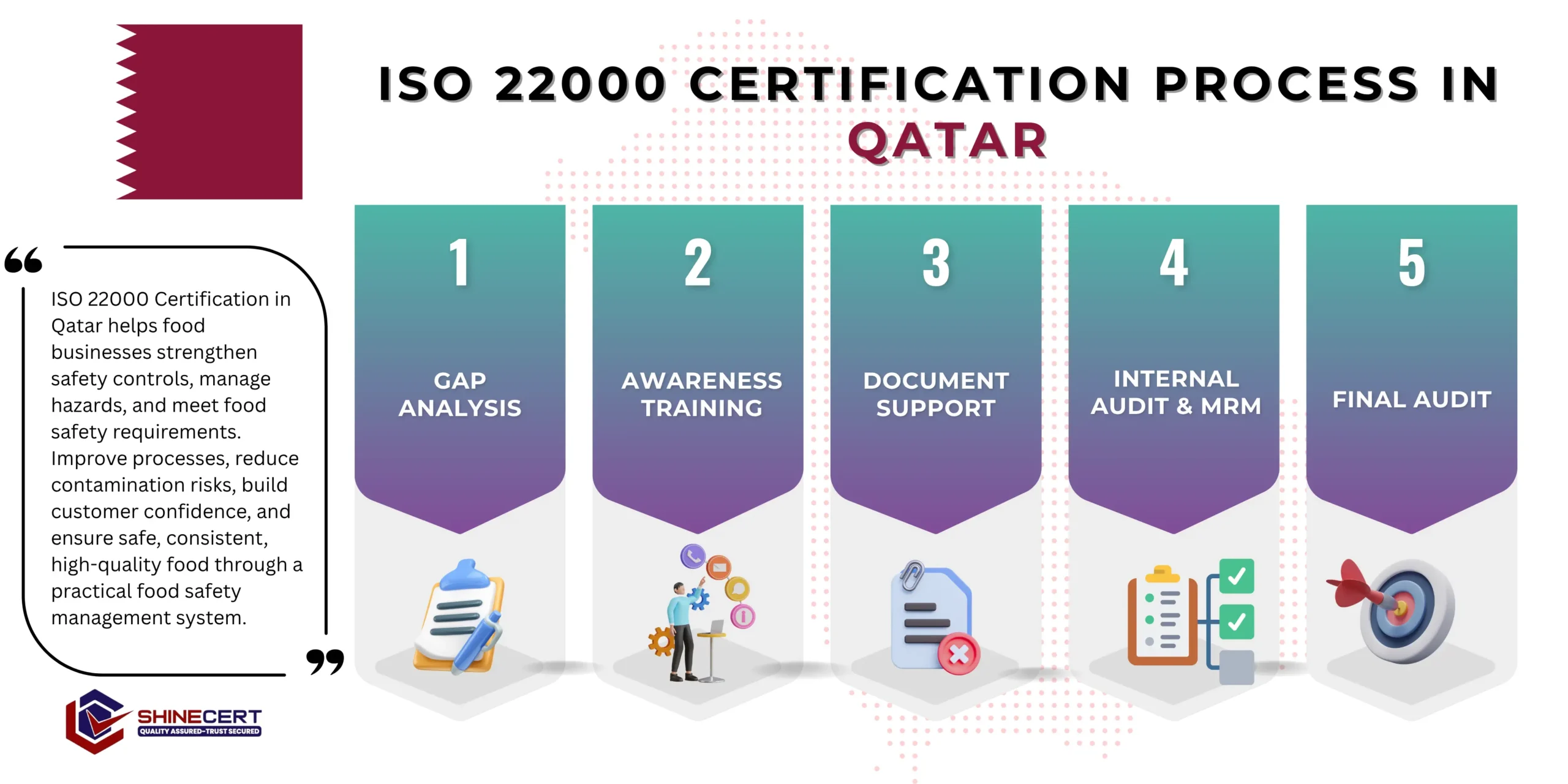
Our Five-Step ISO 22000 Certification Process
Hazard Analysis and Critical Control Point Identification
We identify your genuine food safety hazards and critical control points, calibrated to your specific position in the food chain and applicable MoPH requirements.
A hazard analysis and critical control point register, plus a regulatory compliance obligations register specific to Qatar.
Documentation Development
Your food safety policy, operational control procedures, and traceability documentation get built around your actual hazards and supply chain position, not a generic template.
A complete ISO 22000 documentation set addressing your specific hazards and Qatar regulatory obligations, including recall procedures aligned with MoPH's guide.
Implementation and Training
Operational controls roll out across your facilities, with staff trained by role on hazard-specific procedures relevant to their work in the food chain.
Training records and evidence of functioning critical control points and traceability systems.
Internal Audit and Management Review
A genuine internal audit tests whether your food safety controls actually function under real operating conditions, with findings feeding into a management review where leadership commits to specific corrective actions.
An internal audit report with real findings and management review minutes demonstrating genuine leadership engagement with food safety.
Certification Audit
We coordinate Stage 1 and Stage 2 with a GAB-accredited or GAC-recognized certification body experienced in Qatar's food safety regulatory environment.
Your ISO 22000 certificate and a clear surveillance audit schedule.
Hazard Analysis and Critical Control Point Identification
We identify your genuine food safety hazards and critical control points, calibrated to your specific position in the food chain and applicable MoPH requirements.
A hazard analysis and critical control point register, plus a regulatory compliance obligations register specific to Qatar.
Documentation Development
Your food safety policy, operational control procedures, and traceability documentation get built around your actual hazards and supply chain position, not a generic template.
A complete ISO 22000 documentation set addressing your specific hazards and Qatar regulatory obligations, including recall procedures aligned with MoPH's guide.
Implementation and Training
Operational controls roll out across your facilities, with staff trained by role on hazard-specific procedures relevant to their work in the food chain.
Training records and evidence of functioning critical control points and traceability systems.
Internal Audit and Management Review
A genuine internal audit tests whether your food safety controls actually function under real operating conditions, with findings feeding into a management review where leadership commits to specific corrective actions.
An internal audit report with real findings and management review minutes demonstrating genuine leadership engagement with food safety.
Certification Audit
We coordinate Stage 1 and Stage 2 with a GAB-accredited or GAC-recognized certification body experienced in Qatar's food safety regulatory environment.
Your ISO 22000 certificate and a clear surveillance audit schedule.
What It Costs: The Factors That Actually Drive ISO 27001 Price
- Complexity of your food chain position : Manufacturers with more processing steps and hazard points typically need more extensive hazard analysis than simpler distribution or retail operations.
- Number of sites and product lines : More facilities and more distinct products mean more hazard analysis and control documentation work.
- Existing food safety maturity : Companies with informal but functioning HACCP practices already in place need less foundational work than those building a system from scratch.
- Import complexity : Businesses managing complex international supply chains need more extensive supplier verification and traceability documentation.
- Bundling with ISO 9001 : Meaningful cost efficiency is available for companies pursuing multiple management system certifications together, given shared documentation infrastructure.
- Product range and allergen profile : Businesses handling a wide variety of ingredients, particularly common allergens, need more extensive allergen management documentation and cross-contamination control than businesses with a narrow, consistent product range.
- Quick answer : Budget QAR 18,000 to QAR 75,000, with the low end reflecting a smaller, single-site operation and the high end reflecting a larger, multi-site manufacturing or import operation.
ISO 22000 vs MoPH Routine Inspection Requirements
- These are complementary, not substitutes, and understanding the distinction helps Qatar food businesses scope their compliance approach correctly. MoPH routine and seasonal inspections check specific, real-time compliance at a given facility on the day inspectors arrive, hygiene conditions, storage temperatures, labeling, and documentation on hand. ISO 22000 certifies your organization’s broader food safety management system, the ongoing discipline of hazard analysis, control, and traceability across your operations generally, independently verified by a third-party certification body.
- We generally recommend Qatar food businesses treat ISO 22000 as the organizational backbone that makes consistently passing MoPH inspections, including surge periods like Ramadan, considerably more achievable, since a functioning food safety management system produces exactly the records, controls, and trained staff behavior that inspectors are checking for. Businesses that only prepare for inspections reactively, without an underlying certified system, tend to face more variable outcomes depending on which specific day an inspector happens to visit.
Benefits: What Certification Actually Changes
A certified food safety management system produces exactly the traceability records and incident response evidence the Food Establishments Guide for Food Recall Requirements expects across the food chain.
A functioning system genuinely reduces the likelihood of adverse findings during MoPH’s active inspection programs, including seasonal surges like the Ramadan inspection plan.
Supermarkets, hotels, and food service operators increasingly expect ISO 22000 certification from their suppliers as a baseline expectation.
Structured hazard control and traceability genuinely reduce both the likelihood of a food safety incident and how disruptive a recall becomes if one occurs.
Given Qatar’s import dependency, certified food safety management supports smoother, more trusted relationships with international food suppliers.
Companies already pursuing ISO 9001 find the shared management system structure makes ISO 22000 implementation considerably faster to build.
Mandatory Documents Required for Implementation
Genuine leadership commitment addressing your specific hazard profile and food chain position.
Documented, specific to your operations, not a generic industry template.
Documented systems tracking product movement through your operations, aligned with MoPH’s Food Establishments Guide expectations.
Documented plans for managing food safety incidents and recalls, genuinely tested where feasible.
Covering temperature control, cross-contamination prevention, and allergen management specific to your significant hazards.
Evidence of genuine, ongoing oversight.
Documented evidence of due diligence on incoming ingredients and materials, particularly important given Qatar’s import dependency.
Applicable Standards by Industry
Food Manufacturing
Beyond ISO 22000, Qatar food manufacturers typically need to demonstrate compliance with specific MoPH product registration and labeling requirements calibrated to their product category.
Read moreFood Import & Distribution
Importers face MoPH’s points-of-entry health control procedures directly, and typically need ISO 22000 alongside detailed supplier verification and customs documentation processes.
Read moreHospitality & Food Service
Hotels and restaurants increasingly pursue ISO 22000 alongside broader hospitality quality certifications, particularly given the seasonal scrutiny of MoPH’s Ramadan inspection programs.
Read moreRetail
Supermarkets and grocery operators typically need ISO 22000 alongside MoPH retail-specific food handling and storage requirements.
Read moreCatering & Events
Companies serving large gatherings, including Ramadan Iftar banquets, face particularly close MoPH seasonal inspection attention and benefit from certified, documented food safety systems.
Read moreHalal Food Producers
Many ISO 22000-certified Qatar food businesses also pursue Halal certification, since the two address genuinely different concerns, food safety hazard control versus religious compliance in sourcing and processing, and are commonly implemented together rather than treated as a single combined certification.
Read moreWhat Happens If a Recall Is Triggered Without a Traceability System in Place?
- This scenario is worth walking through directly, because it illustrates concretely why traceability isn’t a paperwork formality. Under MoPH’s Food Establishments Guide for Food Recall Requirements, when a food safety issue is identified, the responsible party in the chain, importer, manufacturer, distributor, or retailer, needs to be able to trace affected products forward and backward through the supply chain quickly and accurately. Without a genuine traceability system, this becomes a scramble: reconstructing which batches went where, often under time pressure, with incomplete records, while the food safety risk to consumers continues in the meantime.
- A certified ISO 22000 system with genuine traceability documentation turns this into a structured, rehearsed process rather than a crisis. You know precisely which batches are affected, which customers received them, and can communicate a targeted, accurate recall rather than a broader precautionary one that damages more of your business than necessary. We’ve generally found that food businesses that treat traceability as background operational discipline, tested periodically through mock recalls, handle actual incidents, when they do occur, with considerably less business disruption and reputational damage than those encountering the requirement for the first time during a live situation.
Food Safety Requirements, Clause by Clause
- Context of the Organization : Understand your genuine position in the food chain, your specific food safety hazards, and the interested parties, including MoPH and your customers, who depend on your food safety performance.
- Leadership : Top management commitment to food safety that goes beyond a signed policy, with resources genuinely allocated to hazard control and traceability, not treated as a compliance afterthought.
- Planning. A genuine hazard analysis identifying critical control points specific to your operations, plus identification of applicable MoPH requirements and any Food Establishments Guide obligations relevant to your position in the supply chain.
- Support : Competence and food safety training calibrated by role, a production line worker handling raw ingredients needs meaningfully different training than office-based quality assurance staff.
- Operation : Operational controls over your identified critical control points, temperature control, cross-contamination prevention, allergen management, documented and genuinely monitored, not just described in a procedure nobody checks.
- Performance Evaluation : Monitoring and measurement of actual food safety performance, with internal audits testing whether critical control points function as designed, including genuine verification testing where relevant.
- Improvement : A structured response to food safety incidents and nonconformities, including genuine root-cause investigation, this directly supports the traceability and recall communication mechanisms MoPH’s Food Establishments Guide now formally requires.
A Scenario: What a Ramadan Inspection Surge Looks Like for a Doha Supermarket
- Concrete examples make this easier to plan for than abstract compliance language. Picture a mid-sized Doha supermarket during Ramadan, when MoPH’s inspection plan is actively covering more than 2,000 retail outlets across the country. In the weeks before Ramadan begins, MoPH inspection teams typically increase visit frequency to supermarkets and consumer complexes specifically, checking storage temperatures for perishables, expiry date management across a higher-turnover inventory, and hygiene conditions in fresh food preparation areas, all under conditions of genuinely elevated foot traffic and inventory movement compared to the rest of the year.
- A supermarket with a certified ISO 22000 system going into this period isn’t scrambling to prepare, its critical control points for temperature monitoring and stock rotation are already documented, already staffed, and already being checked through routine internal verification, not assembled hastily for a known high-scrutiny season. Store managers can produce traceability and supplier verification records on request rather than needing to reconstruct them under time pressure. Supermarkets without this groundwork tend to treat Ramadan as an annual scramble, pulling together documentation, retraining staff on procedures they haven’t reinforced since the previous year, which is precisely the kind of reactive posture that produces inconsistent inspection outcomes. We generally recommend Qatar retailers treat the months before Ramadan as a verification period for an already-functioning system, not a build period for one that doesn’t yet exist.
Why ShineCert?
We coordinate Qatar engagements from ShineCert’s Riyadh and Lebanon offices, with direct familiarity with MoPH’s food safety framework and the practical realities of Qatar’s import-dependent food supply chain. As the best ISO 22000 consultant in Qatar, our team has guided more than 10,000 organizations through ISO certification globally.
Choosing a Certification Body in Qatar?
What to Check | Why It Matters |
GAB accreditation, or another GAC-recognized body | Confirms genuine, internationally recognized certification |
Genuine food safety and HACCP audit experience | Food safety auditing requires specific technical competence distinct from general management system auditing |
Familiarity with MoPH’s Food Establishments Guide | Helps ensure certification genuinely supports alignment with Qatar’s national recall and traceability framework |
Realistic audit scoping for multi-site or import operations | Complex supply chains typically need more thorough on-site audit attention |
Ready to Get Started?
ShineCert supports Qatar businesses end to end, from hazard analysis through certification audit, with direct experience navigating MoPH’s food safety and recall requirements. Book a free consultation or contact us directly, and we’ll review your operations before proposing a fixed-scope plan.
Frequently Asked Questions
It’s the international standard for food safety management systems, integrating HACCP principles into a structured framework for managing food safety hazards across the food chain.
Typically QAR 18,000 to QAR 75,000, depending on your operation’s complexity and number of sites.
It’s not universally legally mandatory, but it’s increasingly expected by retail, hospitality, and international supply chain partners, and it directly supports MoPH compliance readiness.
Typically two to five months.
Not by name, but a genuine ISO 22000 traceability and incident response system directly supports the recall procedures set out in MoPH’s Food Establishments Guide.
No, MoPH inspections check specific, real-time compliance at a facility, while ISO 22000 certifies your organization’s broader food safety management system, the two are complementary.
No separate preparation should be needed if your ISO 22000 system is genuinely functioning year-round, the months before Ramadan should be a verification period for existing controls, not a scramble to build documentation from scratch.
They can be implemented together for efficiency, but they remain genuinely distinct certifications, ISO 22000 addresses food safety hazard control, while Halal certification addresses religious compliance in sourcing and processing.
We coordinate Qatar engagements from our Riyadh and Lebanon offices, with consultants traveling on-site as needed.