
ISO 31000 Certification in Qatar
Quick Answer
ISO 31000 is the international guidance standard for risk management, and unlike ISO 9001 or ISO 27001, it is not a certifiable standard, no accreditation body issues an ISO 31000 certificate, and any provider claiming otherwise is misrepresenting the standard’s actual structure. In Qatar, ISO 31000’s principles have become genuinely relevant to a specific, current governance shift: the Qatar Central Bank and Qatar Financial Centre Regulatory Authority both introduced mandatory sustainability and ESG reporting requirements effective from Q1 2026, built around governance, strategy, risk management, and metrics pillars that map directly onto ISO 31000’s framework. Implementation support (not certification) typically costs QAR 15,000 to QAR 60,000 depending on organizational complexity, and takes two to four months from kickoff to a defensible, board-ready framework.
What Is ISO 31000?
ISO 31000 is the international guidance standard for risk management, first published in 2009 and updated in 2018, providing principles and a generic framework for managing risk that organizations of any type or size can adapt to their context. Unlike management system standards such as ISO 9001 or ISO 27001, ISO 31000 doesn’t specify requirements to be audited against, it offers guidance on integrating risk management into governance, strategy, planning, and operations. This distinction matters enormously in practice: ISO 31000 cannot be “certified” in the way other ISO standards can, and organizations should be skeptical of any provider offering an “ISO 31000 certificate,” since no legitimate accreditation framework issues one.
Why This Matters So Much in Qatar Specifically?
Qatar’s regulatory environment around risk management and governance has shifted concretely and recently. The Qatar Central Bank mandated that sustainability disclosures become mandatory for regulated entities starting Q1 2026, structured in line with IFRS S1 and S2 standards, requiring audited, transparent ESG data organized around four core pillars: governance, strategy, risk management, and metrics and targets. The Qatar Financial Centre Regulatory Authority introduced parallel sustainability reporting rules effective January 1, 2026, for QFC-regulated firms. The Qatar Financial Markets Authority’s governance code separately emphasizes embedding genuine risk culture, not just documented risk policy, across listed and regulated entities.
For Qatar organizations navigating these new requirements, ISO 31000’s principles-based framework offers exactly the structured approach these regulators now expect: genuine risk identification, evaluation, and treatment integrated into governance and strategy, not a standalone compliance exercise bolted onto existing operations. Because ISO 31000 isn’t certifiable, the practical value lies in genuinely implementing its principles well enough to produce the documented risk management evidence QCB and QFCRA now require, not in obtaining a credential to display.
What are the steps to get ISO 31000 Certification in Qatar?
our services
- ISO Certification Qatar
- ISO 9001 Certification Qatar
- ISO 14001 Certification Qatar
- ISO 27001 Certification Qatar
- ISO 22000 Certification Qatar
- ISO 27701 Certification Qatar
- ISO 45001 Certification Qatar
- ISO 20000-1 Certification Qatar
- ISO 13485 Certification Qatar
- ISO 17025 Certification Qatar
- ISO 31000 Certification Qatar
- ISO 42001 Certification Qatar
- ISO 37001 Certification Qatar
- ISO 22301 Certification Qatar
- ISO 50001 Certification Qatar
- CE Mark Certification Qatar
- GDPR Certification Qatar
- GMP Certification Qatar
- Halal Certification Qatar
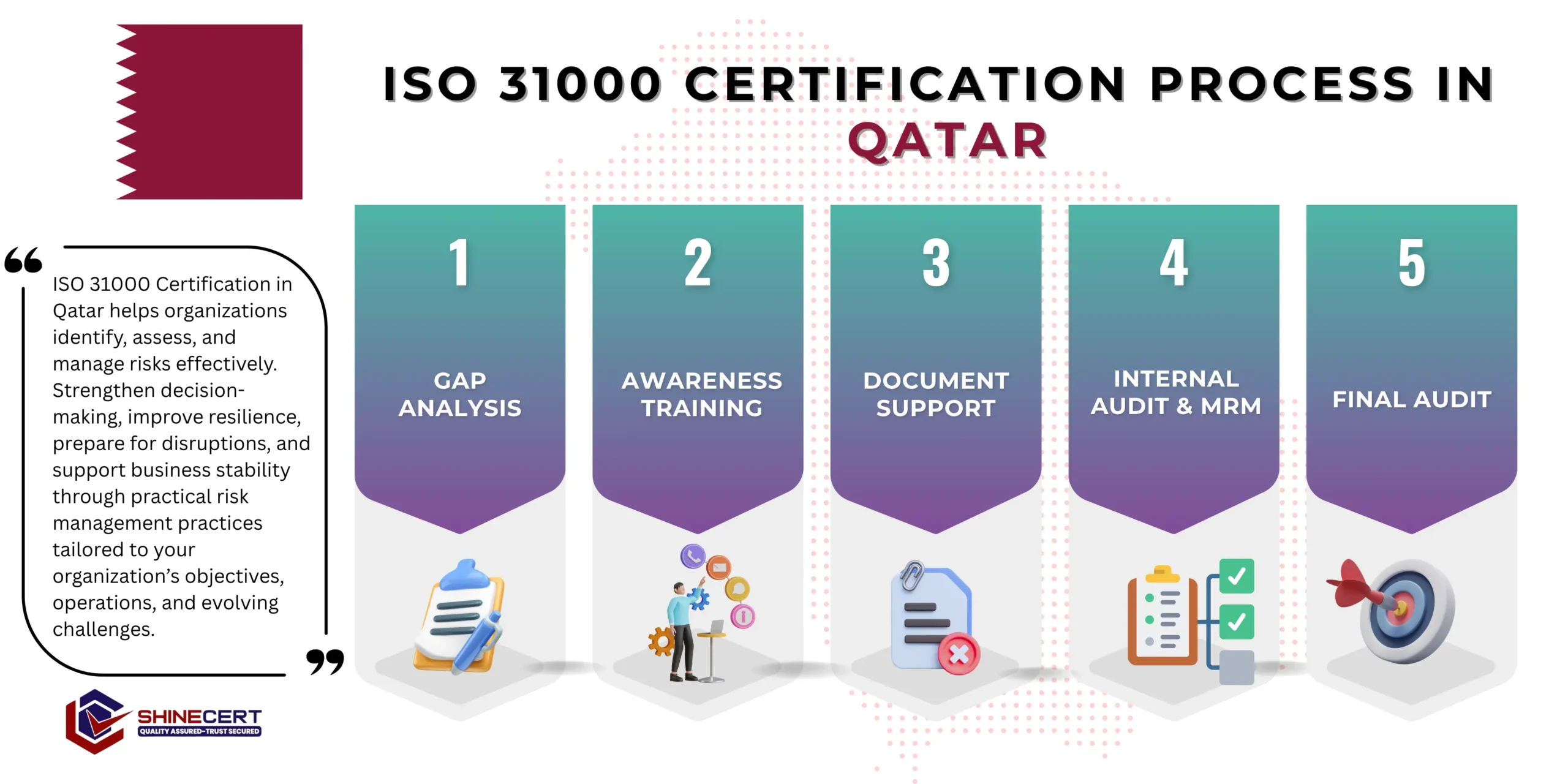
Our Five-Step ISO 31000 Certification Process
Risk Context and Framework Assessment
We assess your organization's genuine risk context, strategic, operational, financial, regulatory, and identify how your current risk practices compare to ISO 31000's principles and QCB/QFCRA's specific disclosure expectations if applicable.
A risk context assessment and gap analysis against ISO 31000 principles.
Framework Documentation Development
Your risk management policy, risk appetite statement, and framework documentation get built around your actual organizational context, not a generic template.
A complete risk management framework document set, structured to support ESG/governance disclosure requirements where relevant.
Implementation and Training
Risk identification, assessment, and treatment processes roll out across your organization, with board and management training on genuine risk oversight responsibilities.
Training records and evidence of functioning risk identification and treatment processes.
Internal Review and Management Reporting
A genuine internal review tests whether your risk management framework functions in practice, with findings feeding into board and management reporting.
An internal review report and management reporting structure demonstrating genuine risk oversight.
Ongoing Support and Conformity Review
We provide an independent conformity review confirming your framework genuinely reflects ISO 31000 principles, not a certification, since none exists, but a documented, defensible basis for your governance and disclosure reporting.
A conformity review report you can reference in board reporting, tender submissions, and regulatory disclosures.
Risk Context and Framework Assessment
We assess your organization's genuine risk context, strategic, operational, financial, regulatory, and identify how your current risk practices compare to ISO 31000's principles and QCB/QFCRA's specific disclosure expectations if applicable.
A risk context assessment and gap analysis against ISO 31000 principles.
Framework Documentation Development
Your risk management policy, risk appetite statement, and framework documentation get built around your actual organizational context, not a generic template.
A complete risk management framework document set, structured to support ESG/governance disclosure requirements where relevant.
Implementation and Training
Risk identification, assessment, and treatment processes roll out across your organization, with board and management training on genuine risk oversight responsibilities.
Training records and evidence of functioning risk identification and treatment processes.
Internal Review and Management Reporting
A genuine internal review tests whether your risk management framework functions in practice, with findings feeding into board and management reporting.
An internal review report and management reporting structure demonstrating genuine risk oversight.
Ongoing Support and Conformity Review
We provide an independent conformity review confirming your framework genuinely reflects ISO 31000 principles, not a certification, since none exists, but a documented, defensible basis for your governance and disclosure reporting.
A conformity review report you can reference in board reporting, tender submissions, and regulatory disclosures.
What It Costs: The Factors That Actually Drive ISO 31000 Price
- Organizational complexity : Larger organizations with more business lines and risk categories need more extensive framework development and risk register work.
- Regulatory disclosure obligations : QCB or QFCRA-regulated entities facing mandatory ESG disclosure need more extensive documentation aligned with IFRS S1/S2 requirements than non-regulated organizations.
- Existing risk management maturity : Organizations with informal but functioning risk practices already in place need less foundational work than those building a framework from scratch.
- Board and governance complexity : Organizations with more complex governance structures need more extensive risk reporting and oversight framework development.
- Bundling with certifiable standards : Meaningful cost efficiency is available for companies pursuing ISO 27001, ISO 9001, or ISO 45001 alongside ISO 31000 implementation, given the shared risk assessment foundation.
- Quick answer : Budget QAR 15,000 to QAR 60,000, with the low end reflecting a smaller organization without mandatory disclosure obligations and the high end reflecting a larger, QCB or QFCRA-regulated entity facing mandatory ESG reporting.
What Happens If You Skip Documented Risk Management Under the New QCB/QFCRA Rules?
- This deserves direct attention given how recently these mandates took effect. Regulated entities under QCB or QFCRA now face mandatory, IFRS S1/S2-aligned sustainability disclosure requiring genuine governance, strategy, risk management, and metrics data, not aspirational statements. Organizations without a genuinely functioning risk management framework find themselves scrambling to produce this data retroactively, often with gaps that don’t hold up under the auditor scrutiny these disclosures now require, since they’re meant to be audited, transparent data, not marketing narrative.
- We generally recommend Qatar organizations subject to these mandates treat ISO 31000 implementation as the practical foundation for compliant disclosure, rather than approaching disclosure as a standalone reporting exercise disconnected from actual risk practice. A framework built genuinely around ISO 31000’s principles produces defensible, consistent data year over year, which matters considerably once disclosures face genuine audit scrutiny rather than a one-time compliance check.
Benefits: What Certification Actually Changes
A genuinely implemented risk management framework produces exactly the governance, strategy, and risk data these mandatory disclosures require.
Structured risk management gives boards genuine visibility into organizational risk exposure, supporting the kind of authentic governance QFMA’s code expects rather than delegated, superficial compliance.
Organizations with genuine risk management integrated into planning make measurably better-informed decisions about major investments, expansions, and market entries.
A dynamic, well-implemented framework catches emerging risks earlier, before they become costly incidents requiring reactive crisis management.
Genuine, documented risk management practices increasingly matter to international investors evaluating Qatar-based partners and portfolio companies.
Companies pursuing ISO 27001, ISO 9001, or ISO 45001 find that genuine ISO 31000 principles considerably strengthen the risk assessment components those certifiable standards require.
Mandatory Documents Required for Implementation
Genuine board-level commitment to structured risk management, referencing your organization’s specific context.
Documented boundaries for acceptable risk exposure, specific to your organization, not generic industry language.
A living document tracking identified risks, their assessment, treatment, and ownership.
Documented processes for how risk information reaches the board and senior management.
Evidence of genuine, ongoing framework evaluation and improvement.
Where applicable, documentation supporting QCB or QFCRA sustainability disclosure requirements.
Applicable Standards by Industry
Financial Services
Beyond ISO 31000 principles, QCB-regulated banks and QFCRA-regulated firms now face mandatory IFRS S1/S2-aligned sustainability disclosure requiring genuine governance and risk management documentation.
Read moreListed Companies
Publicly listed entities face QFMA governance code expectations around embedded risk culture, closely aligned with ISO 31000’s inclusive and dynamic principles.
Read moreFamily-Owned Conglomerates
Qatar’s many large family-owned business groups increasingly benefit from formalized risk management frameworks addressing succession, concentration, and governance risks that don’t show up on a standard operational risk register.
Read moreGovernment-Adjacent Entities
Organizations working closely with government bodies increasingly face expectations of documented risk governance as part of broader public accountability standards.
Read moreReal Estate & Major Project Developers
Large-scale developments benefit from structured risk management addressing market, construction, and financing risk across long project timelines.
Read moreEnergy & Industrial Sector Companies
Organizations supporting Qatar’s energy sector increasingly integrate ISO 31000 principles into broader enterprise risk frameworks that already address process safety and environmental risk under ISO 14001 or ISO 45001.
Read moreISO 31000 vs Risk Clauses Within ISO 9001, ISO 14001, or ISO 45001
- It’s worth being genuinely clear about this distinction, since it’s a common point of confusion. ISO 9001, ISO 14001, and ISO 45001 each include their own risk-based thinking requirements specific to their domain, quality risk, environmental risk, occupational safety risk respectively, as part of their certifiable clause structure. ISO 31000 is the broader, non-certifiable guidance standard underlying good risk management practice generally, applicable across all risk categories, not domain-specific.
- We generally recommend organizations already implementing or certified to ISO 9001, ISO 14001, or ISO 45001 use ISO 31000’s principles to strengthen and unify the risk management approach underlying all of those domain-specific clauses, rather than treating each standard’s risk requirements as separate, disconnected exercises. Organizations that build a genuine, unified ISO 31000-aligned risk framework find their domain-specific certifiable standards become considerably easier to implement and maintain consistently, since the underlying risk thinking is shared rather than duplicated across each certification.
Risk Management Principles, Clause by Clause
- Integration : Risk management should be integrated into governance and all organizational activities, not run as a parallel, disconnected process, directly relevant to how QCB and QFCRA now expect risk management to appear within broader ESG governance reporting.
- Structured and Comprehensive : A systematic, structured approach to risk management produces consistent, comparable results, important given that QCB’s IFRS S1/S2-aligned disclosures require genuinely comparable data, not ad hoc risk commentary.
- Customized : Your risk management framework should be tailored to your organization’s genuine external and internal context, not a generic template applied uniformly regardless of your actual risk exposure.
- Inclusive : Appropriate and timely involvement of stakeholders, including board-level engagement, which QFMA’s governance code specifically emphasizes as genuine risk culture rather than delegated compliance.
- Dynamic : Risk management should anticipate, detect, and respond to change, not operate as a static annual exercise disconnected from actual emerging risks.
- Best Available Information : Risk decisions should be based on genuine, current information and data, including climate and ESG-related risk data now expected under QCB’s supervisory principles.
- Human and Cultural Factors : Genuine recognition that human behavior and culture significantly influence risk management effectiveness at every organizational level, not just documented procedures.
- Continual Improvement : Risk management capability should be continually enhanced through learning and experience, reflected in how your framework evolves as Qatar’s regulatory expectations themselves continue to evolve.
A Scenario: A QFC-Regulated Asset Manager Preparing for Its First Mandatory Disclosure
- Concrete examples clarify what genuine implementation actually looks like. Picture a mid-sized asset management firm regulated by the QFC Regulatory Authority, facing its first mandatory sustainability disclosure under the rules effective January 1, 2026. The firm’s existing risk practices were reasonably functional but informal, risk discussions happened at management meetings without systematic documentation, and there was no single risk register consolidating what the firm actually knew about its exposure across market, operational, and reputational categories.
- Building genuine ISO 31000-aligned practice meant starting with an honest risk context assessment: what does this firm’s business actually expose it to, who are the genuine stakeholders in that risk picture, and what data already exists versus what needs to be built. The firm then developed a documented risk appetite statement, a genuinely useful exercise that forced explicit board-level agreement on risk tolerances that had previously been implicit and inconsistently applied. By the time the QFCRA disclosure deadline arrived, the firm had defensible, consistent governance, strategy, and risk management data to report, rather than assembling narrative explanations under deadline pressure. Firms that treat this disclosure as a one-time reporting exercise rather than evidence of a genuinely functioning framework tend to find each subsequent year’s disclosure just as stressful as the first, since nothing structural actually changed.
Two Myths About ISO 31000 That Circulate in Qatar
- We can get ISO 31000 certified like we did with ISO 9001 : This is genuinely the most common misconception, and it’s worth restating plainly: ISO 31000 is a guidance standard with no certification scheme behind it. Any consultant or provider offering an “ISO 31000 certificate” or “ISO 31000 certification audit” is either confused about the standard’s structure or being deliberately misleading, and organizations should treat this as a genuine warning sign about that provider’s broader credibility.
- Since it’s not certifiable, it’s not really worth doing properly : This gets the logic backwards. Precisely because there’s no external certificate to display, the only reason to genuinely implement ISO 31000’s principles is that doing so actually improves your risk management and, increasingly in Qatar, produces the substantive governance and disclosure evidence QCB and QFCRA now require. Organizations that treat it as optional because it’s non-certifiable tend to discover the gap in their risk practices exactly when a mandatory disclosure deadline or a genuine risk event forces the issue.
Why ShineCert?
We coordinate Qatar engagements from ShineCert’s Riyadh and Lebanon offices, with direct familiarity with QCB and QFCRA’s 2026 governance and disclosure requirements. Our team has guided more than 10,000 organizations through ISO implementation and certification globally, and as the best ISO 31000 consultant in Qatar, we are consistently upfront when a standard, like this one, genuinely has no certification to offer.
Choosing an ISO 31000 Implementation Partner in Qatar?
What to Check | Why It Matters |
Honesty about non-certifiability | Any provider offering an “ISO 31000 certificate” is misrepresenting the standard, a red flag worth taking seriously |
Genuine experience with QCB/QFCRA disclosure requirements | Helps ensure your framework produces data that actually holds up under mandatory disclosure audit scrutiny |
Board-level governance advisory experience | Effective risk framework implementation typically requires genuine engagement at board level, not just operational staff |
Sector-specific risk category experience | Financial services, real estate, and family conglomerate risk profiles differ meaningfully from each other |
Ready to Get Started?
ShineCert supports Qatar organizations end to end, from risk context assessment through independent conformity review, with direct experience navigating QCB and QFCRA’s 2026 governance requirements and a firm commitment to never misrepresenting ISO 31000 as a certifiable standard. Book a free consultation or contact us directly, and we’ll review your risk management practices honestly before proposing a fixed-scope plan.
Frequently Asked Questions
No, ISO 31000 is a guidance standard, not a certifiable one, no accreditation body issues an ISO 31000 certificate, and providers claiming otherwise are misrepresenting the standard.
Typically QAR 15,000 to QAR 60,000, depending on organizational complexity and any mandatory disclosure obligations under QCB or QFCRA.
Yes, its principles strengthen risk management for any organization, though the urgency is highest for regulated entities facing the new 2026 mandatory disclosure requirements.
Typically two to four months.
No, it complements them, those standards include certifiable, domain-specific risk clauses, while ISO 31000 provides the broader principles underlying good risk management generally.
Certification doesn’t exist for ISO 31000, we provide implementation support and an independent conformity review, which is genuinely different from a certification audit against a certifiable standard.
No, this is a genuine warning sign, ISO 31000 has no certification scheme, and any provider claiming otherwise is misrepresenting the standard or lacks basic familiarity with it.
We coordinate Qatar engagements from our Riyadh and Lebanon offices, with consultants traveling on-site as needed.