
ISO 9001 Certification in Qatar
Quick Answer
If you’re bidding on a government tender or a major contractor’s supply chain in Qatar, there’s a good chance ISO 9001 certification is either explicitly required or quietly used as a tiebreaker between otherwise similar bidders. ISO 9001 is the world’s most widely adopted quality management standard, and in Qatar it’s certified through bodies accredited by the Global Accreditation Bureau (GAB), Qatar’s national accreditation body, or another body recognized under the new Global Accreditation Cooperation (GAC) framework that replaced the old IAF system in January 2026. Budget QAR 15,000 to QAR 55,000 depending on company size, and plan for two to four months from kickoff to certificate.
What Is ISO 9001?
ISO 9001 is the international standard for quality management systems, published by the International Organization for Standardization and first released in 1987. It sets out a framework, not a rigid checklist, for how an organization plans, controls, and continually improves the way it delivers products or services, built around the idea that consistent quality comes from consistent process, not luck or individual heroics. Any organization, in any sector and of any size, can pursue certification: it doesn’t specify what your product or service should look like, only that you have a genuine, documented, functioning system for managing how you produce it. It’s built on seven quality management principles, customer focus, leadership, engagement of people, process approach, improvement, evidence-based decision making, and relationship management, that run through every clause of the standard, and it’s structured around the Plan-Do-Check-Act cycle familiar to anyone who’s worked with a formal management system before.
A Change Worth Knowing About: IAF Doesn’t Exist Anymore
For years, “IAF-accredited” was the phrase every ISO consultant in Qatar used to signal a legitimate certificate. As of January 1, 2026, that’s technically outdated: the International Accreditation Forum (IAF) merged with the International Laboratory Accreditation Cooperation (ILAC) into a single body, the Global Accreditation Cooperation Incorporated (GAC), which now issues its own Multilateral Recognition Arrangement covering both certification and laboratory accreditation. Existing IAF-marked certificates remain valid and recognized during a phase-out transition expected to run roughly three years, so nothing you already hold becomes worthless overnight, but if a consultant in Doha is still selling you on an “IAF-accredited” certificate as if nothing changed, it’s worth asking whether they’re current on the industry’s own recent restructuring, since GAB itself now operates under this new GAC umbrella.
What are the steps to get ISO 9001 Certification in Qatar?
our services
- ISO Certification Qatar
- ISO 9001 Certification Qatar
- ISO 14001 Certification Qatar
- ISO 27001 Certification Qatar
- ISO 22000 Certification Qatar
- ISO 27701 Certification Qatar
- ISO 45001 Certification Qatar
- ISO 20000-1 Certification Qatar
- ISO 13485 Certification Qatar
- ISO 17025 Certification Qatar
- ISO 31000 Certification Qatar
- ISO 42001 Certification Qatar
- ISO 37001 Certification Qatar
- ISO 22301 Certification Qatar
- ISO 50001 Certification Qatar
- CE Mark Certification Qatar
- GDPR Certification Qatar
- GMP Certification Qatar
- Halal Certification Qatar
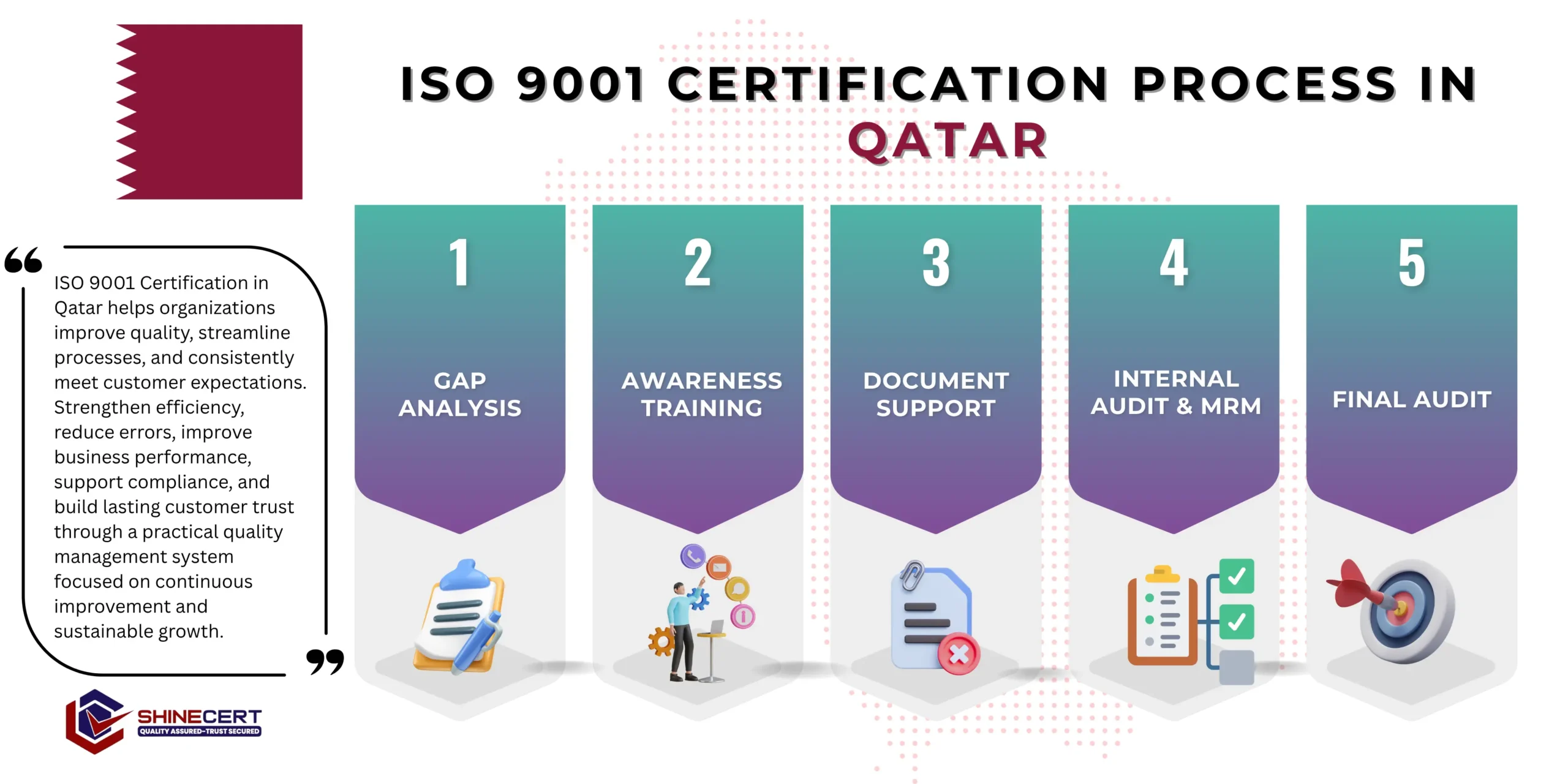
Our Five-Step ISO 9001 Certification Process
Gap Analysis
We spend real time on-site or reviewing your current operations against every ISO 9001 clause, not just a document checklist. This means talking to the people actually doing the work, project managers, site supervisors, procurement staff, to understand how things genuinely function day to day, then comparing that against what the standard requires.
A detailed gap analysis report identifying exactly what's missing, what's partially in place, and what's already working and can simply be documented as-is.
Documentation Development
Your quality manual, procedures, and required records get built around how your organization actually operates, informed directly by the gap analysis. We deliberately avoid generic templates here, a procedure describing a process you don't actually follow creates an audit liability, not a credibility asset.
A complete ISO 9001 documentation set, written in language your own staff will actually understand and use, not consultant jargon nobody references again.
Implementation and Training
This is where the system moves from paper to practice. Staff get trained by role, site supervisors need different training than procurement or admin staff, and we run the system live for a defined period before the certification audit, giving genuine time for gaps to surface and get corrected.
Training attendance records, completed internal work using the new procedures, and early evidence the system functions under real operating conditions.
Internal Audit and Management Review
Before the external auditor ever arrives, we run a genuine internal audit designed to find real problems, not confirm everything's fine. Findings feed into a management review where leadership actually engages with the results and commits to specific corrective actions.
An internal audit report with real findings, and management review minutes documenting genuine leadership engagement and decisions.
Certification Audit
We coordinate Stage 1 (documentation review and readiness assessment) and Stage 2 (the full on-site audit described above) with a GAB-accredited or GAC-recognized certification body, and we're available throughout to help interpret and respond to any findings.
Your ISO 9001 certificate, plus a clear surveillance audit schedule so you know exactly what's expected of you going forward.
Gap Analysis
We spend real time on-site or reviewing your current operations against every ISO 9001 clause, not just a document checklist. This means talking to the people actually doing the work, project managers, site supervisors, procurement staff, to understand how things genuinely function day to day, then comparing that against what the standard requires.
A detailed gap analysis report identifying exactly what's missing, what's partially in place, and what's already working and can simply be documented as-is.
Documentation Development
Your quality manual, procedures, and required records get built around how your organization actually operates, informed directly by the gap analysis. We deliberately avoid generic templates here, a procedure describing a process you don't actually follow creates an audit liability, not a credibility asset.
A complete ISO 9001 documentation set, written in language your own staff will actually understand and use, not consultant jargon nobody references again.
Implementation and Training
This is where the system moves from paper to practice. Staff get trained by role, site supervisors need different training than procurement or admin staff, and we run the system live for a defined period before the certification audit, giving genuine time for gaps to surface and get corrected.
Training attendance records, completed internal work using the new procedures, and early evidence the system functions under real operating conditions.
Internal Audit and Management Review
Before the external auditor ever arrives, we run a genuine internal audit designed to find real problems, not confirm everything's fine. Findings feed into a management review where leadership actually engages with the results and commits to specific corrective actions.
An internal audit report with real findings, and management review minutes documenting genuine leadership engagement and decisions.
Certification Audit
We coordinate Stage 1 (documentation review and readiness assessment) and Stage 2 (the full on-site audit described above) with a GAB-accredited or GAC-recognized certification body, and we're available throughout to help interpret and respond to any findings.
Your ISO 9001 certificate, plus a clear surveillance audit schedule so you know exactly what's expected of you going forward.
What It Costs: The Factors That Actually Drive ISO 9001 Price
- Company size and headcount : More employees generally means more processes to document and more people to train, which scales cost upward, though not linearly, a well-run 200-person company can sometimes cost less to certify than a chaotic 40-person one.
- Number of physical sites : Each additional site or project location typically needs its own scope consideration during the audit, adding both consulting time and certification body audit days.
- Existing process maturity : Companies with informal but genuinely functioning quality practices already in place need considerably less foundational documentation work than those starting from a completely blank slate.
- Industry complexity : Construction and industrial services companies, with their multi-layered subcontractor and procurement chains, typically need more documentation depth than a straightforward professional services firm.
- Certification body fees : These are separate from consulting fees and vary based on the certification body’s own pricing, your company’s headcount, and the number of audit days required, larger or more complex operations require more auditor time on-site.
- Bundling with other certifications : Companies pursuing ISO 9001 alongside ISO 45001 or ISO 14001 typically find meaningful cost efficiency from shared documentation infrastructure and combined audit scheduling.
Transitioning from ISO 9001:2015 to the 2026 Revision
- If your company is currently certified to ISO 9001:2015, or is about to start the certification process, it’s worth understanding what’s coming. ISO 9001:2026 is currently at Final Draft International Standard stage, with formal publication expected in September 2026. Once published, certified organizations get a three-year transition window, running to approximately September 2029, during which existing ISO 9001:2015 certificates remain fully valid, nothing about your current certificate becomes invalid the moment the new edition is published. Realistically, the first certificates actually issued against the new 2026 edition aren’t expected until Q3 2027 at the earliest, since certification bodies themselves first need to be trained and accredited to the new standard by their own accreditation bodies, a process that typically takes nine to twelve months.
- The revision itself is genuinely evolutionary rather than revolutionary, the core requirements running through Clauses 4 through 10 see only minor changes, which means companies already compliant with the 2015 edition face a comparatively light transition burden. The most substantive change is the formal integration of climate change considerations into Clause 4.1’s context-of-the-organization requirement, building on a 2024 amendment: organizations will need to genuinely assess whether climate change is relevant to their context, and if it is, integrate that into risk assessment and quality objectives rather than treating it as a separate sustainability side-project. For Qatar companies with import-dependent supply chains, this isn’t an abstract exercise, auditors will expect to see genuine planning around climate-related supply chain risk, such as alternative supplier identification or reviewed inventory buffers, not just a paragraph acknowledging the topic exists. Clause 5.1.1 also now explicitly requires top management to demonstrate a genuine quality culture and ethical behavior, and Clause 5.2 strengthens the link between the quality policy and actual business strategy, rather than allowing the policy to exist as a disconnected, generic statement.
- We generally recommend Qatar companies currently pursuing ISO 9001:2015 certification proceed as planned rather than waiting for the 2026 edition, given the multi-year transition window and the evolutionary nature of the changes, certifying now and transitioning later during a routine surveillance or recertification cycle is considerably more practical than delaying certification altogether while the new edition works through final publication.
Benefits: What Certification Actually Changes
A functioning quality system catches problems before they compound into expensive rework, particularly valuable on fixed-price construction and infrastructure contracts where rework eats directly into margin.
Government and semi-government procurement teams in Qatar increasingly use ISO 9001 as a prequalification filter, meaning certified companies get through the initial screening stage faster and face less scrutiny on basic quality capability questions.
Major contractors managing large Qatar projects prefer working with certified subcontractors specifically because it reduces their own oversight burden, a certified subcontractor is one they have to actively manage less closely.
As companies grow past the point where the founder can personally check every job, a documented quality system becomes the mechanism that keeps output consistent without that direct oversight.
Traceable, documented processes make it considerably easier to investigate and resolve disputes when they arise, rather than relying on memory and informal accounts of what happened.
Companies that later pursue ISO 45001 for safety or ISO 14001 for environmental management find the shared management system structure makes each additional certification meaningfully faster, since core elements like document control and internal audit processes transfer directly.
Mandatory Documents Required for Implementation
Genuinely specific, measurable, and known by staff, not generic language.
Precisely describing what’s covered and, importantly, what’s excluded.
Documented, specific to your operations, reviewed regularly.
Covering your core processes, calibrated to actual complexity, not padded with unnecessary detail.
A real audit schedule with genuine findings, not a formality.
Evidence leadership actually reviews performance data and makes decisions from it.
Showing root-cause investigation, not just symptom fixes.
Applicable Standards by Industry
Construction and Infrastructure
Qatar construction companies often combine ISO 9001 with QGOSM building and materials standards, client quality requirements, and ISO 45001 for safety.
Read moreEnergy and Industrial Services
Firms supporting Qatar's LNG and energy sector often need ISO 9001 alongside operator-specific quality requirements and supplier qualification audits.
Read moreGovernment and Semi-Government Contracting
ISO 9001 is the most consistently referenced quality credential across ministries and state-linked entities' prequalification criteria.
Read moreProfessional and Consulting Services
ISO 9001 alone is typically sufficient, without the additional sector-specific requirements often seen in construction and energy.
Read moreManufacturing and Industrial Production
Companies producing goods for Qatar or export often need ISO 9001 alongside QGOSM product conformity requirements for their product category.
Read moreA Day in the Life of an ISO 9001 Stage 2 Audit in Qatar
- It helps to know what actually happens on audit day, since a lot of the anxiety around certification comes from not knowing what to expect. The auditor typically arrives with an audit plan already shared in advance, covering which departments and processes they’ll sample. They’ll open with a meeting involving your management team, confirming scope and any changes since Stage 1. From there, expect a genuinely process-based walk-through: they’ll pick a live project or work order and trace it end to end, how it was planned, resourced, executed, and verified, rather than simply asking to see your procedures manual.
- They’ll interview staff directly, not just management, and they’re specifically listening for whether frontline answers match what the documentation says should happen. Internal audit records and management review minutes get reviewed closely, since these are the two areas where “paper compliance” without real substance shows up fastest. The day closes with a closing meeting summarizing findings, minor nonconformities are common and expected; major nonconformities mean a return visit before certification can be granted.
What Auditors Are Actually Checking, Clause by Clause?
- Context of the Organization. Not a formality, auditors want to see that you’ve genuinely thought through who your interested parties are (QGOSM, your major clients, Qatari joint venture partners if applicable) and scoped the certificate to match what you actually do, not an aspirational description of your business. A contracting firm that scopes its certificate to include design services it doesn’t actually perform in-house will get flagged immediately.
- Leadership. Top management needs to be able to speak to the quality policy without reading it off a wall poster. We’ve sat through Stage 2 audits in Doha where the CEO couldn’t explain a single quality objective, that’s an automatic major nonconformity, and it usually signals the whole system was built by a consultant in isolation rather than genuinely owned by the business.
- Planning. Risk-based thinking applied to your specific operating context. For Qatar contractors, this usually means supply chain risk (a lot of materials still get imported, and shipping delays are a real, recurring risk category), and labor availability risk around major project deadlines, particularly during peak construction seasons.
- Support. Competence, awareness, and communication, genuinely trained staff, not staff who attended one session two years ago and never again. This includes making sure new hires get onboarded into the quality system promptly, not left to pick it up informally from colleagues.
- Operation. Your actual operational controls: how work gets planned, executed, and verified. This is where most of the real evidence review happens during Stage 2, and it’s where auditors spend the majority of their site-visit time tracing actual work orders and project files.
- Performance Evaluation. Internal audits and management review that genuinely function, with real data driving real decisions, not a checkbox exercise completed the week before the external audit arrives.
- Improvement. Nonconformities get investigated and fixed at the root cause, not just patched at the surface, a recurring quality issue that gets “fixed” the same way three times running is itself evidence the corrective action process isn’t working.
What Happens If You Fail Stage 2
It’s worth knowing this upfront rather than discovering it mid-process: failing Stage 2 doesn’t mean starting over from zero, but it does mean a delay. Major nonconformities require documented corrective action and, typically, a focused follow-up visit to verify the fix before certification can be granted, this usually adds four to eight weeks to the timeline, depending on how substantial the finding was. Minor nonconformities are more common and don’t block certification; they simply require a documented corrective action plan submitted within an agreed timeframe, verified at the next surveillance audit. In our experience, the companies that fail Stage 2 outright are almost always the ones that skipped genuine implementation time in favor of a rushed, paper-only version of the system, which is exactly why we build a real internal audit and management review cycle into Step 4 of our process, specifically to catch these issues before the external auditor does.
Three Myths About ISO 9001 That Circulate in Doha
- ISO 9001 certification means my company is of high quality : Not quite, it means you have a functioning system for managing quality consistently, which is different from your products or services being objectively excellent. A poorly run company can still pass an ISO 9001 audit if its quality management system genuinely functions as designed, even if the underlying work itself has room for improvement.
- Once certified, I don’t need to think about it again for three years : This is a common and costly misunderstanding. Surveillance audits happen annually between the three-year recertification cycles, and a system that gets neglected between audits typically shows it clearly when the surveillance auditor arrives.
- Any consultant who promises fast certification is doing you a favor : Genuinely rushed certification, without real implementation time, tends to produce systems that look fine on paper and collapse the moment a client or government body actually scrutinizes them during a project dispute or tender challenge.
Why ShineCert?
We coordinate Qatar engagements from ShineCert’s Riyadh and Lebanon offices, with direct familiarity with QGOSM standards and GAB-accredited certification bodies operating under the new GAC framework. As the best ISO 9001 consultant in Qatar, our team has guided more than 10,000 organizations through ISO certification globally.
Choosing a Certification Body in Qatar?
What to Check | Why It Matters |
GAB accreditation, or another GAC-recognized body | Confirms your certificate carries genuine, internationally recognized weight |
Sector-relevant audit experience | Construction, energy, and professional services all carry different practical audit realities |
Realistic audit day estimates | A body quoting an unusually short audit duration for your company size is a red flag, not a bargain |
Genuine post-certification support | Surveillance audits happen annually, and you want a body that communicates clearly, not one that disappears after issuing the certificate |
Ready to Get Started?
ShineCert supports Qatar businesses end to end, from gap analysis through certification audit, with direct experience in Doha’s construction, energy, and government contracting sectors. Book a free consultation or contact us directly, and we’ll review your operations before proposing a fixed-scope plan.
Frequently Asked Questions
Typically QAR 15,000 to QAR 55,000, depending on company size, number of sites, and process maturity.
Not universally mandatory, but it’s frequently referenced in prequalification criteria and increasingly functions as a practical requirement for competitive bids.
GAB, Qatar’s national accreditation body, now operates under the new Global Accreditation Cooperation (GAC) framework that replaced IAF as of January 2026, existing certificates remain valid through a multi-year transition.
Typically two to four months, from gap analysis through certificate issuance.
No, it certifies that you have a functioning system for managing quality consistently, which is related to but distinct from the inherent quality of your output.
Yes, pursuing ISO 45001 or ISO 14001 alongside ISO 9001 typically produces meaningful savings through shared documentation infrastructure and combined audit scheduling.
Major nonconformities require documented corrective action and typically a follow-up visit, usually adding four to eight weeks; minor nonconformities don’t block certification but require a corrective action plan verified at the next surveillance audit.
It’s the international standard for quality management systems, setting out a framework for how an organization plans, controls, and continually improves the way it delivers products or services, without dictating what the product or service itself should be.
No, we generally recommend certifying now, the three-year transition window and evolutionary nature of the changes mean you can transition later during a routine surveillance or recertification cycle rather than delaying certification.
Formal publication is expected in September 2026, with a three-year transition period running to approximately September 2029; existing ISO 9001:2015 certificates remain fully valid throughout that window.
We coordinate Qatar engagements from our Riyadh and Lebanon offices, with consultants traveling on-site as needed.