
ISO 22301 Certification in Qatar
Quick Answer
ISO 22301 is the international standard for business continuity management systems, and it arrives in Qatar at a moment of genuine national emphasis on resilience, the National Cyber Security Agency launched new national cyber crisis management frameworks in September 2025 and a “Cyber Shield” critical infrastructure initiative in May 2026, both explicitly built around continuity, recoverability, and measurable readiness rather than just technical compliance. Get certified through a body accredited by the Global Accreditation Bureau (GAB) or another body recognized under the new Global Accreditation Cooperation (GAC) framework. Budget QAR 18,000 to QAR 80,000 depending on organizational complexity, and plan for three to six months from kickoff to certificate.
What Is ISO 22301?
ISO 22301 is the international standard for business continuity management systems, requiring organizations to identify potential threats to their operations and build a structured system for maintaining or rapidly resuming critical functions when disruption occurs. It covers the full continuity lifecycle: business impact analysis, risk assessment, continuity strategy development, incident response, and recovery planning, tested through genuine exercises rather than documentation that exists only on paper. Unlike disaster recovery alone, which focuses narrowly on IT systems, ISO 22301 addresses continuity of the entire organization, people, processes, facilities, and supply chains.
Why This Matters So Much in Qatar Specifically?
Qatar’s National Cyber Security Strategy 2024-2030 explicitly names resilience, coordinated response, and trusted digital growth as core priorities, with the national posture shifting deliberately toward continuity and recoverability rather than technical compliance checklists alone. The National Cyber Security Agency reinforced this with new national cyber crisis management frameworks launched in September 2025, designed to ensure the country can respond quickly to incidents, recover efficiently, and maintain uninterrupted delivery of essential services. In May 2026, the NCSA extended this further with its “Cyber Shield” initiative specifically targeting critical infrastructure sectors, and the agency has joined the international ISASecure certification program to advance industrial cyber resilience standards.
Beyond the cyber dimension, Qatar’s economy depends on genuinely uninterrupted operations in ways few countries do at this scale: the country is the world’s leading LNG exporter, and disruption to production, processing, or export logistics carries consequences that extend well beyond any single company’s balance sheet. For organizations across Qatar’s energy, financial services, and critical infrastructure sectors, ISO 22301 certification gives you a structured, independently verified way to demonstrate genuine continuity capability against this backdrop of active national resilience-building.
What are the steps to get ISO 22301 Certification in Qatar?
our services
- ISO Certification Qatar
- ISO 9001 Certification Qatar
- ISO 14001 Certification Qatar
- ISO 27001 Certification Qatar
- ISO 22000 Certification Qatar
- ISO 27701 Certification Qatar
- ISO 45001 Certification Qatar
- ISO 20000-1 Certification Qatar
- ISO 13485 Certification Qatar
- ISO 17025 Certification Qatar
- ISO 31000 Certification Qatar
- ISO 42001 Certification Qatar
- ISO 37001 Certification Qatar
- ISO 22301 Certification Qatar
- ISO 50001 Certification Qatar
- CE Mark Certification Qatar
- GDPR Certification Qatar
- GMP Certification Qatar
- Halal Certification Qatar
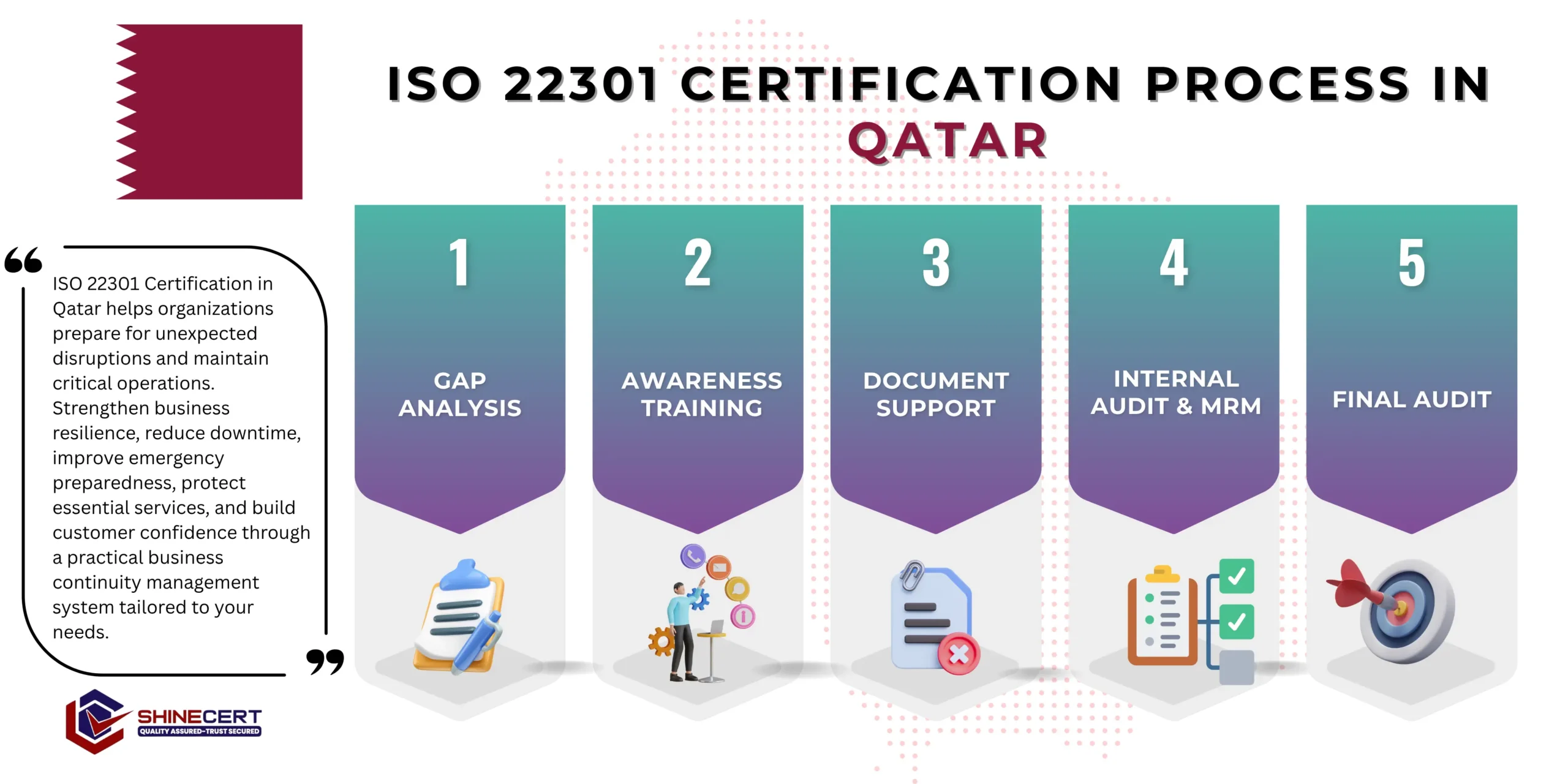
Our Five-Step ISO 22301 Certification Process
Business Impact Analysis and Risk Assessment
We identify your genuine critical functions, acceptable downtime thresholds, and the risks most relevant to your operations and Qatar's specific operating environment.
A business impact analysis and risk assessment register specific to your organization.
Documentation Development
Your business continuity policy, strategies, and incident response and recovery plans get built around your actual critical functions, not a generic template.
A complete ISO 22301 documentation set, including continuity plans for each identified critical function.
Implementation and Training
Continuity plans roll out across your organization, with staff trained by role, including genuine crisis management team training for those with defined incident roles.
Training records and evidence of functioning continuity plans and crisis management structures.
Exercise, Internal Audit, and Management Review
A genuine continuity exercise tests whether your plans function under realistic conditions, with findings feeding into a management review where leadership commits to specific plan improvements.
An exercise report with real findings and management review minutes demonstrating genuine leadership engagement with continuity readiness.
Certification Audit
We coordinate Stage 1 and Stage 2 with a GAB-accredited or GAC-recognized certification body experienced in Qatar's critical infrastructure and financial services sectors.
Your ISO 22301 certificate and a clear surveillance audit schedule.
Business Impact Analysis and Risk Assessment
We identify your genuine critical functions, acceptable downtime thresholds, and the risks most relevant to your operations and Qatar's specific operating environment.
A business impact analysis and risk assessment register specific to your organization.
Documentation Development
Your business continuity policy, strategies, and incident response and recovery plans get built around your actual critical functions, not a generic template.
A complete ISO 22301 documentation set, including continuity plans for each identified critical function.
Implementation and Training
Continuity plans roll out across your organization, with staff trained by role, including genuine crisis management team training for those with defined incident roles.
Training records and evidence of functioning continuity plans and crisis management structures.
Exercise, Internal Audit, and Management Review
A genuine continuity exercise tests whether your plans function under realistic conditions, with findings feeding into a management review where leadership commits to specific plan improvements.
An exercise report with real findings and management review minutes demonstrating genuine leadership engagement with continuity readiness.
Certification Audit
We coordinate Stage 1 and Stage 2 with a GAB-accredited or GAC-recognized certification body experienced in Qatar's critical infrastructure and financial services sectors.
Your ISO 22301 certificate and a clear surveillance audit schedule.
What It Costs: The Factors That Actually Drive ISO 22301 Price
- Number and complexity of critical functions : Organizations with more critical functions requiring individual continuity plans need more extensive business impact analysis and plan development.
- Number of sites and geographic spread : Multi-site organizations need continuity plans addressing site-specific risks and potential relocation or failover scenarios.
- Existing continuity maturity : Companies with informal but functioning continuity practices already in place need less foundational work than those building a system from scratch.
- Exercise complexity : More sophisticated exercise programs, including full-scale simulations rather than tabletop discussions, add to implementation cost but produce considerably more valuable readiness evidence.
- Bundling with ISO 27001 : Meaningful cost efficiency is available for companies pursuing multiple management system certifications together, given shared risk and incident response infrastructure.
- Supply chain complexity : Organizations with more extensive supplier networks, particularly those dependent on international vendors, need more thorough supply chain risk assessment and contingency planning.
- Quick answer : Budget QAR 18,000 to QAR 80,000, with the low end reflecting a smaller, single-site operation and the high end reflecting a larger, multi-site critical infrastructure or financial services organization.
A Scenario: How an LNG Support Contractor Might Handle a Genuine Supply Chain Disruption
- Concrete examples clarify what genuine continuity capability looks like in practice. Picture a mid-sized contractor providing logistics and maintenance support to Qatar’s LNG export operations, facing an unexpected disruption to a key supplier, a critical equipment vendor overseas suddenly unable to fulfill orders due to circumstances entirely outside the contractor’s control. Without a tested continuity plan, the contractor’s response would likely be improvised: scrambling to identify alternative suppliers, negotiating expedited terms under pressure, and communicating uncertainty to the client rather than a clear recovery timeline.
- A contractor with a genuinely implemented ISO 22301 system approaches this differently, because supply chain dependency risk was already identified during business impact analysis, and alternative supplier relationships or safety stock strategies were already established as part of the continuity plan for that specific critical function. The crisis management team already knows who makes the call on activating contingency suppliers, and client communication protocols are already defined rather than improvised. Given how directly Qatar’s LNG export continuity matters to the national economy, contractors who can demonstrate this kind of genuine, tested resilience increasingly find it becomes a meaningful factor in how major operators evaluate long-term contractor relationships, not just a compliance checkbox.
Benefits: What Certification Actually Changes
A certified business continuity management system produces exactly the recoverability and readiness evidence NCSA’s crisis management frameworks and Cyber Shield initiative are built around.
A functioning continuity system genuinely reduces both the likelihood of extended outages and their financial and reputational cost when disruptions occur.
Energy, financial services, and infrastructure project owners increasingly expect demonstrable business continuity capability from contractors and partners.
Structured continuity planning extends to supplier and partner dependencies, reducing the risk that a third-party disruption becomes your disruption too.
Certified business continuity management increasingly matters to international partners and can favorably affect business interruption insurance terms.
Companies already pursuing ISO 27001 find the shared risk and incident response infrastructure makes ISO 22301 implementation considerably faster to build.
Mandatory Documents Required for Implementation
Genuine leadership commitment addressing your specific critical functions and risk profile.
Documented, specific to your operations, identifying critical functions and acceptable downtime thresholds.
Documented threats to continuity specific to your operations and Qatar’s operating environment.
Documented response and recovery procedures for each identified critical function.
Documented plans for incident escalation and stakeholder communication during disruption.
Evidence of genuine, periodic testing, not just documented plans that have never been exercised.
Evidence of genuine, ongoing oversight.
Applicable Standards by Industry
Energy and LNG
Beyond ISO 22301, Qatar energy companies typically need to demonstrate compliance with NCSA’s critical infrastructure resilience expectations, including the “Cyber Shield” initiative’s specific requirements for the sector.
Read moreFinancial Services
Banks and QFC-regulated firms typically need ISO 22301 alongside QCB or QFCRA-specific operational resilience expectations, given the systemic importance of continuous financial services availability.
Read moreGovernment-Adjacent Contractors
Vendors supporting government and critical infrastructure operations face the most direct exposure to NCSA’s national crisis management framework expectations.
Read moreHealthcare
Hospitals and healthcare providers need ISO 22301 alongside Ministry of Public Health continuity requirements specific to maintaining patient care during disruptions.
Read moreLogistics and Transportation
Companies supporting Qatar’s import-dependent supply chains need continuity planning addressing points-of-entry disruption and alternative logistics routing.
Read moreHospitality and Major Events
Hotels and event venues need continuity plans addressing large-gathering-specific risks, particularly given Qatar’s continued role hosting major international events and the operational scrutiny that comes with it.
Read moreWhat Happens When a Crisis Hits an Organization Without a Tested Continuity Plan?
- This is worth walking through concretely, because the gap between “having a plan” and “having a tested plan” only becomes visible during an actual incident. Organizations with a documented but never-exercised continuity plan typically discover, mid-crisis, that key contact information is outdated, that the designated crisis team members are unavailable or unclear on their roles, or that the recovery procedures assume resources or access that aren’t actually available under real disruption conditions. NCSA’s own crisis management frameworks are explicitly built around measurable readiness, not just documentation existing somewhere in a folder.
- Organizations with a genuinely tested plan, by contrast, have already discovered and fixed these gaps during a controlled exercise, when the stakes are low, rather than during a live incident when they’re high. We’ve generally found that the difference between organizations that recover quickly from genuine disruptions and those that struggle for weeks isn’t the sophistication of their written plan, it’s whether that plan was ever actually tested against realistic conditions before it was needed for real.
Business Continuity Requirements, Clause by Clause
- Context of the Organization : Understand your genuine critical functions, dependencies, and the interested parties, regulators including NCSA, customers, supply chain partners, who depend on your continuity.
- Leadership : Top management commitment to business continuity that goes beyond a signed policy, with resources genuinely allocated to continuity planning and testing, not treated as a compliance afterthought.
- Planning : A genuine business impact analysis identifying your critical functions and acceptable downtime thresholds, plus risk assessment addressing threats specific to your operations and Qatar’s operating environment.
- Support : Competence and business continuity training calibrated by role, crisis management team members need meaningfully different training than general staff following evacuation or continuity procedures.
- Operation : Business continuity strategies and plans for your identified critical functions, documented and genuinely tested through exercises, not just written and filed away.
- Performance Evaluation : Monitoring and measurement of continuity readiness, with internal audits and genuine exercises testing whether plans function under realistic conditions, not just tabletop discussions.
- Improvement : A structured response to continuity incidents and exercise findings, including genuine root-cause investigation and plan updates, an exercise that reveals gaps and produces no changes defeats its own purpose.
ISO 22301 vs. NCSA’s National Cyber Crisis Management Frameworks
- These are complementary, not substitutes, and understanding the distinction helps Qatar organizations scope their resilience investment correctly. NCSA’s national frameworks operate at a country level, coordinating cross-sector response to major cyber incidents and ensuring essential services continue nationally. ISO 22301 certifies your organization’s own business continuity management system, the ongoing discipline of identifying your critical functions and maintaining your specific capability to continue operating or recover quickly, independently verified by a third-party certification body.
- We generally recommend Qatar organizations treat ISO 22301 as the organizational-level foundation that makes your business a genuinely resilient participant in Qatar’s broader national crisis response, rather than a weak link that struggles regardless of how well NCSA’s national coordination functions. Organizations with strong individual continuity capability contribute to genuine national resilience; organizations relying entirely on external coordination without their own tested plans remain vulnerable regardless of national-level frameworks.
Three Myths About Business Continuity in Qatar
- We have cloud backups, so we already have business continuity covered : Backups address data recovery, one narrow piece of continuity. Genuine business continuity also covers alternative facilities, staffing plans, supplier contingencies, and crisis communication, a company can have flawless backups and still fail to resume operations if these other elements aren’t planned and tested.
- Business continuity is really just an IT department responsibility : This significantly undersells the standard’s scope. Genuine continuity planning requires business unit leaders identifying their own critical functions and acceptable downtime, not IT staff guessing at organizational priorities from outside those business units.
- Since Qatar’s infrastructure is generally reliable, we’re at low risk anyway : Reliable infrastructure reduces certain risks but doesn’t eliminate supply chain disruption, cyber incidents, or the kind of external shocks NCSA’s own national frameworks are explicitly built to prepare for, genuine national infrastructure quality and organizational continuity planning address different risk categories entirely.
Keeping Certification Current: Surveillance and Recertification
ISO 22301 certification isn’t a one-time achievement, certification bodies conduct annual surveillance audits to confirm your continuity management system remains active and genuinely tested, not shelved after the initial certificate is issued. A full recertification audit follows at the three-year mark, reviewing your entire system rather than the sampled elements a surveillance audit typically covers. Organizations that treat these ongoing audits as a genuine opportunity to refine their continuity plans, rather than a box-ticking formality, tend to get considerably more operational value from certification over time, since each exercise and audit cycle surfaces gaps that a static, unexamined plan never would.
Why ShineCert?
We coordinate Qatar engagements from ShineCert’s Riyadh and Lebanon offices, with direct familiarity with NCSA’s crisis management frameworks and the practical realities of maintaining continuity in Qatar’s energy and financial services sectors. Our team has guided more than 10,000 organizations through ISO certification globally, and as the best ISO 22301 consultant in Qatar, we build every continuity system around your organization’s actual critical functions rather than adapting a generic template to fit.
Choosing a Certification Body in Qatar?
What to Check | Why It Matters |
GAB accreditation, or another GAC-recognized body | Confirms genuine, internationally recognized certification |
Genuine business continuity and crisis management audit experience | Continuity auditing requires distinct competence in exercise evaluation, not just documentation review |
Familiarity with NCSA’s crisis management framework | Helps ensure certification genuinely supports alignment with Qatar’s national resilience direction |
Experience evaluating genuine exercises, not just plan documentation | The most meaningful audit evidence comes from how your organization performs during a tested exercise |
Ready to Get Started?
ShineCert supports Qatar businesses end to end, from business impact analysis through certification audit, with direct experience navigating NCSA’s crisis management and critical infrastructure resilience expectations. Book a free consultation or contact us directly, and we’ll review your operations before proposing a fixed-scope plan.
Frequently Asked Questions
It’s the international standard for business continuity management systems, requiring organizations to identify critical functions and build a structured system for maintaining or resuming operations during disruption.
Typically QAR 18,000 to QAR 80,000, depending on organizational complexity and number of sites.
It’s not universally legally mandatory, but it’s increasingly expected in energy, financial services, and critical infrastructure sectors given NCSA’s active resilience push.
Typically three to six months.
No, they’re complementary, NCSA’s frameworks coordinate national-level response, while ISO 22301 certifies your organization’s own continuity capability.
Disaster recovery typically focuses narrowly on IT systems, while ISO 22301 addresses continuity of the entire organization, including people, processes, facilities, and supply chains.
No, backups address only data recovery, genuine continuity also covers facilities, staffing, suppliers, and crisis communication.
No, effective planning requires business unit leaders identifying their own critical functions, not IT staff working in isolation.
Yes, and we generally recommend it where both are relevant, since business continuity and information security share overlapping risk assessment, incident response, and management review infrastructure, meaning a combined audit program typically costs less and takes less staff time than running the two certifications on entirely separate schedules.
We coordinate Qatar engagements from our Riyadh and Lebanon offices, with consultants traveling on-site as needed.