
ISO Certification in Qatar
Quick Answer
ISO 9001 is the standard most Qatari businesses need first, since it’s checked routinely by Qatar’s government procurement channels and by the major contractors managing Qatar National Vision 2030-linked developments. Add ISO 45001 if you’re in construction or industrial work, and ISO 27001 if you handle financial or personal data. Look for certification bodies registered with the Qatar General Organization for Standardization (QGOS) and accredited by an IAF member such as the Gulf Accreditation Center (GAC) or Qatar’s own national accreditation function. Budget roughly QAR 20,000 to QAR 90,000 for a single standard at a small or mid-sized company, and expect three to six months from kickoff to certificate.
Why Certification Matters for Qatari Businesses Right Now?
Qatar’s post-World Cup infrastructure economy didn’t simply pause once the tournament ended, it redirected. Qatar National Vision 2030’s four pillars (human, social, economic, and environmental development) continue to drive a steady pipeline of construction, logistics, and technology investment, and the contractors and government entities managing that pipeline have carried forward the international-standard expectations they adopted during the World Cup buildout. A construction firm or supplier that could win work on relationships and local reputation alone a decade ago increasingly finds that Qatari and multinational main contractors now expect the same documented quality and safety systems they’d require anywhere else in the world.
Government procurement reinforces this directly. Public tenders increasingly reference ISO 9001 as a prequalification criterion rather than a scoring bonus, and Qatar’s push to diversify its economy beyond hydrocarbons, into logistics, financial services, and technology, has broadened which sectors feel this pressure well beyond the traditional construction and industrial base.
Qatar’s Standards and Accreditation Landscape
Two organizations matter most. The Qatar General Organization for Standardization (QGOS) is Qatar’s national standards authority, it adopts national and regional standards, regulates conformity assessment activity, and maintains the register of certification bodies and management consultancy firms approved to operate in Qatar. Accreditation, meanwhile, runs through Qatar’s national accreditation function under the Ministry of Commerce and Industry, alongside recognition from the Gulf Accreditation Center (GAC), the regional GCC accreditation body that many certification bodies operating in Qatar hold alongside broader IAF membership through bodies like UKAS or DAkkS.
For a Qatari business, the practical takeaway is to confirm two things before signing with a certification body: that it appears on QGOS’s approved register, and that its accreditation traces back to a recognized IAF MLA signatory, whether that’s GAC, Qatar’s own national accreditation body, or an internationally recognized alternative. A certificate missing either link can create real friction during a government tender evaluation, even if the underlying management system work was done well.
Beyond QGOS, sector regulators shape how certification gets applied. The Ministry of Public Health references food safety and quality frameworks in facility licensing; Qatar Central Bank’s operational resilience expectations for financial institutions overlap significantly with ISO 27001’s control structure; and Ashghal, Qatar’s Public Works Authority, maintains its own registered certification body list for infrastructure contractors.
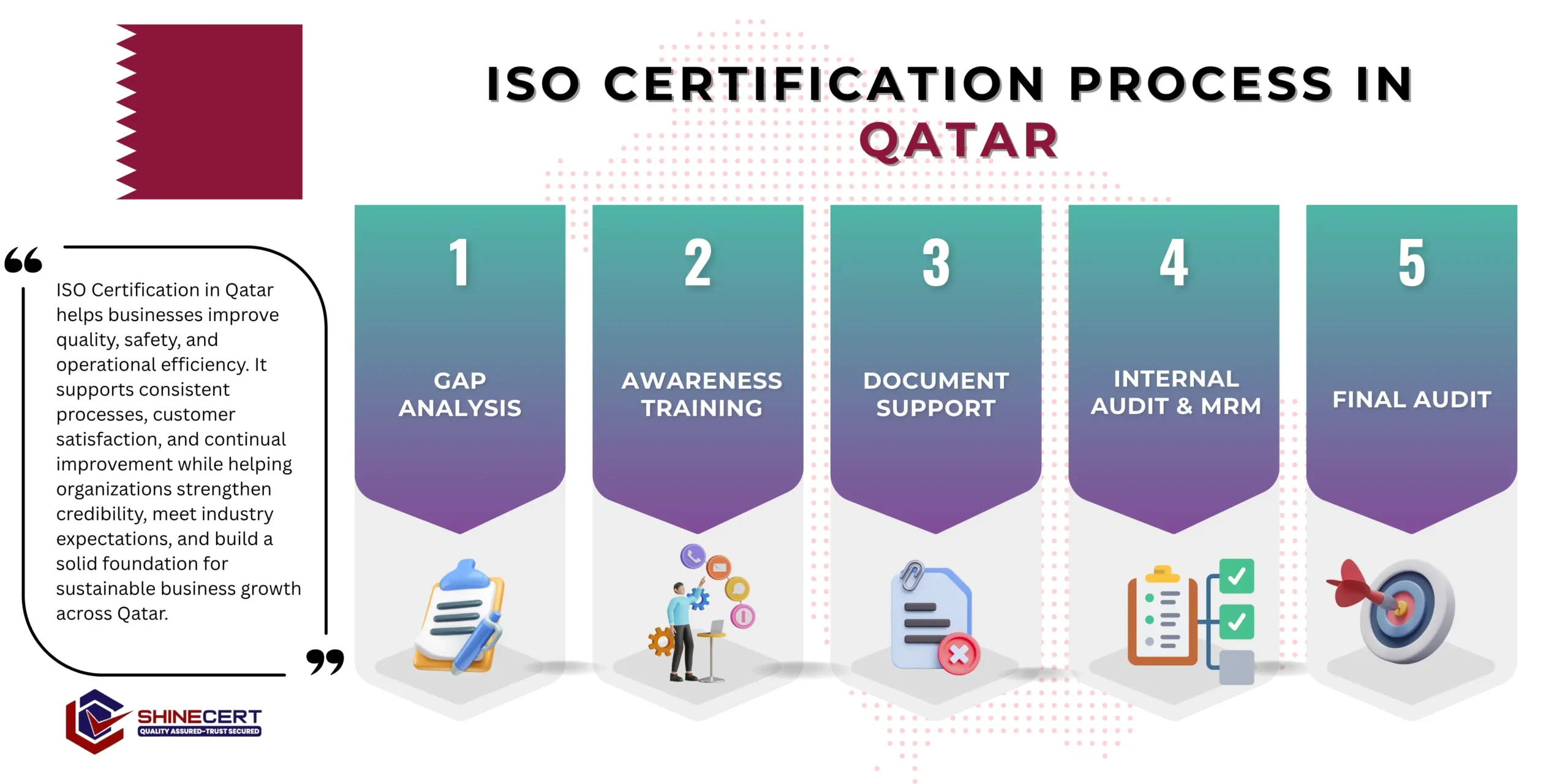
What are the steps to get ISO Certification in Qatar?
our services
- ISO Certification Qatar
- ISO 9001 Certification Qatar
- ISO 14001 Certification Qatar
- ISO 27001 Certification Qatar
- ISO 22000 Certification Qatar
- ISO 27701 Certification Qatar
- ISO 45001 Certification Qatar
- ISO 20000-1 Certification Qatar
- ISO 13485 Certification Qatar
- ISO 17025 Certification Qatar
- ISO 31000 Certification Qatar
- ISO 42001 Certification Qatar
- ISO 37001 Certification Qatar
- ISO 22301 Certification Qatar
- ISO 50001 Certification Qatar
- CE Mark Certification Qatar
- GDPR Certification Qatar
- GMP Certification Qatar
- Halal Certification Qatar
ShineCert’s Certification Process in Qatar
Gap Analysis
We review your current operations against your target standard on-site, and separately map how QGOS, Ashghal, or Ministry of Public Health requirements intersect with your specific sector.
Documentation Development
We build management system documentation with your team, typically bilingual in Arabic and English, so it works equally for your day-to-day Qatari workforce and for international auditors or partners.
Implementation and Training
We train staff using practical, scenario-based sessions rather than a policy walkthrough, with particular attention to construction and industrial clients where safety training needs to translate into genuine on-site behavior change, not just signed attendance sheets.
Internal Audit and Management Review
We run a genuinely rigorous internal audit before any external certification body sees your system, followed by a formal management review where leadership commits to real corrective action.
Certification Audit
We coordinate Stage 1 and Stage 2 audits with a QGOS-registered, IAF-recognized certification body, support your team through the audit process, and set up ongoing surveillance so your system doesn't quietly lapse after certification.
Certification Cost in Qatar
Expect somewhere between QAR 20,000 and QAR 90,000 for a single standard at a small or mid-sized company. Company size and site count are the biggest cost drivers, since audit duration is calculated largely from headcount and number of locations. Sector risk profile matters too, a construction or industrial operator managing safety-critical sites costs more to certify than a low-risk professional services firm of similar size. Existing documentation maturity shifts cost meaningfully as well: a company that’s informally followed sound practice for years moves through gap closure faster than one starting from nothing. Pursuing ISO 9001 and 45001 together, common for Qatari construction and industrial clients, is consistently more efficient than running them as separate projects, since a meaningful share of the audit and documentation work overlaps.
Benefits of ISO Certification in Qatar
- Prequalification access : Certification increasingly determines whether a bid gets evaluated at all in Ashghal and broader government tenders, not just how it scores.
- Credibility with international partners : For Qatari businesses working with multinational contractors or investors, a recognized certificate shortcuts due diligence conversations considerably.
- Operational consistency during growth : Businesses scaling alongside Vision 2030-linked demand often need the structural discipline certification imposes once informal processes stop holding up at scale.
- A defensible data security position : ISO 27001 gives Qatari financial and technology firms a structured way to demonstrate security maturity to regulators and increasingly security-conscious clients.
- Fewer safety incidents and less liability exposure : For construction and industrial operators, structured safety management under ISO 45001 reduces both incident rates and the costly disruptions that follow them.
- A genuine competitive edge : In Qatar’s construction and industrial sectors, where competition for large contracts is intense, certification is one of the few objectively verifiable differentiators available.
- Consolidated regulatory tracking : Folding QGOS, Ashghal, and Ministry of Public Health requirements into one system reduces the odds an overlooked requirement becomes an expensive surprise later.
- International recognition beyond Qatar : For Qatari businesses with regional or global ambitions, an IAF-recognized certificate reads the same to a buyer in Europe as it does locally.
A Word on Multi-Site and Group Company Certification
- Larger Qatari business groups with multiple operating entities under one parent structure, common across the construction, trading, and hospitality conglomerates that dominate much of Doha’s private sector, often ask whether they need separate certificates for each subsidiary or can certify under one group scope.
- The honest answer depends on how genuinely integrated the management systems are across entities: a group with shared quality procedures, shared leadership oversight, and centralized document control can often pursue a single multi-site certificate covering several locations or subsidiaries, which is meaningfully more cost-efficient than certifying each entity separately. Where subsidiaries operate with genuinely independent management systems and different leadership, separate certificates usually make more sense despite the added cost, since a shared certificate implies a level of operational integration that auditors will specifically test for during the certification audit. We assess this honestly during gap analysis rather than defaulting to whichever structure is more profitable for us to sell.
ISO Standards Most Relevant to Qatar
ISO 9001 Quality Management
The starting point for nearly every Qatari business pursuing government or large contractor work, since it’s the standard checked first in most prequalification processes. Holding it early signals reliability to procurement teams and helps companies move smoothly through tender evaluations.
ISO 14001 Environmental Management
Qatar’s environmental sustainability strategy and the LNG and petrochemical sector’s own environmental commitments have pushed certification expectations into supplier chains around Ras Laffan and Mesaieed industrial cities, making compliance a practical requirement for smaller suppliers.
ISO 45001 Occupational Health and Safety
With infrastructure and industrial projects continuing under Qatar National Vision 2030, safety certification has become close to mandatory for contractors bidding on larger developments, particularly those tied to Ashghal’s registered contractor requirements, and it increasingly influences which firms win major awards.
ISO 27001 Information Security Management
Qatar Central Bank’s cybersecurity expectations for financial institutions, and Qatar’s growing fintech and government digital services sector, have made this an increasingly common requirement for vendors handling sensitive data, particularly where client records, payments, or national digital platforms are involved.
ISO 22000 Food Safety Management
Ministry of Public Health food safety expectations and Qatar’s food security strategy, developed in response to past regional supply disruptions, have made this relevant for food manufacturers, importers, and hospitality operators serving Doha’s hospitality sector.
ISO 41001 Facility Management
Qatar’s substantial stock of World Cup-era stadiums, hotels, and mixed-use developments has created real demand for structured facility management, particularly for operators managing large multi-tenant properties, including hospitality and retail.
ISO 13485 Medical Devices Quality Management
Qatar’s healthcare expansion under Vision 2030’s social development pillar has created demand among device suppliers and facility vendors for quality certification aligned with Ministry of Public Health expectations.
ISO 50001 Energy Management
Kahramaa’s efficiency initiatives and Qatar’s broader environmental development pillar have started pulling larger energy consumers, particularly in hospitality and industrial operations, toward formal energy management systems, while cutting operating costs.
Qatar’s Retail and Consumer Sector
- Doha’s retail and consumer goods sector has grown considerably alongside Qatar’s broader economic diversification, with shopping destinations and mixed-use developments expanding well beyond what the World Cup buildout originally required.
- Retailers and distributors increasingly find that major mall operators and government-linked landlords expect ISO 9001 as part of tenant vendor standing, particularly for larger retail groups managing multiple locations across Doha and beyond. This mirrors a pattern we see across the GCC more broadly: as retail infrastructure matures past its initial construction phase, quality expectations shift from the developers themselves onto the tenants and suppliers operating within that infrastructure.
Common Challenges in Qatar
- Certification bodies that are QGOS-registered but not IAF-accredited internationally : Both matter for different reasons; missing either can create friction depending on who’s evaluating your certificate.
- Documentation that hasn’t kept pace with post-World Cup growth : Many Qatari businesses scaled quickly during the tournament buildout and haven’t revisited processes written for a much smaller operation.
- Treating safety training as a compliance formality : Ashghal-registered projects in particular expect genuine behavioral change on-site, not just signed training records.
- Assuming government sector demand alone justifies certification : Qatar’s diversification push means private-sector buyers, particularly in finance and technology, are starting to expect it too.
A Note on Sustaining Certification After the Initial Push
- One pattern we see often enough to flag directly: a Qatari business invests real effort in the initial certification push, often motivated by a specific tender deadline or a new contractor relationship, earns the certificate, and then treats the management system as finished rather than ongoing. Surveillance audits, typically conducted annually by your certification body, exist precisely to catch the natural drift that happens when day-to-day pressure pulls attention away from documented processes.
- We build surveillance planning into every Qatar engagement from the start rather than leaving clients to figure out renewal logistics on their own a year later, since a lapsed or suspended certificate right before a major tender deadline is a genuinely avoidable problem that we’ve seen catch out businesses working with less proactive consultancies.
Industries We Support in Qatar
Construction and Infrastructure
Ongoing Vision 2030-linked development across Doha, Lusail, and beyond continues to drive demand for ISO 9001 and 45001 among contractors and subcontractors on Ashghal-registered projects.
Read moreOil, Gas, and Petrochemicals
Ras Laffan and Mesaieed’s industrial base still drives significant demand for ISO 9001, 14001, and 45001 among equipment suppliers, engineering firms, and service contractors.
Read moreHospitality and Facility Management
Doha’s substantial World Cup-era hotel and stadium infrastructure has created steady demand for ISO 41001 and ISO 22000 among facility operators and food service providers.
Read moreFinancial Services and Technology
Qatar’s push to diversify beyond hydrocarbons has grown its financial services and fintech sector, where ISO 27001 has become close to a standard vendor expectation.
Read moreHealthcare
Vision 2030’s social development pillar continues to drive hospital and clinic investment, with ISO 13485 relevant for device suppliers and quality frameworks relevant for facility operators.
Read moreISO Certification Timeline in Qatar
Phase | Typical Duration |
Gap analysis | 2–4 weeks |
Documentation development | 5–7 weeks |
Implementation and training | 4–7 weeks |
Internal audit and management review | 1–2 weeks |
Certification audit (Stage 1 + Stage 2) | 3–4 weeks |
Total, single standard | 3–6 months |
Qatar’s Financial Free Zone and Digital Economy Push
- The Qatar Financial Centre (QFC) has spent the past several years actively courting international financial and professional services firms with tax and regulatory advantages designed to compete directly with hubs like DIFC in Dubai. That competition works in certification’s favor: firms setting up within QFC increasingly find that ISO 27001 certification, and in some cases ISO 22301, functions as a credibility shortcut when courting regional clients who are comparing a new QFC entrant against more established Gulf financial centers with longer track records.
- Qatar’s Ministry of Communications and Information Technology has also pushed a broader national digital transformation agenda that touches government service delivery and encourages private sector vendors serving government digital initiatives to demonstrate structured information security practices, adding another practical use case for certification beyond the traditional construction and industrial demand this market is best known for.
Where We Support Clients in Qatar?
We coordinate Qatar engagements from ShineCert’s Riyadh and Lebanon offices, with consultants traveling to Doha, Lusail, Al Wakrah, and Qatar’s broader industrial cities for on-site gap analysis, training, and audit support.
Choosing a Certification Body in Qatar?
What to Check | Why It Matters |
QGOS registration | Confirms the certification body is recognized under Qatar’s own conformity assessment framework |
GAC or other IAF MLA accreditation | Ensures the certificate carries genuine international recognition, not just local registration |
Experience with Ashghal-registered contractor requirements | Matters directly for construction and infrastructure clients |
Arabic-English bilingual audit capability | Reduces friction for Qatari workforces and local regulator interactions |
Why Choose ShineCert in Qatar?
We manage the full certification journey, gap analysis through certification audit, for Qatari businesses across construction, industrial, hospitality, and financial services sectors. Our team has guided more than 10,000 organizations through international certification, with ShineCert as the best ISO consultant in Qatar and specific familiarity in Qatar’s QGOS registration requirements and Ashghal contractor expectations that a generalist consultancy often misses.
Start Your ISO Certification Journey in Qatar
ShineCert supports Qatari businesses through every stage of ISO certification, from gap analysis to certificate issuance. Book a free consultation or contact us directly, and we’ll review your sector, target standard, and Ashghal or QGOS-specific requirements before proposing a fixed-scope plan.
Frequently Asked Questions
Typically QAR 20,000 to QAR 90,000 for a single standard at a small or mid-sized company, covering consulting and certification body audit fees.
No, it’s voluntary outside specific regulated sectors, though Ashghal-registered infrastructure projects and broader government tenders increasingly treat it as a prerequisite.
QGOS registration confirms recognition under Qatar’s national framework; IAF accreditation (through GAC or another signatory) confirms international recognition, a credible certification body should have both.
Typically three to six months, depending on company size and existing process maturity.
We coordinate Qatar engagements from our Riyadh and Lebanon offices, with consultants traveling on-site for audits and training as needed.
Most start with ISO 9001, then add ISO 45001 given the safety expectations tied to Ashghal-registered infrastructure work.
Yes, while ISO 27001 certification and QFC regulatory licensing are separate processes, having a certified information security management system in place typically strengthens a licensing application and shortens the due diligence conversation with QFC regulators and prospective regional clients alike.