
ISO 13485 Certification in Qatar
Quick Answer
ISO 13485 is the international standard for medical device quality management systems, and it arrives in Qatar at a genuinely urgent regulatory moment: mandatory device registration through the Ministry of Public Health’s Pharmacy and Drug Control Department (PDCD) became a hard requirement as of July 1, 2026, and importing unregistered devices is now restricted. Get certified through a body accredited by the Global Accreditation Bureau (GAB) or another body recognized under the new Global Accreditation Cooperation (GAC) framework. Budget QAR 25,000 to QAR 100,000 depending on device classification and manufacturing complexity, and plan for four to eight months from kickoff to certificate.
What Is ISO 13485?
ISO 13485 is the international standard for quality management systems specific to medical devices, applicable to organizations involved in the design, production, installation, and servicing of medical devices and related services. It shares structural similarities with ISO 9001 but is far more prescriptive about risk management, regulatory compliance, design controls, and traceability, reflecting the genuinely higher stakes of quality failures in medical device manufacturing. Unlike general quality standards, ISO 13485 requires documented evidence that risk management is embedded throughout the product lifecycle, from design input through post-market surveillance. The standard is widely recognized as the global baseline for medical device quality management, and certification against it is accepted or referenced by regulators in most major markets worldwide, not just Qatar.
Why This Matters So Much in Qatar Specifically?
Qatar’s medical device regulatory environment has just undergone a genuinely significant shift. The Ministry of Public Health, acting through its Pharmacy and Drug Control Department, is the sole regulatory authority for medical devices in the country, and as of July 1, 2026, registration became mandatory before a device can be legally imported, a deadline that has only just passed at the time of writing. The MoPH launched its dedicated e-portal for device registration applications in August 2025 to support this transition, and moderate-to-high risk devices (Class C) and high-risk devices (Class D, using the EU-aligned classification framework Qatar has adopted) are now subject to mandatory registration under the new framework.
For manufacturers, importers, and distributors operating in Qatar’s medical device market, this changes the practical calculus considerably: a device that could previously move through import channels with lighter registration friction now faces a hard compliance gate. ISO 13485 certification directly supports this registration process, since MoPH’s PDCD registration requirements expect exactly the kind of documented quality management, risk management, and traceability evidence a certified quality management system produces as a matter of course.
What are the steps to get ISO 13485 Certification in Qatar?
our services
- ISO Certification Qatar
- ISO 9001 Certification Qatar
- ISO 14001 Certification Qatar
- ISO 27001 Certification Qatar
- ISO 22000 Certification Qatar
- ISO 27701 Certification Qatar
- ISO 45001 Certification Qatar
- ISO 20000-1 Certification Qatar
- ISO 13485 Certification Qatar
- ISO 17025 Certification Qatar
- ISO 31000 Certification Qatar
- ISO 42001 Certification Qatar
- ISO 37001 Certification Qatar
- ISO 22301 Certification Qatar
- ISO 50001 Certification Qatar
- CE Mark Certification Qatar
- GDPR Certification Qatar
- GMP Certification Qatar
- Halal Certification Qatar
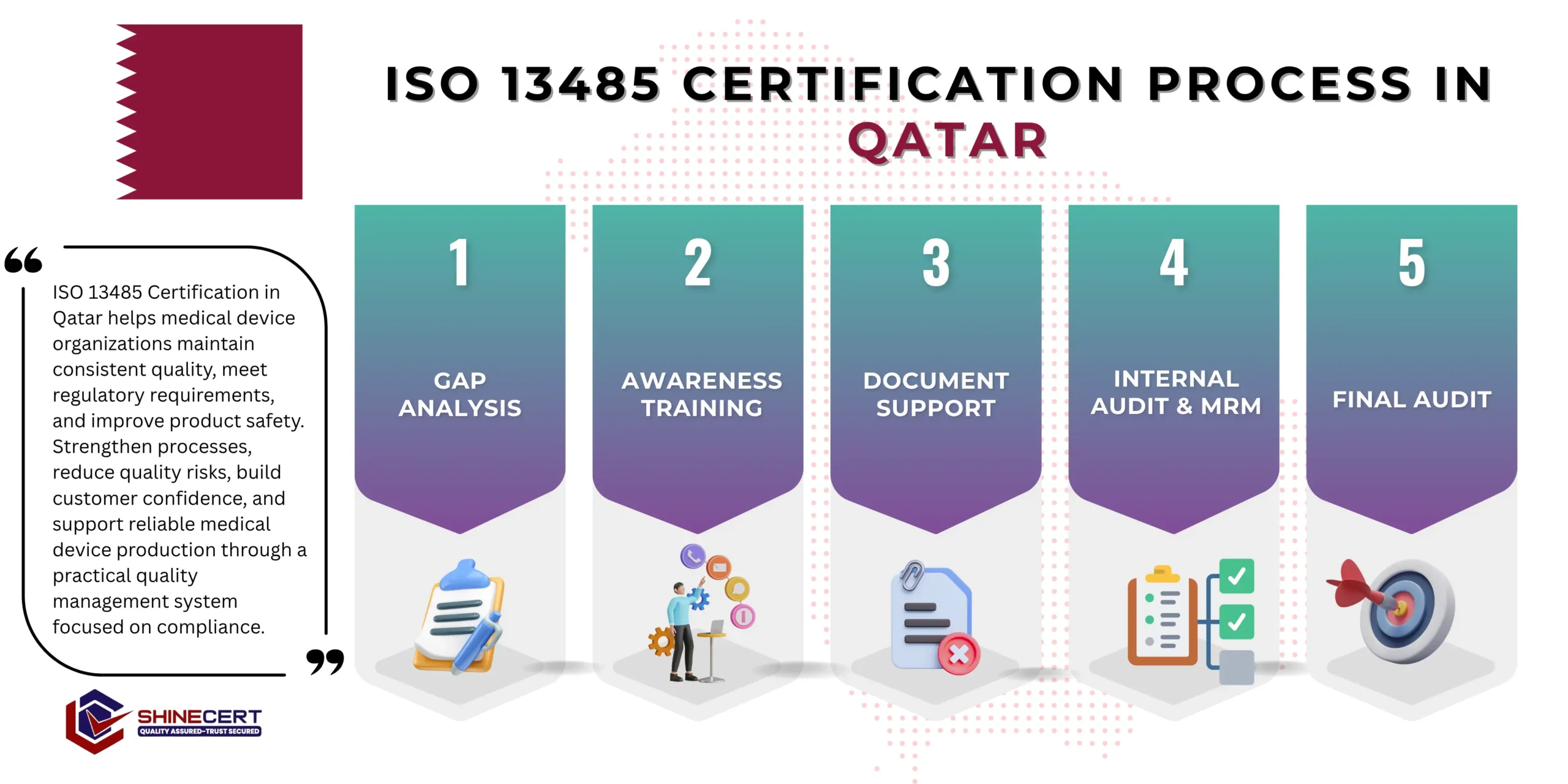
Our Five-Step ISO 13485 Certification Process
Gap Analysis and Risk Assessment
We assess your current quality management practices against ISO 13485 requirements and identify device-specific risk management gaps, calibrated to your device classification and Qatar's PDCD registration expectations.
A gap analysis report and a risk management framework aligned with your specific device portfolio.
Documentation Development
Your quality manual, design control procedures, risk management file, and traceability documentation get built around your actual devices and processes, not a generic template.
A complete ISO 13485 documentation set, structured to also support your MoPH device registration application.
Implementation and Training
Quality controls roll out across your design, production, and distribution processes, with staff trained by role on device-specific quality and regulatory requirements.
Training records and evidence of functioning design controls, production controls, and traceability systems.
Internal Audit and Management Review
A genuine internal audit tests whether your quality management controls function under real conditions, with findings feeding into a management review where leadership commits to specific corrective actions.
An internal audit report with real findings and management review minutes demonstrating genuine leadership engagement with medical device quality.
Certification Audit
We coordinate Stage 1 and Stage 2 with a GAB-accredited or GAC-recognized certification body experienced in medical device quality management assessment.
Your ISO 13485 certificate and a clear surveillance audit schedule.
Gap Analysis and Risk Assessment
We assess your current quality management practices against ISO 13485 requirements and identify device-specific risk management gaps, calibrated to your device classification and Qatar's PDCD registration expectations.
A gap analysis report and a risk management framework aligned with your specific device portfolio.
Documentation Development
Your quality manual, design control procedures, risk management file, and traceability documentation get built around your actual devices and processes, not a generic template.
A complete ISO 13485 documentation set, structured to also support your MoPH device registration application.
Implementation and Training
Quality controls roll out across your design, production, and distribution processes, with staff trained by role on device-specific quality and regulatory requirements.
Training records and evidence of functioning design controls, production controls, and traceability systems.
Internal Audit and Management Review
A genuine internal audit tests whether your quality management controls function under real conditions, with findings feeding into a management review where leadership commits to specific corrective actions.
An internal audit report with real findings and management review minutes demonstrating genuine leadership engagement with medical device quality.
Certification Audit
We coordinate Stage 1 and Stage 2 with a GAB-accredited or GAC-recognized certification body experienced in medical device quality management assessment.
Your ISO 13485 certificate and a clear surveillance audit schedule.
What It Costs: The Factors That Actually Drive ISO 13485 Price
- Device risk classification : Higher-risk devices (Class C and D) require more extensive risk management documentation and design control evidence than lower-risk devices.
- Number of device lines : More distinct products mean more device-specific risk files and design documentation, even under a single certified quality management system.
- Existing quality system maturity : Companies with informal but functioning quality practices already in place need less foundational work than those building a system from scratch.
- Manufacturing versus distribution role : Manufacturers face more extensive design control and production requirements than pure importers or distributors, who focus more heavily on traceability and complaint handling.
- Bundling with ISO 9001 : Meaningful cost efficiency is available for companies pursuing multiple management system certifications together, given shared documentation infrastructure.
- Urgency of your registration timeline : Companies still finalizing post-deadline MoPH registration sometimes need accelerated implementation support, which can affect overall project cost and sequencing.
- Quick answer : Budget QAR 25,000 to QAR 100,000, with the low end reflecting a smaller distributor with a limited device portfolio and the high end reflecting a larger manufacturer with multiple higher-risk device lines.
ISO 13485 vs MoPH’s PDCD Device Registration
- These are complementary, not substitutes, and understanding the distinction genuinely matters given the new mandatory registration environment. MoPH’s PDCD registration is a specific, mandatory legal gate your actual devices must pass through before import, tied to device classification, reference market approval, and your Authorized Representative arrangement. ISO 13485 certifies your organization’s broader quality management system, the ongoing discipline of risk management, design control, and traceability across your operations generally, independently verified by a third-party certification body.
- We generally recommend Qatar medical device businesses treat ISO 13485 as the operational backbone that makes navigating PDCD registration, and any future registration renewals or device portfolio expansions, considerably more manageable, since a functioning quality management system produces exactly the documentation registration applications request. Companies that approach PDCD registration as a standalone paperwork exercise, without an underlying certified quality system, tend to find the registration process considerably more labor-intensive and error-prone, particularly as their device portfolio grows.
Benefits: What Certification Actually Changes
A certified quality management system produces exactly the documented risk management, design control, and traceability evidence PDCD registration applications require.
Manufacturers and importers with genuine ISO 13485 documentation typically navigate MoPH’s registration process more smoothly than those assembling documentation reactively.
Given the July 2026 mandatory registration deadline, certified quality management directly protects your ability to continue importing and distributing devices in Qatar without disruption.
Since Qatar’s framework requires prior approval in a GHTF reference market, ISO 13485 certification strengthens your regulatory standing in those markets too, not just in Qatar.
Structured risk management and traceability genuinely reduce both the likelihood of quality incidents and how disruptive a recall becomes if one occurs.
Companies already pursuing ISO 9001 find the shared management system structure makes ISO 13485 implementation considerably faster to build, though the device-specific risk and design control requirements still need dedicated attention.
Mandatory Documents Required for Implementation
Genuine leadership commitment and scope definition specific to your device portfolio.
Documented risk analysis, evaluation, and control measures specific to each device, maintained throughout the product lifecycle.
Documented processes for design input, output, verification, and validation.
Documentation supporting rapid, accurate traceability in the event of a quality issue or recall.
Documented plans for ongoing monitoring of device performance once in the field.
Evidence of genuine, ongoing quality oversight.
Documented, tested processes for responding to quality issues.
Applicable Standards by Industry
Medical Device Manufacturing
Beyond ISO 13485, Qatar-based manufacturers typically need to demonstrate compliance with MoPH’s specific device classification and registration requirements for each product they bring to market.
Read moreMedical Device Import & Distribution
Importers face the July 2026 mandatory registration requirement most directly, and typically need ISO 13485 alongside a formal Authorized Representative arrangement with a locally registered Qatari entity.
Read moreDiagnostic & IVD Companies
In vitro diagnostic device companies face a related but distinct regulatory process under Qatar’s IVD framework, typically requiring ISO 13485 alongside IVD-specific registration documentation.
Read moreHealthcare Facilities
Hospitals and clinics increasingly expect ISO 13485 certification from their device suppliers as a baseline procurement requirement, reflecting the same quality assurance MoPH now expects at registration.
Read morePharmaceutical Companies
Companies producing combination products typically need both ISO 13485 and MoPH drug registration compliance, since these products span both regulatory frameworks.
Read moreDental & Aesthetic Device Suppliers
Qatar’s growing private clinic and cosmetic medicine sector increasingly requires suppliers of dental and aesthetic devices to hold ISO 13485 certification as a baseline procurement expectation, alongside standard MoPH classification and registration.
Read moreThe July 2026 Registration Deadline: What It Actually Means for Your Business
- This deserves direct, practical attention given how recently the deadline passed. As of July 1, 2026, MoPH requires medical device registration before import, and this is no longer a phased-in expectation, it’s an active compliance gate. If your organization imports Class C or Class D devices into Qatar and hasn’t yet completed registration through the PDCD’s e-portal, your import activity is now genuinely at risk of restriction, not just facing future tightening.
- The practical path forward involves several concrete requirements: your device needs prior approval in a recognized GHTF reference market (Australia, Canada, Europe, Japan, or the USA), and as a foreign manufacturer, you cannot interact directly with MoPH, you need a locally registered Qatari company acting as your Authorized Representative. A certified ISO 13485 quality management system doesn’t replace this registration process, but it substantially streamlines it, since the risk management files, design documentation, and traceability records PDCD registration requests are exactly what a functioning quality management system already maintains as routine operational output, not documents assembled specially for a single application.
Medical Device Quality Requirements, Clause by Clause
- Context of the Organization : Understand your genuine role in the medical device supply chain, manufacturer, importer, distributor, and the regulatory requirements specific to that role, including MoPH’s PDCD registration framework.
- Leadership : Top management commitment to medical device quality and regulatory compliance, with resources genuinely allocated to risk management and design control, not distributed vaguely across a general quality function.
- Planning : Risk management planning integrated throughout the product lifecycle, plus identification of applicable regulatory requirements, MoPH’s device classification and registration rules, and any reference market approvals your device already holds.
- Support : Competence and training specific to medical device quality requirements, calibrated by role, design engineers need meaningfully different training than production floor staff or regulatory affairs personnel.
- Operation : Design controls, production controls, and traceability systems specific to your devices, documented and genuinely functioning, including device identification and traceability records supporting any future recall.
- Performance Evaluation : Monitoring and measurement of quality performance, including genuine post-market surveillance for devices already in the field, not just pre-market quality checks.
- Improvement : A structured response to quality incidents, complaints, and nonconformities, including genuine root-cause investigation and, where relevant, coordination with MoPH’s regulatory reporting expectations.
A Scenario: A Device Distributor Racing the July 2026 Deadline
- Concrete situations make the stakes here clearer than abstract compliance language. Picture a Doha-based distributor bringing in a range of Class C diagnostic devices from a European manufacturer, who had been operating for years under Qatar’s previous, lighter-touch import framework. As the July 2026 deadline approached, this distributor faced a genuinely compressed timeline: confirming the manufacturer’s existing CE approval qualified as valid GHTF reference market approval, formalizing an Authorized Representative arrangement since the distributor itself needed to act in that capacity, and assembling the risk management and design documentation the PDCD’s e-portal application actually requests.
- Distributors without an underlying quality management system found this scramble considerably harder, because the documentation PDCD wanted, risk files, design verification records, traceability procedures, simply didn’t exist in usable form; it had to be reconstructed after the fact, under deadline pressure, often with gaps that triggered additional information requests from MoPH and delayed approval further. Distributors with a functioning ISO 13485 system, even an informal one not yet certified, moved through the same process considerably faster, because the requested documentation was already routine operational output rather than something assembled specially. We generally recommend companies still navigating post-deadline registration treat certification as the fastest route to making future registrations, renewals, and portfolio expansions considerably less stressful than this first one likely was.
Why ShineCert?
We coordinate Qatar engagements from ShineCert’s Riyadh and Lebanon offices, with direct familiarity with MoPH’s PDCD framework and the practical realities of the July 2026 device registration transition. As the best ISO 13485 consultant in Qatar, our team has guided more than 10,000 organizations through ISO certification globally.
Choosing a Certification Body in Qatar
What to Check | Why It Matters |
GAB accreditation, or another GAC-recognized body | Confirms genuine, internationally recognized certification |
Genuine ISO 13485 and medical device audit experience | Medical device auditing requires specific technical competence in risk management and design control, distinct from general quality auditing |
Familiarity with MoPH’s PDCD registration framework | Helps ensure certification documentation genuinely supports your registration application, not just the certificate itself |
Device classification-specific experience | Class C and D device audits require more rigorous scrutiny than lower-risk device categories |
Ready to Get Started?
ShineCert supports Qatar medical device businesses end to end, from risk management and design control through certification audit, with direct experience navigating MoPH’s new registration requirements and the practical realities of the July 2026 transition. Book a free consultation or contact us directly, and we’ll review your device portfolio honestly before proposing a fixed-scope plan.
Frequently Asked Questions
It’s the international standard for medical device quality management systems, requiring documented risk management, design control, and traceability throughout the product lifecycle.
Typically QAR 25,000 to QAR 100,000, depending on device classification and manufacturing complexity.
ISO 13485 itself isn’t legally mandated by name, but MoPH device registration is now mandatory as of July 1, 2026, and a certified quality management system directly supports meeting registration requirements.
Typically four to eight months, reflecting the greater documentation and risk management depth required compared to standards like ISO 9001.
Import of unregistered Class C or D devices is now restricted, making prompt registration through the PDCD’s e-portal a genuine priority if you haven’t already completed it.
Yes, foreign manufacturers cannot interact directly with MoPH and must appoint a locally registered Qatari company as their Authorized Representative.
No, registration is a mandatory legal gate for specific devices, while ISO 13485 certifies your organization’s broader quality management system, the two are complementary.
Now, a certified quality management system makes both your current registration and any future registrations, renewals, or portfolio expansions considerably faster and less stressful.
We coordinate Qatar engagements from our Riyadh and Lebanon offices, with consultants traveling on-site as needed.