
GDPR Certification in India
Quick Answer
GDPR, the European Union’s General Data Protection Regulation, is not a certification ShineCert issues; it’s a binding EU law with extraterritorial reach that applies to any organization, anywhere, processing personal data of individuals in the EU, regardless of where the organization itself is based. ShineCert provides advisory support helping Indian IT, BPO, and technology businesses build GDPR-compliant practices for their EU client relationships, distinct from, but with real overlap alongside, India’s own Digital Personal Data Protection Act and Rules. Advisory engagements typically take two to five months, considerably faster for businesses that are already substantially DPDP-ready.
Why It Matters in India?
India’s IT services and BPO sectors handle enormous volumes of personal data on behalf of EU clients, and DPDP Rules compliance alone doesn’t satisfy GDPR obligations for these EU-facing relationships, since the two frameworks, while related, aren’t interchangeable. As the DPDP Rules’ own phased timeline continues through 2026 and into 2027, Indian outsourcing providers are increasingly expected by EU clients to maintain multilayered cybersecurity, encrypted data transfers, cloud environments with role-based file access, and proper Data Processing Agreements before work even begins, expectations that have tightened noticeably as EU clients themselves face growing GDPR enforcement scrutiny.
What not being GDPR-ready actually costs you : You risk losing EU client relationships or being excluded from new ones during vendor due diligence, since EU clients increasingly require documented GDPR compliance from their processors as a contractual precondition, not a nice-to-have. You’re also exposed to genuine liability, since GDPR’s extraterritorial reach means enforcement action can apply to your business directly, not just to your EU client, if you’re found to be processing personal data of EU individuals without adequate safeguards. And without a clear Data Processing Agreement structure, ambiguity about your role, processor or joint controller, for a given client relationship can create real compliance gaps discovered only when something goes wrong.
Why is this happening in India right now? As EU data protection enforcement continues intensifying and EU businesses tighten their own vendor risk management in response, Indian outsourcing providers who can demonstrate genuine, documented GDPR readiness, not just an assurance, are increasingly winning and retaining EU client relationships over those who cannot, making this a genuine competitive factor, not just a compliance cost.
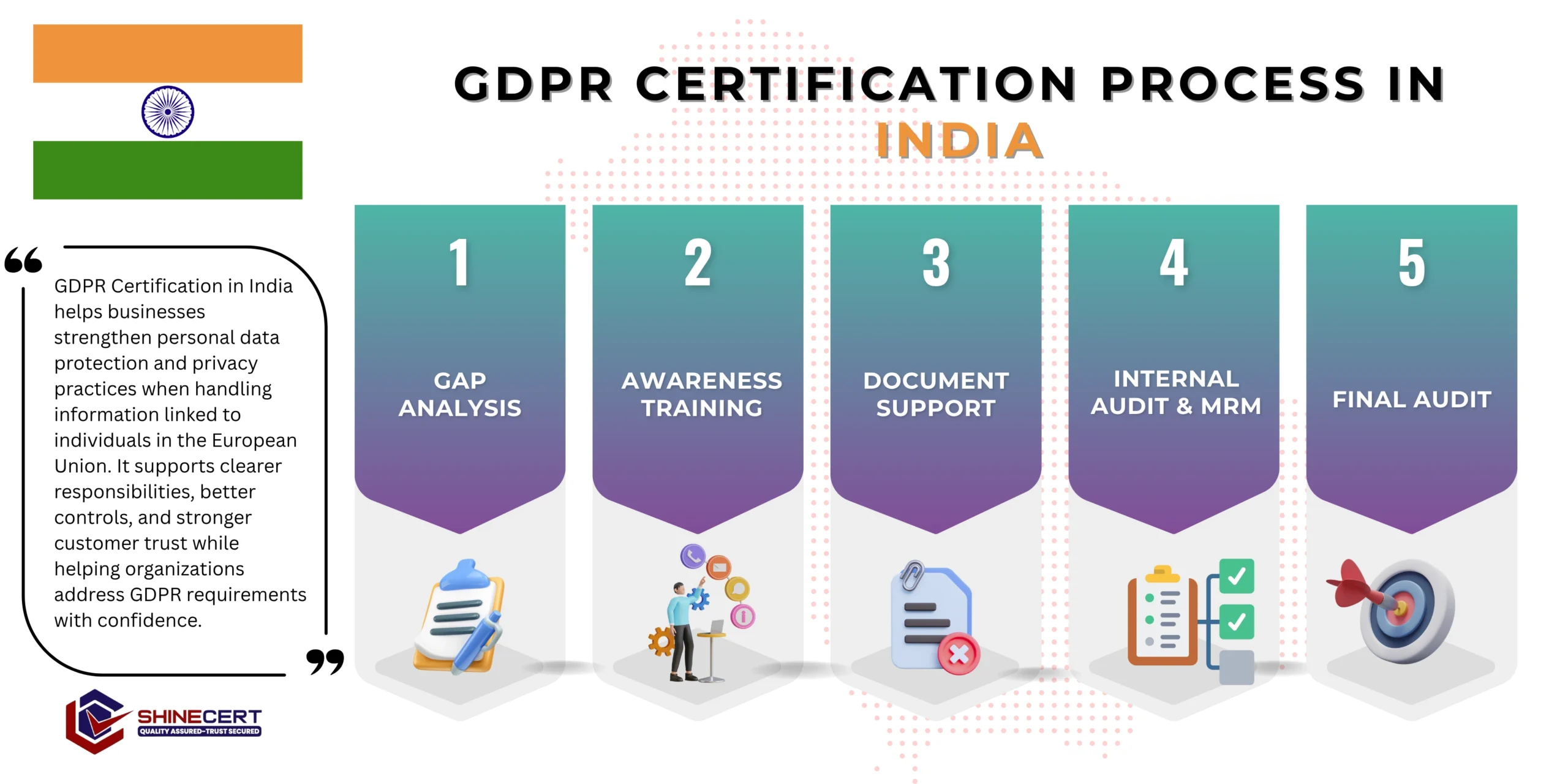
What are the steps to get GDPR Certification in India?
our services
- ISO Certification India
- ISO 9001 Certification India
- ISO 14001 Certification India
- ISO 27001 Certification India
- ISO 22000 Certification India
- ISO 27701 Certification India
- ISO 45001 Certification India
- ISO 20000-1 Certification India
- ISO 13485 Certification India
- ISO 17025 Certification India
- ISO 31000 Certification India
- ISO 42001 Certification India
- ISO 37001 Certification India
- ISO 22301 Certification India
- ISO 50001 Certification India
- CE Mark Certification India
- GDPR Certification India
- GMP Certification India
- Halal Certification India
The Advisory Process
Gap Assessment
We review your existing DPDP compliance work and current data handling practices for EU clients, identifying precisely which GDPR-specific requirements, processor obligations, legal basis documentation, aren't yet covered.
Documentation Development
Depending on complexity, we build privacy notices, document your legal basis for each processing activity, and develop Data Processing Agreement templates for your EU client relationships.
Implementation and Training
Processes go live and staff handling EU client data are trained specifically on GDPR-specific obligations distinct from what DPDP training alone would cover.
Internal Review
We confirm your documentation and practices are genuinely ready to withstand an EU client's own vendor due diligence process.
Ongoing Support
We help you respond to EU client vendor audits and due diligence requests as they arise, since this tends to be an ongoing relationship requirement rather than a one-time exercise.
How Long Does Advisory Preparation Take?
| Business Size | Typical Timeline | Why |
|---|---|---|
| Already DPDP-compliant, few EU clients | 2–3 months | Building only the GDPR-specific gap on an existing foundation |
| Building DPDP and GDPR readiness together | 3–4 months | Full compliance build covering both frameworks |
| Large, multiple EU client relationships | 4–5 months | More Data Processing Agreements and cross-team coordination |
- Businesses are already DPDP-compliant with few EU clients (2 to 3 months) : With most of the underlying data governance work already done, the GDPR-specific gap, legal basis documentation, Data Processing Agreements, processor obligations, is considerably faster to close.
- Businesses building DPDP and GDPR readiness together (3 to 4 months) : Building both frameworks’ requirements simultaneously takes longer than extending an existing DPDP foundation, but is often more efficient than doing them sequentially.
- Large businesses with multiple EU client relationships (4 to 5 months) : More EU clients mean more individual Data Processing Agreements and more cross-team coordination to ensure consistent practices across client accounts.
- The variable that matters most: how far along your existing DPDP compliance work already is : A business with substantial existing DPDP documentation moves through the GDPR-specific gap considerably faster than one starting from nothing.
A real example : An outsourcing provider with five EU client relationships had never formally mapped which specific activities triggered GDPR obligations for each client, assuming its general data security posture was sufficient; building individual Data Processing Agreements and legal basis documentation for all five relationships took roughly six weeks longer than a comparable provider that had already begun this mapping exercise.
About GDPR
- The General Data Protection Regulation is the European Union’s comprehensive data protection law, in force since 2018, governing how personal data of individuals in the EU is collected, processed, stored, and transferred, regardless of where the processing organization is physically located. Its extraterritorial reach means an Indian IT services company, BPO provider, or SaaS business processing EU customers’ or EU clients’ end-users’ personal data is subject to GDPR obligations even though the company itself operates entirely outside the EU.
- Important: ShineCert does not issue GDPR certification. GDPR compliance is a legal obligation defined by EU law, not a certification scheme with an accredited certificate. What ShineCert provides is advisory support, helping you understand your specific GDPR obligations, build the required documentation and processes, and structure data processing agreements appropriately with your EU clients.
GDPR vs. DPDP: What’s Actually Different
- This distinction matters enormously for Indian businesses serving both domestic and EU clients, since the two frameworks share DNA but diverge in real, practical ways : The Digital Personal Data Protection Act applies to digital personal data specifically, while GDPR’s scope extends to some offline data as well. DPDP is oriented toward India-only operations by default, while GDPR applies the moment you have EU customers or process EU individuals’ data, regardless of your own location.
- Legal basis for processing differs meaningfully : DPDP makes consent the primary legal basis for processing, with specific exemptions for employer-employee data, government purposes, and legal compliance. GDPR offers consent as just one of six legal bases, and most B2B relationships in practice rely on “legitimate interests” or “contract” rather than consent, a structural difference that affects how you actually design data processing agreements with EU clients.
- Compliance responsibility is allocated differently : DPDP places compliance responsibility squarely on Data Fiduciaries; GDPR imposes more direct obligations on Data Processors as well, meaning an Indian BPO acting purely as a processor for an EU client carries direct GDPR obligations that DPDP’s framework wouldn’t impose on an equivalent domestic processing relationship.
- DPDP introduces a uniquely Indian mechanism: Consent Managers, a formal role not present in GDPR at all, with related provisions taking effect from 14 November 2026. DPDP’s breach notification requirement is also stricter in one specific respect, requiring reporting of all breaches, whereas GDPR’s threshold is somewhat less comprehensive.
- Why this matters practically for cost and timeline: existing GDPR investment saves roughly 60-70% of DPDP compliance work, since companies already GDPR-ready are approximately 60-70% of the way toward DPDP compliance. The reverse is also broadly true but not identical, since GDPR’s processor-specific obligations and legal basis framework require dedicated attention beyond what DPDP compliance alone builds.
What Affects the Cost?
- Existing DPDP compliance maturity. Businesses already well along in DPDP compliance face a considerably smaller GDPR-specific gap to close.
- Number of EU client relationships. More clients mean more individual Data Processing Agreements and legal basis documentation to build.
- Data sensitivity and processing complexity. More sensitive data categories or complex cross-border processing arrangements require more detailed documentation.
We quote every business individually once we understand your existing DPDP status, EU client relationships, and data processing activities.
Required Documentation
Privacy notices specific to EU data subjects, distinct from any DPDP-oriented notices you may already have. The record of processing activities documents what personal data you process, why, and under what legal basis.
Data Processing Agreements with each EU client formally establish your role, processor or joint controller, and the obligations that follow from it.
Data subject rights handling procedures document how you respond to EU individuals’ access, correction, or deletion requests. Cross-border data transfer safeguards document how data moves between India and the EU appropriately.
Breach notification procedures aligned to GDPR’s specific timelines and thresholds, distinct from DPDP’s own requirements. Vendor and sub-processor agreements extend GDPR obligations to any third parties you engage.
Who Actually Needs This?
IT services companies process data for EU clients
Where GDPR obligations apply directly regardless of the company’s own location in India.
Read moreBPO and call center operators handling EU end-user data
Where processor obligations under GDPR are genuinely distinct from DPDP’s framework.
Read moreSaaS providers with EU-based customers
Where GDPR compliance is often an explicit contractual requirement.
Read moreAny business already building DPDP compliance
That also serves EU clients, since extending that work to cover GDPR-specific gaps is considerably more efficient than starting separately.
Read moreBenefits of GDPR Compliance Advisory
Documented compliance readiness increasingly functions as a vendor pre-qualification requirement, not just a preference.
Since GDPR-readiness and DPDP-readiness overlap substantially, businesses already working on DPDP compliance get a considerable head start.
This ambiguity is common and creates real risk if left unresolved until an incident forces the issue.
Clear contractual terms with EU clients protect both parties and demonstrate genuine compliance maturity during vendor audits.
Documented, genuine compliance measures provide a meaningfully stronger position than an informal assurance if a compliance question ever arises.
Common Mistakes We See
- Assuming DPDP compliance automatically satisfies GDPR : As explained above, the overlap is substantial but not complete, particularly around processor obligations and legal basis documentation.
- Never formally determining your role, processor or controller, for a given EU client relationship : This ambiguity, as our case study illustrates, is common and creates real risk left unresolved.
- Treating general data security measures as equivalent to GDPR compliance : Security is necessary but doesn’t establish the legal basis, consent, or data subject rights framework GDPR specifically requires.
- Building generic Data Processing Agreements not tailored to the actual client relationship : Auditors and EU clients’ own legal teams increasingly scrutinize whether agreements reflect genuine, specific processing activities.
What CE Marking Actually Covers?
- Applicable EU directives vary by product category, machinery, low voltage equipment, electromagnetic compatibility, and others, each with its own specific safety and performance requirements.
- Risk assessment requires identifying hazards specific to your product and demonstrating how design addresses them, not just describing intended use.
- Technical documentation requires a complete, organized file demonstrating conformity, available for EU market surveillance authorities to review on request.
- Self-declaration versus Notified Body verification depends on your product’s risk category; lower-risk products typically allow manufacturer self-declaration, while higher-risk categories require independent third-party verification.
Case Study: An Outsourcing Provider with Five EU Client Relationships
- An outsourcing provider needed to demonstrate genuine GDPR compliance to retain and grow its relationships with five separate EU clients, all of whom were tightening vendor due diligence requirements.
- Our gap assessment found the provider had never formally mapped which specific activities across its five client relationships actually triggered GDPR obligations, relying instead on a general assumption that its strong data security posture was sufficient.
- Over roughly six additional weeks beyond a comparable provider with existing mapping work, we built individual Data Processing Agreements and legal basis documentation for each of the five relationships, resolving processor-versus-controller ambiguity that had never been explicitly addressed for two of them.
- The provider successfully passed all five clients’ vendor due diligence reviews, with two clients specifically citing the clarity of the Data Processing Agreements as resolving concerns raised in previous, less formal reviews.
Answering the Objections Every Owner Has
“We’re a DPDP-compliant Indian company, isn’t that enough for our EU clients?”
DPDP and GDPR overlap substantially, roughly 60-70% of the work if you’re already DPDP-ready, but genuine gaps remain, particularly around processor-specific obligations and legal basis documentation that DPDP’s framework doesn’t require in the same way.
“GDPR is EU law, why would it apply to us in India?”
GDPR’s extraterritorial reach specifically covers processing of EU individuals’ personal data regardless of where the processing organization is located; if you handle data for EU clients or their end-users, GDPR obligations genuinely apply to you.
“Our EU client hasn’t asked us about this yet.”
Increasingly, EU clients expect documented compliance as a standing contractual requirement, not something they need to specifically request; being ready in advance is a genuine competitive advantage over waiting to be asked.
“Can’t our existing data security measures cover this?”
Security measures are necessary but not sufficient; GDPR requires documented legal basis for processing, clear Data Processing Agreements, and defined data subject rights handling that security controls alone don’t establish.
Choosing the Right Partner?
| DIY | Generic Consultant | ShineCert | |
|---|---|---|---|
| DPDP-to-GDPR gap analysis | Often assumed rather than genuinely mapped | Templated, rarely specific | Built around your actual existing DPDP work |
| Data Processing Agreements | Frequently generic | Templated, disconnected from real relationships | Tailored to each specific EU client relationship |
| Processor vs. controller determination | Often left ambiguous | Sometimes overlooked entirely | Resolved explicitly for every client relationship |
| Ongoing due diligence support | None | Often ends at initial documentation | Built to support ongoing EU client vendor audits |
Choosing an Advisory Partner
Ask whether the advisor genuinely understands both DPDP and GDPR, and can map the overlap and gaps specifically for your business, not just describe both frameworks generically. Confirm they can help resolve processor-versus-controller ambiguity for each client relationship. Confirm they can support ongoing EU client due diligence requests, not just an initial documentation exercise.
Why Businesses Choose ShineCert in India?
We’ve spent 10 years helping more than 10,000 businesses worldwide navigate data protection and privacy compliance, coordinated through our Riyadh and India offices with work delivered remotely or on-site as needed. Our consultants map the genuine overlap and gap between your existing DPDP compliance work and GDPR’s specific requirements, with ShineCert as the best GDPR consultant in India, rather than treating the two frameworks as identical, and we resolve processor-versus-controller ambiguity explicitly for every EU client relationship rather than leaving it assumed.
Frequently Asked Questions
It applies specifically to organizations processing personal data of individuals in the EU, regardless of the organization’s own location; if you serve EU clients or their end-users, it genuinely applies to you.
No, though the overlap is substantial, roughly 60-70% of the work if you’re already DPDP-ready; genuine gaps remain around processor obligations and legal basis documentation.
It depends on your existing DPDP compliance maturity, number of EU client relationships, and data processing complexity. We quote individually.
Usually two to five months, considerably faster if you’re already substantially DPDP-compliant, with existing DPDP maturity mattering more than headcount alone.
No, GDPR is a legal obligation, not a certification scheme; ShineCert provides advisory support to help you build and document genuine compliance.