
ISO 45001 Certification in India
Quick Answer
ISO 45001 certification is an internationally recognized Occupational Health and Safety Management System credential confirming an organization systematically identifies hazards, controls risks, and protects workers. In India it isn’t a separate legal mandate on its own, but it directly supports compliance with the Occupational Safety, Health and Working Conditions Code, 2020, which came into force on 21 November 2025 and consolidated 13 older labour laws. Certification typically takes two to six months and is increasingly a pre-qualification filter for multinational supply chains and larger domestic contracts.
About ISO 45001
ISO 45001 is the world’s leading Occupational Health and Safety Management System standard, published by the International Organization for Standardization. It requires organizations to identify workplace hazards, assess and control risks, and involve workers directly in shaping the safety system, rather than treating safety as a compliance checklist managed only by a designated officer.
Certification means an independent, accredited certification body has audited your actual worksite conditions, incident records, and worker consultation practices, and confirmed they genuinely meet the standard’s requirements. It runs on a three-year cycle with annual surveillance audits, keeping the system alive rather than a one-time achievement.
A brief history of the standard : ISO 45001 was published in March 2018, the first ISO standard dedicated specifically to occupational health and safety management. It replaced OHSAS 18001, the previous British-originated safety management specification, which was formally withdrawn in March 2021, meaning any business still holding an OHSAS 18001 certificate today is operating on a standard that no longer has any active certification pathway.
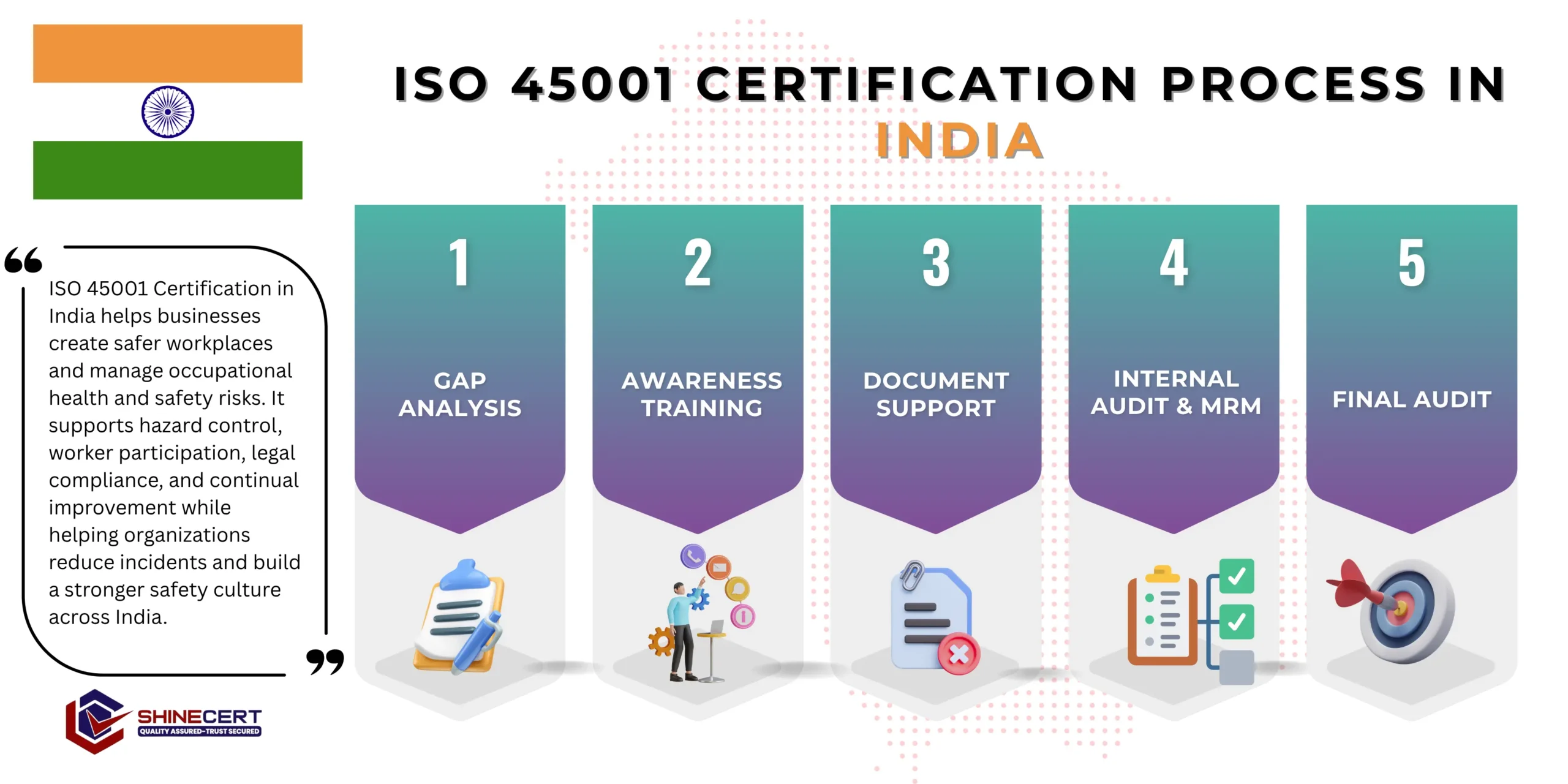
What are the steps to get ISO 45001 Certification in India?
our services
- ISO Certification India
- ISO 9001 Certification India
- ISO 14001 Certification India
- ISO 27001 Certification India
- ISO 22000 Certification India
- ISO 27701 Certification India
- ISO 45001 Certification India
- ISO 20000-1 Certification India
- ISO 13485 Certification India
- ISO 17025 Certification India
- ISO 31000 Certification India
- ISO 42001 Certification India
- ISO 37001 Certification India
- ISO 22301 Certification India
- ISO 50001 Certification India
- CE Mark Certification India
- GDPR Certification India
- GMP Certification India
- Halal Certification India
The Certification Process
Gap Assessment
We walk your actual worksite, factory floor, construction site, or warehouse, and identify every hazard category present, comparing what we find against both the standard's requirements and the OSH Code's central rules, so the plan reflects your real risk profile, not a generic checklist.
Documentation Development
We build the safety policy, hazard identification and risk assessment register, and legal compliance register, written around your actual operations and workforce, not aspirational language nobody will follow on the ground.
Implementation and Training
The system goes live and workers, particularly those in higher-hazard roles, are trained not just on procedures but on why they matter, with genuine worker consultation built into the rollout rather than treated as a formality.
Internal Audit and Management Review
We run a structured internal audit against the same criteria the certification auditor will use, and complete a formal management review with leadership, catching gaps while they're still inexpensive to fix.
Certification Audit
An accredited certification body audits your actual worksite conditions and records, and issues the certificate once satisfied you genuinely meet the standard's requirements.
How Long Does Certification Take?
| Business Size | Typical Timeline | Why |
|---|---|---|
| Small, single site | 2–3 months | Fewer environmental aspects to document and control |
| Medium, multiple processes or a larger site | 3–5 months | More aspects, consents, and staff training coordination |
| Large or multi-site industrial operations | 5–6 months | Multiple sites, consent conditions, and processes to align |
- Small, single-site businesses (2 to 3 months) : With fewer workers and a narrower hazard profile, there’s less to document and fewer people to train, and existing informal safety habits, if genuinely followed, often translate quickly into formal procedures.
- Medium businesses with multiple shifts or departments (3 to 5 months) : Reconciling safety practices across shifts that may currently operate slightly differently, and training a larger workforce consistently, takes longer than a single-shift operation requires.
- Large or multi-site industrial or construction operations (5 to 6 months) : Different sites often have different hazard profiles, different subcontractor relationships, and different existing safety cultures; bringing all of this into one certifiable system typically requires more site visits and coordination time.
- The variable that matters most: how genuinely your existing safety practices are followed, not just documented : A business where workers actually follow informal safety habits consistently moves faster than one where practices exist on paper but aren’t really followed day to day, since the latter requires real behavior change, not just documentation.
A real example : A construction contractor in Bengaluru had genuine, consistent toolbox-talk habits before every shift but no formal hazard register or incident-reporting process; formalizing what was already a strong safety culture took roughly six weeks, while a comparable contractor without that underlying culture took closer to five months to build both the practices and the documentation from scratch.
Why It Matters in India?
The Occupational Safety, Health and Working Conditions Code, 2020 came into force on 21 November 2025, consolidating 13 older labour laws into a single framework, with the Occupational Safety, Health and Working Conditions (Central) Rules, 2026 further operationalizing it through concrete registration, reporting, and worker welfare requirements. The Code applies to establishments with 10 or more workers, spanning factories, construction sites, mines, plantations, and a wide range of other workplaces.
- What not being certified actually costs you : You’re weaker positioned to demonstrate genuine compliance during OSH Code inspections, since without a documented system, safety practices often rely on informal habits rather than records inspectors can review directly. You’re also increasingly excluded from multinational supply chains, which now routinely treat ISO 45001 as a mandatory pre-qualification filter before even discussing terms. And incident costs, medical expenses, lost productivity, regulatory penalties, tend to run higher for businesses managing safety reactively rather than through structured hazard identification.
- Why is this happening in India right now? With the OSH Code’s central rules only recently notified and full state-level implementation still progressing through 2026, Indian businesses in construction, manufacturing, and logistics are actively formalizing safety practices they may have run informally for years, and certification gives them a structured, auditable way to demonstrate this to both regulators and buyers simultaneously.
What Affects the Cost?
- Business size and workforce : More workers and shifts mean more training and documentation coordination.
- Hazard complexity : Construction and heavy manufacturing typically involve more hazard categories than a straightforward office environment.
- Current safety culture and documentation state : A business with genuinely followed informal practices starts from a stronger position than one relying on assumption alone.
- Certification body fees : Separate from consulting fees, and worth confirming accreditation before comparing quotes.
Required Documentation
The scope statement defines exactly what the certification covers. The occupational health and safety policy sets top management’s commitment and worker consultation approach.
The hazard identification and risk assessment register documents what could harm workers and what controls are in place. The legal and other requirements register lists every OSH Code and other applicable obligations.
Competence and training records prove workers in hazardous roles are genuinely trained. The worker consultation and participation records demonstrate the standard’s specific emphasis on involving workers directly, not just management.
Operational control procedures describe how hazardous tasks are actually managed. Emergency preparedness and response procedures document your plan for incidents.
Incident investigation records, internal audit reports, and management review minutes demonstrate ongoing oversight. Corrective action records show how you respond when something goes wrong.
Who Actually Needs This?
Construction contractors
Construction contractors, where hazard exposure is constant and OSH Code compliance scrutiny is direct and frequent.
Read moreManufacturers with 10 or more workers
Manufacturers with 10 or more workers, squarely within the OSH Code’s applicability threshold.
Read moreLogistics and warehousing operators
Logistics and warehousing operators, where manual handling and vehicle movement create ongoing safety exposure.
Read moreBusinesses supplying multinational buyers
Businesses supplying multinational buyers, where ISO 45001 is increasingly a stated contract requirement.
Read moreMining and plantation operations
Mining and plantation operations, explicitly named among the OSH Code’s covered establishment types.
Read moreBenefits of ISO 45001 Certification
Certification builds exactly the documentation, hazard registers, and consultation records the Code’s central rules expect.
Certification is now a standard pre-qualification filter for construction, manufacturing, and logistics contracts with international buyers.
Structured hazard identification and control catches risks before they become injuries, medical costs, or regulatory penalties.
The standard specifically requires worker consultation, which tends to surface real hazards management alone would miss.
Systematic risk control reduces the frequency of incidents serious enough to halt operations.
ISO 45001 shares its High-Level Structure with ISO 9001 and ISO 14001, simplifying combined certification.
Common Mistakes We See
- Treating worker consultation as a formality rather than a genuine requirement : Auditors specifically probe whether workers were actually involved, not just informed, and this is a common area of nonconformity.
- Not reconciling ISO 45001 documentation with OSH Code central rules requirements : Building two disconnected sets of records doubles the maintenance burden and creates gaps.
- Underestimating emergency preparedness planning : Routine hazard controls are often documented well while realistic incident-response planning is skipped.
- Choosing a certification body without confirming accreditation : An unaccredited certificate carries no real recognition with multinational buyers or during regulatory scrutiny.
Standards and Clauses: What ISO 45001 Actually Requires
- Context of the Organization (Clause 4) : requires identifying workplace conditions and worker expectations relevant to your safety performance.
- Leadership and Worker Participation (Clause 5) : requires top management to set safety policy and, distinctly from most other management standards, genuinely involve workers in shaping the system, not just inform them of it.
- Planning (Clause 6) : requires identifying hazards, assessing risk, and determining legal obligations, operationalizing proactive risk management rather than reactive incident response.
- Support (Clause 7) : covers competence, training, and communication needed to run the system.
- Operation (Clause 8) : covers operational controls over hazardous activities, management of change, and emergency preparedness.
- Performance Evaluation (Clause 9) : requires monitoring safety performance, internal audits, and management review.
- Improvement (Clause 10) : requires investigating incidents and continually improving safety performance over time.
Case Study: A Construction Contractor in Bengaluru
- A construction contractor needed ISO 45001 certification to satisfy a multinational developer’s vendor pre-qualification requirement ahead of a major commercial project bid.
- Our gap assessment found the contractor’s crews genuinely practiced consistent pre-shift toolbox talks, a real safety culture, but had no formal hazard register, no documented worker consultation process, and no incident-investigation procedure.
- Over roughly six weeks, we formalized the existing safety culture into documented hazard assessments and consultation records, rather than building a system from nothing. The certification audit found the underlying culture genuinely matched the documentation, with only minor administrative nonconformities.
- The contractor secured the project bid, with the developer specifically citing the certification as removing what would otherwise have been a disqualifying gap.
Answering the Objections Every Owner Has
“We already follow safety practices informally, why formalize them?”
Informal practices don’t survive staff turnover or produce evidence when an inspector or auditor asks for records; formalizing what you already do well is usually faster than owners expect.
“Isn’t this just for high-risk industries like construction?”
Every workplace has hazards, ergonomic strain, electrical risk, even a straightforward office, and the standard scales its documentation expectations to your actual risk profile.
“We’re worried this will slow down operations.”
A properly implemented system reduces disruptive incidents over time; the upfront documentation work is a smaller cost than a serious workplace injury and its aftermath.
“Can’t we just download a safety manual template?”
Templates rarely reflect your specific hazards or your workers’ actual roles, and a system that doesn’t match real conditions tends to fail exactly when tested by an audit or an actual incident.
Choosing the Right Partner?
| DIY | Generic Consultant | ShineCert | |
|---|---|---|---|
| OSH Code 2020 integration | Often built as a separate, disconnected system | Sometimes overlooked entirely | Directly reconciled with Central Rules requirements |
| Worker consultation | Frequently treated as a signature on a form | Templated, rarely genuine | Built as a real, ongoing practice |
| Accreditation verification | Often overlooked | Sometimes assumed rather than confirmed | Verified explicitly before you commit |
| Post-certification support | None | Often ends at the certificate | Built to support your ongoing surveillance audits |
Which Certification Body Should You Choose?
Confirm the certification body is accredited by NABCB or another IAF-member accreditation authority. Ask whether the consultant understands the OSH Code 2020’s Central Rules, not just the generic ISO standard. Confirm the certification audit includes an actual site visit and worker interviews.
Why Businesses Choose ShineCert in India?
We’ve spent 10 years helping more than 10,000 businesses worldwide get certified, coordinated through our Riyadh and India offices with work delivered remotely or on-site as needed. Our consultants build genuine worker consultation into every implementation, not a signature formality, and reconcile your system directly with OSH Code 2020 obligations rather than maintaining two disconnected sets of records, with ShineCert as the best ISO 45001 consultant in India. We only work with accredited certification bodies, never unaccredited shortcuts.
Frequently Asked Questions
Not as a standalone legal mandate, but it directly supports compliance with the Occupational Safety, Health and Working Conditions Code, 2020, and is increasingly required by multinational buyers.
It depends on business size, hazard complexity, and current safety documentation. We quote individually.
Usually two to six months depending on business size, with genuine (not just documented) safety culture mattering more than headcount alone.
No, it doesn’t replace legal obligations under the Code; it gives you a documented system that directly supports demonstrating and maintaining that compliance.
Confirm accreditation by NABCB or another IAF-member authority, and confirm the audit includes genuine worker interviews, not just a paperwork review.