
ISO 13485 Certification in UAE
Quick Answer
The UAE has positioned itself as a regional medical device and healthcare hub, and both the Ministry of Health and Prevention (MOHAP) and the Dubai Health Authority (DHA) require medical device manufacturers and, in many cases, distributors to demonstrate a functioning quality management system as part of device registration. ISO 13485 is the internationally recognized quality management standard specifically built for medical devices, and it’s increasingly treated in the UAE as a practical prerequisite for MOHAP registration rather than an optional extra. Get certified through a body accredited by the Emirates International Accreditation Centre (EIAC) or another IAF-recognized body. Budget AED 18,000 to AED 75,000 depending on device classification and company size, and plan for three to six months from kickoff to certificate.
What This Standard Actually Does?
ISO 13485 is a quality management standard built specifically for organizations involved in the design, production, installation, or servicing of medical devices, it shares structural DNA with ISO 9001 but replaces ISO 9001’s general customer-satisfaction orientation with an explicit focus on patient safety and regulatory compliance. Risk management runs through nearly every clause rather than sitting in a single dedicated section, and the standard expects design controls, traceability, and post-market surveillance that go considerably further than what a general quality management system requires. For UAE medical device businesses, it functions as a genuinely practical bridge between international quality expectations and MOHAP’s own registration framework.
Why This Matters So Much Here Specifically?
- The UAE has invested heavily in becoming a genuine regional hub for healthcare and medical device distribution, not just a consumption market, Dubai Healthcare City and Dubai Science Park both host medical device companies specifically because of the access they provide to Gulf, Levant, and East African markets. MOHAP’s medical device registration process increasingly expects manufacturers and, for higher-risk device classes, importers and distributors to demonstrate a documented quality management system, and ISO 13485 certification is the standard reference point auditors and reviewers look for. The Dubai Health Authority runs its own parallel registration requirements for devices distributed specifically within the Emirate of Dubai, which UAE medical device companies operating across multiple emirates need to navigate alongside the federal MOHAP framework.
- For device distributors specifically, a genuinely significant category given how much of the UAE’s medical device market is import-based rather than domestically manufactured, ISO 13485 certification demonstrates that post-market surveillance, complaint handling, and vigilance reporting obligations are being managed systematically rather than reactively.
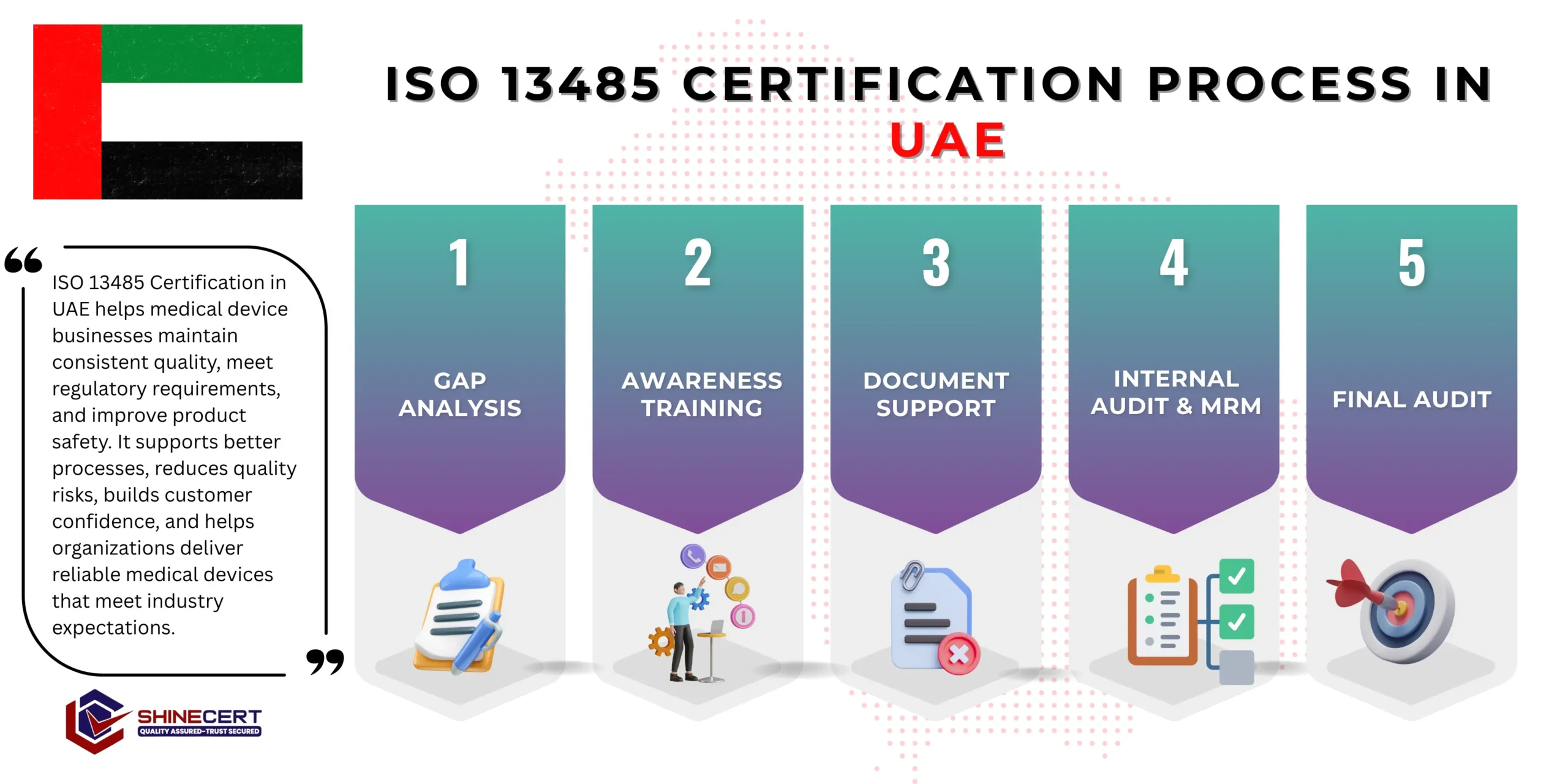
What are the steps to get ISO 13485 Certification in UAE?
our services
- ISO Certification UAE
- ISO 9001 Certification UAE
- ISO 14001 Certification UAE
- ISO 27001 Certification UAE
- ISO 22000 Certification UAE
- ISO 27701 Certification UAE
- ISO 45001 Certification UAE
- ISO 20000-1 Certification UAE
- ISO 13485 Certification UAE
- ISO 17025 Certification UAE
- ISO 31000 Certification UAE
- ISO 42001 Certification UAE
- ISO 37001 Certification UAE
- ISO 22301 Certification UAE
- ISO 50001 Certification UAE
- CE Mark Certification UAE
- GDPR Certification UAE
- GMP Certification UAE
- Halal Certification UAE
How We Handle This?
Gap analysis and regulatory mapping
We assess your current quality practices against ISO 13485 and map your specific MOHAP and, where relevant, DHA registration requirements.
A gap analysis report and a regulatory requirements map specific to your device classification.
Documentation
Your quality manual, design control procedures (for manufacturers), and traceability and distribution procedures get built around your actual device portfolio.
A complete ISO 13485 documentation set aligned with MOHAP registration expectations.
Implementation and training
Device handling, storage, and distribution procedures get rolled out, with staff trained on both the quality system and relevant regulatory obligations.
Training records and evidence of functioning traceability and complaint-handling processes.
Internal audit and management review
A rigorous internal audit covering design controls, traceability, and vigilance readiness, followed by a management review addressing regulatory compliance status.
An internal audit report and management review minutes demonstrating genuine leadership oversight of patient safety issues.
Certification audit
We coordinate Stage 1 and Stage 2 with an EIAC-accredited or IAF-recognized body experienced in medical device audits.
Your ISO 13485 certificate and a surveillance audit schedule.
What You Actually Get?
- A quality management system that directly supports MOHAP device registration, reducing friction and delay in what can otherwise be a genuinely slow regulatory process.
- Stronger positioning for Dubai Healthcare City and Dubai Science Park tenancy and partnership opportunities, where certified quality systems are increasingly expected.
- Credibility with hospital procurement departments and healthcare group purchasing organizations across the UAE, who increasingly specify certified suppliers.
- A genuine platform for regional expansion, since ISO 13485 certification is recognized (with varying local registration requirements) across most Gulf and MENA medical device markets.
- Reduced regulatory risk around device recalls and vigilance reporting, since the traceability and complaint-handling systems required by the standard are exactly what regulators expect to see during an incident investigation.
ISO 13485 vs. CE Marking for Medical Devices
These serve genuinely different purposes and UAE medical device companies frequently conflate them. ISO 13485 certifies your quality management system, the processes by which you design, manufacture, or distribute devices. CE Marking is a product-level conformity marking required for placing devices on the European market, assessed against specific EU medical device regulations rather than a general management system standard. A UAE medical device manufacturer exporting to Europe will typically need both: ISO 13485 certification often supports the technical file and quality system evidence required for CE Marking, but it doesn’t substitute for the device-specific conformity assessment CE Marking requires. We generally recommend UAE manufacturers pursuing both markets sequence ISO 13485 first, since a functioning quality system materially simplifies the CE technical documentation process that follows.
What It Costs?
Quick answer: ISO 13485 certification in the UAE typically runs AED 18,000 to AED 75,000, with device classification and whether you’re a manufacturer or distributor as the main cost drivers.
Design control documentation adds meaningfully to scope.
Higher-risk device classes require more extensive risk management documentation.
Companies with functioning ISO 9001 systems typically need less foundational work.
Each distribution or storage site typically needs its own assessment.
Certification body fees are separate, and vary based on device scope and audit duration.
Where Companies Usually Trip Up?
- Treating distributor traceability as a formality : Bidirectional traceability needs to genuinely work during a recall, not just exist on paper.
- Underestimating design control documentation for manufacturers : This is consistently the most resource-intensive part of implementation.
- Disconnecting complaint handling from corrective action : Complaints need to feed directly into a structured investigation process, not sit in a customer service log.
- Overlooking DHA-specific requirements when distributing in Dubai : MOHAP registration alone doesn’t automatically satisfy DHA’s Dubai-specific expectations.
Where This Shows Up Most?
Medical Device Manufacturing
Companies producing devices within Dubai Science Park, Dubai Healthcare City, or elsewhere in the UAE.
Read moreMedical Device Import and Distribution
A particularly large category given the UAE’s import-heavy device market and its role as a regional distribution hub.
Read moreHospitals and Healthcare Facilities
Larger facilities increasingly expect certified suppliers as part of procurement prequalification.
Read moreIn-Vitro Diagnostics
A growing UAE segment with its own specific traceability and risk management demands under the standard.
Read moreDental and Aesthetic Device Suppliers
A notably active UAE market segment given the country’s medical tourism positioning.
Read moreISO 13485 and the UAE’s Regional Medical Device Ambitions
The UAE’s positioning as a regional healthcare and medical device hub isn’t accidental, it’s backed by deliberate infrastructure investment in Dubai Healthcare City, Dubai Science Park, and increasingly Abu Dhabi’s own healthcare free zones. We’ve found that medical device companies treating ISO 13485 certification as core infrastructure for regional expansion, rather than a one-off UAE registration requirement, build considerably stronger positioning when they subsequently pursue registration in Saudi Arabia, Qatar, or other Gulf markets, since the underlying quality system requirements share substantial common ground across the region even where local registration processes differ.
What the Standard Actually Requires?
- Context of the Organization : Identify your role in the device supply chain (manufacturer, distributor, or both) and the specific regulatory requirements that apply, MOHAP, DHA if distributing in Dubai specifically, and any destination-market requirements if you’re also exporting devices onward from the UAE.
- Leadership : Top management needs to demonstrate genuine commitment to both quality and regulatory compliance, with a documented quality policy addressing patient safety explicitly, not just generic quality language. We’ve seen UAE distributors treat this section as a formality, when auditors specifically look for evidence that leadership actively reviews regulatory and vigilance data, not just sales figures.
- Planning : Risk-based planning covering both product risk and quality management system risk, with UAE-specific regulatory planning explicitly addressing MOHAP registration timelines and, where relevant, DHA requirements for Dubai-specific distribution.
- Support : Competence requirements are stricter here than in general ISO 9001 implementations, staff involved in device handling, storage, and distribution need documented, verifiable training specific to medical device requirements, including proper cold chain handling where devices require temperature control.
- Operation : This is the most substantial section for medical device companies: design and development controls (for manufacturers), purchasing controls over suppliers and components, device traceability from origin through to the end customer, and stringent controls over storage and distribution conditions. UAE distributors need traceability that works in both directions, back to the manufacturer and forward to the specific healthcare facility or customer that received a given device or lot.
- Performance Evaluation : Monitoring customer complaints and feedback, tracking regulatory compliance against both MOHAP and DHA requirements where applicable, and running internal audits specifically calibrated to medical device risk.
- Improvement : Corrective and preventive action processes that connect directly to vigilance and post-market surveillance obligations, if a device-related complaint or adverse event occurs, the standard expects it to feed directly into a structured investigation and corrective action process, not just a customer service log entry.
Medical Tourism and Device Servicing: A UAE-Specific Consideration
- The UAE’s deliberate push into medical tourism, supported by internationally accredited hospital networks in Dubai and Abu Dhabi and by government initiatives specifically marketing the country as a destination for specialized treatment, creates a servicing and maintenance dimension to medical device quality management that a purely domestic-market device business wouldn’t necessarily face at the same scale. Devices used in high-volume specialized treatment centers, from imaging equipment to surgical instrumentation, need documented servicing, calibration, and maintenance records that satisfy both ISO 13485’s own requirements and the specific expectations of hospital accreditation bodies these facilities answer to.
- For UAE-based device distributors and service providers supporting this segment, we’ve generally recommended building a servicing and maintenance record system that’s explicitly linked to the device traceability records required elsewhere in the standard, rather than treated as a separate operational function. This matters practically: when a medical tourism patient returns home and a question arises about a device used during their treatment, the facility needs to be able to produce a complete service and maintenance history quickly, not reconstruct it after the fact. Facilities and distributors that get this right tend to find it also strengthens their standing with the international hospital accreditation bodies that many UAE medical tourism-focused facilities pursue alongside their local regulatory registrations.
- This servicing dimension is one of the more distinctive aspects of implementing ISO 13485 in the UAE specifically, and it’s worth scoping explicitly during the gap analysis phase rather than discovering it as a gap during the certification audit itself.
Timeline
Quick answer: ISO 13485 certification in the UAE typically takes three to six months, somewhat longer than general management system standards given the design control and traceability requirements involved.
Phase | Typical Duration |
Gap analysis and regulatory mapping | 3–4 weeks |
Documentation development | 5–8 weeks |
Implementation and training | 4–6 weeks |
Internal audit and management review | 2 weeks |
Certification audit (Stage 1 + Stage 2) | 3–5 weeks |
Total | 3–6 months |
Documentation You’ll Need
Quick answer: ISO 13485 requires a quality manual, design and development files (for manufacturers), device master records, traceability and distribution records, and complaint and vigilance handling procedures.
Explicitly addressing patient safety and regulatory compliance.
For manufacturers, documented evidence of design controls and risk management throughout the device lifecycle.
Complete specifications for each device or device family.
Bidirectional traceability from manufacturer through to end customer or facility.
Documented evaluation and monitoring of component and material suppliers.
Structured handling of customer complaints and adverse event reporting.
Evidence of ongoing, genuine leadership oversight.
Why ShineCert?
We coordinate UAE engagements from ShineCert’s Riyadh and Lebanon offices, with direct familiarity with MOHAP and DHA medical device requirements. Our team has guided more than 10,000 organizations through ISO certification globally, and as the best ISO 13485 consultant in UAE, we bring specific depth in Gulf medical device registration.
Choosing a Certification Body?
What to Check | Why It Matters |
EIAC accreditation, or another IAF-recognized body | Confirms genuine international recognition |
Specific medical device auditor competence | ISO 13485 audits require specialized technical knowledge general auditors typically lack |
Familiarity with MOHAP and DHA registration frameworks | Helps ensure certification genuinely supports your regulatory submissions |
Regional recognition across Gulf medical device markets | Relevant for companies distributing beyond the UAE alone |
Ready to Get Certified?
ShineCert supports UAE medical device manufacturers and distributors end to end, from gap analysis through certification audit, with direct experience navigating MOHAP and DHA registration requirements. Book a free consultation or contact us directly, and we’ll review your device portfolio before proposing a fixed-scope plan.
Frequently Asked Questions
Yes, servicing, calibration, and maintenance records fall within the standard’s scope, and UAE facilities supporting medical tourism patients should link these records to broader device traceability documentation.
Typically AED 18,000 to AED 75,000, depending on device classification and whether you’re a manufacturer or distributor.
It’s not always formally mandatory, but it’s increasingly treated as the practical standard reference point that reviewers expect to see, and it materially eases the registration process.
Typically three to six months.
Both, in practice, distributors handling higher-risk device classes increasingly need to demonstrate systematic traceability, storage, and complaint-handling controls.
No, ISO 13485 certifies your quality management system, while CE Marking is a product-level conformity marking for the European market.
Yes, DHA runs its own parallel registration process for devices distributed specifically within Dubai, alongside the federal MOHAP framework.
We coordinate UAE engagements from our Riyadh and Lebanon offices, with consultants traveling on-site as needed.