
ISO 22000 Certification in UAE
Quick Answer
Very little food consumed in the UAE is actually grown here, the country imports the overwhelming majority of what ends up on shelves and in restaurants, which makes food safety management a genuinely structural priority rather than a nice-to-have compliance exercise. ISO 22000 is the international food safety management standard, and Dubai Municipality’s Food Safety Department, along with the Emirates Authority for Standardization and Metrology (ESMA), both increasingly reference formal food safety credentials when evaluating food businesses, importers, and manufacturers. Get certified through a body accredited by the Emirates International Accreditation Centre (EIAC) or another IAF-recognized body. Budget AED 14,000 to AED 65,000 depending on product complexity, and plan for two to five months from kickoff to certificate.
What This Standard Actually Does?
ISO 22000 takes the HACCP principles most food businesses already know something about and embeds them inside a genuine management system, meaning it’s not just about identifying critical control points, but about building leadership accountability, prerequisite programs, supplier control, and traceability around those control points so the whole thing actually functions as an ongoing system rather than a document that gets updated once a year before an audit. It applies across the entire food chain: primary producers, processors, packaging manufacturers, distributors, and food service operations all fall within its scope, which matters in a market like the UAE’s where food often passes through several hands, importer, distributor, retailer or restaurant, before it reaches a consumer.
Why This Matters So Much Here Specifically?
- The UAE’s near-total dependence on food imports means the entire supply chain, from the port of entry through final distribution, carries genuine food safety risk that a domestic-production-heavy country wouldn’t face in quite the same way. Dubai Municipality’s Food Safety Department runs an active inspection and grading regime for restaurants and food businesses, and formal food safety certification increasingly factors into how larger retailers, hotel groups, and government-linked catering contracts evaluate suppliers. ESMA’s own food standards, aligned with broader GCC Standardization Organization (GSO) frameworks, add another layer that UAE food businesses need to navigate alongside international certification.
- For food importers specifically, a genuinely large category of UAE businesses given the import dependence, ISO 22000 certification provides a structured way to demonstrate that safety controls extend beyond just “we checked it looked fine on arrival” to a genuinely traceable, verifiable chain of custody from origin to shelf.
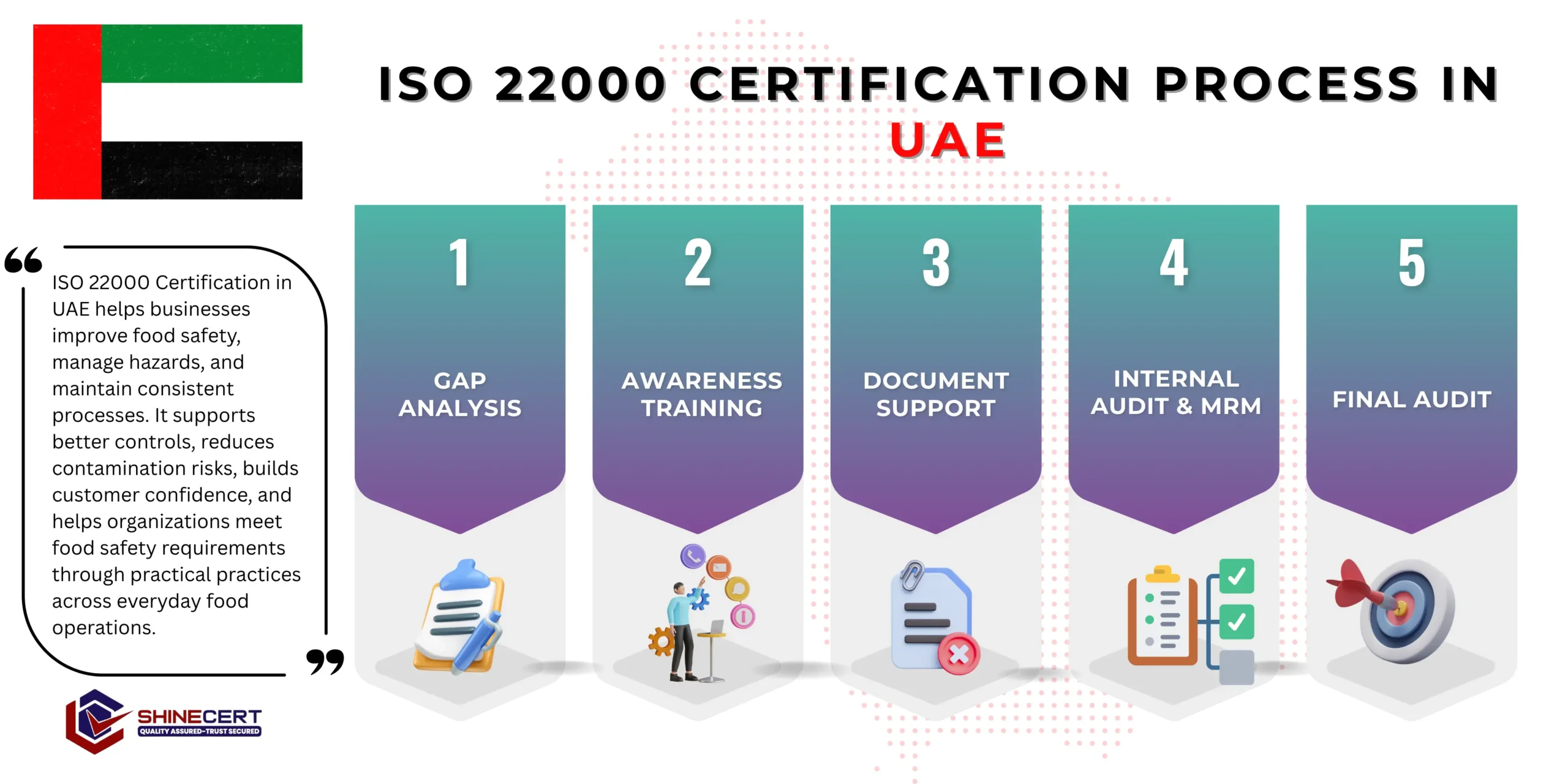
What are the steps to get ISO 22000 Certification in UAE?
our services
- ISO Certification UAE
- ISO 9001 Certification UAE
- ISO 14001 Certification UAE
- ISO 27001 Certification UAE
- ISO 22000 Certification UAE
- ISO 27701 Certification UAE
- ISO 45001 Certification UAE
- ISO 20000-1 Certification UAE
- ISO 13485 Certification UAE
- ISO 17025 Certification UAE
- ISO 31000 Certification UAE
- ISO 42001 Certification UAE
- ISO 37001 Certification UAE
- ISO 22301 Certification UAE
- ISO 50001 Certification UAE
- CE Mark Certification UAE
- GDPR Certification UAE
- GMP Certification UAE
- Halal Certification UAE
How We Handle This?
Gap analysis and hazard analysis
We assess current practices and run a hazard analysis specific to your actual products, identifying critical control points that matter for your operation, not a generic list.
A gap analysis and hazard analysis scoped to your specific product lines.
Documentation
Your food safety policy, prerequisite programs, and HACCP plan get built with Dubai Municipality and ESMA requirements explicitly addressed.
A complete food safety management documentation set, including your HACCP plan and traceability procedures.
Implementation and training
Prerequisite programs and critical control point monitoring get rolled out, with food handlers trained on hygiene practices specific to your facility.
Training records and evidence of functioning critical control point monitoring.
Internal audit and management review
A rigorous internal audit covering food safety performance, followed by a management review addressing verification results.
An internal audit report and management review minutes showing genuine leadership engagement.
Certification audit
We coordinate Stage 1 and Stage 2 with an EIAC-accredited or IAF-recognized body.
Your ISO 22000 certificate and a surveillance audit schedule.
What You Actually Get?
- Access to larger retail, hotel, and government catering contracts that increasingly specify formal food safety certification as a supplier requirement.
- Stronger positioning with Dubai Municipality during inspections, since structured evidence beats scrambling to produce documentation on the spot.
- Genuine traceability that protects you during a recall situation, rather than discovering during a crisis that your paper trail has gaps.
- Reduced product safety incidents, which matters both for consumer safety and for protecting your brand in a market where reputational damage travels fast.
- A natural complement to Halal certification for UAE food businesses pursuing both, given overlapping documentation and traceability requirements.
What It Costs?
Quick answer : ISO 22000 certification in the UAE typically runs AED 14,000 to AED 65,000, with product and process complexity as the main driver.
Multiple product lines with varied hazard profiles need more extensive hazard analysis.
Less foundational work needed if you’re already running HACCP.
Distinct from consulting support.
Each site typically needs its own hazard analysis.
Shared traceability and documentation requirements.
Where Companies Usually Trip Up?
- Traceability that stops at the local distributor : It needs to trace back to actual origin, and inspectors increasingly test this directly.
- Treating the food safety team leader role as purely technical : Real organizational authority is required, not just technical knowledge.
- Underestimating cold chain documentation : Given the climate, this needs to be genuinely verified, not assumed.
- Overlooking destination-specific requirements for re-export : A product cleared for the UAE isn’t automatically cleared for onward GCC distribution.
Where This Shows Up Most?
Food Import and Distribution
Given how much of the UAE’s food supply arrives from elsewhere, this is arguably the single largest relevant category.
Read moreFood Manufacturing and Processing
Direct applicability for the UAE’s growing domestic food production sector.
Read moreHospitality and Catering
Hotels and large-scale catering, including operations serving major events and tourism, increasingly require certified suppliers.
Read moreRetail and Supermarkets
Larger retail chains increasingly specify certification as a supplier prequalification requirement.
Read moreFood Packaging
Materials in direct food contact fall within the standard’s supply chain scope.
Read moreISO 22000 and the Reality of Being an Import-Dependent Food Market
Very few countries face quite the same food safety supply chain challenge the UAE does, given how little of the food consumed here is actually produced domestically. We’ve found that food businesses treating ISO 22000’s traceability requirements as a genuine operational priority, rather than a paperwork exercise satisfied by a shipping manifest, build considerably more resilient supply chains, and more importantly, respond to actual food safety incidents, when they occur, with real speed and precision rather than scrambling to reconstruct a supply chain after the fact. This matters enormously during a recall situation, where the difference between a genuinely traceable system and one that only looks traceable on paper becomes immediately, painfully obvious.
What the Standard Actually Requires?
- Context of the Organization : Identify the food safety issues relevant to your operations and who cares about them, Dubai Municipality, ESMA, and for hotel or retail suppliers, whatever specific requirements those buyers impose contractually. UAE food processors running multiple product lines need a scope statement that clearly says which products and processes are actually covered.
- Leadership : Someone needs real authority to make food safety decisions, including stopping production when something’s wrong, this is a formally designated role under the standard, not an informal understanding. We’ve seen UAE food manufacturers assume a technical quality assurance manager can hold this role without genuine organizational authority behind them, which auditors specifically check for during Stage 2 by testing whether that person can actually act, not just advise.
- Planning : Identify food safety risks and set measurable objectives. For UAE food importers and distributors specifically, this planning should explicitly address destination-specific requirements, a product cleared for UAE distribution might still need additional considerations for re-export to other GCC markets given varying local requirements.
- Support : Resources, competence, and infrastructure specific to food safety, including genuinely trained food handlers and production infrastructure that actually supports food safety control. Given the UAE’s climate, cold chain integrity from port of entry through final distribution is a particularly important, non-negotiable piece of this, not something you can assume works because the paperwork says it should.
- Operation : This is where the real content lives: hazard analysis, prerequisite programs covering hygiene and pest control, critical control point determination, and traceability systems. UAE food importers need traceability that genuinely works backward to country and facility of origin, not just to the local distributor, Dubai Municipality inspectors increasingly test this directly during audits and product recalls.
- Performance Evaluation : Monitoring critical control points and verifying the system actually works as designed, plus tracking compliance against both Dubai Municipality and ESMA requirements systematically.
- Improvement : A structured response to food safety incidents, including recall procedures where necessary, and continual improvement based on verification results and any regulatory findings.
Dubai as a Re-Export Hub: An Extra Layer of Traceability Complexity
- A meaningful share of the food moving through the UAE isn’t actually destined for UAE consumers at all, it passes through Jebel Ali Port, JAFZA, or DMCC’s dedicated food logistics infrastructure on its way to onward markets across the wider Gulf, East Africa, and South Asia. This re-export role is genuinely significant to Dubai’s economy, but it adds a layer of traceability complexity that a purely domestic-market food business wouldn’t face: a shipment might clear UAE customs, sit briefly in bonded warehousing, and move on to a destination market with its own separate food safety requirements, all without ever being formally “released” into UAE retail circulation.
- For food businesses operating in this re-export capacity, ISO 22000 certification does double duty. It satisfies UAE buyers and Dubai Municipality’s own oversight of goods moving through its jurisdiction, and it also gives destination-market customers, a distributor in Nairobi, a retailer in Karachi, a recognized, internationally portable signal of food safety competence that doesn’t need to be re-established from scratch for every new market relationship. We’ve generally recommended that UAE-based re-exporters build traceability procedures that explicitly document the “pass-through” chain of custody, including bonded warehousing conditions and any repackaging or relabeling steps, since these are exactly the points where an otherwise solid traceability system tends to develop gaps. Auditors reviewing re-export operations pay particular attention to temperature logs during bonded storage and to whether repackaging activities are captured under the same hazard analysis as the original product.
- This matters because a food safety incident traced back to UAE-handled goods, even goods that were only ever in transit, can damage the reputation of the handling business regardless of where the product was originally produced or ultimately consumed.
Timeline
Quick answer : ISO 22000 certification in the UAE typically takes two to five months, similar to other established standards.
Phase | Typical Duration |
Gap analysis and hazard analysis | 3–4 weeks |
Documentation development | 4–6 weeks |
Implementation and training | 3–5 weeks |
Internal audit and management review | 1–2 weeks |
Certification audit (Stage 1 + Stage 2) | 3–4 weeks |
Total | 2–5 months |
Documentation You’ll Need
Quick answer : ISO 22000 requires a food safety policy, hazard analysis and HACCP plan, prerequisite program documentation, traceability procedures, and records covering critical control point monitoring, internal audits, and management review.
Real leadership commitment, not a generic statement.
Documented assessment of hazards and the critical control points managing them.
Records covering hygiene, pest control, and supplier approval.
Documented, genuinely testable systems tracing products from origin through to shelf, critical for a market this import-dependent.
Ongoing monitoring evidence, not periodic spot checks.
Confirmation the system genuinely functions as designed.
The evidence trail showing genuine oversight.
Why ShineCert?
We coordinate UAE engagements from ShineCert’s Riyadh and Lebanon offices, with direct familiarity with Dubai Municipality and ESMA requirements. Our team has guided more than 10,000 organizations through ISO certification globally, and as the best ISO 22000 consultant in UAE, we bring specific depth in UAE’s food import, re-export, and distribution sector.
Choosing a Certification Body?
What to Check | Why It Matters |
EIAC accreditation, or another IAF-recognized body | Confirms genuine international recognition |
Food import and distribution audit experience | Matters given how central the import chain is to UAE food safety risk |
Familiarity with Dubai Municipality and ESMA expectations | Helps ensure certification genuinely supports regulatory interactions |
Multi-market GCC recognition | Relevant for food businesses distributing beyond the UAE alone |
Ready to Get Certified?
ShineCert supports UAE food businesses end to end, from hazard analysis through certification audit, with direct experience across the import and distribution chain. Book a free consultation or contact us directly, and we’ll review your products before proposing a fixed-scope plan.
Frequently Asked Questions
Yes, it gives destination-market customers a recognized, internationally portable signal of food safety competence, and it helps demonstrate proper chain-of-custody control over goods passing through UAE bonded warehousing and free zones.
Typically AED 14,000 to AED 65,000, depending on product complexity.
No, it’s voluntary, though larger retail and hospitality contracts increasingly require it in practice.
Typically two to five months.
No, it complements it with a systematic management approach, but legal compliance must still be independently met.
No, it incorporates HACCP principles within a broader management system covering leadership, prerequisite programs, and continual improvement.
Yes, significant documentation and traceability requirements overlap.
We coordinate UAE engagements from our Riyadh and Lebanon offices, with consultants traveling on-site as needed.