
ISO 27001 Certification in UAE
Quick Answer
If your UAE business handles customer data, works with financial institutions, or serves government clients, ISO 27001 has probably already come up in a conversation with a partner or auditor. It’s the international standard for information security management, and it matters in the UAE for a specific reason: the country’s Personal Data Protection Law (PDPL), Federal Decree-Law No. 45 of 2021, reached full enforcement in 2026, with the transition period closing entirely by January 2027, and ISO 27001 provides the structured management framework that makes ongoing PDPL compliance considerably less chaotic. Look for a certification body accredited by the Emirates International Accreditation Centre (EIAC) or another IAF-recognized body. Expect to pay AED 18,000 to AED 85,000 depending on your data footprint, and plan for three to seven months from start to certificate.
What ISO 27001 Actually Covers?
ISO 27001 isn’t a checklist of IT security tools you buy and install, it’s a management system requiring you to genuinely assess your information security risks, choose controls that actually address them from the standard’s Annex A, and then run a system that keeps checking whether those controls still work as your business and threats change. It covers people, process, and technology together, which is the part companies most often underestimate: a business can have excellent firewalls and still fail an ISO 27001 audit because nobody’s tracking who has access to what, or because there’s no documented incident response plan beyond “call IT.”
Why This Matters More in the UAE Than It Used To?
- The UAE’s PDPL was closely modeled on the EU’s GDPR, which means UAE businesses handling personal data now face genuine, enforceable obligations, the UAE Data Office can levy fines from AED 50,000 up to AED 5 million for serious or repeat violations. That’s not a theoretical risk anymore; 2026 is the year full enforcement kicked in, with the grace period closing entirely in January 2027. On top of PDPL, a newer law worth knowing about, Federal Decree-Law No. 26 of 2025 on Child Digital Safety, took effect in January 2026, adding specific obligations around age verification and parental consent for platforms serving users under 18, which is directly relevant if your UAE business runs any consumer-facing digital product.
- None of this means ISO 27001 automatically satisfies PDPL on its own, it doesn’t, and anyone telling you otherwise is oversimplifying. What it does is give you a structured, auditable way to organize the risk assessment and control implementation work PDPL compliance actually requires, instead of scrambling to build ad hoc processes every time a new regulatory question comes up. For DIFC and ADGM-based financial services firms specifically, the DFSA and FSRA’s own cybersecurity expectations layer on top of both PDPL and ISO 27001, and coordinating all three from the start saves considerable duplicated effort later.
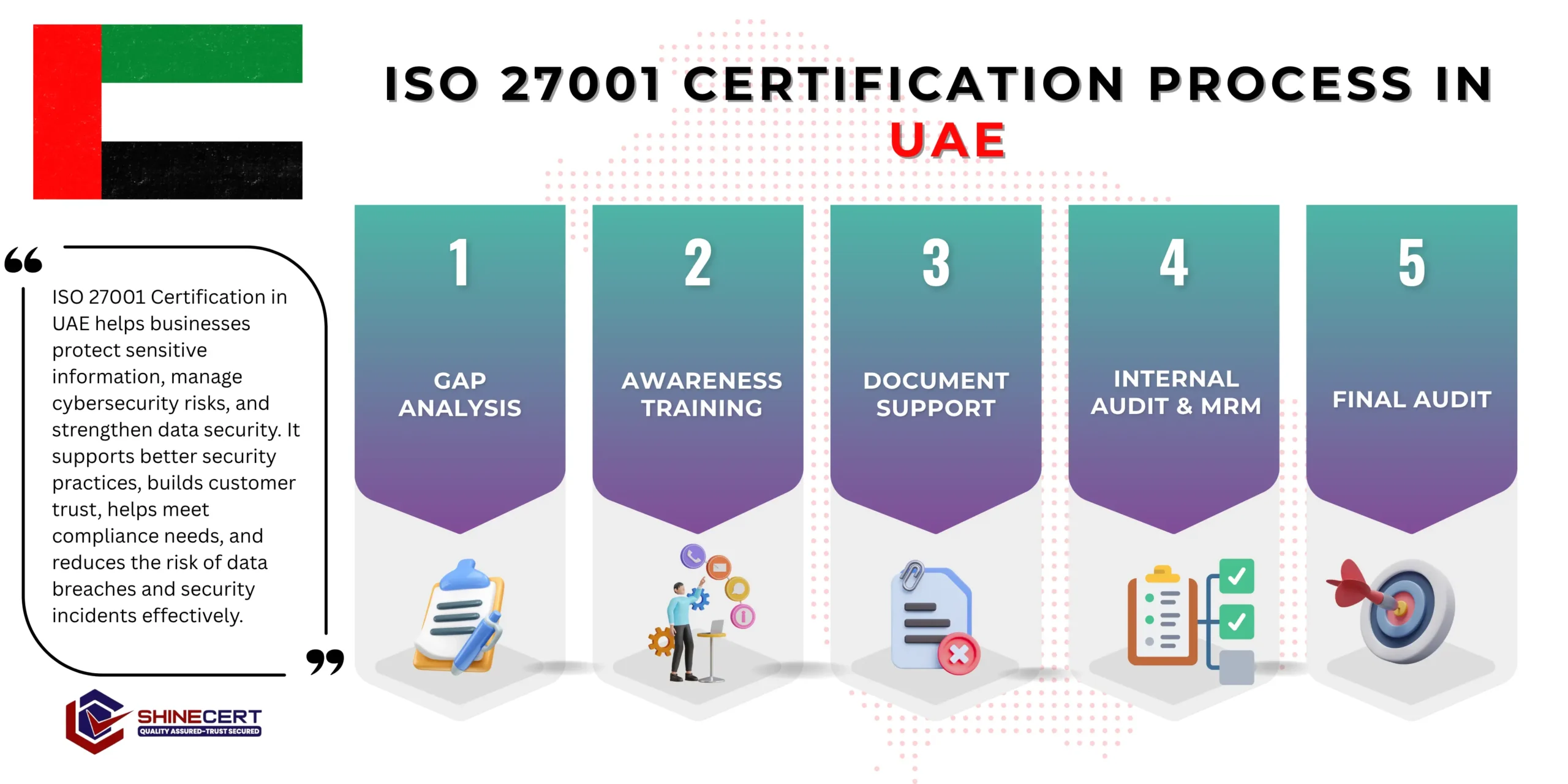
What are the steps to get ISO 27001 Certification in UAE?
our services
- ISO Certification UAE
- ISO 9001 Certification UAE
- ISO 14001 Certification UAE
- ISO 27001 Certification UAE
- ISO 22000 Certification UAE
- ISO 27701 Certification UAE
- ISO 45001 Certification UAE
- ISO 20000-1 Certification UAE
- ISO 13485 Certification UAE
- ISO 17025 Certification UAE
- ISO 31000 Certification UAE
- ISO 42001 Certification UAE
- ISO 37001 Certification UAE
- ISO 22301 Certification UAE
- ISO 50001 Certification UAE
- CE Mark Certification UAE
- GDPR Certification UAE
- GMP Certification UAE
- Halal Certification UAE
How We Get You There
Gap analysis and risk assessment
We check your current practices against ISO 27001 and run a genuine risk assessment, cross-referencing PDPL obligations and, where relevant, DFSA or FSRA expectations from the outset.
A gap analysis, risk assessment, and draft Statement of Applicability specific to your business.
Building the documentation
Your security policy, risk treatment plan, and procedures get built with PDPL’s specific requirements woven in, not bolted on afterward.
A complete ISMS documentation set, including a finalized Statement of Applicability.
Rolling it out
Controls get implemented and staff get trained, with particular attention to anyone handling personal data or holding privileged system access.
Training records and evidence your access control and incident response procedures actually function.
Internal audit and management review
A genuinely independent internal audit, then a management review covering control effectiveness and legal compliance status.
An internal audit report and management review minutes showing real engagement with security risk.
Certification audit
We coordinate Stage 1 and Stage 2 with an EIAC-accredited or IAF-recognized body, then support you through any corrective actions.
Your ISO 27001 certificate and a surveillance audit schedule.
What You Actually Get Out of It?
- Government and financial sector vendor qualification gets noticeably easier when you’re not the only bidder without a recognized security credential.
- PDPL compliance efforts get organized around a real management structure instead of scattered ad hoc fixes whenever a new requirement surfaces.
- DIFC and ADGM firms get a credential that speaks directly to DFSA and FSRA’s cybersecurity expectations, on top of satisfying international counterparties.
- Breach risk and impact both drop measurably once you’re systematically assessing and treating risk instead of reacting after something goes wrong.
- International partners and investors increasingly expect ISO 27001 as table stakes before they’ll discuss data-sharing arrangements.
- Certification sets you up well for ISO 27701 later if privacy management becomes a bigger priority, since it builds directly on an existing 27001 system.
What It Costs?
Quick answer: ISO 27001 certification in the UAE typically runs AED 18,000 to AED 85,000, with data sensitivity and infrastructure complexity as the biggest cost drivers.
Organizations handling extensive personal or financial data need more extensive risk assessment work.
Companies already running reasonable security practices need less foundational work.
The accredited body’s audit fee is distinct from consulting support.
Heavy reliance on outsourced IT means more supplier security assessment work.
If privacy management is on your roadmap given PDPL, plan for the extension early.
Common Mistakes
- Assuming ISO 27001 equals PDPL compliance : It supports compliance efforts but doesn’t replace the need to independently verify PDPL’s specific legal obligations.
- Treating the Statement of Applicability as a one-time document : It needs active maintenance as your risk environment evolves.
- Underestimating third-party and cloud risk assessment : Outsourced infrastructure dependencies get overlooked more often than they should.
- Training only IT staff on security awareness : PDPL obligations extend to anyone touching personal data, sales, HR, customer service, not just technical teams.
Where ISO 27001 Shows Up Most?
Financial Services
DIFC and ADGM firms face DFSA/FSRA cybersecurity expectations that ISO 27001 directly supports.
Read moreTechnology and Fintech
UAE’s growing tech sector relies on certification for enterprise customer trust, particularly with international clients.
Read moreGovernment-Linked Entities and Contractors
Vendor qualification increasingly references formal information security credentials.
Read moreHealthcare
Patient data sensitivity, combined with PDPL, has made this increasingly relevant for UAE healthcare providers.
Read moreTelecommunications
Critical infrastructure status makes robust information security a near-necessity.
Read moreISO 27001 and the UAE’s New Data Transfer Reality
Here’s a detail worth knowing if your UAE business moves data internationally: as of mid-2026, the UAE Data Office hasn’t published a federal adequacy list or official Standard Contractual Clauses, meaning organizations transferring personal data out of mainland UAE need to rely on contractual safeguards modeled on international standards and document the legal basis for each transfer category themselves, rather than pointing to an official government framework. This is a genuine gap in the current regulatory landscape, not a minor technicality, and we’ve found that UAE companies building their ISO 27001 risk assessment with this transfer documentation requirement explicitly built in, rather than treating cross-border data flow as an afterthought, end up with considerably stronger PDPL compliance positioning than those who only address it once a client or regulator asks a direct question about it.
The Requirements That Actually Matter
- Context of the Organization : You need to map out the information security issues genuinely relevant to your business and who cares about them, customers, the UAE Data Office, and for DIFC or ADGM firms, DFSA or FSRA. Get your scope statement precise here; a vague scope is one of the most common reasons certification ends up not covering the systems it actually needed to.
- Leadership : Top management has to own the information security policy, not hand it off entirely to IT. We’ve noticed this trip up UAE companies pursuing certification for government or financial sector contracts specifically, the technical implementation is often solid, but auditors are trained to check whether leadership genuinely understands security as a business risk, not just a technical problem someone else handles.
- Planning : This is where your formal risk assessment lives, resulting in a Statement of Applicability documenting which Annex A controls you’ve applied and why. UAE organizations should build this with PDPL’s specific requirements explicitly in view from day one, since retrofitting PDPL alignment onto a risk assessment built without it in mind means redoing meaningful chunks of the work later.
- Support : Covers whether you actually have the resources and trained people to run the system, including staff who handle personal data getting real security awareness training, not a slideshow they click through once a year.
- Operation : Implementing your risk treatment plan in practice: access control, incident response, and if you rely on cloud providers or outsourced IT (which most UAE companies do to some degree), supplier security requirements too.
- Performance Evaluation : Monitoring whether your controls are actually working, running internal audits, and doing management review, plus tracking your PDPL compliance status as an ongoing part of this evaluation, not a separate box you check once a year.
- Improvement : A documented, structured response to security incidents and nonconformities, with genuine continual improvement as new threats and regulatory changes emerge, and in the UAE right now, regulatory change is happening fast enough that this clause matters more than it might in a more static regulatory environment.
Timeline
Quick answer: ISO 27001 certification in the UAE typically takes three to seven months, generally longer than ISO 9001 given the depth of risk assessment involved.
Phase | Typical Duration |
Gap analysis and risk assessment | 3–5 weeks |
Documentation development | 5–7 weeks |
Implementation and training | 4–6 weeks |
Internal audit and management review | 1–2 weeks |
Certification audit (Stage 1 + Stage 2) | 3–5 weeks |
Total | 3–7 months |
Documentation You’ll Need on File
Quick answer: ISO 27001 requires an information security policy, risk assessment and treatment plan, a Statement of Applicability, an asset inventory, and records covering access control, incidents, audits, and management review.
Genuine leadership-issued commitment, not boilerplate.
The methodology and results behind your control selection.
Every Annex A control, applied or excluded, with justification for each.
What information assets you have and how they’re classified, particularly relevant given PDPL’s data classification implications.
How access gets granted, reviewed, and revoked, and how incidents get detected and handled.
The evidence trail showing the system is genuinely checked and adjusted.
A tracked list including PDPL and, where relevant, DFSA or FSRA obligations.
UAE companies should keep the Statement of Applicability genuinely current, it’s one of the documents international clients and investors ask for directly during due diligence, more often than you’d expect.
Why ShineCert?
We coordinate UAE engagements from ShineCert’s Riyadh and Lebanon offices, with direct familiarity with PDPL, DFSA, and FSRA expectations. Our team has guided more than 10,000 organizations through ISO certification globally, and as the best ISO 27001 consultant in UAE, we bring specific depth in the UAE’s fast-evolving data protection landscape.
Choosing a Certification Body
What to Check | Why It Matters |
EIAC accreditation, or another IAF-recognized body | Confirms genuine international recognition |
PDPL and Child Digital Safety Law familiarity | Ensures certification genuinely supports your regulatory compliance, not just a standalone credential |
DIFC/ADGM financial sector experience | Matters if you’re regulated by DFSA or FSRA |
Technical depth for cloud risk assessment | Relevant given how many UAE companies rely on outsourced infrastructure |
Ready to Get Certified?
ShineCert supports UAE businesses navigating ISO 27001 alongside PDPL, from risk assessment through certification audit. Book a free consultation or contact us directly, and we’ll review your data environment before proposing a fixed-scope plan.
Frequently Asked Questions
Typically AED 18,000 to AED 85,000, depending on data sensitivity and company size.
No, it’s voluntary, though government, financial sector, and enterprise vendor qualification increasingly make it a practical necessity.
Typically three to seven months.
No, it supports compliance through structured risk management, but PDPL’s specific legal obligations must still be independently met.
Federal Decree-Law No. 26 of 2025, in force since January 2026, adds specific obligations for platforms serving users under 18, relevant to factor into your risk assessment if applicable.
Yes, ISO 27701 is a privacy-specific extension built on an existing ISO 27001 certification.
We coordinate UAE engagements from our Riyadh and Lebanon offices, with consultants traveling on-site as needed.