
ISO 45001 Certification in UAE
Quick Answer
The UAE’s construction sector runs at a pace few countries match, with major developments happening simultaneously across Dubai and Abu Dhabi, and that pace has real safety implications that the Ministry of Human Resources and Emiratisation (MOHRE) takes seriously. ISO 45001 is the international occupational health and safety management standard, and it gives UAE employers a structured way to demonstrate genuine safety management maturity rather than just a stack of toolbox talk records. Get certified through a body accredited by the Emirates International Accreditation Centre (EIAC) or another IAF-recognized body. Costs typically run AED 18,000 to AED 95,000, and plan for three to six months from kickoff to certificate.
What ISO 45001 Actually Requires?
Unlike most other ISO standards, ISO 45001 carries one requirement that genuinely sets it apart: real worker participation in safety decision-making, not just management issuing rules from the top down. It requires you to identify workplace hazards, assess and control risk, and build a system that continually improves safety performance, but the standard also specifically checks whether frontline workers have a genuine voice in the process, auditors interview workers directly to verify this during certification, not just review paperwork. Built on the same Harmonised Structure as ISO 9001 and 14001, it replaced the older OHSAS 18001 and integrates considerably more cleanly with other management systems as a result.
Why This Matters More in the UAE Right Now?
MOHRE has expanded workplace safety inspection activity meaningfully over recent years, and with the volume of concurrent major construction projects across Dubai and Abu Dhabi, safety credentials have become genuinely relevant to how contractors get selected for large-scale work, not a nice-to-have anymore, but something increasingly baked into prequalification. The UAE’s workforce composition also matters here: most construction and industrial labor comes from a genuinely diverse mix of nationalities, which means safety training that only works in one language leaves real gaps, and ISO 45001’s competence requirements force employers to actually address this rather than assume a single safety briefing covers everyone adequately.
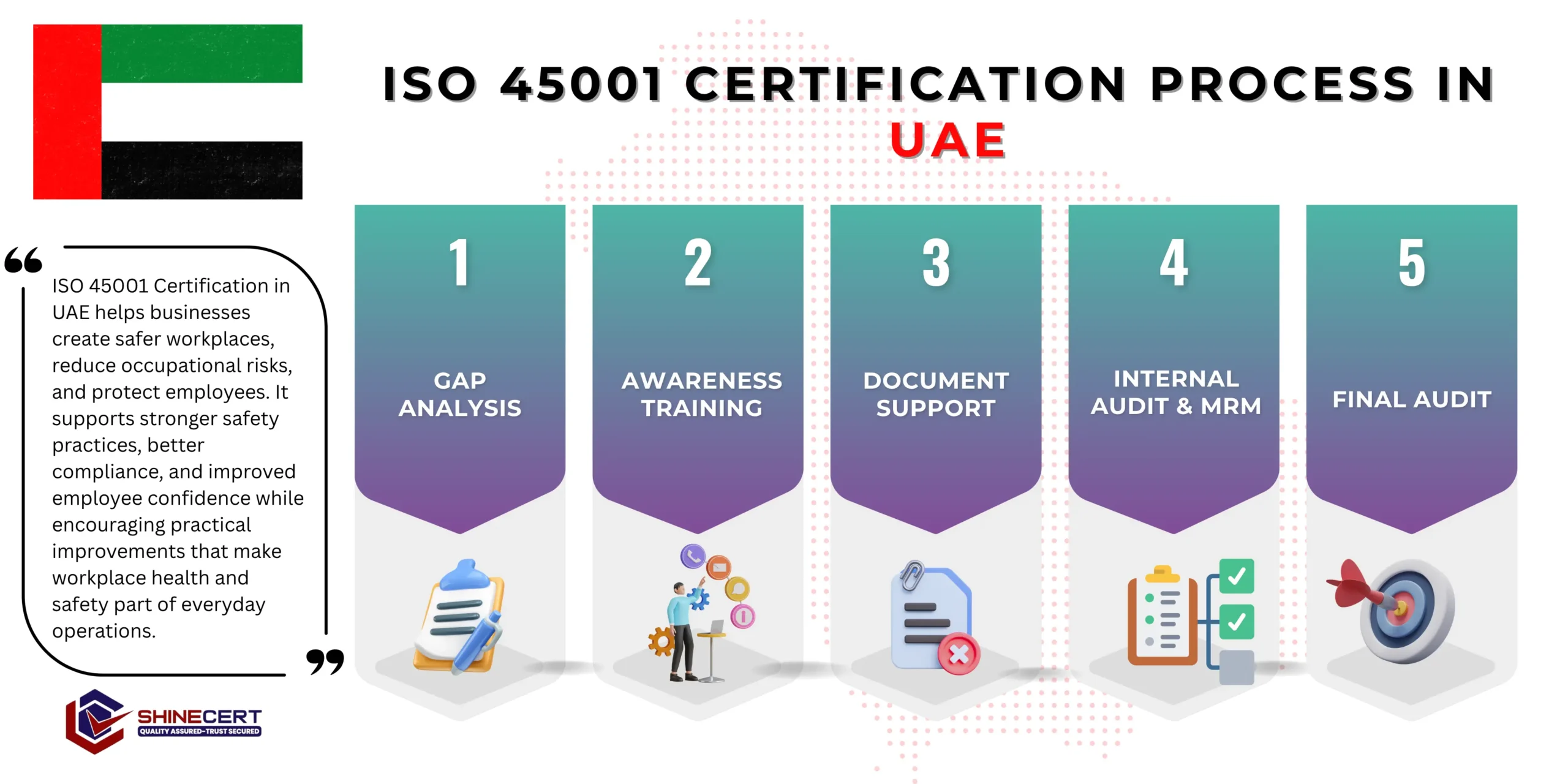
What are the steps to get ISO 45001 Certification in UAE?
our services
- ISO Certification UAE
- ISO 9001 Certification UAE
- ISO 14001 Certification UAE
- ISO 27001 Certification UAE
- ISO 22000 Certification UAE
- ISO 27701 Certification UAE
- ISO 45001 Certification UAE
- ISO 20000-1 Certification UAE
- ISO 13485 Certification UAE
- ISO 17025 Certification UAE
- ISO 31000 Certification UAE
- ISO 42001 Certification UAE
- ISO 37001 Certification UAE
- ISO 22301 Certification UAE
- ISO 50001 Certification UAE
- CE Mark Certification UAE
- GDPR Certification UAE
- GMP Certification UAE
- Halal Certification UAE
How We Handle This?
Gap analysis and environmental aspects identification
We assess your current practices and run a structured environmental aspects assessment specific to your operations, a manufacturing facility’s emissions and waste streams look very different from a construction contractor’s site-level footprint.
A gap analysis and environmental aspects register scoped to your business.
Documentation
Your environmental policy, objectives, and procedures get built with your specific permitting obligations and any project-level sustainability commitments explicitly addressed.
A complete EMS documentation set, including your compliance obligations register.
Implementation and training
Operational controls get rolled out and staff trained on environmentally significant activities relevant to their actual roles.
Training records and evidence operational controls genuinely function.
Internal audit and management review
A rigorous internal audit covering environmental performance and compliance, followed by a management review addressing objectives progress and any findings.
An internal audit report and management review minutes showing real leadership engagement.
Certification audit
We coordinate Stage 1 and Stage 2 with an EIAC-accredited or IAF-recognized body, and help you plan for the ISO 14001:2026 transition if that’s relevant to your certification scope.
Your ISO 14001 certificate and a surveillance audit plan.
What You Actually Get?
- Prequalification for major construction and industrial tenders gets noticeably easier once demonstrated safety management maturity is off the table as a question.
- MOHRE compliance positioning strengthens considerably with structured evidence of genuine safety management, rather than scrambling to produce documentation during an inspection.
- Workforce retention tends to improve in a competitive labor market when workers genuinely experience a safer, more consultative workplace.
- Fewer safety incidents means fewer project delays from stoppages, which matters on time-sensitive UAE developments with real delivery deadlines.
- Certification sets you up efficiently for combined certification with ISO 9001 and 14001 given the shared Harmonised Structure.
What It Costs?
Quick answer : ISO 45001 certification in the UAE typically runs AED 18,000 to AED 95,000, with workforce risk profile as the biggest cost driver.
High-hazard construction or industrial work costs more than lower-risk office environments.
Each active project site typically needs its own hazard assessment.
Distinct from consulting support.
More involved than simply issuing a safety policy.
The shared Harmonised Structure makes combined certification more efficient.
Where Companies Usually Trip Up?
- Treating worker consultation as paperwork : Auditors interview workers directly, and a process that only exists on paper fails.
- Underestimating heat stress management : A genuine, well-scrutinized risk category here, not a minor addition to a generic template.
- Training in the wrong language : Training a workforce doesn’t understand doesn’t satisfy the competence requirement, regardless of attendance records.
- Disconnecting from MOHRE data : Safety performance evaluation should actively reference MOHRE inspection history, not rely solely on internal reporting.
Where This Shows Up Most?
Construction
Major concurrent developments across Dubai and Abu Dhabi drive the most significant safety scrutiny given project scale and heat exposure risk.
Read moreManufacturing
Machinery and chemical handling risks make ISO 45001 close to essential for UAE manufacturers.
Read moreOil, Gas, and Industrial Facilities
High-hazard process industries rely on ISO 45001 alongside sector-specific safety frameworks.
Read moreLogistics and Warehousing
Material handling and vehicle safety risks make this relevant across UAE’s substantial logistics sector.
Read moreFacilities Management
Large commercial and mixed-use developments increasingly expect safety credentials from service providers.
Read moreISO 45001 and the Pace of UAE Construction
The sheer concurrent scale of construction activity across Dubai and Abu Dhabi creates safety management challenges that differ meaningfully from slower-growing markets, rapid workforce scaling, deep subcontractor networks with varying safety maturity, and genuine climate-driven risk that makes heat stress management a leading concern rather than an afterthought. We’ve found that contractors who build ISO 45001 systems specifically designed around these realities, rather than adapting a generic template built for a different climate and workforce structure, achieve considerably better real safety outcomes, not just smoother certification audits. This matters most for main contractors managing multi-tier subcontractor networks, where safety requirements increasingly flow down contractually, making a genuinely functioning system a real competitive differentiator in subcontractor selection.
What the Standard Actually Asks For?
- Context of the Organization : You need to identify the safety issues genuinely relevant to your operations and who cares about them, MOHRE, and for construction contractors, whatever safety requirements the specific developer sets for a given project. Companies running projects across multiple emirates need a scope statement that clearly covers which sites and workforce populations the system actually addresses.
- Leadership and Worker Participation : This is the clause that catches companies off guard most often. It’s not enough to issue a safety policy from the top, you need genuine consultation mechanisms, like functioning worker safety committees, that actually work across the language and cultural differences present on most UAE work sites. Auditors interview frontline workers specifically to check whether this consultation is real or just exists on paper, and a token committee that never meets doesn’t survive that scrutiny.
- Planning : Systematic hazard identification and risk assessment covering both routine and non-routine work, plus a documented process for managing change when new equipment or work locations get introduced. For UAE construction contractors moving between project sites, hazard assessments need to be genuinely site-specific, extreme summer heat exposure is a real, well-documented risk category here, not a footnote to add to a generic template built for a temperate climate.
- Support : Competence, training, and communication specific to occupational safety, including documented evidence that workers doing hazardous tasks have real safety training delivered in a language they actually understand, a meaningful practical requirement given how multinational most UAE construction workforces are.
- Operation : Documented operational controls for identified hazards, plus emergency preparedness including heat stress management protocols, and procedures for managing subcontractors on multi-tier projects, which is the norm rather than the exception on major UAE developments.
- Performance Evaluation : Monitoring safety performance through both leading indicators like near-miss reporting and lagging indicators like injury rates, plus systematically evaluating compliance against MOHRE-relevant legal requirements.
- Improvement : Structured incident investigation and corrective action, addressing both the immediate cause of an incident and any systemic safety gap it reveals, applied consistently rather than only after serious incidents.
Heat Stress Management: The Risk Category UAE Employers Can’t Treat as an Afterthought
- If there’s one hazard category we consistently push UAE clients to take more seriously than they initially plan to, it’s heat stress. The UAE’s mandatory midday work break during summer months addresses part of the risk, but ISO 45001’s hazard assessment requirements go considerably further than simple compliance with that rule, requiring genuine, documented risk evaluation covering hydration protocols, acclimatization procedures for newly arrived workers, heat illness recognition training, and emergency response specific to heat-related incidents.
- We’ve found that contractors who build a genuinely thorough heat stress management program, rather than treating the midday break as sufficient on its own, see measurably fewer heat-related incidents over a full summer season, and this operational reality translates directly into stronger audit outcomes too, since auditors increasingly probe this specific hazard category closely given how well-documented and foreseeable the risk is in this climate. Workers newly arrived in the UAE, unaccustomed to the summer heat, represent a particularly significant risk group that a generic, one-size-fits-all safety program often fails to address adequately, and a genuinely well-designed acclimatization protocol phased over the first one to two weeks of a new worker’s exposure makes a measurable difference in incident rates during exactly this vulnerable period.
Timeline
Quick answer : ISO 45001 certification in the UAE typically takes three to six months, with high-hazard multi-site construction sometimes needing longer.
Phase | Typical Duration |
Gap analysis and hazard identification | 2–4 weeks |
Documentation development | 4–6 weeks |
Implementation and training | 3–6 weeks |
Internal audit and management review | 1–2 weeks |
Certification audit (Stage 1 + Stage 2) | 3–4 weeks |
Total | 3–6 months |
Documentation You’ll Need
Quick answer : ISO 45001 requires an OHS policy, a hazard identification and risk assessment register, worker consultation records, and documentation covering incident investigation, internal audits, and management review.
Genuine leadership commitment to worker safety, not generic language.
Site-specific, covering both routine and non-routine activities.
A tracked list of MOHRE-relevant occupational safety obligations.
Documented evidence of genuine worker involvement, which auditors specifically probe.
Covering scenarios relevant to your operations, including heat stress protocols.
What happened, why, and what corrective action followed.
Evidence workers doing hazardous tasks have real, understood training.
UAE construction contractors should keep worker consultation records genuinely current, this is where audits most often surface gaps between what’s documented and what’s actually happening on site.
Why ShineCert?
We coordinate UAE engagements from ShineCert’s Riyadh and Lebanon offices, with direct familiarity with MOHRE expectations and the realities of building safety systems across a genuinely multinational UAE construction and industrial workforce. Our team has guided more than 10,000 organizations through ISO certification globally, and as the best ISO 45001 consultant in UAE, we bring specific depth in UAE’s high-hazard sectors.
Choosing a Certification Body?
What to Check | Why It Matters |
EIAC accreditation, or another IAF-recognized body | Confirms genuine international recognition |
Construction or industrial audit experience | Matters for high-hazard operations |
Auditor experience verifying worker consultation genuinely | Ensures the audit tests real participation, not just documentation |
MOHRE familiarity | Helps ensure your system supports real regulatory interactions |
Ready to Get Certified?
ShineCert supports UAE businesses from hazard identification through certification audit, with direct experience across the region’s high-hazard construction and industrial sectors. Book a free consultation or contact us directly, and we’ll review your workforce and site safety needs before proposing a fixed-scope plan.
Frequently Asked Questions
Typically AED 18,000 to AED 95,000, depending on workforce risk profile.
No, it’s voluntary, though major construction and industrial tender prequalification increasingly make it a practical advantage.
Typically three to six months.
No, it complements them with a systematic management approach, but legal compliance must still be independently met.
Its distinctive requirement for genuine worker participation, verified directly through worker interviews during audits.
Yes, it shares the same Harmonised Structure as ISO 9001 and 14001.
We coordinate UAE engagements from our Riyadh and Lebanon offices, with consultants traveling on-site as needed.
No, the standard requires a genuinely comprehensive heat stress management program covering hydration, acclimatization, and heat illness recognition, not just compliance with the mandated break alone.