
ISO 9001 Certification in Egypt
Quick Answer
ISO 9001 certification confirms an organization’s quality management system meets an internationally recognized standard, verified by an independent, accredited certification body. In Egypt, it’s increasingly a commercial requirement rather than a nice-to-have: public-procurement guidelines for infrastructure, healthcare, and manufacturing projects frequently require bidders to hold a valid ISO 9001 certificate, and firms lacking one can be excluded from a meaningful share of state-funded contracts above a certain value. Certification typically takes three to six months from a genuine starting point, and most of the real work is building a quality system your business will actually use, not producing paperwork for an auditor.
Why ISO 9001 Matters in Egypt?
Procurement exclusion is real, not theoretical : Public-procurement guidelines for infrastructure, healthcare, and manufacturing projects in Egypt frequently require bidders to hold a valid ISO 9001 certificate, and firms lacking certification can be excluded from roughly 30% of state-funded contracts above a certain threshold.
Export markets increasingly expect it : Egyptian exporters of textiles, processed foods, chemicals, and IT services find that ISO credentials smooth entry into EU, GCC, and African markets, where buyers use certification as a fast, low-cost way to pre-qualify suppliers.
Industrial zone growth is creating first-time certification demand : The Suez Canal Economic Zone alone has drawn roughly $16 billion in investment over the past four years, with 205 factories now operational and 172 more under construction, many of them first-time exporters who will need to demonstrate quality credentials to international partners and financiers.
EOS sets the domestic reference point : The Egyptian Organization for Standardization and Quality, established in 1964, is Egypt’s national standards body and the domestic reference for quality requirements, though ISO 9001 certification itself is issued by internationally accredited certification bodies, not by EOS directly.
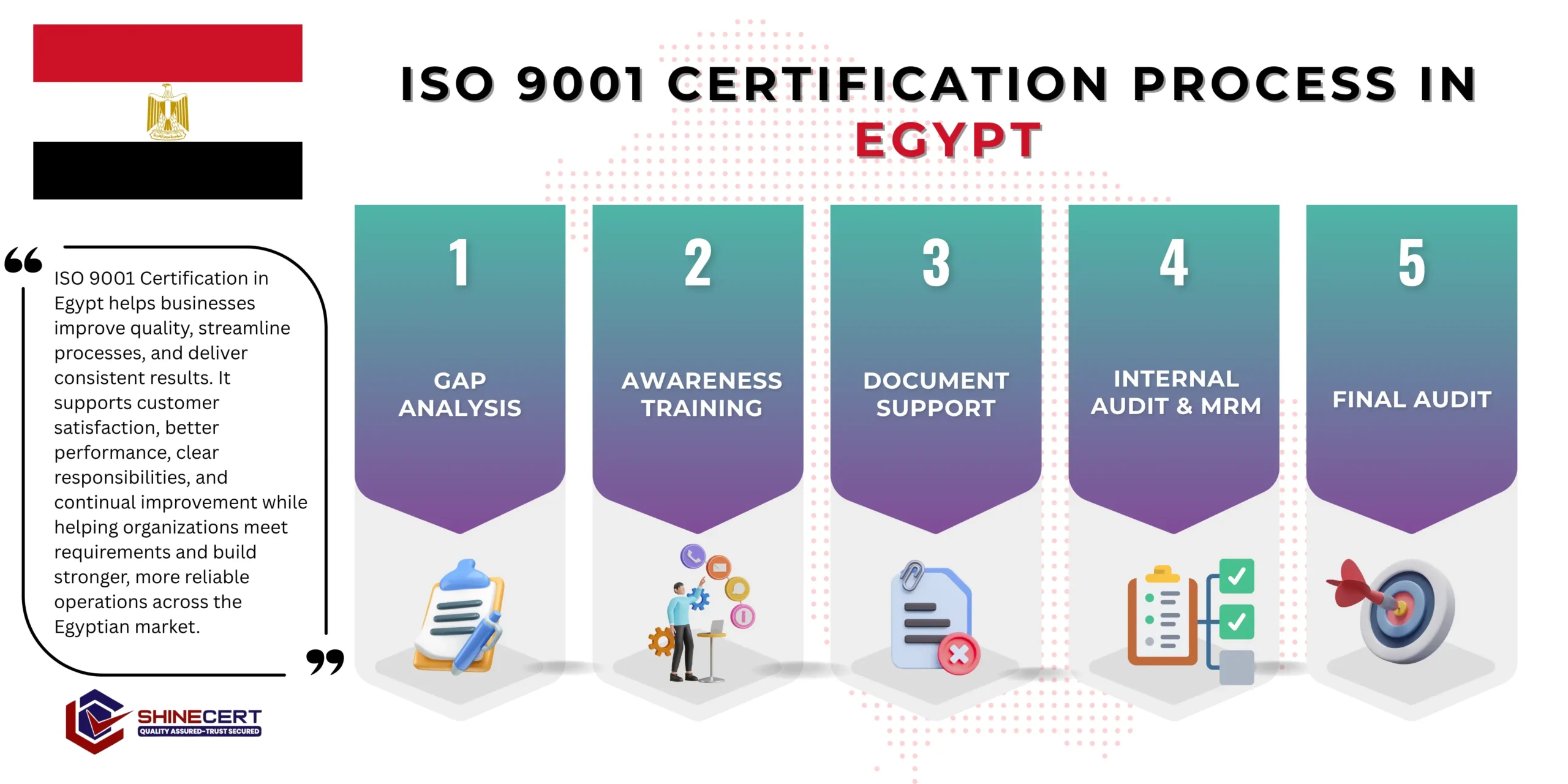
What are the steps to get ISO 9001 Certification in Egypt?
our services
- ISO Certification Egypt
- ISO 9001 Certification Egypt
- ISO 14001 Certification Egypt
- ISO 27001 Certification Egypt
- ISO 22000 Certification Egypt
- ISO 27701 Certification Egypt
- ISO 45001 Certification Egypt
- ISO 20000-1 Certification Egypt
- ISO 13485 Certification Egypt
- ISO 17025 Certification Egypt
- ISO 31000 Certification Egypt
- ISO 42001 Certification Egypt
- ISO 37001 Certification Egypt
- ISO 22301 Certification Egypt
- ISO 50001 Certification Egypt
- CE Mark Certification Egypt
- GDPR Certification Egypt
- GMP Certification Egypt
- Halal Certification Egypt
The ISO 9001 Certification Process in Egypt
Getting certified follows five steps. Here’s exactly what happens at each one.
Gap Assessment
We review your current processes against every clause from Context of the Organization through Improvement, not just the ones that are easy to document.
You get an honest map of exactly which clauses need real work versus which you already satisfy informally.
A clause-by-clause gap assessment report.
Documentation Development
We help write the quality manual, procedures, and records your specific operations need, mapped explicitly to Clauses 4 through 10.
Documentation that mirrors how your business actually runs, not a generic template with your company name inserted.
A complete, audit-ready documentation set.
Implementation and Training
The documented system goes live, and staff are trained on the specific parts of it relevant to their role, since a warehouse worker and a sales manager interact with the system very differently.
By the time the auditor asks staff about the quality system, they'll actually know the answer.
Training records and evidence of the system operating in daily practice.
Internal Audit and Management Review
We conduct an internal audit against Clause 9's requirements, then facilitate the management review Clause 5 and Clause 9 both require, surfacing any remaining gaps while there's still time to fix them quietly.
Nothing about the real audit should come as a surprise.
An internal audit report and management review minutes.
Certification Audit
An accredited certification body conducts the formal audit, typically in two stages, a documentation review followed by an on-site assessment, then issues your ISO 9001 certificate.
This is the step that actually unlocks the procurement and export doors described above.
Your ISO 9001 certificate and a three-year surveillance audit schedule.
What Is ISO 9001, Clause by Clause?
Most explanations of ISO 9001 stop at “it’s a quality management standard.” That’s true but not useful if you’re the one who has to implement it. Here’s what the standard document itself actually asks an organization to do, clause by clause, in plain language.
- Clause 4: Context of the Organization : Before anything else, the standard requires you to identify the internal and external issues that affect your ability to deliver consistent quality, and to define who your “interested parties” are (customers, regulators, suppliers, staff) and what they expect from you. In practice, this means writing down what your business actually does, who it answers to, and where its quality risks genuinely sit, not a generic mission statement.
- Clause 5: Leadership : This clause makes quality management a leadership responsibility, not something delegated entirely to a compliance officer. Top management must set a quality policy, assign clear responsibilities, and demonstrably engage with the system rather than signing off on documents they’ve never read. Auditors specifically probe for this: a management team that can’t explain its own quality policy in an interview is a common audit finding.
- Clause 6: Planning : This is where risk and opportunity thinking enters the standard formally. You’re required to identify risks that could stop you delivering consistent quality and opportunities to improve, then plan actions to address both, plus set measurable quality objectives. This clause is often under-implemented in practice, treated as a one-time exercise rather than something revisited as the business changes.
- Clause 7: Support : This covers the resources, competence, awareness, communication, and documented information needed to run the system, everything from making sure staff are actually trained for their role to keeping your procedures under proper version control. It’s the clause most closely tied to day-to-day usability of your system.
- Clause 8: Operation : This is the largest clause and covers the actual production or service delivery process: planning and controlling operations, managing requirements from customers, controlling design and development where relevant, controlling external providers (your suppliers), and controlling the release of products or services, including handling nonconforming output. Most of your operational procedures live here.
- Clause 9: Performance Evaluation : The standard requires you to monitor, measure, analyze, and evaluate your quality system’s actual performance, conduct internal audits at planned intervals, and hold management reviews. This is the clause that turns quality management from a static document into something that responds to real data.
- Clause 10: Improvement : Finally, the standard requires you to act on nonconformities, take corrective action, and continually improve the system’s suitability and effectiveness. A system that never changes after certification is a system that isn’t meeting this clause in spirit, even if it technically holds a certificate.
What Does ISO 9001 Certification Cost in Egypt?
- Business size and structure : More employees, departments, and locations mean more processes to document and more staff to train, directly affecting the time and cost involved.
- Current documentation maturity : A business with organized, if informal, procedures starts from a stronger position than one with no documented processes at all.
- Industry complexity : Manufacturing and construction typically involve more operational controls under Clause 8 than a straightforward service business.
- Certification body fees : These are separate from consulting fees and vary by body, scope, and site count; we help you compare quotes rather than defaulting to the first one offered.
- Standard bundling : Businesses pursuing ISO 9001 alongside ISO 14001 or ISO 45001 often reduce total audit costs through combined assessments.
Benefits of ISO 9001 Certification
Certification removes the procurement barrier that excludes roughly 30% of eligible bidders on qualifying contracts.
Certification acts as a pre-qualification shortcut that buyers in these markets increasingly expect by default.
A functioning Clause 8 and Clause 9 system catches problems through internal controls and monitoring before they become customer complaints.
Businesses that treat the Clause 6 planning and Clause 10 improvement requirements seriously get a system that actually helps them run better, not just a wall certificate.
As Egypt’s industrial zones draw billions in foreign investment, certified local suppliers are easier for international partners to select and integrate into their supply chains.
A properly implemented Clause 9 monitoring system catches nonconformities early, which is consistently cheaper than fixing quality failures after the fact.
Clause 7’s documented information requirements mean new hires can be trained against a known standard rather than tribal knowledge.
Many businesses use ISO 9001 as the foundation before adding ISO 14001, ISO 45001, or industry-specific standards, since the underlying management-system structure carries over.
How Long Does ISO 9001 Certification Take in Egypt?
| Business Size | Typical Timeline | Why |
|---|---|---|
| Small, single site, under 50 employees | 3 months | Fewer processes and less documentation to build |
| Medium, multiple departments | 4–5 months | More processes, more staff training required |
| Larger, multi-site operations | 5–6 months | More sites and processes to align and audit |
What Documents Do You Need for ISO 9001 in Egypt? (By Clause)
- Clause 4 Documentation : Document: Scope of the Quality Management System. Defines exactly what parts of your business the certification covers. Document: Interested Parties and Context Analysis. Records the internal and external issues and stakeholder expectations relevant to your quality system.
- Clause 5 Documentation : Document: Quality Policy. Top management’s documented commitment to quality objectives. Document: Roles, Responsibilities, and Authorities Record. Shows who owns which part of the quality system.
- Clause 6 Documentation : Document: Risk and Opportunity Register. Identifies what could disrupt quality and what could improve it. Document: Quality Objectives and Planning Record. Measurable targets tied to your quality policy.
- Clause 7 Documentation : Document: Competence and Training Records. Evidence staff are qualified for their quality-relevant roles. Document: Document Control Procedure. Governs how procedures are created, approved, and updated.
- Clause 8 Documentation : Document: Operational Control Procedures. Covers production planning, customer requirements, supplier control, and nonconforming output handling. Document: Design and Development Records. Where applicable to your product or service.
- Clause 9 Documentation : Document: Internal Audit Program and Reports. Evidence of planned, systematic self-checking. Document: Management Review Minutes. Records leadership’s periodic evaluation of system performance.
- Clause 10 Documentation : Document: Corrective Action Records. Shows how nonconformities are investigated and resolved. Document: Continual Improvement Log. Evidence the system evolves rather than staying static.
What People Research Before Getting ISO 9001 Certified?
Before contacting a consultant, most business owners in Egypt are quietly researching a specific set of questions. Here’s what those searches usually reveal, answered directly.
“Is ISO 9001 mandatory in Egypt?”
Not by law for most businesses, but it functions as a de facto requirement for public-sector tenders above certain thresholds and for many export contracts, which is why so many businesses pursue it despite it being technically voluntary.
“How much does ISO 9001 cost?”
There’s no fixed answer, since it depends on your size, current documentation, and industry, which is exactly why credible consultants quote individually rather than publishing a flat price online.
“Can I get certified without a consultant?”
Technically yes, but most first-time businesses underestimate how much of Clause 6, 8, and 9 needs genuine, working documentation rather than a downloaded template, which is where most self-led attempts stall before the real audit.
“What’s the difference between EOS and ISO certification?”
EOS is Egypt’s national standards body and domestic quality reference point; ISO 9001 certification itself is issued by internationally accredited certification bodies, a distinction that matters because a certificate needs to carry international accreditation to be recognized by export buyers.
“How do I choose a certification body?”
Look for accreditation from a recognized national accreditation body, confirm the certifier’s scope covers your industry, and be cautious of unusually fast or unusually cheap offers, since a rushed audit process is a red flag international buyers increasingly know to check for.
“Will certification actually change how we operate, or is it just paperwork?”
depends entirely on whether Clause 6 planning and Clause 10 improvement are implemented for real or treated as a one-time exercise; done properly, ISO 9001 becomes a genuine management tool, not a filing cabinet exercise.
Migrating from ISO 9001:2015 to ISO 9001:2026
If you’re certifying now, or you’re already certified against the current 2015 edition, there are two separate changes worth understanding, since they move on different timelines.
The climate change amendment is already in force : In 2024, ISO required every management-system standard built on its common framework, including ISO 9001, to add climate change explicitly into Clause 4. Practically, this means two things: under Clause 4.1, your organization must now determine whether climate change is a relevant issue affecting your ability to deliver consistent quality, and under Clause 4.2, you must determine whether any of your interested parties, whether that’s an EU buyer, a GCC importer, or a domestic regulator, have requirements related to climate change that your quality system needs to account for. This amendment applies to currently certified organizations without waiting for the next full revision, and certification bodies have already begun checking for it during routine surveillance audits.
The full ISO 9001:2026 revision is still coming. Separately from the climate amendment, ISO 9001 is undergoing its first full revision since 2015, expected to reach Final Draft International Standard stage around mid-2026 and be formally published around September 2026, with a transition window of roughly three years for currently certified organizations to move across. Here’s what’s actually changing, clause by clause:
- Clause 4 (Context of the Organization): gains the climate change language described above as a permanent structural addition, not a temporary bolt-on.
- Clause 5 (Leadership): is expanded to place more explicit emphasis on organizational culture, ethical conduct, and top management’s demonstrated ownership of quality outcomes, not just its formal sign-off.
- Clause 6 (Planning): separates risk and opportunity into more distinct planning activities, rather than treating them as a single combined exercise the way the 2015 edition allows.
- Clause 7 (Support): adds a more explicit staff-awareness and competence-verification requirement, meaning training records will need to show genuine understanding, not just attendance.
- Clause 8 (Operation): sees only minor wording clarifications, with the core operational-control requirements remaining largely intact.
- Clause 9 (Performance Evaluation): updates the expectations around what a genuinely thorough internal audit checklist covers, reflecting the broader Clause 5 and 6 changes.
- Clause 10 (Improvement): carries forward largely unchanged from the 2015 edition.
- A new Annex A of roughly fifteen pages is being added, giving organizations more detailed guidance on interpreting the revised clauses, something the 2015 edition’s shorter annex didn’t provide in the same depth.
What this means practically for Egyptian businesses: if you’re a first-time applicant certifying now, we build your system against the 2015 edition but structure your Clause 4 context analysis and your planning documentation in a way that absorbs the 2026 changes with minimal rework later, since a business in the Suez Canal Economic Zone bringing on European or Gulf buyers is exactly the kind of organization those buyers will expect to see current on the latest edition once it publishes. If you’re already certified, we’ll flag this as part of your next surveillance audit prep rather than waiting for a scramble closer to the transition deadline.
Why Businesses Choose ShineCert in Egypt?
Businesses searching for the best ISO 9001 consultant in Egypt are usually comparing more than price. They’re checking whether a consultant can actually explain the standard, not just sell a template. We’ve spent 10 years helping more than 10,000 businesses worldwide get certified, coordinated through our Riyadh and India offices with work delivered remotely or on-site as needed. We explain every clause in plain language before we ask you to document anything against it, quote based on your real business rather than a flat rate, and build a system genuinely designed to survive your surveillance audits, not just your first one.
Case Study: A Sokhna Industrial Complex Component Manufacturer
- A newly established engineering components manufacturer in Ain Sokhna, part of the Suez Canal Economic Zone’s growing technology-focused industrial complex, needed ISO 9001 certification within four months to satisfy a European buyer’s supplier qualification requirement before a first purchase order would be confirmed.
- Our gap assessment found the company’s production floor already ran fairly disciplined processes informally, but nothing was documented against Clause 8’s operational control requirements, there was no internal audit process for Clause 9, and management had never formally reviewed quality performance as Clause 5 requires.
- Over three and a half months, we documented the existing production discipline into a proper quality manual, built an internal audit schedule, and ran the company’s first management review. The certification audit found only two minor nonconformities, both corrected before the certificate was issued.
- The company received its ISO 9001 certificate in time to confirm the European order, and has since used the same documented system to pass two subsequent customer quality audits without additional consulting support.
Ready to Get Started?
Whether you’re bidding on your first state-funded contract or preparing for an international buyer’s supplier audit, ShineCert works as the best ISO 9001 consultant in Egypt for businesses that want the standard explained honestly, not just sold. We’ll walk through exactly what your business needs and give you a clear, honest quote. Book a free consultation or contact us to get started.
Frequently Asked Questions
No, but public-procurement guidelines frequently require it for infrastructure, healthcare, and manufacturing bids above certain contract values, and many export buyers expect it.
It depends on your business size, current documentation maturity, and industry complexity. We quote every business individually.
Usually three to six months, depending on how much of the system already exists informally.
No, EOS is Egypt’s national standards body; ISO 9001 certificates are issued by internationally accredited certification bodies.
An accredited certification body reviews your documentation, then conducts an on-site assessment checking whether your real operations match what’s documented across Clauses 4 through 10.
Documentation development can happen remotely; the certification audit typically requires at least a partial on-site visit.