
ISO 20000-1 Certification in Egypt
Quick Answer
ISO 20000-1 certification confirms an organization’s IT service management system meets an internationally recognized standard, verified by an independent, accredited certification body. In Egypt, this lands squarely inside one of the country’s fastest-growing sectors: outsourcing service exports are targeted to reach $6 billion in 2026, up from $4.8 billion in 2025, with ITIDA projecting job growth of over 300% in the BPO sector between 2022 and 2026 alone. As Egypt pushes toward higher-value outsourcing work, AI, data analytics, engineering R&D, certified IT service management becomes the credential that separates serious providers from the rest. Certification typically takes three to five months.
Why ISO 20000-1 Matters in Egypt?
The outsourcing sector is scaling fast : Egypt targets outsourcing service exports of $6 billion in 2026, up from $4.8 billion in 2025, spanning IT services, business process outsourcing, and engineering R&D, with the BPO industry alone projected to contribute 1.2 to 1.4% of national GDP by 2026.
Job growth reflects genuine scale, not just ambition : ITIDA projects BPO sector job creation increasing by more than 300% between 2022 and 2026, backed by an 800,000-person national training target and a talent base that already includes 850,000 active digital freelancers.
The strategy is shifting toward higher-value, higher-scrutiny work : Egypt’s next phase specifically targets AI, data analytics, engineering R&D, and chip design, aiming to triple outsourcing exports between 2027 and 2030, and higher-value clients in these categories apply more rigorous service management scrutiny than commodity call-center work.
International clients increasingly require certified service management as a baseline : As competition for outsourcing contracts intensifies across this growing sector, ISO 20000-1 certification is one of the clearest ways to differentiate a provider before a client even evaluates technical capability.
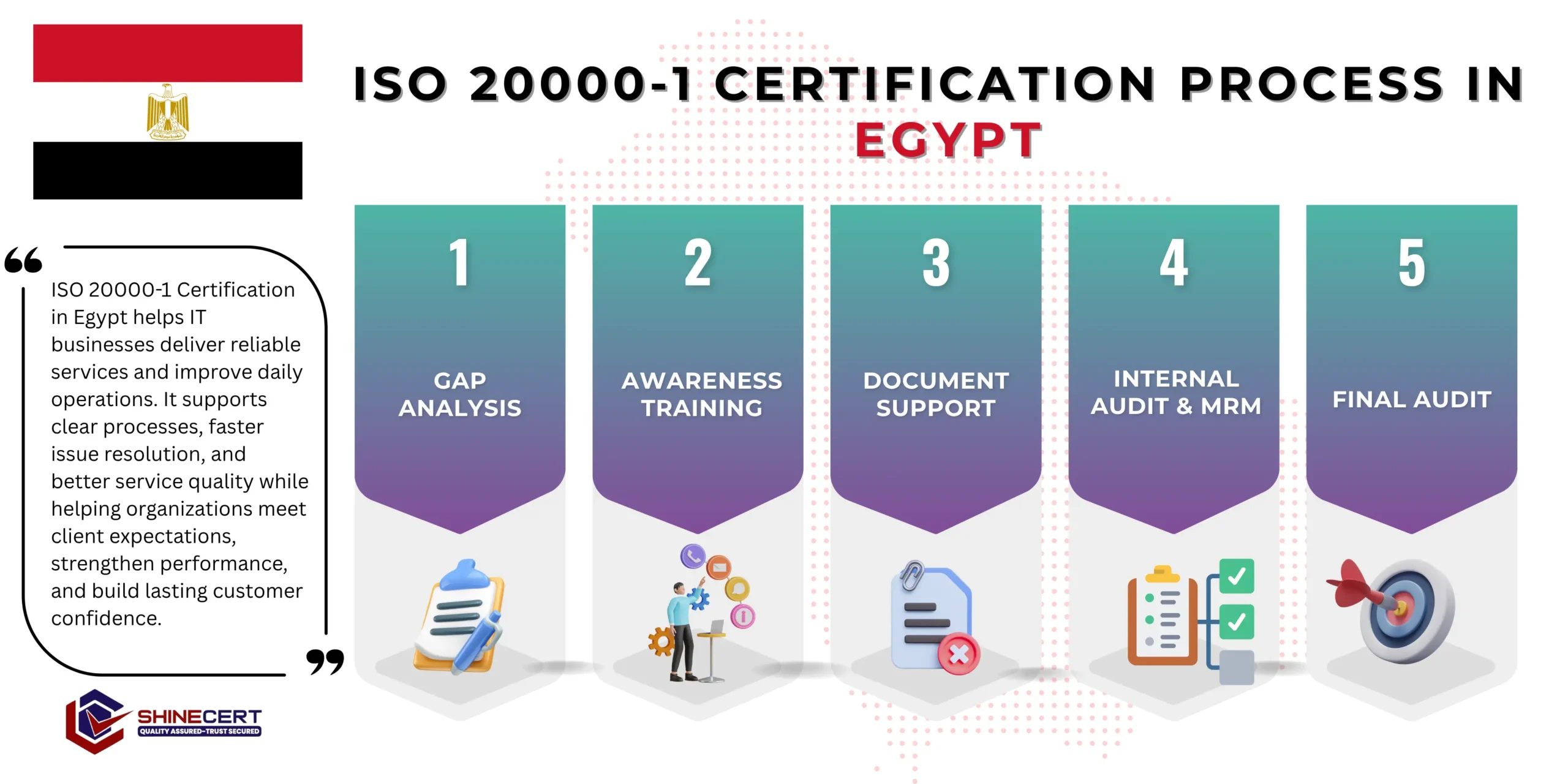
What are the steps to get ISO 20000-1 Certification in Egypt?
our services
- ISO Certification Egypt
- ISO 9001 Certification Egypt
- ISO 14001 Certification Egypt
- ISO 27001 Certification Egypt
- ISO 22000 Certification Egypt
- ISO 27701 Certification Egypt
- ISO 45001 Certification Egypt
- ISO 20000-1 Certification Egypt
- ISO 13485 Certification Egypt
- ISO 17025 Certification Egypt
- ISO 31000 Certification Egypt
- ISO 42001 Certification Egypt
- ISO 37001 Certification Egypt
- ISO 22301 Certification Egypt
- ISO 50001 Certification Egypt
- CE Mark Certification Egypt
- GDPR Certification Egypt
- GMP Certification Egypt
- Halal Certification Egypt
The ISO 20000-1 Certification Process in Egypt
Gap Assessment
We review your current service delivery, incident management, and client relationship processes against every clause.
Clarity on where your real service management gaps sit before a client audit finds them first.
A clause-by-clause gap report.
Documentation Development
We build your service management policy, service level agreements, and incident and change management procedures specific to your client relationships.
Documentation that reflects how you actually deliver services, not a generic ITIL template.
A complete documentation set.
Implementation and Training
Controls go live, and staff are trained on incident response, change management, and client communication processes.
Teams that can demonstrate consistent service delivery during the audit, not just describe a process on paper.
Training records and operating evidence.
Internal Audit and Management Review
We test the system internally and run your first management review.
Gaps surface with time to fix them before the real audit.
An internal audit report and review minutes.
Certification Audit
An accredited certification body audits your system and issues your certificate.
A credential that differentiates you in an increasingly competitive outsourcing market.
Your certificate and a surveillance schedule.
What Is ISO 20000-1, Clause by Clause?
- Clause 4: Context of the Organization : Requires understanding your service management system’s scope and the expectations of interested parties, particularly clients whose own operations depend on your service delivery.
- Clause 5: Leadership : Requires top management to establish a service management policy and demonstrate ownership of service quality outcomes, not delegate it entirely to a technical delivery team.
- Clause 6: Planning : Requires identifying risks and opportunities affecting service delivery and setting measurable service management objectives.
- Clause 7: Support : Covers resources, competence, and documented information needed to deliver services consistently, including knowledge management critical for client-facing IT and outsourcing work.
- Clause 8: Operation : The largest clause, covering service delivery planning and control, relationship and agreement management (particularly relevant for outsourcing client relationships), supply and demand management, and change, incident, and problem management.
- Clause 9: Performance Evaluation : Requires monitoring service performance against agreed levels, conducting internal audits, and management review of service delivery effectiveness.
- Clause 10: Improvement : Requires acting on nonconformities and continually improving service management, directly relevant to client expectations for ongoing service quality improvement.
What Does ISO 20000-1 Certification Cost in Egypt?
- Service complexity and client volume : Providers managing multiple distinct client relationships with different SLAs typically require more extensive documentation than single-client operations.
- Current service management maturity : A business already using structured incident and change management starts from a stronger position than one operating informally.
- Move toward higher-value services : Businesses shifting into AI, data analytics, or engineering R&D work often need more rigorous change and quality management documentation than commodity BPO work.
- Certification body fees : Separate from consulting costs and vary by scope.
Benefits of ISO 20000-1 Certification
As Egypt’s outsourcing exports climb toward $6 billion, certified providers stand out clearly to clients comparing multiple vendors.
Certification answers many of the service management questions international clients ask before signing, reducing sales cycle friction.
Structured incident and problem management under Clause 8 catches recurring issues rather than treating each incident as isolated.
As Egypt’s strategy shifts toward AI, data analytics, and engineering R&D, certified service management demonstrates readiness for more demanding client expectations.
As outsourcing providers scale headcount rapidly to meet demand, documented service processes keep quality consistent even as teams expand quickly.
How Long Does ISO 20000-1 Certification Take in Egypt?
| Business Size | Typical Timeline | Why |
|---|---|---|
| Small, single-client focus | 3 months | Simpler service scope and fewer SLAs |
| Medium, multiple clients | 4 months | More service level agreements and processes to document |
| Larger, multi-client, multi-service operations | 5 months | Extensive service catalog and process documentation |
What Documents Do You Need for ISO 20000-1 in Egypt? (By Clause)
- Clause 4 Documentation : Document: Scope of the Service Management System. Document: Interested Parties and Context Analysis.
- Clause 5 Documentation : Document: Service Management Policy. Document: Roles and Responsibilities Record.
- Clause 6 Documentation : Document: Service Management Risk and Opportunity Register. Document: Objectives and Planning Record.
- Clause 7 Documentation : Document: Competence and Training Records. Document: Knowledge Management Procedure.
- Clause 8 Documentation : Document: Service Catalog and Service Level Agreements. Document: Incident, Problem, and Change Management Procedures.
- Clause 9 Documentation : Document: Service Performance Reports. Document: Internal Audit and Management Review Records.
- Clause 10 Documentation : Document: Corrective Action Records. Document: Continual Improvement Log.
Why Businesses Choose ShineCert in Egypt?
Businesses searching for the best ISO 20000-1 consultant in Egypt are usually competing for the same growing pool of international outsourcing contracts. We’ve spent 10 years helping more than 10,000 businesses worldwide get certified, coordinated through our Riyadh and India offices. We build service management documentation around your real client relationships, so certification becomes a genuine sales advantage, not just a compliance exercise.
Case Study: A Cairo IT Outsourcing Provider
- A Cairo-based IT outsourcing provider serving three European clients needed ISO 20000-1 certification after losing a fourth prospective client’s evaluation to a competitor that already held it, despite comparable technical capability.
- Our gap assessment found the provider delivered genuinely good service in practice, but had no documented service catalog, inconsistent incident escalation procedures across different client accounts, and no formal service performance reporting.
- Over four months, we built a documented service catalog, standardized incident management across all client accounts, and established consistent monthly service performance reporting. The certification audit passed with one minor nonconformity, corrected quickly.
- The provider used its new certification to win its next prospective client evaluation and has since standardized onboarding for two additional client accounts using the same documented service management framework.
Ready to Get Started?
Whether you’re competing for your next international client or scaling service delivery across a growing team, ShineCert will assess your real service management practices and give you a clear, honest quote. Book a free consultation or contact us to get started.
Frequently Asked Questions
No, it’s entirely voluntary, though it’s increasingly expected by international clients evaluating outsourcing and IT service providers.
It depends on your service complexity and client relationship structure. We quote individually.
Usually three to five months, depending on how many distinct services and client relationships need documentation.
Yes, the standard applies to any IT-enabled service delivery, including BPO operations with a significant technology component.
Certification is increasingly a differentiator as competition for Egypt’s growing outsourcing market intensifies, particularly for higher-value work.
Documentation development can happen remotely; the certification audit typically requires at least a partial site or virtual operations review.