
ISO 22000 Certification in Egypt
Quick Answer
ISO 22000 certification confirms an organization’s food safety management system meets an internationally recognized standard, verified by an independent, accredited certification body. In Egypt, the National Food Safety Authority (NFSA), established under Law No. 181 of 2020, regulates food safety across the entire supply chain, from production through export, and its 2023-2026 strategic plan explicitly aims to position Egypt as a leading food safety regulator across Africa and the Middle East. ISO 22000 gives food businesses a structured way to meet NFSA expectations and satisfy international buyers simultaneously. Certification typically takes three to five months.
Why ISO 22000 Matters in Egypt?
NFSA regulates the entire supply chain. Established under Law No : 181 of 2020 as an independent authority under the Office of the Prime Minister, NFSA is responsible for food safety regulation from production and processing through import, export, distribution, and sale, with authority to set standards, license operators, and conduct inspections.
NFSA’s own strategy is oriented toward export credibility : The authority’s 2023-2026 strategic plan explicitly aims to position it as a leading food safety regulator across Africa and the Middle East, meaning Egyptian food businesses face rising expectations both domestically and for export documentation.
Export market access depends on demonstrable food safety systems : NFSA sets guidelines specifically designed to help Egyptian food producers meet international export standards, and certification is the most recognized way to demonstrate this to buyers unfamiliar with Egypt’s domestic regulatory detail.
A single license framework applies throughout the supply chain : Because NFSA’s licensing and control procedures apply consistently from farm to final sale, a certified management system helps food businesses maintain consistency across every stage they touch, not just their own facility.
What are the steps to get ISO 22000 Certification in Egypt?
our services
- ISO Certification Egypt
- ISO 9001 Certification Egypt
- ISO 14001 Certification Egypt
- ISO 27001 Certification Egypt
- ISO 22000 Certification Egypt
- ISO 27701 Certification Egypt
- ISO 45001 Certification Egypt
- ISO 20000-1 Certification Egypt
- ISO 13485 Certification Egypt
- ISO 17025 Certification Egypt
- ISO 31000 Certification Egypt
- ISO 42001 Certification Egypt
- ISO 37001 Certification Egypt
- ISO 22301 Certification Egypt
- ISO 50001 Certification Egypt
- CE Mark Certification Egypt
- GDPR Certification Egypt
- GMP Certification Egypt
- Halal Certification Egypt
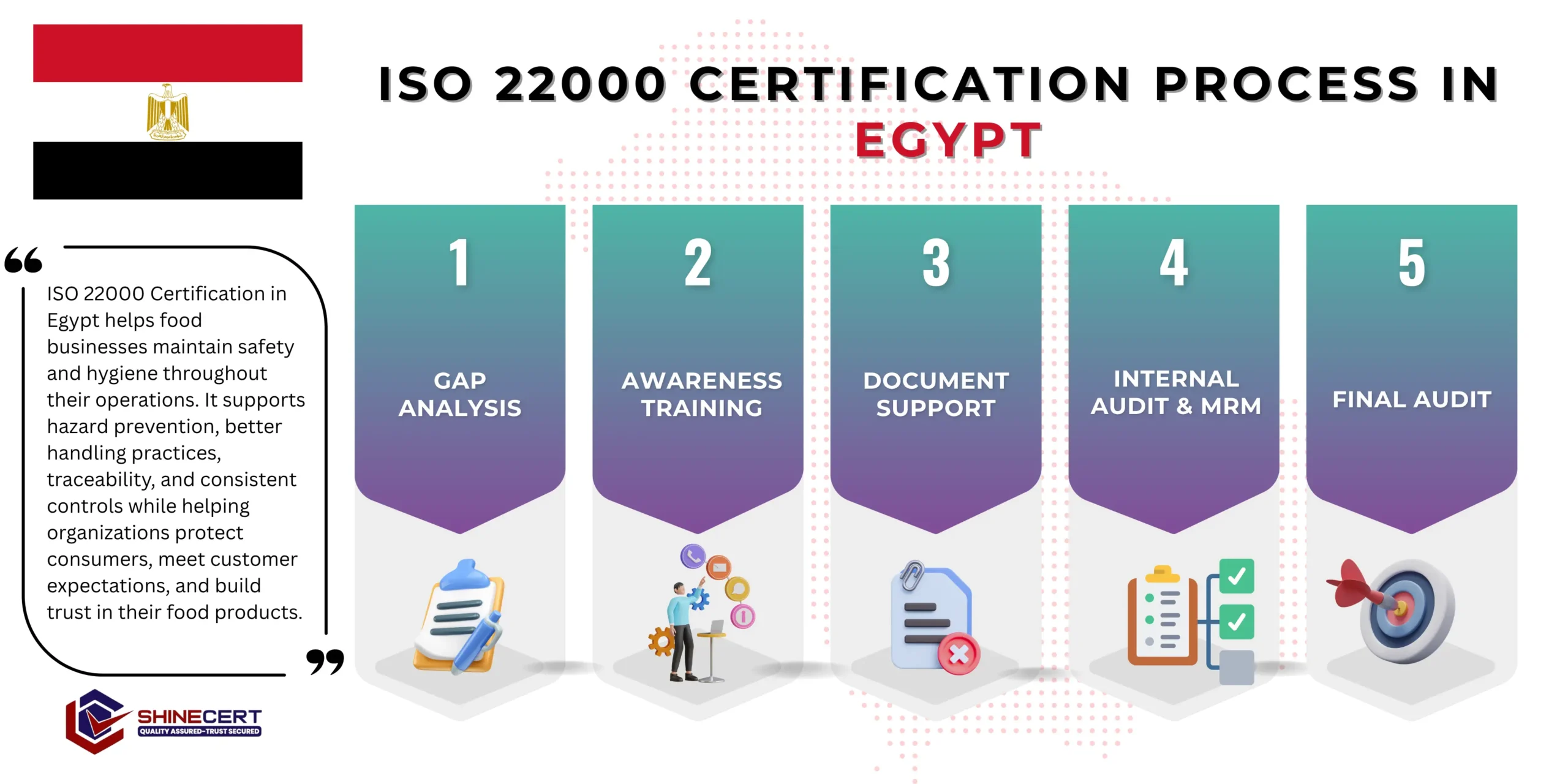
The ISO 22000 Certification Process in Egypt
Gap Assessment
We review your current hygiene practices, hazard controls, and NFSA licensing status against every clause.
Clarity on where your real food safety exposure sits before an NFSA inspection or export buyer audit finds it first.
A clause-by-clause gap report.
Documentation Development
We build your food safety policy, HACCP-based hazard analysis plan, and prerequisite program documentation specific to your product and process.
Documentation reflecting your actual production line, not a generic food safety template.
A complete documentation set.
Implementation and Training
Controls go live and staff are trained on hygiene, critical control points, and their specific role in maintaining food safety.
Production staff who can demonstrate genuine understanding during the audit, not just recite a policy.
Training records and operating evidence.
Internal Audit and Management Review
We test the system internally and run your first management review.
Gaps surface with time to correct them.
An internal audit report and review minutes.
Certification Audit
An accredited certification body audits your system and issues your certificate.
Documentation that satisfies both NFSA expectations and international buyer due diligence in one system.
Your certificate and a surveillance schedule.
What Is ISO 22000, Clause by Clause?
- Clause 4: Context of the Organization : Requires identifying food safety issues relevant to your operations and understanding interested-party expectations, including NFSA requirements and export-market buyer standards.
- Clause 5: Leadership : Requires top management to set a food safety policy and take demonstrated ownership, ensuring food safety isn’t treated as solely a production-floor concern.
- Clause 6: Planning : Requires identifying food safety risks and opportunities and planning actions to address them, integrating with HACCP-based hazard analysis principles the standard builds on.
- Clause 7: Support : Covers competence, awareness, infrastructure, and work environment requirements needed to maintain food safety, plus documented information control.
- Clause 8: Operation : The largest clause, covering operational planning and control, prerequisite programs (hygiene, pest control, cleaning), hazard analysis and critical control points, traceability, and handling of nonconforming products and recalls.
- Clause 9: Performance Evaluation : Requires monitoring and measuring food safety performance, conducting internal audits, and management review of the system’s actual effectiveness.
- Clause 10: Improvement : Requires acting on nonconformities, including any food safety incidents, and continually improving the system over time.
What Does ISO 22000 Certification Cost in Egypt?
- Product type and complexity : Perishable or high-risk products, such as dairy or meat, typically require more extensive hazard controls than shelf-stable goods.
- Current hygiene and HACCP maturity : A facility with existing hygiene programs and hazard analysis starts from a stronger position than one without.
- Export market ambitions : Businesses targeting EU or GCC export markets often need more rigorous documentation than those serving only the domestic market.
- Certification body fees : Separate from consulting costs and vary by scope.
- Bundling with Halal certification : Businesses pursuing both often share hygiene and traceability documentation, reducing total cost.
Benefits of ISO 22000 Certification
A functioning food safety management system gives inspectors documented evidence of systematic control, not just a clean facility on inspection day.
Certification acts as a pre-qualification shortcut for buyers across the EU, GCC, and African markets who don’t have time to evaluate Egyptian regulatory detail themselves.
Clause 8’s hazard analysis and traceability requirements catch problems before they reach consumers.
As NFSA works toward its goal of regional regulatory leadership, certified Egyptian businesses benefit from being ahead of that curve rather than catching up to it.
Systematic monitoring under Clause 9 is consistently cheaper than managing a recall or export rejection after the fact.
Much of the hygiene and traceability documentation overlaps directly for businesses pursuing both.
How Long Does ISO 22000 Certification Take in Egypt?
| Business Size | Typical Timeline | Why |
|---|---|---|
| Small, single product line | 3 months | Fewer hazard points and simpler documentation |
| Medium, multiple product lines | 4 months | More hazard analysis and traceability work |
| Larger, export-focused operations | 5 months | Extensive documentation to satisfy international buyer standards |
What Documents Do You Need for ISO 22000 in Egypt? (By Clause)
- Clause 4 Documentation : Document: Scope of the Food Safety Management System. Document: Interested Parties and Context Analysis, including NFSA and export-buyer requirements.
- Clause 5 Documentation : Document: Food Safety Policy. Document: Roles and Responsibilities Record.
- Clause 6 Documentation : Document: Food Safety Risk and Opportunity Register. Document: Objectives and Planning Record.
- Clause 7 Documentation : Document: Competence and Training Records. Document: Infrastructure and Work Environment Records.
- Clause 8 Documentation : Document: HACCP Plan and Hazard Analysis. Document: Prerequisite Program Records (hygiene, pest control, cleaning). Document: Traceability and Recall Procedure.
- Clause 9 Documentation : Document: Internal Audit Program and Reports. Document: Management Review Minutes.
- Clause 10 Documentation : Document: Corrective Action Records. Document: Continual Improvement Log.
Why Businesses Choose ShineCert in Egypt?
Businesses searching for the best ISO 22000 consultant in Egypt are usually balancing two audiences at once: NFSA and an export buyer with its own standards. We’ve spent 10 years helping more than 10,000 businesses worldwide get certified, coordinated through our Riyadh and India offices. We build food safety systems that satisfy both without duplicating the underlying documentation work.
Case Study: A Delta Region Dairy Processor
- A dairy processor in Egypt’s Delta region needed ISO 22000 certification after a Gulf import partner required it as a condition for a long-term supply agreement, on top of its existing NFSA licensing.
- Our gap assessment found the processor’s hygiene practices were reasonably strong on the floor, but there was no formal HACCP plan documenting critical control points, and traceability records were inconsistent across batches.
- Over four months, we built a proper HACCP plan identifying critical control points across the pasteurization and packaging process, and established consistent batch traceability records. The certification audit passed with no major nonconformities.
- The processor secured the Gulf supply agreement, and the improved traceability system has since helped it resolve two minor quality queries from buyers without any product recall.
Ready to Get Started?
Whether you’re satisfying NFSA requirements, an export buyer’s conditions, or both, ShineCert will assess your real food safety practices and give you a clear, honest quote. Book a free consultation or contact us to get started.
Frequently Asked Questions
No, but NFSA licensing under Law 181/2020 is mandatory for food businesses, and certification demonstrates systematic compliance beyond the licensing baseline.
It depends on your product type, current hygiene maturity, and export ambitions. We quote individually.
Usually three to five months, depending on product complexity.
No, they’re separate; NFSA licensing is a legal requirement, while ISO 22000 is a voluntary certification that demonstrates systematic food safety management on top of it.
Yes, certification is often the fastest way to satisfy international buyer due diligence without them needing to evaluate Egyptian regulatory detail directly.
Documentation development can happen remotely; the certification audit requires a facility visit.