
ISO 22301 Certification in Egypt
Quick Answer
ISO 22301 certification confirms an organization’s business continuity management system meets an internationally recognized standard, verified by an independent, accredited certification body. Egypt just lived through the most direct proof of why this matters: Houthi attacks on Red Sea shipping between 2023 and 2025 forced carriers to reroute around Africa’s Cape of Good Hope, costing Egypt roughly $9 billion in Suez Canal revenue over two years before traffic began recovering in 2026. Any Egyptian business dependent on shipping, imports, or the logistics chain running through the canal experienced a version of this disruption directly. Certification typically takes three to five months.
Why ISO 22301 Matters in Egypt?
The Suez Canal disruption was a real, sustained continuity event, not a hypothetical : Houthi attacks on Red Sea shipping, in the context of the Gaza war, forced many carriers to reroute around the Cape of Good Hope between 2023 and 2025, and Egypt lost approximately $9 billion in canal revenue over that period as a direct result.
Recovery is real but not yet complete : Suez Canal revenue reached $449 million in early 2026 with vessel traffic up 5.8% and tonnage up 16% in the first half of the 2025/26 fiscal year, and the canal authority is targeting $10 billion in annual revenue as shipping lines gradually return to normal routes by year-end. Businesses built around canal-dependent logistics lived through years of genuine disruption before this recovery began.
Grid and energy reliability add a second, ongoing continuity risk : Electricity tariff increases and the broader subsidy-removal roadmap sit alongside logistics disruption as a compounding operational risk for continuity planning, particularly for energy-intensive or time-sensitive operations.
Any business in the import-export chain experienced a version of this directly : Whether through delayed shipments, longer transit times, or higher freight costs from rerouted vessels, Egyptian businesses dependent on maritime trade had direct, lived experience of exactly the kind of disruption ISO 22301 exists to help organizations plan for.
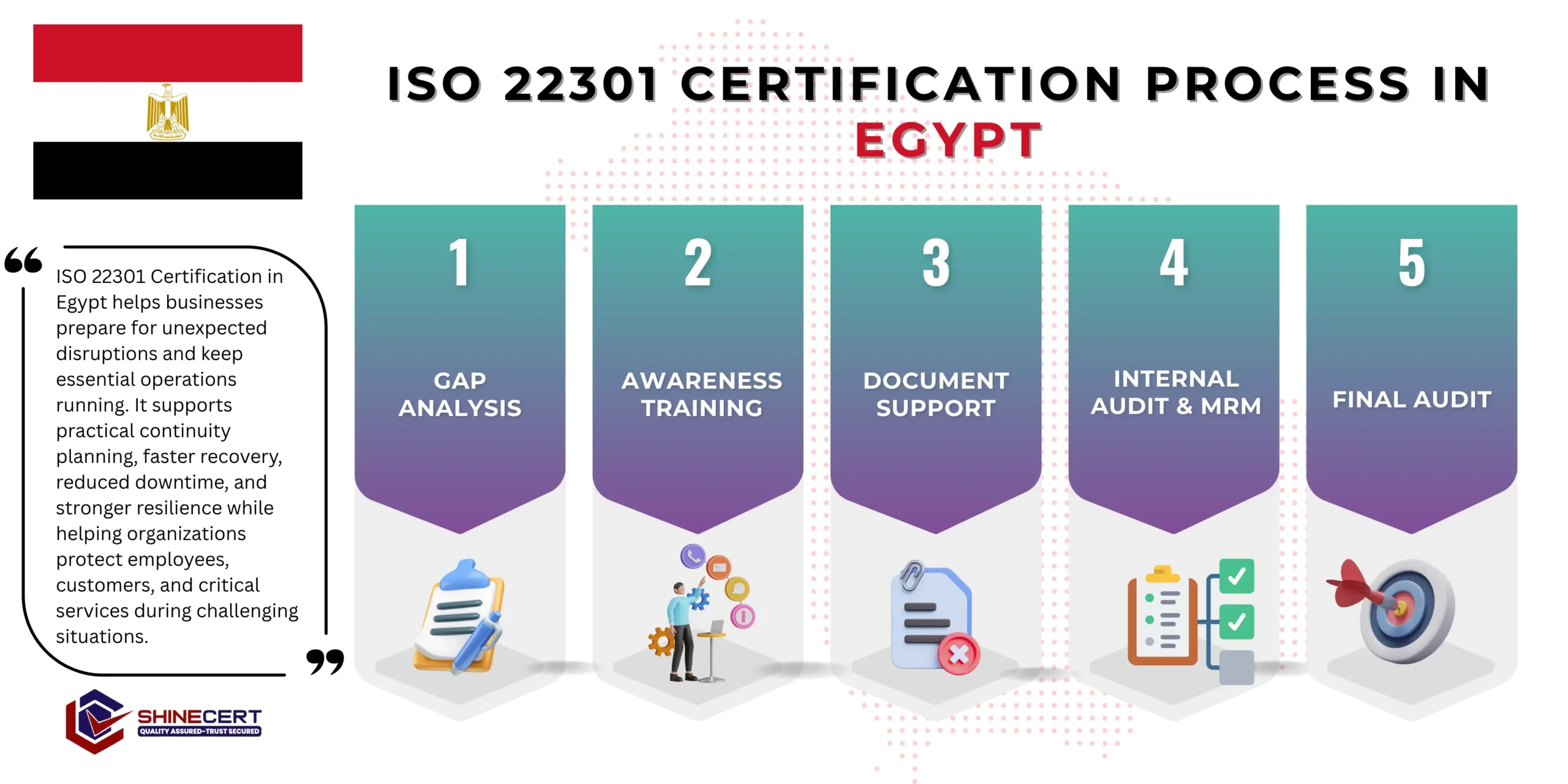
What are the steps to get ISO 22301 Certification in Egypt?
our services
- ISO Certification Egypt
- ISO 9001 Certification Egypt
- ISO 14001 Certification Egypt
- ISO 27001 Certification Egypt
- ISO 22000 Certification Egypt
- ISO 27701 Certification Egypt
- ISO 45001 Certification Egypt
- ISO 20000-1 Certification Egypt
- ISO 13485 Certification Egypt
- ISO 17025 Certification Egypt
- ISO 31000 Certification Egypt
- ISO 42001 Certification Egypt
- ISO 37001 Certification Egypt
- ISO 22301 Certification Egypt
- ISO 50001 Certification Egypt
- CE Mark Certification Egypt
- GDPR Certification Egypt
- GMP Certification Egypt
- Halal Certification Egypt
The ISO 22301 Certification Process in Egypt
Business Impact Analysis
We identify your critical activities, including logistics and supply chain dependencies specific to your operations, and assess the impact of disruption to each.
Clarity on what actually needs a continuity plan, not everything treated with equal urgency.
A business impact analysis and dependency map.
Documentation Development
We build your continuity policy, strategies for maintaining critical activities during disruption, and detailed response plans and procedures.
Plans built around your real dependencies, including shipping and logistics exposure, not generic disaster-recovery language.
A complete documentation set.
Implementation and Training
Plans go live, and staff are trained on their specific roles during a disruption event.
A team that knows what to do when disruption hits, not one improvising under pressure.
Training records and role assignments.
Testing and Management Review
We run a continuity exercise simulating a real disruption scenario, then facilitate your first management review.
Gaps surface during a drill, not during an actual crisis.
A test exercise report and review minutes.
Certification Audit
An accredited certification body audits your system and issues your certificate.
Documented, tested continuity capability, not just a plan sitting in a drawer.
Your certificate and a surveillance schedule.
What Is ISO 22301, Clause by Clause?
- Clause 4: Context of the Organization : Requires understanding your organization’s critical activities, dependencies, and the internal and external issues that could disrupt them, including logistics and supply chain dependencies specific to your operations.
- Clause 5: Leadership : Requires top management to set a business continuity policy and demonstrate genuine commitment, ensuring continuity planning isn’t treated as a document exercise disconnected from real operational decisions.
- Clause 6: Planning : Requires setting business continuity objectives and planning how to achieve them, informed directly by the risk assessment and business impact analysis.
- Clause 7: Support : Covers resources, competence, awareness, and communication needed to support continuity management, plus documented information control.
- Clause 8: Operation : The core clause, requiring business impact analysis and risk assessment, business continuity strategies, and documented continuity plans and procedures covering how the organization actually responds during disruption.
- Clause 9: Performance Evaluation : Requires monitoring continuity readiness, conducting internal audits, and testing continuity plans through exercises, not just reviewing them on paper.
- Clause 10: Improvement : Requires acting on issues identified during testing or actual disruptions and continually improving the continuity management system.
What Does ISO 22301 Certification Cost in Egypt?
- Dependency complexity : Businesses with significant logistics, shipping, or single-supplier dependencies require more thorough business impact analysis than those with simpler, more diversified operations.
- Current continuity maturity : A business with existing informal contingency practices starts from a stronger position than one with none.
- Number of critical activities : More distinct critical processes mean more continuity strategies and plans to document.
- Certification body fees : Separate from consulting costs and vary by scope.
- Bundling with ISO 31000 : Businesses pursuing both often share risk assessment work, reducing total cost.
Benefits of ISO 22301 Certification
A tested continuity plan means the next shipping disruption, whatever its cause, is a managed event rather than a scramble.
Documented response plans mean less time spent figuring out what to do and more time actually doing it.
Certification signals genuine operational resilience to partners who lived through the same disruption period.
Businesses with tested plans typically recover market position faster than competitors improvising a response.
Much of the risk identification from a risk management framework feeds directly into business impact analysis.
How Long Does ISO 22301 Certification Take in Egypt?
| Business Profile | Typical Timeline | Why |
|---|---|---|
| Limited critical dependencies | 3 months | Simpler business impact analysis and fewer plans |
| Moderate logistics or supply chain exposure | 4 months | More dependencies and continuity strategies to document |
| Significant shipping or single-supplier exposure | 5 months | Extensive impact analysis and multi-scenario planning |
What Documents Do You Need for ISO 22301 in Egypt? (By Clause)
- Clause 4 Documentation : Document: Scope of the Business Continuity Management System. Document: Critical Activities and Dependency Analysis.
- Clause 5 Documentation : Document: Business Continuity Policy. Document: Roles and Responsibilities Record.
- Clause 6 Documentation : Document: Business Continuity Objectives and Planning Record.
- Clause 7 Documentation : Document: Competence and Training Records. Document: Document Control Procedure.
- Clause 8 Documentation : Document: Business Impact Analysis. Document: Risk Assessment. Document: Business Continuity Strategies and Plans.
- Clause 9 Documentation : Document: Exercise and Testing Records. Document: Internal Audit and Management Review Records.
- Clause 10 Documentation : Document: Corrective Action Records. Document: Continual Improvement Log.
Why Businesses Choose ShineCert in Egypt?
Businesses searching for the best ISO 22301 consultant in Egypt often come to us after living through exactly the kind of disruption the standard addresses, most recently the Suez Canal shipping crisis. We’ve spent 10 years helping more than 10,000 businesses worldwide get certified, coordinated through our Riyadh and India offices. We build plans around your actual dependencies, logistics, energy, suppliers, not generic disaster-recovery templates written before anyone understood what disruption in Egypt actually looks like.
Case Study: A Cairo Import Distributor
- An import distributor based in Cairo, heavily reliant on shipments transiting the Suez Canal from Asian suppliers, spent nearly two years absorbing unpredictable delays and elevated freight costs during the Red Sea disruption period, with no formal plan beyond reactive expediting and price renegotiation.
- Our business impact analysis identified the company’s single-supplier dependencies as its most significant continuity risk, alongside no documented alternative sourcing or routing strategy for future disruptions.
- Over four months, we built a business continuity plan including alternative sourcing arrangements and a documented decision framework for when to absorb versus pass through freight cost increases. A continuity exercise simulating a renewed shipping disruption surfaced two communication gaps, both corrected before certification.
- The company’s certification audit passed, and management reports far more confidence heading into any future disruption than during the recent Red Sea crisis, when decisions were made without a clear framework.
Ready to Get Started?
Whether you’re still recovering from the recent disruption or want to be ready before the next one, ShineCert will build a continuity plan around your real dependencies and give you a clear, honest quote. Book a free consultation or contact us to get started.
Frequently Asked Questions
No, it’s entirely voluntary, though the recent Suez Canal disruption gave many Egyptian businesses direct, costly experience of why continuity planning matters.
It depends on your dependency complexity and current continuity maturity. We quote individually.
Usually three to five months, depending on how many critical activities need planning.
Yes, business impact analysis under Clause 8 is built to identify exactly this kind of dependency and plan for it.
Recovery is underway, with revenue and traffic improving through 2026, but the underlying regional volatility that caused the 2023-2025 disruption hasn’t disappeared, which is exactly why planning matters regardless of current conditions.
Documentation development can happen remotely; testing exercises typically involve at least some on-site participation.