
GMP Certification in Egypt
Quick Answer
Good Manufacturing Practice (GMP) certification confirms that a manufacturing facility for medicines, medical devices, food, or cosmetics consistently produces safe, quality products under controlled, documented conditions. In Egypt, the Egyptian Drug Authority (EDA) oversees GMP expectations for pharmaceutical and medical device manufacturers, and 2026 brought more rigorous pre-market and post-market requirements alongside digital submission tools and a new fast-track pathway. Certification typically takes two to four months.
Why GMP Certification Matters in Egypt?
EDA oversees Good Manufacturing Practice (GMP) expectations as part of broader manufacturing regulation : The Egyptian Drug Authority, responsible for regulating the safety and quality of medicines and medical devices, expects manufacturing facilities to demonstrate GMP-aligned practices as part of its registration and inspection framework.
2026 brought genuinely stricter requirements : New rules effective in 2026 introduce more rigorous pre-market and post-market requirements aimed at improving patient safety and product quality, meaning facilities operating under older, looser assumptions face real gaps if they haven’t updated their practices.
Digital infrastructure is accelerating alongside stricter enforcement : The MeDevice portal handles digital submission, and a fast-track pathway with simplification measures introduced in February 2026 rewards well-documented applicants with faster processing, while poorly prepared facilities face more friction navigating the same system.
Local manufacturing capacity is a genuine strategic priority : As Egypt continues developing its domestic pharmaceutical and device manufacturing base, GMP-compliant facilities are positioned to benefit from that direction more directly than those treating compliance as a formality.
What are the steps to get GMP Certification in Egypt?
our services
- ISO Certification Egypt
- ISO 9001 Certification Egypt
- ISO 14001 Certification Egypt
- ISO 27001 Certification Egypt
- ISO 22000 Certification Egypt
- ISO 27701 Certification Egypt
- ISO 45001 Certification Egypt
- ISO 20000-1 Certification Egypt
- ISO 13485 Certification Egypt
- ISO 17025 Certification Egypt
- ISO 31000 Certification Egypt
- ISO 42001 Certification Egypt
- ISO 37001 Certification Egypt
- ISO 22301 Certification Egypt
- ISO 50001 Certification Egypt
- CE Mark Certification Egypt
- GDPR Certification Egypt
- GMP Certification Egypt
- Halal Certification Egypt
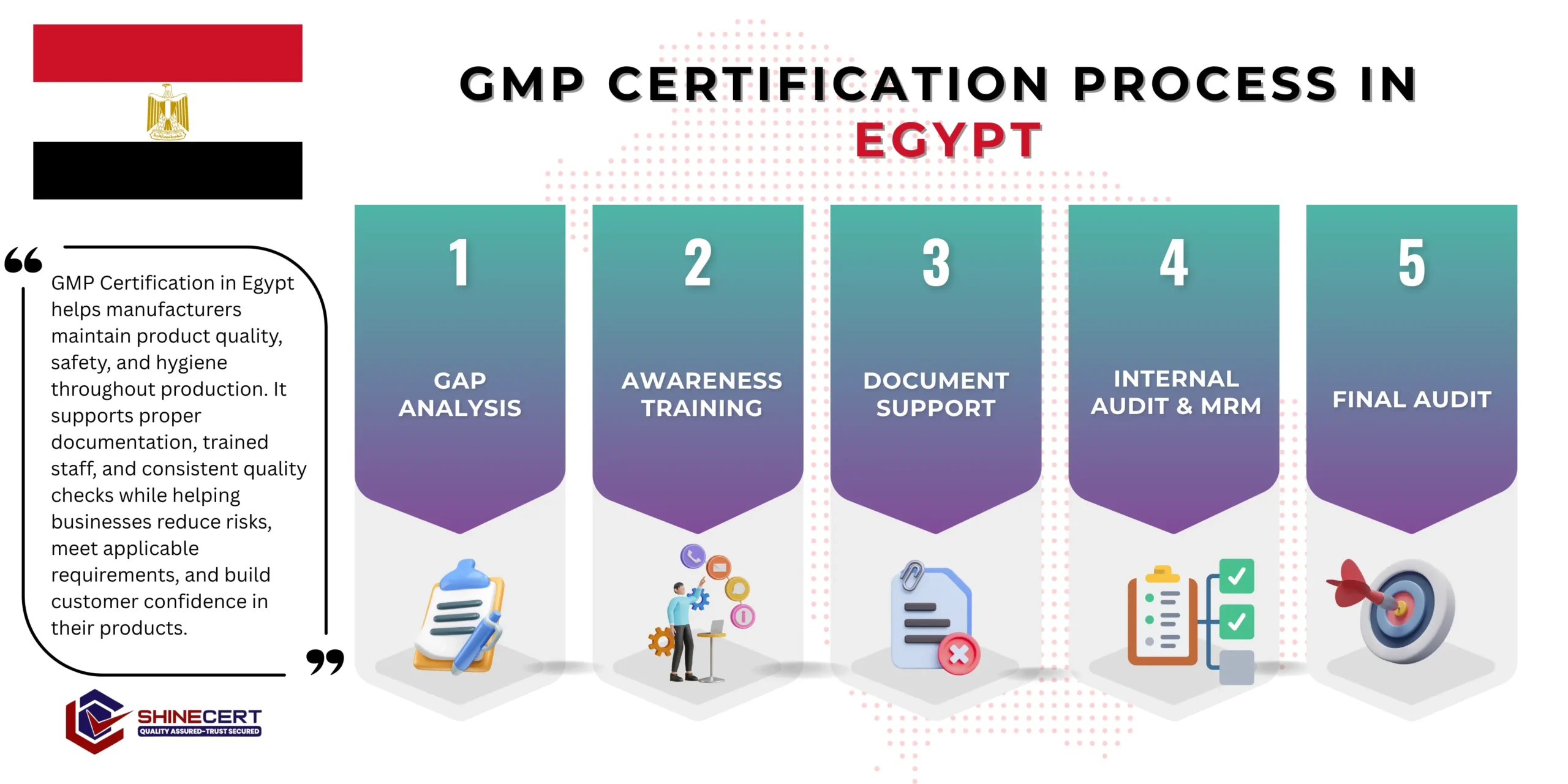
The GMP Certification Process in Egypt
Getting certified follows five phases. Here’s exactly what happens at each one.
Facility Baseline Review
We walk your manufacturing facility and compare current conditions, equipment, and record-keeping against GMP requirements, with specific attention to the stricter 2026 expectations.
An honest picture of where real gaps sit before spending on fixes.
A facility gap assessment.
Documentation
We help build the quality manual, standard operating procedures, and batch-record systems your specific product line needs.
Documentation your production staff will actually follow during real manufacturing runs.
A complete GMP documentation set.
Facility and Process Upgrades
Whatever gaps Phase 1 uncovered, from equipment calibration schedules to staff hygiene protocols, get addressed here.
This is typically the longest phase, since physical changes take more time than paperwork.
A facility that genuinely meets GMP conditions.
Pre-Inspection Readiness Check
We run an internal mock inspection to catch anything a real inspector would flag.
Surprises get caught while there’s still time to fix them quietly.
A readiness report with final action items.
GMP Inspection
An accredited certification body inspects your facility and issues certification, supporting your broader EDA registration where relevant.
Documented evidence of manufacturing quality that speeds up registration processes.
Your GMP certificate and a renewal schedule.
What Does GMP Certification Cost in Egypt?
- Product category : Pharmaceutical manufacturing typically requires more rigorous facility controls than food or cosmetics manufacturing.
- Current facility condition : A facility with existing quality systems and calibrated equipment costs less to bring into compliance than one starting from scratch.
- Facility size and product line complexity : More production lines or a wider product range mean more area and documentation to bring into scope.
- Certification body fees : Separate from consulting costs and vary by scope.
Benefits of GMP Certification
GMP-compliant manufacturing is a foundational expectation behind registering pharmaceutical and medical device products for sale in Egypt.
Consistent manufacturing controls catch problems before products reach the market, not after.
A genuine GMP-compliant facility is easier to sell into partnerships with distributors who have their own due diligence requirements.
Facilities already meeting updated GMP expectations face far less enforcement risk and registration friction than those catching up after the fact.
Much of the documentation and facility-control work overlaps directly with medical device or food safety management requirements.
How Long Does GMP Certification Take in Egypt?
| Facility Type | Typical Timeline | Why |
|---|---|---|
| Existing quality systems, minor gaps | 2 months | Facility and documentation largely already in place |
| Moderate upgrades needed | 3 months | Some equipment or procedural changes required |
| Starting from limited existing controls | 4 months | Facility upgrades and full documentation build required |
What Documents Do You Need for GMP Certification in Egypt?
- Quality Management Documentation : Document: Quality Manual. Document: Standard Operating Procedures for every critical manufacturing activity.
- Batch and Production Records : Document: Batch Manufacturing Records. Document: Equipment Calibration Log.
- Facility and Hygiene Documentation : Document: Facility Layout and Flow Plan. Document: Staff Hygiene and Training Records.
- Supplier and Material Documentation : Document: Raw Material Specifications and Supplier Qualification Records.
- Ongoing Compliance : Document: Internal Audit and Deviation Records.
Why Businesses Choose ShineCert in Egypt?
We’ve spent 10 years helping more than 10,000 businesses worldwide get certified, coordinated through our Riyadh and India offices. With ShineCert as the best GMP consultant in Egypt, we understand EDA’s stricter 2026 requirements in practical detail, and we build documentation your production team can genuinely maintain, not paperwork designed only to pass a single inspection.
Case Study: A Cairo Pharmaceutical Manufacturer
- A pharmaceutical manufacturer near Cairo found its EDA registration application flagged for additional review after the 2026 rule changes raised the bar for facility documentation the company hadn’t yet updated.
- Our facility baseline review found the underlying manufacturing process was sound, but batch records were kept inconsistently across production lines, and there was no formal calibration schedule for key equipment, gaps that had gone unnoticed under the previous, less rigorous framework.
- Over three months, we rebuilt the company’s quality manual, standardized batch-record keeping across every production line, and implemented a documented equipment calibration schedule. A pre-inspection readiness check caught two remaining gaps in staff hygiene protocol, corrected before the real inspection.
- The company passed its GMP inspection, and its previously flagged EDA registration cleared shortly after certification.
Ready to Get Started?
Whether you’re preparing your first EDA registration or updating an existing facility to meet 2026’s stricter requirements, we’ll assess where you stand and give you a clear, honest quote. Book a free consultation or contact us to get started.
Frequently Asked Questions
GMP-aligned practices are expected for pharmaceutical and medical device manufacturers as part of EDA’s broader regulatory framework, particularly under the stricter 2026 requirements.
New rules introduced more rigorous pre-market and post-market requirements, alongside a fast-track pathway and simplification measures for well-documented applicants.
It depends on product category and current facility condition. We quote individually.
Usually two to four months.
No, they’re complementary; ISO 13485 covers the quality management system, while GMP focuses specifically on manufacturing conditions and batch consistency.
Documentation review can happen remotely; the facility inspection requires an on-site visit.