
Halal Certification in Egypt
Quick Answer
Egypt runs a genuinely distinct two-body Halal certification system, not the single domestic scheme found in many other countries. Halal-ALQAHIRAH is the officially recognized body for certifying imported meat, poultry, and related products entering Egypt, while IS EG Halal (ISEGHALAL) is the sole organization authorized by the Egyptian government to certify Egyptian exports for international markets, and it holds World Trade Organization recognition. Which body applies to you depends entirely on whether you’re importing into Egypt or exporting from it, and confusing the two is the most common and costly mistake businesses make. Certification typically takes two to four months.
What Is Halal Certification?
Halal certification confirms that a food, cosmetic, or pharmaceutical product has been produced, handled, and processed in accordance with Islamic law. Depending on the product and market, this covers ingredient sourcing, slaughter method for meat products, and prevention of cross-contamination with non-Halal materials throughout production and storage.
In most countries, a single domestic scheme or a small handful of internationally recognized private bodies handle certification. Egypt is structurally different: it operates two separate, purpose-specific systems, one for products entering the country and one for products leaving it, and a business needs to know which system actually applies to its situation before pursuing certification.
Why Halal Certification Matters in Egypt?
The import and export systems are entirely separate : Halal-ALQAHIRAH was officially recognized as of February 1, 2026 as the approved certification body for imported meat, poultry, and related products, while IS EG Halal operates independently as the sole body authorized to certify Egyptian products for export.
Export certification carries genuine international weight : IS EG Halal’s recognition by the World Trade Organization gives Egyptian exporters certification that’s credible well beyond the immediate Middle East and Gulf markets most businesses initially target.
Import requirements have tightened, not loosened : Halal certification remains mandatory for imports of meat, poultry, and related products, with Halal Al-Qahirah’s certification specifically required for these categories, even as some other product categories have seen certification requirements adjusted over time.
Choosing the wrong body wastes real time and money : A business exporting Egyptian products but mistakenly pursuing certification through the import-focused body, or vice versa, will find its certificate doesn’t actually satisfy the requirement it needed to meet.
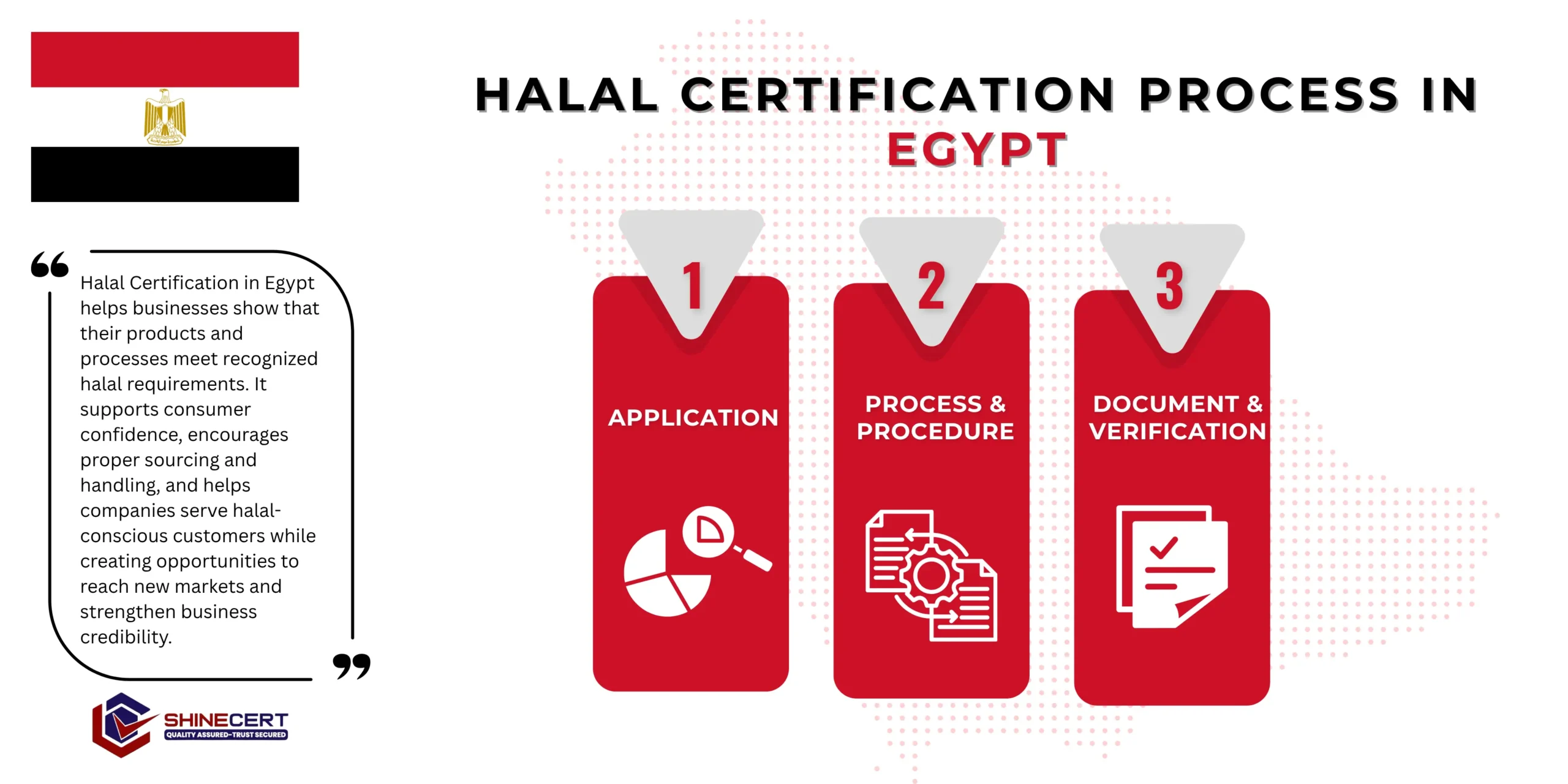
What are the steps to get Halal Certification in Egypt?
our services
- ISO Certification Egypt
- ISO 9001 Certification Egypt
- ISO 14001 Certification Egypt
- ISO 27001 Certification Egypt
- ISO 22000 Certification Egypt
- ISO 27701 Certification Egypt
- ISO 45001 Certification Egypt
- ISO 20000-1 Certification Egypt
- ISO 13485 Certification Egypt
- ISO 17025 Certification Egypt
- ISO 31000 Certification Egypt
- ISO 42001 Certification Egypt
- ISO 37001 Certification Egypt
- ISO 22301 Certification Egypt
- ISO 50001 Certification Egypt
- CE Mark Certification Egypt
- GDPR Certification Egypt
- GMP Certification Egypt
- Halal Certification Egypt
The Halal Certification Process in Egypt
Direction and Body Confirmation
We confirm immediately whether your situation calls for Halal-ALQAHIRAH (importing into Egypt) or IS EG Halal (exporting from Egypt), since this single decision shapes everything that follows.
Certainty from day one that you’re pursuing the certification that actually applies to you.
A confirmed certification pathway.
Documentation
We build your Halal policy and traceability procedures aligned to the specific body’s requirements, since import and export documentation expectations differ.
Documentation that matches what the correct body will actually ask for.
A complete Halal certification documentation set.
Implementation and Training
Controls go live, with staff trained on Halal handling, storage separation, and cross-contamination prevention specific to your process.
Genuine operational compliance, not just paperwork.
Training records and evidence controls are operating.
Internal Review
We check whether controls are genuinely being followed before the real certification audit.
Gaps surface while there’s still time to fix them quietly.
An internal review report.
Certification Audit
The correct body, Halal-ALQAHIRAH or IS EG Halal, audits your process and issues your certificate if requirements are met.
A certificate that actually satisfies the requirement you need it for.
Your Halal certificate and a renewal schedule.
What Does Halal Certification Cost in Egypt?
- Import versus export certification : The two pathways involve different documentation and audit requirements, which affects overall cost differently depending on which applies to you.
- Product category : Meat and poultry products, requiring specific slaughter and handling verification, typically involve more rigorous review than packaged or shelf-stable goods.
- Target market for exports : Certification aimed at specific export destinations may require additional documentation depending on that market’s own recognition requirements.
- Current production practices : Businesses already maintaining clear handling records and separated storage aren’t starting from nothing.
Benefits of Halal Certification
Halal-ALQAHIRAH certification is the required pathway for these import categories to clear Egyptian customs.
IS EG Halal’s WTO recognition gives Egyptian exporters standing that extends beyond regional markets.
Using the correct certification body for your specific situation directly reduces the risk of a compliant shipment being rejected on a technicality.
Certification provides trust signals to different audiences depending on which direction your trade flows.
Much of the hygiene and traceability documentation overlaps directly with food safety management requirements.
How Long Does Halal Certification Take in Egypt?
| Business Situation | Typical Timeline | Why |
|---|---|---|
| Import certification, established supplier relationships | 2 months | Fewer ingredients and a defined body relationship |
| Export certification, single target market | 3 months | Documentation aligned to WTO-recognized standards |
| Export certification, multiple international markets | 4 months | Broader verification and multiple market alignment |
What Documents Do You Need for Halal Certification in Egypt?
- Policy and Scope : Document: Halal Policy Statement. A signed commitment to maintaining Halal compliance, referencing the correct certifying body for your situation.
- Ingredient and Supplier Documentation : Document: Ingredient Source Register. A record confirming the Halal status and source of every relevant ingredient. Document: Supplier Halal Certificates. Copies of Halal certification for any pre-certified inputs.
- Process Documentation : Document: Production Process Map. Shows where potential Halal risk points occur in your process. Document: Cross-Contamination Prevention Procedure.
- Training and Records : Document: Staff Training Records. Document: Traceability Records.
Why Businesses Choose ShineCert in Egypt?
We’ve spent 10 years helping more than 10,000 businesses worldwide get certified, coordinated through our Riyadh and India offices. Because Egypt’s Halal system is genuinely more complex than most countries’, with two entirely separate bodies for imports and exports, ShineCert, the best Halal consultant in Egypt, starts every engagement by confirming the correct pathway before any documentation work begins, avoiding a mistake that can cost both time and money.
Case Study: An Alexandria Export-Focused Food Processor
- An Alexandria-based food processor preparing to export halal-certified products to Gulf markets initially approached certification the way many first-time exporters do, assuming a single Halal certification body would cover both its future import ingredients and its export products.
- We clarified early that its outbound export certification needed to go through IS EG Halal specifically, while a small volume of imported ingredients it used would separately need Halal-ALQAHIRAH certification if those ingredients themselves required Halal status.
- Over three months, we built the company’s export-facing Halal documentation aligned to IS EG Halal’s requirements, established traceability from ingredient sourcing through to finished product, and separately confirmed which imported ingredients needed their own Halal-ALQAHIRAH documentation.
- The company’s first export shipment cleared without incident, and it avoided what would have been a costly rejection had it pursued the wrong certification pathway from the start.
Ready to Get Started?
Whether you’re importing meat and poultry products or preparing your first Halal-certified export shipment, we’ll confirm the correct pathway and give you a clear, honest quote. Book a free consultation or contact us to get started.
Frequently Asked Questions
No, Egypt operates two separate bodies: Halal-ALQAHIRAH for imported meat and poultry products, and IS EG Halal for Egyptian exports.
It depends entirely on the direction of trade: use Halal-ALQAHIRAH if you’re importing into Egypt, and IS EG Halal if you’re exporting Egyptian products internationally.
Yes, it holds World Trade Organization recognition, giving Egyptian export certification credibility beyond regional markets.
It depends on whether you need import or export certification and your specific product category. We quote individually.
Usually two to four months, depending on your specific pathway and target markets.
Documentation review can happen remotely; the certification audit requires a facility visit.