
ISO 50001 Certification in Egypt
Quick Answer
ISO 50001 certification confirms an organization’s energy management system meets an internationally recognized standard, verified by an independent, accredited certification body. In Egypt, this arrives at a genuinely consequential moment: the government ended a reduced industrial electricity tariff in mid-2025, tariffs rose a further 15 to 25% in 2026, and the broader subsidy-removal roadmap, part of Egypt’s IMF-backed reform program, points toward continued cost-reflective pricing ahead. Energy costs that were manageable under subsidized rates are becoming a genuine line-item risk, and ISO 50001 gives businesses a structured way to manage it. Certification typically takes three to five months.
Why ISO 50001 Matters in Egypt?
The subsidy-removal roadmap is real and ongoing : Electricity subsidies currently stand at roughly EGP 170 billion, with the government continuing to sell power below its actual cost, natural gas priced to power plants at $4 per million BTU against a real cost exceeding $7, and the IMF-backed reform program committing Egypt to gradually phase out these subsidies toward cost-reflective pricing.
Industrial tariffs have already moved, and further increases are expected : The reduced industrial electricity rate in place since 2020 ended on July 1, 2025, and 2026 brought further tariff increases of 15 to 25% depending on consumption bracket, with commercial rates rising roughly 20% as well.
Businesses that haven’t systematically tracked energy use are exposed the most : Without a documented energy baseline and monitoring system, it’s difficult to know exactly how tariff increases translate into your specific cost structure, or where genuine efficiency opportunities exist to offset them.
The roadmap points in one direction : Since the subsidy-removal trajectory is a structural, IMF-linked commitment rather than a temporary measure, businesses treating recent increases as a one-off shock rather than an ongoing trend risk being caught off guard again.
What are the steps to get ISO 50001 Certification in Egypt?
our services
- ISO Certification Egypt
- ISO 9001 Certification Egypt
- ISO 14001 Certification Egypt
- ISO 27001 Certification Egypt
- ISO 22000 Certification Egypt
- ISO 27701 Certification Egypt
- ISO 45001 Certification Egypt
- ISO 20000-1 Certification Egypt
- ISO 13485 Certification Egypt
- ISO 17025 Certification Egypt
- ISO 31000 Certification Egypt
- ISO 42001 Certification Egypt
- ISO 37001 Certification Egypt
- ISO 22301 Certification Egypt
- ISO 50001 Certification Egypt
- CE Mark Certification Egypt
- GDPR Certification Egypt
- GMP Certification Egypt
- Halal Certification Egypt
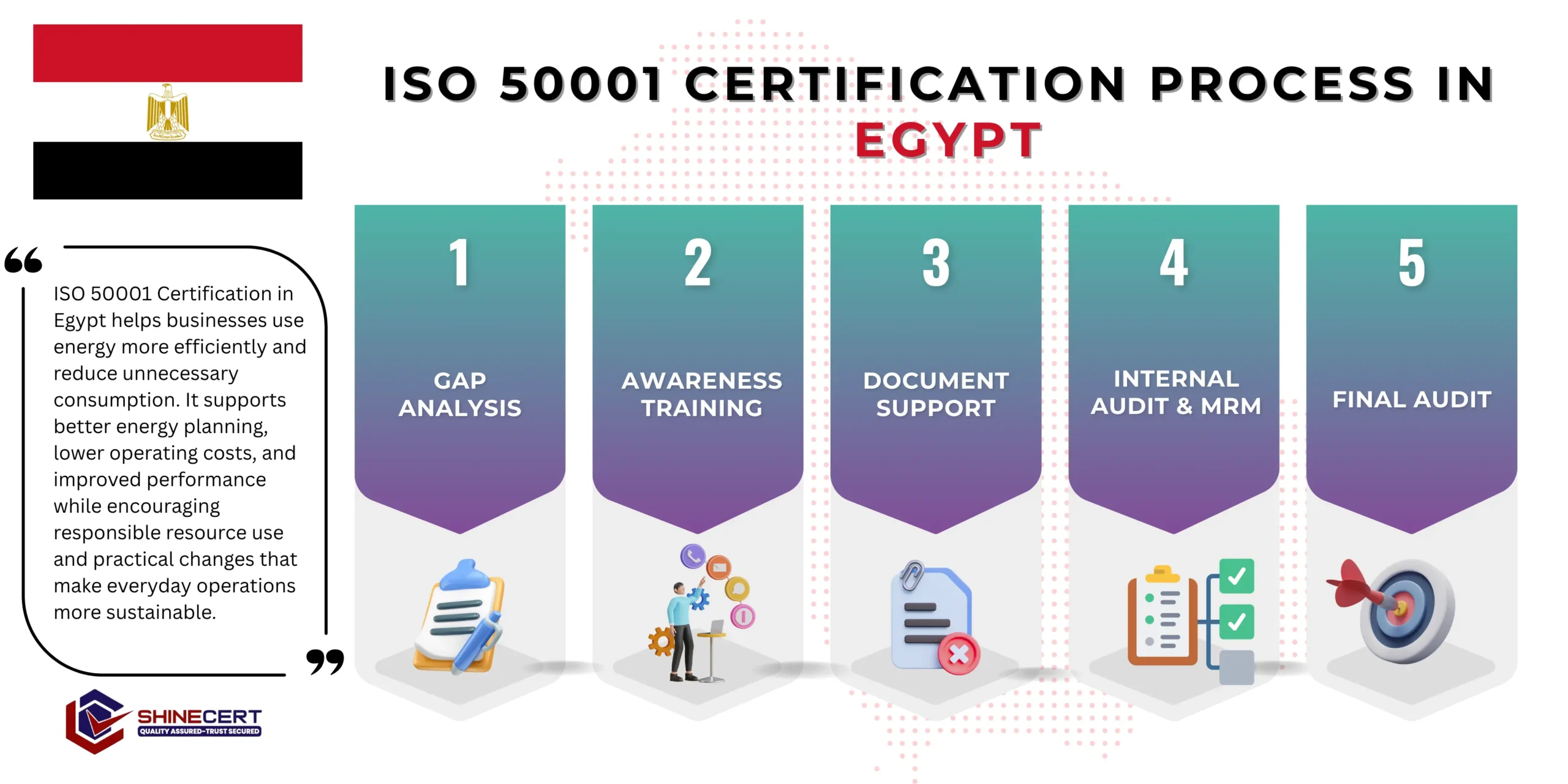
The ISO 50001 Certification Process in Egypt
Energy Review
We establish your actual energy baseline and identify which processes or equipment drive the majority of your consumption.
Clarity on exactly where tariff increases hit hardest in your specific operation.
An energy review and baseline document.
Documentation Development
We build your energy policy, performance indicators, and monitoring procedures tied to your identified significant energy uses.
A system that tracks the energy costs that actually matter to your bottom line, not generic sustainability language.
A complete documentation set.
Implementation and Training
Controls go live, and staff are trained on how their operational decisions affect energy performance.
Energy efficiency becomes a genuine operational habit, not a facilities-department afterthought.
Training records and operating evidence.
Internal Audit and Management Review
We test the system internally and run your first management review.
Gaps surface with time to address them before the real audit.
An internal audit report and review minutes.
Certification Audit
An accredited certification body audits your system and issues your certificate.
Documented, verified energy management as tariffs continue their upward trajectory.
Your certificate and a surveillance schedule.
What Is ISO 50001, Clause by Clause?
- Clause 4: Context of the Organization : Requires identifying energy-related issues relevant to your operations, including exposure to rising tariffs, and understanding interested-party expectations around energy performance.
- Clause 5: Leadership :Requires top management to set an energy policy and take genuine ownership of energy performance, not delegate it entirely to a facilities team reacting to bills after the fact.
- Clause 6: Planning : Requires an energy review identifying significant energy uses, establishing an energy baseline, and setting energy performance indicators and objectives you can actually track over time.
- Clause 7: Support : Covers competence, awareness, and documented information needed to run the system, including staff understanding of how their operational decisions affect energy consumption.
- Clause 8: Operation : Covers operational controls over significant energy uses, procurement of energy-efficient equipment and services, and design considerations for new facilities or major changes.
- Clause 9: Performance Evaluation : Requires monitoring and measuring actual energy performance against your baseline and indicators, conducting internal audits, and management review of results.
- Clause 10: Improvement : Requires acting on nonconformities and continually improving energy performance, not just documenting a static energy policy.
What Does ISO 50001 Certification Cost in Egypt?
- Energy intensity of your operations : Manufacturing and industrial facilities with significant energy consumption typically require more extensive monitoring infrastructure than office-based operations.
- Current energy monitoring maturity : A business already tracking consumption by process or equipment starts from a stronger position than one working only from aggregate utility bills.
- Number of sites : Multi-site operations require baselines and monitoring documented per location.
- Certification body fees : Separate from consulting costs and vary by scope.
- Bundling with ISO 14001 : Combined audits often reduce total certification cost given the overlapping environmental and energy management structure.
Benefits of ISO 50001 Certification
A documented energy baseline turns a vague sense that “electricity costs are rising” into specific, actionable data.
Clause 6’s energy review frequently surfaces savings opportunities that offset a meaningful share of tariff increases.
Understanding your actual energy performance supports smarter decisions about which upgrades genuinely pay for themselves as tariffs rise.
Certification signals systematic energy management, increasingly relevant given global attention to industrial energy use.
A system built to track and respond to energy costs handles the next increase far more smoothly than one caught off guard again.
ISO 50001 pairs naturally with ISO 14001 under the shared management-system structure.
How Long Does ISO 50001 Certification Take in Egypt?
| Facility Type | Typical Timeline | Why |
|---|---|---|
| Lower energy intensity, single site | 3 months | Simpler baseline and monitoring requirements |
| Moderate energy intensity, multiple sites | 4 months | More significant energy uses and sites to document |
| High energy intensity industrial facility | 5 months | Extensive monitoring infrastructure and equipment review |
What Documents Do You Need for ISO 50001 in Egypt? (By Clause)
- Clause 4 Documentation : Document: Scope of the Energy Management System. Document: Interested Parties and Context Analysis.
- Clause 5 Documentation : Document: Energy Policy. Document: Roles and Responsibilities Record.
- Clause 6 Documentation : Document: Energy Review and Baseline. Document: Energy Performance Indicators and Objectives.
- Clause 7 Documentation : Document: Competence and Training Records. Document: Document Control Procedure.
- Clause 8 Documentation : Document: Operational Control Procedures for significant energy uses. Document: Energy-Efficient Procurement Criteria.
- Clause 9 Documentation : Document: Energy Performance Monitoring Records. Document: Internal Audit and Management Review Records.
- Clause 10 Documentation : Document: Corrective Action Records. Document: Continual Improvement Log.
Why Businesses Choose ShineCert in Egypt?
Businesses searching for the best ISO 50001 consultant in Egypt are usually responding directly to rising energy costs, not pursuing certification for its own sake. We’ve spent 10 years helping more than 10,000 businesses worldwide get certified, coordinated through our Riyadh and India offices. We build energy baselines around your real consumption patterns, so the system pays for itself through identified savings, not just compliance paperwork.
Case Study: A Manufacturing Facility in an Industrial Zone
- A manufacturing facility in one of Egypt’s industrial zones saw its electricity costs rise sharply after the reduced industrial tariff ended in mid-2025, with management having no clear picture of which parts of the production process drove the bulk of consumption.
- Our energy review found the facility had never established a formal energy baseline, and a significant share of consumption came from equipment running continuously even during low-production periods, a pattern nobody had previously quantified.
- Over four months, we built an energy baseline, identified the continuously-running equipment as the facility’s single largest efficiency opportunity, and implemented monitoring tied to production schedules. The certification audit passed with no major nonconformities.
- The facility has since reduced off-hours consumption meaningfully, offsetting a real portion of the 2026 tariff increase, and management now reviews energy performance data monthly rather than reacting to bills after the fact.
Ready to Get Started?
Whether you’re responding to recent tariff increases or planning ahead of further ones, ShineCert will assess your real energy consumption and give you a clear, honest quote. Book a free consultation or contact us to get started.
Frequently Asked Questions
No, it’s entirely voluntary, though the ongoing subsidy-removal roadmap makes systematic energy management increasingly valuable regardless of any requirement.
It depends on your energy intensity, site count, and current monitoring maturity. We quote individually.
Usually three to five months, depending on facility energy intensity.
The subsidy-removal roadmap is a structural, IMF-linked commitment toward cost-reflective pricing, so further increases are a reasonable planning assumption rather than a one-off risk.
No, but the energy review in Clause 6 typically incorporates energy audit findings into an ongoing management system rather than a one-time report.
Documentation development can happen remotely; the energy review and certification audit typically require a site visit.