
ISO 31000 Certification in Egypt
Quick Answer
ISO 31000 is a risk management framework, not a certifiable standard: there’s no accredited audit or certificate at the end of implementing it, only a genuinely stronger ability to identify and manage risk. In Egypt, that matters for very concrete reasons right now: the Egyptian pound faces continued structural pressure even under the current controlled-depreciation path, inflation is expected to average around 10.5% through 2026, and businesses across energy-intensive sectors are absorbing electricity tariff increases of 15 to 25% as subsidy removal continues. ISO 31000 gives you a structured way to plan for exactly this kind of compounding economic risk. Implementation typically takes two to four months.
Why ISO 31000 Matters in Egypt?
Currency exposure remains structurally real : Even under the current baseline scenario of controlled depreciation, with the pound trading in a range of roughly EGP 45 to 49 per dollar through 2026, elevated public debt, ongoing external obligations, and reliance on foreign currency inflows mean the pound continues to face structural pressure rather than settled stability.
Egypt’s foreign currency inflows depend on a concentrated set of sources : Four pillars, an IMF program worth roughly $8 billion, remittances exceeding $33 billion, tourism revenue above $13 billion, and Suez Canal receipts of $9.4 billion in 2025, together provide most of the country’s foreign currency inflows, meaning a disruption to any one of them has outsized economic ripple effects.
Energy costs are rising as subsidies are removed : Industrial electricity tariffs increased 15 to 25% in 2026 as part of a subsidy-removal roadmap tied to Egypt’s IMF-backed reform program, following the end of a reduced industrial rate in mid-2025, adding a genuine and rising cost-planning risk for energy-intensive businesses.
Inflation continues to erode planning certainty : Inflation is expected to average around 10.5% through 2026, meaning cost assumptions made even a year in advance can be meaningfully wrong by the time they’re tested.
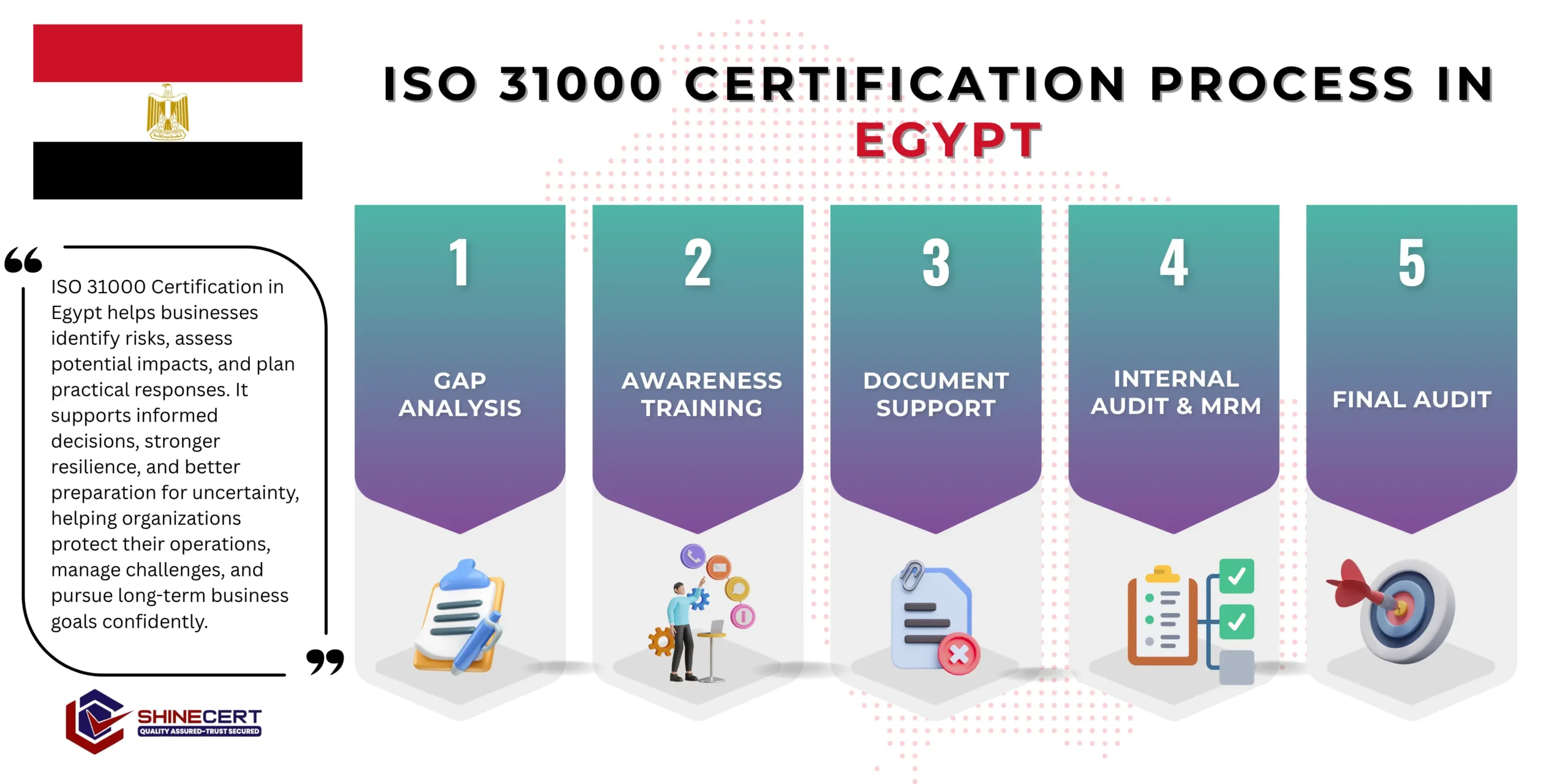
What are the steps to get ISO 31000 Certification in Egypt?
our services
- ISO Certification Egypt
- ISO 9001 Certification Egypt
- ISO 14001 Certification Egypt
- ISO 27001 Certification Egypt
- ISO 22000 Certification Egypt
- ISO 27701 Certification Egypt
- ISO 45001 Certification Egypt
- ISO 20000-1 Certification Egypt
- ISO 13485 Certification Egypt
- ISO 17025 Certification Egypt
- ISO 31000 Certification Egypt
- ISO 42001 Certification Egypt
- ISO 37001 Certification Egypt
- ISO 22301 Certification Egypt
- ISO 50001 Certification Egypt
- CE Mark Certification Egypt
- GDPR Certification Egypt
- GMP Certification Egypt
- Halal Certification Egypt
The ISO 31000 Implementation Process in Egypt
Risk Context Assessment
We establish your organization’s specific internal and external risk context, including currency exposure, energy dependency, and sector-specific factors.
A risk framework built around your real exposure, not generic categories.
A documented risk context statement.
Risk Identification and Analysis
We map the risks actually relevant to your business, from currency and inflation exposure to energy cost volatility and supply chain dependencies.
Visibility into risks you may currently be managing reactively rather than proactively.
A risk register with likelihood and impact analysis.
Framework Development
We build your risk management framework, including governance roles, risk appetite statements, and treatment planning processes.
A structure that survives beyond the initial project, not a one-time exercise.
A documented risk management framework.
Implementation and Training
The framework goes live, and relevant staff are trained on ongoing risk identification and reporting.
Risk management becomes a genuine operating habit, not an annual compliance task.
Training records and operating evidence.
Independent Conformity Review
Since there’s no certification body for ISO 31000, we arrange an independent review confirming your framework genuinely aligns with the standard’s guidance.
External validation without the cost or process of a formal certification audit.
A conformity review report.
Risk Context Assessment
We establish your organization’s specific internal and external risk context, including currency exposure, energy dependency, and sector-specific factors.
A risk framework built around your real exposure, not generic categories.
A documented risk context statement.
Risk Identification and Analysis
We map the risks actually relevant to your business, from currency and inflation exposure to energy cost volatility and supply chain dependencies.
Visibility into risks you may currently be managing reactively rather than proactively.
A risk register with likelihood and impact analysis.
Framework Development
We build your risk management framework, including governance roles, risk appetite statements, and treatment planning processes.
A structure that survives beyond the initial project, not a one-time exercise.
A documented risk management framework.
Implementation and Training
The framework goes live, and relevant staff are trained on ongoing risk identification and reporting.
Risk management becomes a genuine operating habit, not an annual compliance task.
Training records and operating evidence.
Independent Conformity Review
Since there’s no certification body for ISO 31000, we arrange an independent review confirming your framework genuinely aligns with the standard’s guidance.
External validation without the cost or process of a formal certification audit.
A conformity review report.
What Is ISO 31000, Clause by Clause?
ISO 31000 is structured differently from certifiable management-system standards like ISO 9001, since it’s guidance rather than a set of auditable requirements. It’s organized around principles, a framework, and a process.
- The Principles describe what good risk management looks like: integrated into your organization’s activities, structured, customized to your context, inclusive of stakeholders, dynamic, and based on the best available information rather than assumption.
- The Framework covers leadership commitment, integrating risk management into your organizational structure, designing your approach, implementing it, evaluating it, and improving it over time, mirroring the plan-do-check-act logic of certifiable standards without the audit requirement.
- The Process is the practical core: establishing context, risk identification, risk analysis, risk evaluation, risk treatment, and ongoing monitoring, review, recording, and reporting. This is where most of the genuine implementation work happens.
Because there’s no certificate, the value of ISO 31000 lies entirely in whether the process becomes a real decision-making habit, not whether a document exists describing it.
What Does ISO 31000 Implementation Cost in Egypt?
- Complexity of your risk exposure : Businesses with significant currency, energy, or supply chain exposure require more thorough risk analysis than those with simpler, more contained operations.
- Current risk management maturity : A business already tracking some risks informally starts from a stronger position than one with no structured risk awareness at all.
- Organizational size and structure : More departments and decision-making layers mean more governance structure to build into the framework.
- Whether you need the independent conformity review : Some businesses stop at framework implementation; others want the external validation step.
Benefits of ISO 31000 Implementation
A structured framework means pricing, contracts, and forecasts account for realistic currency scenarios rather than optimistic assumptions.
Understanding your exposure to further tariff increases as subsidy removal continues supports smarter capital and operating decisions.
A defined risk appetite and treatment process means decisions don’t have to be re-litigated from scratch each time a new risk appears.
International financiers increasingly expect to see structured risk governance, not just financial statements.
Many of the risks identified under ISO 31000 directly inform a continuity plan’s priorities.
How Long Does ISO 31000 Implementation Take in Egypt?
| Business Size | Typical Timeline | Why |
|---|---|---|
| Small, simpler risk exposure | 2 months | Fewer risk categories to analyze and govern |
| Medium, moderate exposure | 3 months | More risk categories and governance structure |
| Larger, significant currency or energy exposure | 4 months | Extensive risk analysis and treatment planning |
What Documents Support an ISO 31000 Framework?
- Context Documentation : Document: Risk Context Statement, covering currency, energy, and sector-specific exposure. Document: Stakeholder and Interested Party Analysis.
- Risk Assessment Documentation : Document: Risk Register, capturing identified risks with likelihood and impact ratings. Document: Risk Analysis and Evaluation Records.
- Governance Documentation : Document: Risk Management Framework and Policy. Document: Risk Appetite Statement.
- Treatment and Monitoring Documentation : Document: Risk Treatment Plans. Document: Monitoring and Review Records, tracking how risks evolve over time.
Why Businesses Choose ShineCert in Egypt?
Businesses searching for the best ISO 31000 consultant in Egypt are usually trying to move from reactive risk-firefighting to genuine planning. We’ve spent 10 years helping more than 10,000 businesses worldwide with certification and risk implementation, coordinated through our Riyadh and India offices. We build frameworks around your actual exposure, currency, energy, supply chain, not a generic risk template disconnected from Egypt’s current economic conditions.
Case Study: An Alexandria Import-Dependent Manufacturer
- A manufacturer in Alexandria relying heavily on imported raw materials found itself repeatedly caught off guard by currency movements affecting input costs, with pricing decisions made reactively each time the exchange rate shifted.
- Our risk assessment found the company had no formal currency exposure analysis, no documented risk appetite for pricing decisions, and no structured process for reviewing energy cost assumptions against the ongoing subsidy-removal roadmap.
- Over three months, we built a risk register capturing currency, energy, and supply chain exposure, established a risk appetite framework guiding pricing decisions, and created a quarterly review process tied to tariff and currency developments.
- The company’s next pricing cycle used the new framework directly, and management reported far more confidence in decisions that previously felt like guesswork.
Ready to Get Started?
Whether currency volatility, rising energy costs, or general uncertainty is driving the conversation, ShineCert will help you build a risk framework that actually changes how decisions get made. Book a free consultation or contact us to get started.
Frequently Asked Questions
No, it’s a risk management framework with no accredited certificate; we support implementation and can arrange an independent conformity review instead.
No, it’s entirely voluntary, though the currency and energy cost volatility Egyptian businesses currently face make structured risk management genuinely useful regardless of any requirement.
It depends on your risk complexity and organizational structure. We quote individually.
Usually two to four months, depending on risk complexity.
Yes, currency and inflation exposure are typically among the most material risks for Egyptian businesses right now, and the framework is built to address exactly this kind of risk.
Yes, most of the framework development and training can be delivered remotely.