
CE Mark Certification in Egypt
Quick Answer
CE marking is not a certificate of ShineCert or any consultant issues. It’s a manufacturer’s own declaration, backed by technical evidence and in some cases independent testing, that a product meets EU health, safety, and environmental requirements before it can be sold in the European Economic Area. For Egyptian manufacturers, this matters directly: the EU is Egypt’s single largest trading partner, accounting for over 22% of Egypt’s total trade, with EU-Egypt goods trade reaching €32.4 billion in 2025 under the free-trade framework established by the 2004 Association Agreement. We help you assess whether your product needs CE marking and prepare the technical documentation behind it; we do not affix the mark ourselves.
What Is CE Marking?
CE marking is a mandatory marking for certain product categories sold within the European Economic Area, indicating the manufacturer has verified the product meets applicable EU directives and regulations covering health, safety, and environmental protection.
It applies to specific product categories, including machinery, electrical and electronic equipment, personal protective equipment, toys, construction products, and certain medical devices. It does not apply to most raw agricultural commodities, and it is not a general quality or origin mark.
Critically, CE marking is a manufacturer self-declaration, not a certificate issued by a government body or consultant. For higher-risk product categories, a Notified Body based in the EU must assess the product before the manufacturer can affix the mark; for lower-risk categories, the manufacturer self-certifies against a technical file it must be able to produce on request.
Why CE Marking Matters for Egyptian Exporters?
The EU is Egypt’s largest trading partner by a wide margin :The EU accounted for over 22% of Egypt’s total trade in 2025, with goods trade reaching €32.4 billion, and trade in goods between the two has grown around 27% over the last decade.
The Association Agreement already removes tariffs on industrial products : In force since 2004, the EU-Egypt Association Agreement creates a free-trade area for industrial goods, meaning tariff barriers aren’t the obstacle facing Egyptian manufacturers targeting the EU market, product compliance is.
The relationship is deepening, not standing still : The EU and Egypt signed an agreement on Egypt’s association with Horizon Europe, the EU’s research and innovation funding program, at their first bilateral summit in October 2025, signaling a broader deepening of ties beyond pure trade.
Non-compliant products are simply refused entry regardless of trade agreement terms : A shipment without required CE documentation can be stopped at an EU port irrespective of the underlying tariff-free access, since customs authorities check for the mark and supporting technical file, not the trade agreement status.
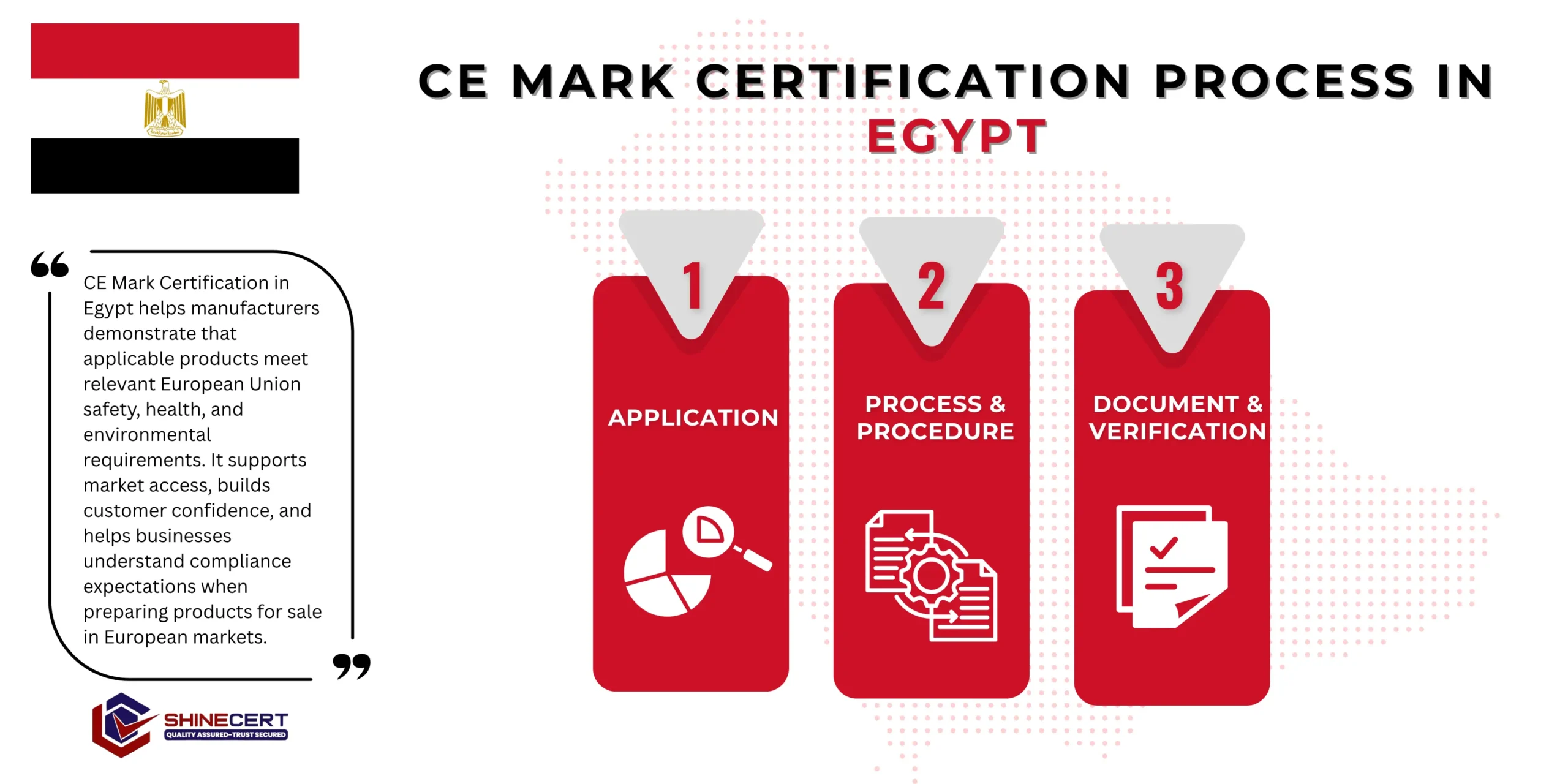
What are the steps to get CE Mark Certification in Egypt?
our services
- ISO Certification Egypt
- ISO 9001 Certification Egypt
- ISO 14001 Certification Egypt
- ISO 27001 Certification Egypt
- ISO 22000 Certification Egypt
- ISO 27701 Certification Egypt
- ISO 45001 Certification Egypt
- ISO 20000-1 Certification Egypt
- ISO 13485 Certification Egypt
- ISO 17025 Certification Egypt
- ISO 31000 Certification Egypt
- ISO 42001 Certification Egypt
- ISO 37001 Certification Egypt
- ISO 22301 Certification Egypt
- ISO 50001 Certification Egypt
- CE Mark Certification Egypt
- GDPR Certification Egypt
- GMP Certification Egypt
- Halal Certification Egypt
Preparing for CE Marking: The Process
CE marking itself is self-declared by the manufacturer, so our role is helping you build the technical file and testing evidence behind that declaration.
Product Classification
We determine exactly which EU directive or regulation governs your product, since machinery, electrical equipment, PPE, and textiles each carry different requirements.
Misclassifying your product wastes money on the wrong testing pathway.
A clear classification of which rules actually apply to you.
Gap Assessment
We compare your current design, materials, and existing documentation against the applicable directive’s essential requirements.
This surfaces exactly what needs to change before you invest in formal testing.
A specific list of design or documentation gaps.
Testing and Technical File
Where testing is required, we help arrange it through appropriate laboratories and compile the technical file demonstrating compliance.
The technical file is what customs or market surveillance authorities can request at any time, so it needs to hold up under scrutiny.
A complete, audit-ready technical file.
Notified Body Assessment
For higher-risk product categories, an EU-based Notified Body independently assesses the product before the mark can be affixed.
This step is not optional for regulated higher-risk categories and cannot be self-certified.
A Notified Body opinion or certificate specific to your product.
Declaration and Ongoing Compliance
As the manufacturer, you sign the EU Declaration of Conformity and affix the CE mark, then maintain the technical file for as long as the product remains on the market.
The declaration is a standing legal commitment, not a one-time event.
A compliant product ready for the EU market and a system for keeping it that way.
What Affects CE Marking Preparation Cost in Egypt?
- Product risk category : Machinery and electrical equipment requiring Notified Body assessment typically costs more to prepare than self-certified lower-risk categories.
- Existing documentation maturity : A manufacturer with organized design records and quality data starts from a stronger position than one with none.
- Testing requirements : Products needing physical laboratory testing add cost beyond documentation-only preparation.
- Number of product variants : Each distinct product variant sold into the EU generally needs its own technical file and, where applicable, its own testing evidence.
Benefits of Getting CE Marking Right
Correctly prepared products clear customs without the delays or refusals that incomplete documentation causes, on top of the tariff-free access the Association Agreement already provides.
Buyers sourcing from Egyptian manufacturers increasingly expect suppliers to understand CE requirements, even where the buyer holds ultimate responsibility for the finished product.
A properly maintained technical file protects the manufacturer if a product safety question arises after sale.
Once the classification and documentation process is understood for one product line, extending it to new products is far faster.
With ties broadening beyond trade into research and innovation cooperation, understanding CE requirements early positions Egyptian exporters ahead of competitors still learning the system.
How Long Does CE Marking Preparation Take?
| Product Type | Typical Timeline | Why |
|---|---|---|
| Low-risk, self-certified category | 6–8 weeks | Documentation-only pathway, no external testing |
| Moderate-risk, testing required | 2–3 months | Laboratory testing adds time beyond documentation |
| Higher-risk, Notified Body required | 3–5 months | External assessment is the longest single step |
Timelines depend heavily on which EU directive applies to your specific product.
What Documentation Is Involved in CE Marking Preparation?
- Classification Record : Document: Directive Applicability Assessment. Confirms which EU directive(s) govern your specific product.
- Design and Risk Documentation : Document: Risk Assessment. Document: Technical Drawings and Specifications.
- Testing Evidence : Document: Test Reports from an accredited facility where specified.
- Declaration Documentation : Document: EU Declaration of Conformity. Document: Notified Body Certificate, where required.
- Ongoing Compliance : Document: Technical File Maintenance Log.
Why Businesses Choose ShineCert in Egypt?
We’ve spent 10 years helping more than 10,000 businesses worldwide navigate certification and compliance requirements, coordinated through our Riyadh and India offices. As the best CE Mark consultant in Egypt, ShineCert helps you classify your product correctly, close documentation gaps, and connect with appropriate testing and Notified Body resources, saving you from costly missteps on a process where mistakes mean rejected shipments into Egypt’s most important export market.
Case Study: An Alexandria Electrical Components Manufacturer
- An electrical components manufacturer in Alexandria targeting a European distributor partnership had never prepared a CE technical file, having sold exclusively into domestic and regional markets until this opportunity arose.
- We classified the product correctly under the applicable EU electrical safety directive, identified an appropriate EU-based Notified Body given the product’s risk category, and helped the manufacturer compile the technical file covering design specifications and safety testing the assessment required.
- Testing samples were shipped and assessed over roughly four months. The manufacturer’s product line passed assessment, and it has since used the same documentation framework to evaluate two additional product lines before committing to new European orders.
Ready to Get Started?
If you’re manufacturing for European buyers or considering it, we’ll help you understand exactly what CE marking requires for your specific product and build the documentation behind it. Book a free consultation or contact us to get started.
Frequently Asked Questions
No. CE marking is a manufacturer self-declaration, sometimes backed by independent Notified Body assessment. We help you prepare the classification, testing, and documentation behind that declaration.
No, the agreement removes tariffs on industrial products but doesn’t replace CE marking, which is a separate product-safety compliance requirement.
It depends heavily on your product’s risk category and whether Notified Body testing is required. We assess your specific product before quoting.
Anywhere from six weeks for low-risk, self-certified products to five months for higher-risk categories requiring Notified Body assessment.
No, Notified Bodies are designated under EU law and based within the EU or in countries with mutual recognition agreements; we help you connect with an appropriate one.
No, manufacturers must maintain the technical file and re-assess compliance if the product design or its use changes.