
ISO 42001 Certification in Egypt
Quick Answer
ISO 42001 certification confirms an organization’s artificial intelligence management system meets an internationally recognized standard for responsible AI governance, verified by an independent, accredited certification body. In Egypt, this arrives at a genuinely relevant moment: the National AI Strategy 2025-2030, led by MCIT and the National Council for Artificial Intelligence, has set explicit governance expectations through the Egyptian Center for Responsible AI and the Responsible AI Charter, and businesses building or deploying AI systems increasingly need to demonstrate exactly the kind of structured governance ISO 42001 provides. Certification typically takes three to five months.
Why ISO 42001 Matters in Egypt?
The National AI Strategy sets real governance expectations : Egypt’s National AI Strategy 2025-2030, its second edition following the original 2021 strategy, is built around six pillars: Governance, Technology, Data, Infrastructure, Ecosystem, and Talent, with a dedicated Capacity Assessment Framework tracking progress against 89 indicators annually.
A responsible-AI institution already exists : The Egyptian Center for Responsible AI, operating under MCIT, is tasked with operationalizing AI governance frameworks, building directly on the Responsible AI Charter first issued in 2023, meaning Egyptian businesses building AI products increasingly answer to an active governance ecosystem, not just internal policy.
Growth targets mean more businesses entering this space : The strategy targets an ICT sector contributing 7.7% of GDP, 30,000 trained AI experts, and more than 250 AI startups by 2030, meaning the number of Egyptian businesses building or deploying AI systems, and needing governance structures for them, is set to grow substantially.
Government use cases are expanding into sensitive domains : The strategy specifically targets applying AI to public services including healthcare and agriculture, areas where governance failures carry real consequences, raising the bar for what “responsible AI” needs to actually mean in practice, not just in policy documents.
What are the steps to get ISO 42001 Certification in Egypt?
our services
- ISO Certification Egypt
- ISO 9001 Certification Egypt
- ISO 14001 Certification Egypt
- ISO 27001 Certification Egypt
- ISO 22000 Certification Egypt
- ISO 27701 Certification Egypt
- ISO 45001 Certification Egypt
- ISO 20000-1 Certification Egypt
- ISO 13485 Certification Egypt
- ISO 17025 Certification Egypt
- ISO 31000 Certification Egypt
- ISO 42001 Certification Egypt
- ISO 37001 Certification Egypt
- ISO 22301 Certification Egypt
- ISO 50001 Certification Egypt
- CE Mark Certification Egypt
- GDPR Certification Egypt
- GMP Certification Egypt
- Halal Certification Egypt
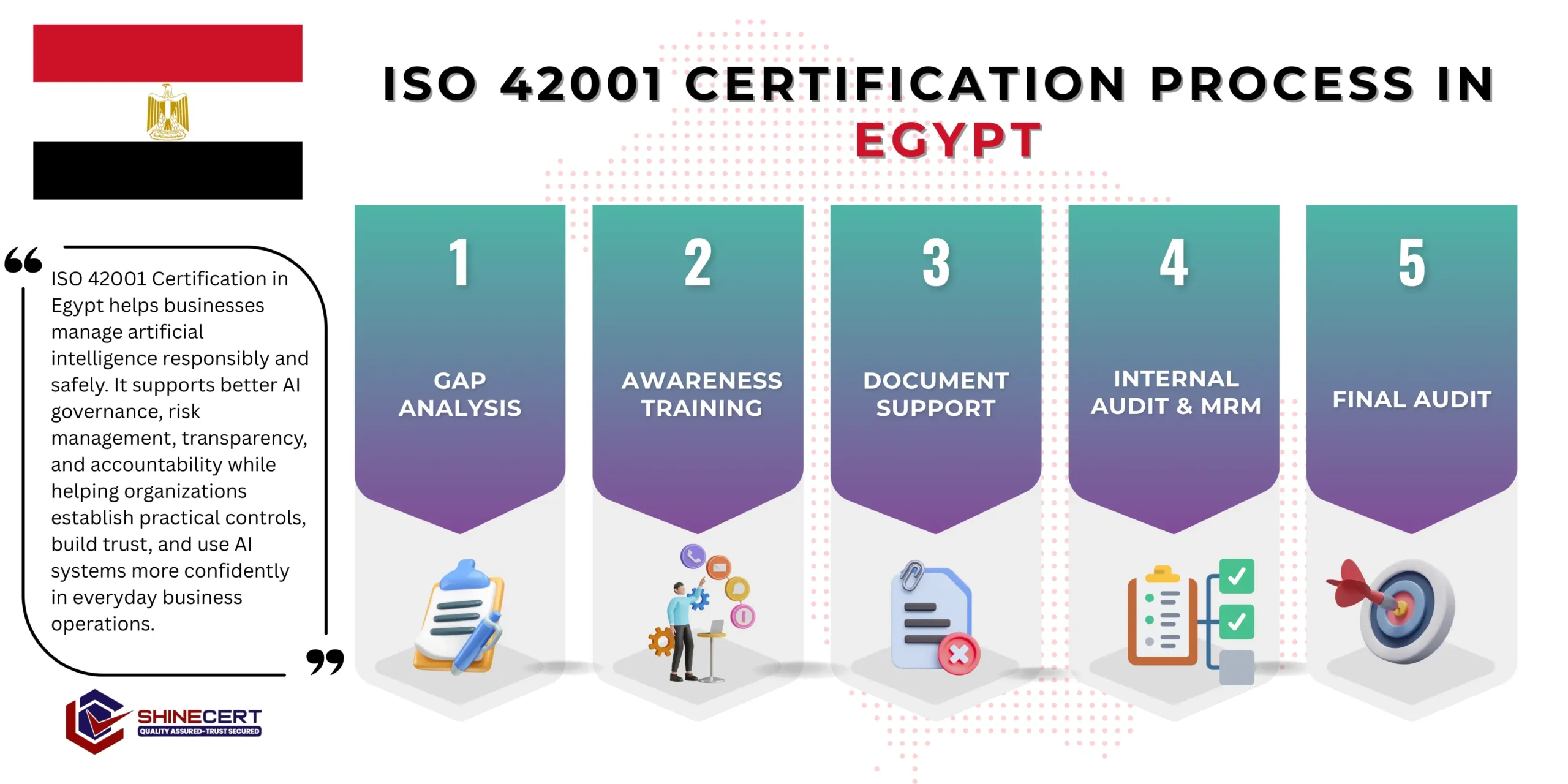
The ISO 42001 Certification Process in Egypt
Gap Assessment
We review your current AI development and deployment practices against every clause, including how you currently assess bias and impact, if at all.
An honest picture of your real governance maturity, not just your technical capability.
A clause-by-clause gap report.
Documentation Development
We build your AI policy, risk assessment covering bias and safety, and lifecycle management procedures specific to how you actually build or deploy AI.
Documentation that reflects your real AI systems, not a generic governance template.
A complete documentation set.
Implementation and Training
Governance controls go live, and staff across technical and business roles are trained on responsible AI practices relevant to their work.
Teams that can explain governance decisions, not just cite a policy document.
Training records and operating evidence.
Internal Audit and Management Review
We test the system internally and run your first management review.
Gaps surface with time to address them before the real audit.
An internal audit report and review minutes.
Certification Audit
An accredited certification body audits your AI management system and issues your certificate.
Documented evidence of genuine AI governance as Egypt’s ecosystem matures around exactly this expectation.
Your certificate and a surveillance schedule.
What Is ISO 42001, Clause by Clause?
- Clause 4: Context of the Organization : Requires identifying the internal and external issues affecting your AI systems, and understanding the expectations of interested parties, including regulators, users affected by AI decisions, and, in Egypt, the emerging national AI governance framework.
- Clause 5: Leadership : Requires top management to set an AI policy and demonstrate genuine ownership of responsible AI outcomes, not delegate governance entirely to a technical team building the models.
- Clause 6: Planning : Requires an AI risk assessment covering bias, transparency, safety, and impact on affected individuals, alongside setting measurable AI governance objectives.
- Clause 7: Support : Covers the competence, awareness, and documented information needed to run the system, including ensuring staff understand the ethical and technical implications of the AI systems they build or deploy.
- Clause 8: Operation : Covers the operational lifecycle of AI systems, from design and development through deployment and monitoring, including data governance and impact assessments for AI systems affecting people.
- Clause 9: Performance Evaluation : Requires monitoring AI system performance, including for bias and unintended outcomes, conducting internal audits, and management review of AI governance effectiveness.
- Clause 10: Improvement : Requires acting on identified issues, including harmful AI outcomes, and continually improving the AI management system over time.
What Does ISO 42001 Certification Cost in Egypt?
- Number and complexity of AI systems : A business with one narrow AI application requires less governance documentation than one deploying multiple systems across different use cases.
- Current governance maturity : A business already conducting informal bias or impact reviews starts from a stronger position than one with no governance practices at all.
- Sensitivity of AI use cases : Systems affecting individuals directly, such as healthcare or financial decisioning, typically require more rigorous risk assessment than internal-only tools.
- Certification body fees : Separate from consulting costs and vary by scope.
- Bundling with ISO 27001 : Businesses pursuing both often share risk assessment and documentation work, reducing total cost.
Benefits of ISO 42001 Certification
Certification demonstrates exactly the kind of structured governance the Egyptian Center for Responsible AI is pushing the market toward.
Systematic risk assessment under Clause 6 catches problems before deployment, not after a public incident.
As Egypt’s AI startup ecosystem grows toward the strategy’s 250-startup target, certified governance differentiates serious ventures from those treating AI ethics as an afterthought.
As government use cases expand into healthcare and public services, demonstrable governance becomes a genuine competitive advantage.
Clause 8’s lifecycle management approach means governance scales with your AI systems rather than becoming an afterthought bolted on later.
Much of the risk assessment and documentation infrastructure overlaps directly with information security management.
How Long Does ISO 42001 Certification Take in Egypt?
| Business Profile | Typical Timeline | Why |
|---|---|---|
| Single, narrow AI application | 3 months | Simpler risk assessment and governance scope |
| Multiple AI systems, moderate sensitivity | 4 months | More systems and use cases to govern |
| AI affecting sensitive domains (health, finance) | 5 months | Extensive risk assessment and impact analysis required |
What Documents Do You Need for ISO 42001 in Egypt? (By Clause)
- Clause 4 Documentation : Document: Scope of the AI Management System. Document: Interested Parties and Context Analysis.
- Clause 5 Documentation : Document: AI Policy. Document: Roles and Responsibilities Record.
- Clause 6 Documentation : Document: AI Risk Assessment covering bias, safety, and transparency. Document: AI Objectives and Planning Record.
- Clause 7 Documentation : Document: Competence and Training Records. Document: Document Control Procedure.
- Clause 8 Documentation : Document: AI System Lifecycle Procedures. Document: Data Governance and Impact Assessment Records.
- Clause 9 Documentation : Document: Internal Audit Program and Reports. Document: Management Review Minutes.
- Clause 10 Documentation : Document: Corrective Action Records. Document: Continual Improvement Log.
Why Businesses Choose ShineCert in Egypt?
Businesses searching for the best ISO 42001 consultant in Egypt are usually navigating unfamiliar territory, since formal AI governance is newer to most organizations than quality or security management. We’ve spent 10 years helping more than 10,000 businesses worldwide get certified, coordinated through our Riyadh and India offices. We translate AI governance requirements into practical documentation your technical and business teams can genuinely use, not abstract ethical principles disconnected from how you actually build AI.
Case Study: A Cairo AI Startup Building Healthcare Diagnostics Tools
- An Egyptian AI startup building diagnostic support tools for healthcare providers needed to demonstrate genuine governance to secure a partnership with a hospital network, following the network’s own due-diligence review of AI vendors.
- Our gap assessment found the startup had strong technical practices but no formal bias assessment process, no documented impact analysis for its diagnostic outputs, and no structured AI risk register.
- Over four months, we built the company’s AI risk assessment framework, documented bias-testing procedures for its diagnostic models, and created an incident response process for handling unexpected model outputs. The certification audit passed with one minor nonconformity, corrected before issuance.
- The certificate satisfied the hospital network’s due-diligence review, and the startup has since used its governance framework as a selling point in subsequent investor conversations.
Ready to Get Started?
Whether you’re building AI products or deploying them to support your business, ShineCert will help you build governance that genuinely holds up, not just a policy document. Book a free consultation or contact us to get started.
Frequently Asked Questions
No, but Egypt’s National AI Strategy and the Egyptian Center for Responsible AI are actively building governance expectations that certification directly demonstrates alignment with.
It depends on the number and sensitivity of your AI systems. We quote individually.
Usually three to five months, depending on how sensitive your AI use cases are.
Yes, if you deploy AI systems that affect decisions about people, governance obligations apply even if you didn’t build the underlying model.
No formal government certification scheme was identified; the Egyptian Center for Responsible AI operationalizes governance frameworks and guidance rather than issuing certificates itself.
Documentation development can happen remotely; the certification audit typically requires at least a partial site or system review.