
ISO 14001 Certification in Egypt
Quick Answer
ISO 14001 certification confirms an organization’s environmental management system meets an internationally recognized standard, verified by an independent, accredited certification body. In Egypt, EEAA (the Egyptian Environmental Affairs Agency) already requires industrial facilities to hold environmental permits and pass EIA review under Environmental Law No. 4 of 1994, and ISO 14001 certification is the fastest way to demonstrate that your environmental controls genuinely hold up to scrutiny, not just on paper. Importantly, the standard itself was just revised: ISO 14001:2026 published in April 2026, so any business certifying now is certifying against a genuinely new edition, not the old 2015 one. Certification typically takes three to six months.
Why ISO 14001 Matters in Egypt?
EEAA enforcement is active, not theoretical : The Egyptian Environmental Affairs Agency issues and renews environmental permits, reviews Environmental Impact Assessments, and conducts inspections across Egypt’s industrial zones, including Cairo, Alexandria, the Delta, Upper Egypt, and the Suez Canal corridor, with authority to suspend activities or revoke permits for noncompliant facilities.
The standard itself just changed : ISO 14001:2026 was published in April 2026, replacing the 2015 edition, with a three-year transition window running to roughly May 2029. Any Egyptian business certifying today is certifying against a materially updated standard, and any business still holding a 2015-edition certificate has a defined window to transition.
Climate considerations are now structurally embedded, not optional : The 2026 edition formally integrates the climate change amendment that was added to Clause 4 in 2024, meaning every certified organization must explicitly determine whether climate change is relevant to its environmental aspects and whether its interested parties have climate-related expectations.
Industrial growth is creating first-time compliance pressure : Facilities across Egypt’s expanding industrial zones, many financed by international investors who expect demonstrable environmental governance, increasingly need certification to satisfy financing and offtake conditions, not just regulatory ones.
What are the steps to get ISO 14001 Certification in Egypt?
our services
- ISO Certification Egypt
- ISO 9001 Certification Egypt
- ISO 14001 Certification Egypt
- ISO 27001 Certification Egypt
- ISO 22000 Certification Egypt
- ISO 27701 Certification Egypt
- ISO 45001 Certification Egypt
- ISO 20000-1 Certification Egypt
- ISO 13485 Certification Egypt
- ISO 17025 Certification Egypt
- ISO 31000 Certification Egypt
- ISO 42001 Certification Egypt
- ISO 37001 Certification Egypt
- ISO 22301 Certification Egypt
- ISO 50001 Certification Egypt
- CE Mark Certification Egypt
- GDPR Certification Egypt
- GMP Certification Egypt
- Halal Certification Egypt
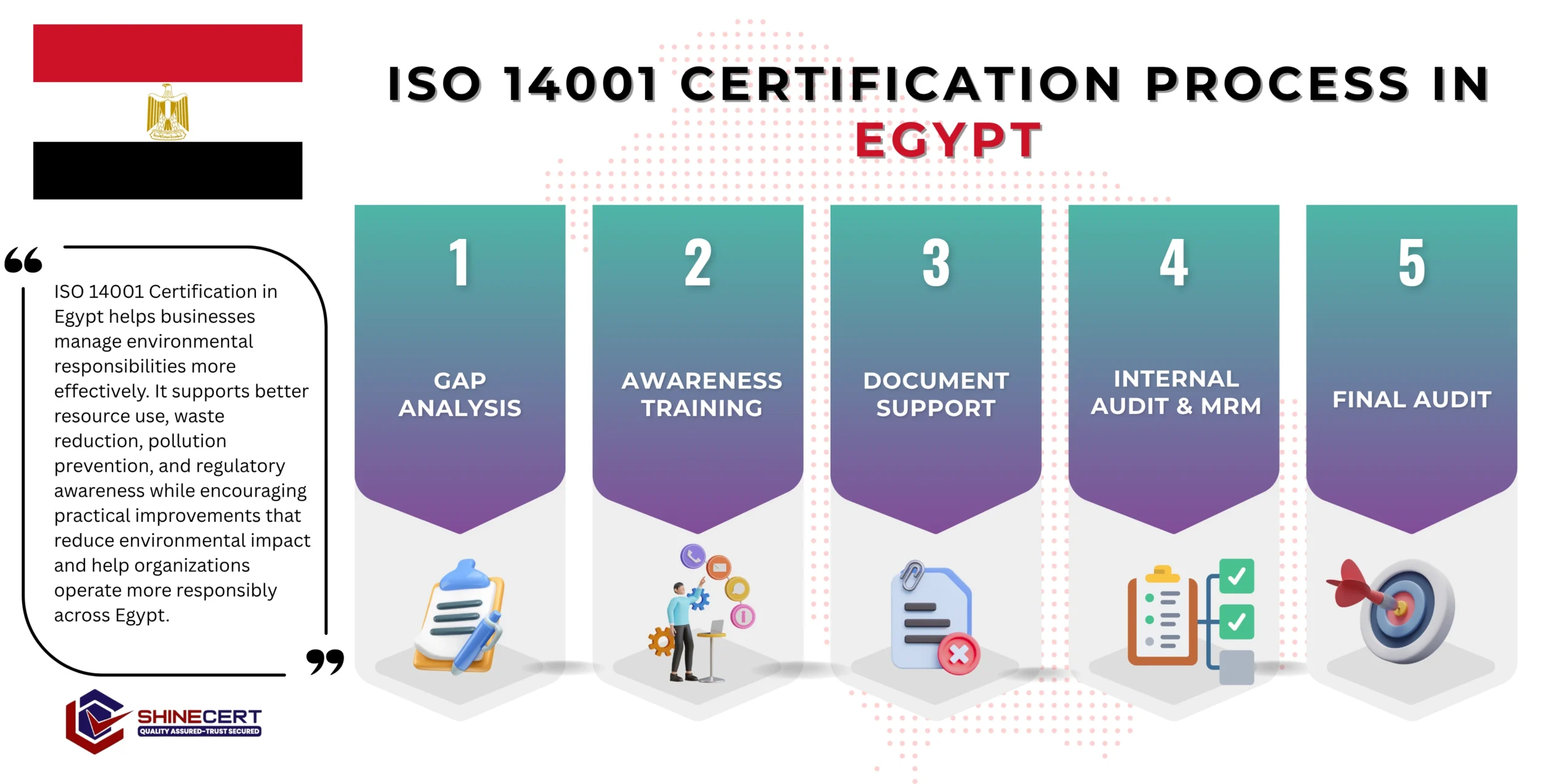
The ISO 14001 Certification Process in Egypt
Gap Assessment
We review your current environmental controls, permits, and EIA status against every clause of the 2026 edition.
An honest picture of where your real exposure sits, including whether EEAA compliance gaps could block certification.
A clause-by-clause gap report.
Documentation Development
We build your environmental policy, aspects and impacts register, compliance obligations register, and operational procedures.
Documentation that reflects your actual site conditions, not a generic template.
A complete, audit-ready documentation set.
Implementation and Training
Controls go live, and staff across relevant roles are trained on their specific environmental responsibilities.
By audit day, staff can explain the system, not just point to a binder.
Training records and operating evidence.
Internal Audit and Management Review
We run an internal audit and facilitate your first management review before the real audit happens.
Remaining gaps surface while there’s time to fix them quietly.
An internal audit report and review minutes.
Certification Audit
An accredited certification body audits your system against the 2026 edition and issues your certificate.
You’re certified against the current standard from day one, not something already due for updating.
Your ISO 14001 certificate and a three-year surveillance schedule.
What Is ISO 14001, Clause by Clause?
ISO 14001 shares the same overall structure as ISO 9001, since both are built on ISO’s common framework for management system standards, but every clause is oriented around environmental performance rather than quality. Here’s what the standard actually requires.
- Clause 4: Context of the Organization : You must identify the environmental issues relevant to your operations, including, as of the 2024 amendment now folded into the 2026 edition, climate change specifically, and determine which interested parties (EEAA, local communities, customers, financiers) have environmental expectations of you.
- Clause 5: Leadership : Top management must set an environmental policy and take visible ownership of environmental performance, not delegate it entirely to an EHS officer who reports upward only when something goes wrong.
- Clause 6: Planning : This is where you identify environmental aspects and impacts, such as emissions, waste, and resource use, assess compliance obligations under Egyptian environmental law, and plan actions to address risks and opportunities, including climate-related ones.
- Clause 7: Support : Covers the resources, competence, and awareness needed to operate the system, plus document control for your environmental procedures and records.
- Clause 8: Operation : The largest clause, covering operational controls over your actual environmental aspects, emergency preparedness and response planning, and management of environmentally significant activities across your operations.
- Clause 9: Performance Evaluation : Requires monitoring and measuring your actual environmental performance against objectives, evaluating compliance with EEAA and other legal obligations, conducting internal audits, and holding management reviews.
- Clause 10: Improvement : Requires acting on nonconformities and continually improving the environmental management system’s performance over time, not just maintaining the status quo once certified.
What Does ISO 14001 Certification Cost in Egypt??
- Facility complexity and environmental footprint : More significant environmental aspects, emissions, waste streams, water use, mean more controls to document and verify.
- Current EEAA compliance standing : A facility with existing permits and a clean EIA history starts from a stronger position than one with unresolved compliance issues.
- Number of sites : Multi-site operations require aspects registers and controls documented per location, not once for the whole business.
- Certification body fees : Separate from consulting fees and dependent on scope and site count; we help you compare quotes.
- Bundling with ISO 9001 or ISO 45001 : Combined audits across standards often reduce total certification cost.
Benefits of ISO 14001 Certification
A functioning environmental management system gives inspectors documented evidence, not just verbal assurances.
International lenders and buyers increasingly require certified environmental governance as a condition of investment or purchase.
Systematic monitoring under Clause 9 catches compliance drift before EEAA does.
Clause 6’s aspects analysis frequently surfaces waste and energy inefficiencies worth fixing regardless of certification.
Certifying now means your system is built to the 2026 requirements from the start, avoiding a transition scramble later.
Certification signals environmental governance maturity to partners across the EU, GCC, and beyond.
ISO 14001 pairs naturally with ISO 45001 and ISO 50001, sharing much of the same underlying management-system structure.
What Documents Do You Need for ISO 14001 in Egypt? (By Clause)
- Clause 4 Documentation : Document: Scope of the Environmental Management System. Document: Interested Parties and Context Analysis, including climate-relevance determination.
- Clause 5 Documentation : Document: Environmental Policy. Document: Roles and Responsibilities Record.
- Clause 6 Documentation : Document: Environmental Aspects and Impacts Register. Document: Compliance Obligations Register covering EEAA permits and Environmental Law No. 4 requirements.
- Clause 7 Documentation : Document: Competence and Training Records. Document: Document Control Procedure.
- Clause 8 Documentation : Document: Operational Control Procedures. Document: Emergency Preparedness and Response Plan.
- Clause 9 Documentation : Document: Internal Audit Program and Reports. Document: Management Review Minutes. Document: Compliance Evaluation Records.
- Clause 10 Documentation : Document: Corrective Action Records. Document: Continual Improvement Log.
How Long Does ISO 14001 Certification Take in Egypt?
| Facility Type | Typical Timeline | Why |
|---|---|---|
| Single site, limited environmental footprint | 3 months | Fewer aspects and controls to document |
| Multi-site or moderate industrial footprint | 4–5 months | More aspects, permits, and sites to align |
| Complex industrial or process facility | 5–6 months | Extensive operational controls and EIA history to document |
The 2026 Revision, Explained
ISO 14001 has already been through its first full revision since 2015. Here’s what actually changed and what it means if you’re certifying now or hold an older certificate.
- The timeline is real and already in motion : The Final Draft International Standard was released in January 2026 for an eight-week ballot, and the finished ISO 14001:2026 was formally published in April 2026. Organizations currently certified against the 2015 edition have roughly three years, until about May 2029, to transition.
- Climate change is now permanently built into Clause 4, not an add-on : The climate amendment issued in 2024 has been fully folded into the 2026 edition’s Clause 4.1 and 4.2, requiring every certified organization to explicitly determine whether climate change is relevant to its environmental aspects and whether interested parties, financiers, regulators, export buyers, have climate-related expectations of the business.
- Life cycle thinking gets more emphasis : The revised standard pushes organizations to consider environmental impacts across a product or service’s life cycle, not just within the factory gate, which matters for Egyptian manufacturers whose supply chains span multiple countries.
- Structured change management is now more explicit : Organizations are expected to formally assess environmental implications before making significant operational changes, rather than reacting to environmental consequences after the fact.
- Measurable environmental performance is emphasized over documentation for its own sake : The revision leans toward organizations demonstrating actual improved outcomes, not just maintaining a complete paper trail.
- Alignment with the Harmonized Structure is tighter : This makes integrating ISO 14001 with ISO 9001 or ISO 45001 into a single combined management system more straightforward than under the 2015 edition.
What this means practically: if you’re certifying now, you’re automatically certifying to the current 2026 edition, so there’s no transition risk to plan for on your first certificate. If you already hold a 2015-edition certificate, we build your transition into your next scheduled surveillance audit rather than treating it as a separate project, since most of the work is updating your Clause 4 context analysis and formalizing change-management practices you may already follow informally.
Why Businesses Choose ShineCert in Egypt?
Businesses searching for the best ISO 14001 consultant in Egypt are increasingly asking a very specific question: is this consultant building me a system for the 2015 edition or the current one? We’ve spent 10 years helping more than 10,000 businesses worldwide get certified, coordinated through our Riyadh and India offices. Every environmental management system we build starts from the 2026 edition, so you’re never certifying against a standard that’s already partway to being superseded.
Case Study: An Industrial Zone Chemical Processing Facility
- A mid-sized chemical processing facility in one of Egypt’s industrial zones needed ISO 14001 certification to satisfy a financing condition attached to an expansion loan from an international lender.
- Our gap assessment found the facility’s EEAA permits were current, but there was no formal aspects and impacts register, no documented emergency response plan for chemical spills, and no internal audit process.
- Over four months, we built the environmental policy and aspects register, documented emergency preparedness procedures specific to the facility’s chemical handling processes, and ran the company’s first internal audit and management review. The certification audit found no major nonconformities.
- The facility secured its certificate in time to satisfy the lender’s condition, and the expansion loan proceeded on schedule.
Ready to Get Started?
Whether you’re certifying for the first time or transitioning an existing certificate to the 2026 edition, ShineCert will walk through exactly what your facility needs and give you a clear, honest quote. Book a free consultation or contact us to get started.
Frequently Asked Questions
No, but EEAA’s permitting and EIA requirements under Environmental Law No. 4 of 1994 create a strong regulatory foundation that certification demonstrates compliance with more credibly.
Yes. ISO 14001:2026 was published in April 2026, replacing the 2015 edition, with a three-year transition window for existing certificate holders.
Yes, formally, in Clause 4.1 and 4.2, building on the amendment first issued in 2024.
It depends on your facility’s environmental footprint, site count, and current EEAA compliance standing. We quote individually.
Usually three to six months, depending on facility complexity.
You have until roughly May 2029 to transition; we build this into your next surveillance audit rather than treating it as urgent.