
ISO 45001 Certification in Egypt
Quick Answer
ISO 45001 certification confirms an organization’s occupational health and safety management system meets an internationally recognized standard, verified by an independent, accredited certification body. In Egypt, Labor Law No. 12 of 2003 already obligates employers to provide a safe working environment under Article 246, and to report workplace injuries to the Ministry of Manpower within 24 hours under Article 229, with penalties up to EGP 20,000 per incident for missing that window. Certification gives you a structured system for meeting these obligations consistently rather than reactively. It typically takes three to five months.
Why ISO 45001 Matters in Egypt?
Reporting obligations carry real penalties : Article 229 of Labor Law 12/2003 requires workplace injuries to be reported to the local Ministry of Manpower office within 24 hours, and missing that window is treated as a serious violation carrying penalties up to EGP 20,000 per incident.
Workplace incidents remain a documented problem : Reports covering just January and February 2024 recorded around 11 worker deaths and 7 injuries across various work accidents, with construction and electrical industries flagged as particularly high-risk.
The legal framework already sets a real bar : Article 246 requires employers to take all necessary precautions against physical hazards, including heat, cold, noise, vibration, inappropriate lighting, harmful radiation, and explosion risks, and Social Insurance Law 148/2019 provides the compensation framework when things go wrong.
Certification demonstrates systematic compliance, not incident-by-incident scrambling : A functioning ISO 45001 system means hazard identification and reporting discipline exist before an inspector or an incident forces the issue.
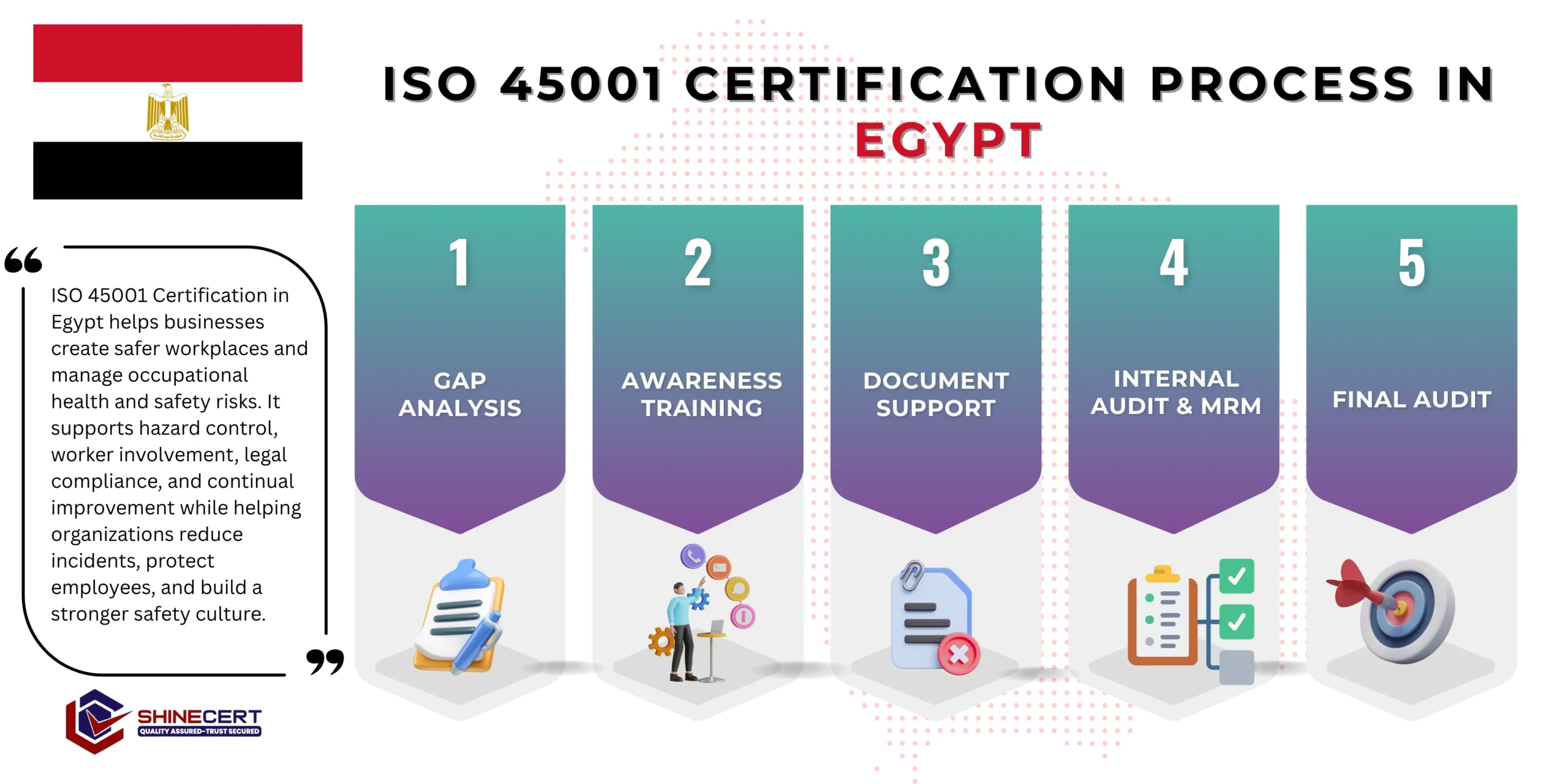
What are the steps to get ISO 45001 Certification in Egypt?
our services
- ISO Certification Egypt
- ISO 9001 Certification Egypt
- ISO 14001 Certification Egypt
- ISO 27001 Certification Egypt
- ISO 22000 Certification Egypt
- ISO 27701 Certification Egypt
- ISO 45001 Certification Egypt
- ISO 20000-1 Certification Egypt
- ISO 13485 Certification Egypt
- ISO 17025 Certification Egypt
- ISO 31000 Certification Egypt
- ISO 42001 Certification Egypt
- ISO 37001 Certification Egypt
- ISO 22301 Certification Egypt
- ISO 50001 Certification Egypt
- CE Mark Certification Egypt
- GDPR Certification Egypt
- GMP Certification Egypt
- Halal Certification Egypt
The ISO 45001 Certification Process in Egypt
Gap Assessment
We review your current safety practices, incident-reporting discipline, and hazard controls against every clause.
An honest map of where your Article 229 reporting compliance and physical hazard controls actually stand.
A clause-by-clause gap report.
Documentation Development
We build your OHS policy, hazard identification and risk assessment register, and legal compliance register tied to Labor Law 12/2003.
Documentation reflecting your actual site hazards, not generic boilerplate.
A complete documentation set.
Implementation and Training
Controls go live, and genuine worker consultation, not just top-down instruction, is built into the rollout as Clause 5 requires.
Workers who can explain hazards relevant to their own roles when the auditor asks.
Training and consultation records.
Internal Audit and Management Review
We test the system internally and run your first management review.
Gaps surface while there’s time to fix them quietly.
An internal audit report and review minutes.
Certification Audit
An accredited certification body audits your system and issues your certificate.
Documented proof of systematic OHS management, not just a clean incident record by chance.
Your certificate and a surveillance schedule.
What Is ISO 45001, Clause by Clause?
- Clause 4: Context of the Organization : Requires identifying the internal and external issues affecting occupational health and safety, and understanding worker and other interested-party needs and expectations, including regulatory expectations from the Ministry of Manpower.
- Clause 5: Leadership and Worker Participation : Puts top management responsibility for OHS front and center, and, distinctly from ISO 9001, explicitly requires genuine worker participation and consultation, not just management-directed safety policy.
- Clause 6: Planning : Requires hazard identification and risk assessment across your operations, along with planning actions to address risks and legal compliance obligations under Labor Law 12/2003 and its associated ministerial decrees.
- Clause 7: Support : Covers competence, awareness, communication, and documented information needed to run the OHS system, including ensuring workers actually understand hazards relevant to their roles.
- Clause 8: Operation : The largest clause, covering operational controls for hazard elimination and risk reduction, management of change, procurement and contractor controls, and emergency preparedness and response.
- Clause 9: Performance Evaluation : Requires monitoring incident and near-miss data, evaluating legal compliance, conducting internal audits, and management review of OHS performance.
- Clause 10: Improvement : Requires investigating incidents, taking corrective action, and continually improving OHS performance, not just maintaining a static safety manual.
What Does ISO 45001 Certification Cost in Egypt?
- Industry risk profile : Construction and electrical work, Egypt’s highest-risk sectors by incident data, typically require more extensive hazard controls than office-based operations.
- Current safety system maturity : A business with existing safety officers and incident logs starts from a stronger position than one without.
- Workforce size and site count : More workers and locations mean more training and hazard-control documentation.
- Certification body fees : Separate from consulting costs and vary by scope and site count.
- Bundling with ISO 14001 or ISO 9001 : Combined audits often reduce total certification cost.
Benefits of ISO 45001 Certification
A systematic incident-reporting process built into the OHS system makes missing the 24-hour window far less likely.
Structured hazard identification under Clause 6 catches risks before they become injuries.
Certification signals genuine safety governance to partners and can support better insurance terms.
Fewer incidents mean less exposure to Social Insurance Law 148/2019 compensation claims and production disruption.
Genuine worker consultation, not just top-down safety rules, tends to build trust that pays off in retention.
ISO 45001 pairs naturally with ISO 14001 and ISO 9001 under the shared Harmonized Structure.
How Long Does ISO 45001 Certification Take in Egypt?
| Business Size | Typical Timeline | Why |
|---|---|---|
| Small, low-risk operations | 3 months | Fewer hazards and simpler documentation |
| Medium, moderate-risk industry | 4 months | More hazard categories and training needs |
| Larger, high-risk operations (construction, industrial) | 5 months | Extensive hazard controls and contractor management |
What Documents Do You Need for ISO 45001 in Egypt? (By Clause)
- Clause 4 Documentation : Document: Scope of the OHS Management System. Document: Interested Parties and Context Analysis.
- Clause 5 Documentation : Document: OHS Policy. Document: Worker Consultation and Participation Record.
- Clause 6 Documentation : Document: Hazard Identification and Risk Assessment Register. Document: Legal Compliance Register covering Labor Law 12/2003 and related decrees.
- Clause 7 Documentation : Document: Competence and Training Records. Document: Document Control Procedure.
- Clause 8 Documentation : Document: Operational Control Procedures. Document: Emergency Preparedness and Response Plan.
- Clause 9 Documentation : Document: Incident Investigation and Reporting Log, aligned to the Article 229 24-hour requirement. Document: Internal Audit and Management Review Records.
- Clause 10 Documentation : Document: Corrective Action Records. Document: Continual Improvement Log.
Why Businesses Choose ShineCert in Egypt?
Businesses searching for the best ISO 45001 consultant in Egypt are usually trying to avoid two things: a preventable incident and a missed regulatory deadline. We’ve spent 10 years helping more than 10,000 businesses worldwide get certified, coordinated through our Riyadh and India offices. We build hazard registers and reporting procedures specific to your real site conditions, not a generic safety manual with your company name on the cover.
Case Study: A Construction Contractor in Greater Cairo
- A mid-sized construction contractor working on commercial projects across Greater Cairo needed ISO 45001 certification after a client began requiring it as a condition for bidding on larger contracts, following a sector-wide push for safety accountability.
- Our gap assessment found the contractor had informal safety practices on site but no documented hazard identification process, inconsistent incident-reporting discipline that had previously triggered a missed 24-hour reporting deadline, and no formal worker consultation mechanism.
- Over four months, we built a site-specific hazard register, formalized an incident-reporting procedure with clear internal escalation timing to guarantee the 24-hour window was met, and introduced regular worker safety consultations. The certification audit passed with no major nonconformities.
- The contractor used its new certificate to qualify for the larger contract and has since applied the same hazard-register approach across two additional project sites.
Ready to Get Started?
Whether you’re responding to a client’s certification requirement or building genuine safety discipline before an incident forces the issue, ShineCert will assess your real risk profile and give you a clear, honest quote. Book a free consultation or contact us to get started.
Frequently Asked Questions
No, but Labor Law 12/2003 already sets binding OHS obligations, including a 24-hour injury reporting requirement under Article 229; certification helps meet these systematically.
It depends on your industry risk profile, workforce size, and current safety maturity. We quote individually.
Usually three to five months, depending on industry risk level.
It’s treated as a serious violation under Article 229, with penalties reaching EGP 20,000 per incident.
Yes, Clause 8’s operational controls extend to contractor and procurement management where relevant to your operations.
Documentation development can happen remotely; the certification audit requires a site visit.