
ISO 27001 Certification in Egypt
Quick Answer
ISO 27001 certification confirms an organization’s information security management system meets an internationally recognized standard, verified by an independent, accredited certification body. In Egypt, this matters more right now than it has at any prior point: the Personal Data Protection Law’s Executive Regulations were issued in November 2025, the Personal Data Protection Center (PDPC) is now the active supervisory authority, and the one-year grace period for businesses to secure mandatory licenses ends October 31, 2026, with full enforcement from November 1, 2026. ISO 27001 won’t substitute for PDPL licensing, but a working information security management system makes meeting the underlying data protection requirements dramatically more realistic. Certification typically takes three to five months.
Why ISO 27001 Matters in Egypt?
The PDPL compliance deadline is close and real : Egypt’s Personal Data Protection Law No. 151/2020 became fully operational once its Executive Regulations (No. 816/2025) were issued on November 1, 2025, establishing the Personal Data Protection Center as the supervisory authority. Businesses have a one-year grace period, ending October 31, 2026, to secure mandatory licenses, including specific licenses for cross-border data transfers, electronic marketing, and video surveillance, before enforcement begins November 1, 2026.
ISO 27001 builds the underlying controls PDPL licensing assumes exist : The PDPC’s licensing process expects organizations to demonstrate genuine data protection practices, not just paperwork; an ISO 27001-certified information security management system gives you the risk assessment, access controls, and incident response processes that make the licensing conversation far more straightforward.
The licensing portal is opening on a tight timeline : The PDPC’s online application portal for licenses and permits was expected to open around mid-2026, meaning businesses that wait until the deadline approaches to start building security controls will be competing with everyone else for licensing attention at the same time.
Egypt’s growing outsourcing sector faces particular exposure : With outsourcing exports targeting $6 billion in 2026 and hundreds of thousands of jobs tied to IT-enabled services, businesses handling client data, much of it originating outside Egypt, sit squarely inside both PDPL’s scope and their international clients’ own security expectations.
What are the steps to get ISO 27001 Certification in Egypt?
our services
- ISO Certification Egypt
- ISO 9001 Certification Egypt
- ISO 14001 Certification Egypt
- ISO 27001 Certification Egypt
- ISO 22000 Certification Egypt
- ISO 27701 Certification Egypt
- ISO 45001 Certification Egypt
- ISO 20000-1 Certification Egypt
- ISO 13485 Certification Egypt
- ISO 17025 Certification Egypt
- ISO 31000 Certification Egypt
- ISO 42001 Certification Egypt
- ISO 37001 Certification Egypt
- ISO 22301 Certification Egypt
- ISO 50001 Certification Egypt
- CE Mark Certification Egypt
- GDPR Certification Egypt
- GMP Certification Egypt
- Halal Certification Egypt
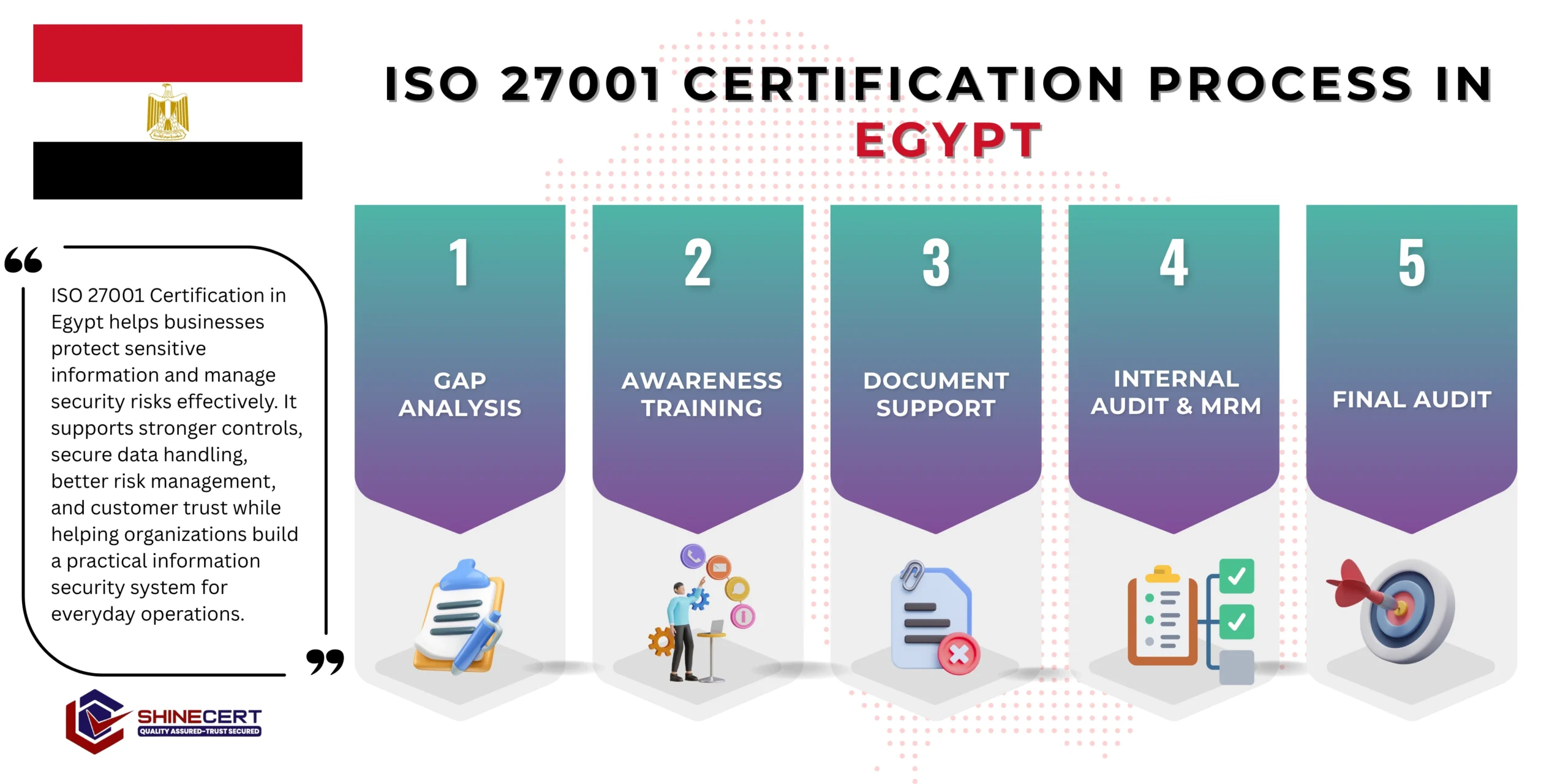
The ISO 27001 Certification Process in Egypt
Gap Assessment
We review your current security controls, data flows, and PDPL exposure, since knowing what personal data you handle is a prerequisite for both certification and licensing.
Clarity on where your real security and compliance gaps sit.
A clause-by-clause gap report plus a PDPL exposure summary.
Documentation Development
We build your information security policy, risk assessment and treatment plan, and Annex A control documentation.
A system genuinely mapped to your actual data flows, not a generic security template.
A complete documentation set.
Implementation and Training
Security controls go live and staff are trained on data-handling responsibilities specific to their role.
Staff who can demonstrate genuine security awareness during the audit.
Training records and operating evidence.
Internal Audit and Management Review
We test the system internally and run your first management review before the real audit.
Remaining gaps surface with time to fix them.
An internal audit report and review minutes.
Certification Audit
An accredited certification body audits your system and issues your certificate.
Documented evidence of genuine security governance heading into the PDPL enforcement deadline.
Your certificate and a surveillance schedule.
Gap Assessment
We review your current security controls, data flows, and PDPL exposure, since knowing what personal data you handle is a prerequisite for both certification and licensing.
Clarity on where your real security and compliance gaps sit.
A clause-by-clause gap report plus a PDPL exposure summary.
Documentation Development
We build your information security policy, risk assessment and treatment plan, and Annex A control documentation.
A system genuinely mapped to your actual data flows, not a generic security template.
A complete documentation set.
Implementation and Training
Security controls go live and staff are trained on data-handling responsibilities specific to their role.
Staff who can demonstrate genuine security awareness during the audit.
Training records and operating evidence.
Internal Audit and Management Review
We test the system internally and run your first management review before the real audit.
Remaining gaps surface with time to fix them.
An internal audit report and review minutes.
Certification Audit
An accredited certification body audits your system and issues your certificate.
Documented evidence of genuine security governance heading into the PDPL enforcement deadline.
Your certificate and a surveillance schedule.
What Is ISO 27001, Clause by Clause?
- Clause 4: Context of the Organization : Requires identifying internal and external issues affecting information security and understanding what interested parties, including the PDPC, customers, and partners, expect regarding data protection.
- Clause 5: Leadership : Requires top management to set an information security policy and take demonstrated ownership, not delegate security entirely to an IT department working in isolation.
- Clause 6: Planning : This is where risk assessment enters formally: you must identify information security risks, plan treatment for them, and set measurable security objectives.
- Clause 7: Support : Covers competence, awareness, communication, and documented information needed to run the system, including ensuring staff understand data-handling responsibilities relevant to their role.
- Clause 8: Operation : Covers implementing the risk treatment plan and operational security controls day to day, drawing on the Annex A control set (encryption, access control, incident management, and more).
- Clause 9: Performance Evaluation : Requires monitoring security performance, conducting internal audits, and holding management reviews to check the system is actually working, not just documented.
- Clause 10: Improvement : Requires acting on nonconformities, including security incidents, and continually improving the system’s effectiveness over time.
What Does ISO 27001 Certification Cost in Egypt?
- Data sensitivity and volume : Businesses handling large volumes of personal data, particularly involving cross-border transfer, typically need more extensive controls than those with limited data processing.
- Current security maturity : A business with existing IT security practices starts from a stronger position than one building from scratch.
- Sector : Outsourcing and financial services providers, given their EU and Gulf client data exposure, typically require more thorough documentation than businesses with purely domestic operations.
- Certification body fees : Separate from consulting costs and vary by scope.
- Overlap with PDPL licensing preparation : Businesses pursuing both together can share much of the risk assessment and documentation work, reducing total cost versus doing them separately.
Benefits of ISO 27001 Certification
Businesses with a working security management system enter the PDPC licensing process with far more of the groundwork already done.
Systematic risk assessment under Clause 6 catches vulnerabilities before they become breaches.
Outsourcing and BPO clients based in the EU or Gulf increasingly require demonstrable security certification as a vendor condition.
Clause 8’s operational controls mean a genuine response plan exists rather than an improvised one under pressure.
As Egypt’s outsourcing exports grow toward $6 billion, certified providers stand out to clients comparing multiple vendors.
The privacy-extension standard builds directly on an existing ISO 27001 system.
How Long Does ISO 27001 Certification Take in Egypt?
| Business Size | Typical Timeline | Why |
|---|---|---|
| Small, limited data processing | 3 months | Simpler risk assessment and fewer controls |
| Medium, moderate data volume | 4 months | More data flows and controls to document |
| Larger, cross-border data operations | 5 months | Extensive risk assessment and transfer-specific controls |
Given the November 2026 PDPL deadline, businesses starting now have a realistic window to certify before enforcement begins; those starting later may be racing the clock.
What Documents Do You Need for ISO 27001 in Egypt? (By Clause)
- Clause 4 Documentation : Document: Scope of the Information Security Management System. Document: Interested Parties and Context Analysis, including PDPL exposure.
- Clause 5 Documentation : Document: Information Security Policy. Document: Roles and Responsibilities Record.
- Clause 6 Documentation : Document: Risk Assessment and Treatment Plan. Document: Statement of Applicability covering Annex A controls.
- Clause 7 Documentation : Document: Competence and Training Records. Document: Document Control Procedure.
- Clause 8 Documentation : Document: Operational Security Procedures. Document: Incident Response Plan.
- Clause 9 Documentation : Document: Internal Audit Program and Reports. Document: Management Review Minutes.
- Clause 10 Documentation : Document: Corrective Action and Incident Records. Document: Continual Improvement Log.
Why Businesses Choose ShineCert in Egypt?
Businesses searching for the best ISO 27001 consultant in Egypt right now are usually racing the PDPL deadline, not just pursuing a certificate for its own sake. We’ve spent 10 years helping more than 10,000 businesses worldwide get certified, coordinated through our Riyadh and India offices. We build your security management system with an eye on your PDPL licensing needs from day one, so the two efforts reinforce each other instead of duplicating work.
Case Study: A Cairo-Based Outsourcing Provider
- A Cairo-based outsourcing provider handling customer service data for a European retail client faced two simultaneous pressures: its client’s own security due-diligence questionnaire, and the approaching PDPL licensing deadline.
- Our gap assessment found the company had basic IT security practices but no formal risk assessment, no documented data processing agreement with its European client, and no incident response plan.
- Over four months, we built the company’s risk register, documented Annex A controls covering access management and data handling, and created an incident response procedure. The certification audit passed with two minor nonconformities, both corrected quickly.
- The certificate satisfied the client’s due-diligence questionnaire directly, and the underlying documentation is now being used as the foundation for the company’s PDPL licensing application ahead of the deadline.
Ready to Get Started?
With the PDPL enforcement deadline approaching in November 2026, the sooner you start building genuine security governance, the more comfortable that deadline becomes. ShineCert will assess your real data exposure and give you a clear, honest quote. Book a free consultation or contact us to get started.
Frequently Asked Questions
No, they’re separate: PDPL licensing is a legal requirement administered by the PDPC, while ISO 27001 is a voluntary certification. A working ISO 27001 system makes meeting PDPL requirements more realistic, but doesn’t replace the license.
The one-year grace period following the November 2025 Executive Regulations ends October 31, 2026, with enforcement from November 1, 2026.
It depends on your data volume, sector, and current security maturity. We quote individually.
Usually three to five months, though starting soon matters given the approaching PDPL deadline.
Yes, particularly given their exposure to both PDPL and their international clients’ own security requirements.
Documentation development can happen remotely; the certification audit typically requires at least a partial site visit.