
ISO Certification in Egypt
Quick Answer
Most Egyptian businesses start with ISO 9001, add ISO 45001 if they’re in manufacturing, construction, or logistics tied to the Suez Canal corridor, and pursue ISO 22000 if they’re in Egypt’s substantial food processing and agricultural export sector. Confirm your certification body is accredited by the Egyptian Accreditation Council (EGAC), the sole national body responsible for accrediting conformity assessment bodies in Egypt, EGAC updated its accreditation fee structure effective January 1, 2026, a useful reminder to confirm you’re working from current pricing when comparing certification body quotes. Budget roughly EGP 40,000 to EGP 250,000 for a single standard at a small or mid-sized company, and expect three to six months from kickoff to certificate.
Why ISO Certification Matters in Egypt?
Egypt sits at one of the world’s most strategically significant logistics chokepoints, and the Suez Canal Economic Zone has become a genuine magnet for international manufacturing and logistics investment as global companies look to establish production and distribution capacity with direct access to one of the busiest shipping lanes on earth. That investment brings certification expectations that didn’t exist in the same way a decade ago: international manufacturers and logistics operators establishing operations in the Suez Canal Economic Zone routinely expect certified local suppliers and partners, and Egyptian companies positioning themselves to capture this opportunity increasingly find ISO 9001 and ISO 45001 certification is a genuine prerequisite for serious consideration.
Egypt’s substantial food processing and agricultural export sector, serving both the broader Middle East region and increasingly demanding European markets, faces a related dynamic: international food buyers increasingly require certified traceability and food safety management as a baseline import condition rather than a competitive differentiator.
Egypt’s Accreditation Landscape
The Egyptian Accreditation Council (EGAC) is the sole body in Egypt authorized to grant accreditation of conformity assessment bodies, including testing and calibration laboratories, inspection bodies, medical laboratories, and certification bodies issuing ISO management system certificates. EGAC updated its accreditation fee structure, referred to as the “R3G” fee document, effective January 1, 2026, a genuinely current administrative development worth being aware of when comparing certification body quotes this year, since fee structure changes can affect how certification bodies price their own services. EGAC holds recognized international standing that supports Egyptian certificates carrying weight with international trading partners, particularly important given Egypt’s substantial export economy.
Beyond EGAC, the Suez Canal Economic Zone Authority maintains its own tenant and vendor expectations for businesses operating within the economic zone, and the Egyptian Food Safety Authority references international food safety frameworks in its own regulatory processes for food manufacturers and exporters.
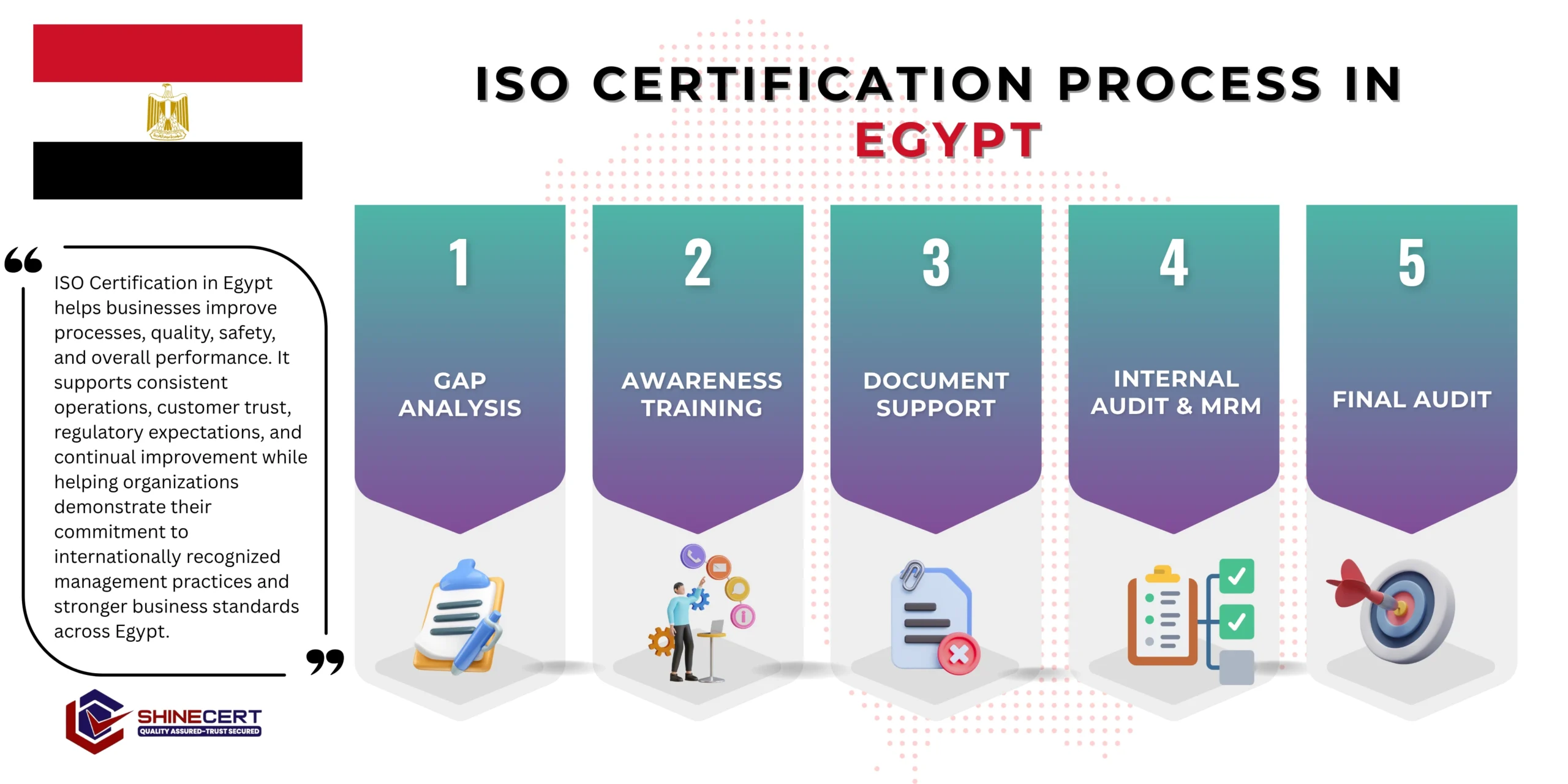
What are the steps to get ISO Certification in Egypt?
our services
- ISO Certification Egypt
- ISO 9001 Certification Egypt
- ISO 14001 Certification Egypt
- ISO 27001 Certification Egypt
- ISO 22000 Certification Egypt
- ISO 27701 Certification Egypt
- ISO 45001 Certification Egypt
- ISO 20000-1 Certification Egypt
- ISO 13485 Certification Egypt
- ISO 17025 Certification Egypt
- ISO 31000 Certification Egypt
- ISO 42001 Certification Egypt
- ISO 37001 Certification Egypt
- ISO 22301 Certification Egypt
- ISO 50001 Certification Egypt
- CE Mark Certification Egypt
- GDPR Certification Egypt
- GMP Certification Egypt
- Halal Certification Egypt
ShineCert’s Certification Process in Egypt
Gap Analysis
We assess your operations against your target standard, with particular attention to Suez Canal Economic Zone tenant requirements or food export traceability expectations depending on your sector.
Documentation Development
We build your management system documentation with your team, in Arabic and English, matched to your Egyptian workforce and international buyer or partner documentation expectations.
Implementation and Training
We train staff through practical, scenario-based sessions tailored to your sector, logistics resilience training looks very different from food safety traceability training.
Internal Audit and Management Review
We run a rigorous internal audit before any external certification body is involved, followed by formal management review with documented corrective action.
Certification Audit
We coordinate Stage 1 and Stage 2 audits with an EGAC-accredited certification body, and set up ongoing surveillance to maintain your certification's value long-term.
ISO Certification Cost in Egypt
Expect roughly EGP 40,000 to EGP 250,000 for a single standard at a small or mid-sized company. Manufacturing and logistics clients operating within the Suez Canal Economic Zone often see costs toward the higher end given the depth of documentation international tenant requirements involve. Company size, site count, and sector risk profile are the main cost drivers. Bundling ISO 9001 with ISO 45001 for manufacturing and logistics clients, or ISO 9001 with ISO 22000 for food exporters, is more cost-efficient than pursuing certifications separately.
Benefits of ISO Certification in Egypt
- Suez Canal Economic Zone opportunity access : International manufacturers and logistics operators establishing operations in the zone increasingly expect certified local suppliers and partners as a baseline requirement.
- Continued access to European and international food markets : Certification is frequently a hard requirement, not a differentiator, for Egyptian food processors and agricultural exporters.
- EGAC’s recognized international standing working in your favor : Because EGAC accreditation carries genuine international recognition, Egyptian certificates support export relationships without needing extensive supplementary foreign accreditation.
- Government tender eligibility : Egyptian public procurement increasingly references ISO 9001 as a prequalification factor for construction, manufacturing, and supply contracts.
- Fintech and technology investor credibility : ISO 27001 certification increasingly supports Cairo-based technology companies seeking international investment and enterprise partnerships.
- Logistics sector resilience credibility : ISO 22301 gives Egyptian shipping and freight-handling companies a structured way to demonstrate operational resilience to international shipping partners relying on Suez Canal transit reliability.
- Consolidated regulatory tracking : EGAC, the Suez Canal Economic Zone Authority, and sector-specific requirements fold into one auditable management system.
- A genuine regional competitive edge : Egypt’s scale and strategic location position certified Egyptian manufacturers and logistics companies well for both regional Middle East and international export markets.
Egypt’s Suez Canal Economic Zone: A Genuine Growth Engine
- The Suez Canal Economic Zone represents one of the more ambitious economic development projects in the broader Middle East and North Africa region, designed to capture value from Egypt’s uniquely strategic position along one of the world’s busiest shipping lanes by attracting manufacturing and logistics investment that benefits directly from Suez Canal transit access.
- International manufacturers establishing production facilities within the zone bring supplier qualification expectations shaped by their own global operations, and Egyptian companies positioning themselves to become local suppliers and partners within this ecosystem increasingly find that early investment in ISO 9001 and ISO 45001 certification, built in before actively pursuing zone-based contracts rather than after, gives them a meaningful competitive advantage over Egyptian businesses still treating certification as an afterthought.
ISO Standards Most Relevant to Egypt
ISO 9001 Quality Management
The foundational standard for Egyptian businesses across every sector, checked routinely by Suez Canal Economic Zone tenant requirements, government tenders, and export buyers. It proves quality and credibility, helping companies win contracts, build trust, and grow confidently in global markets.
ISO 14001 Environmental Management
International manufacturers establishing operations in the Suez Canal Economic Zone increasingly factor environmental management into their own supplier sustainability requirements and local partner expectations, strengthening compliance and long-term partnerships.
ISO 45001 Occupational Health and Safety
Egypt’s manufacturing and logistics sector, increasingly concentrated around the Suez Canal Economic Zone, makes structured safety management close to a baseline requirement for contractors and suppliers, ensuring compliance, reducing risks, and protecting workers across operations.
ISO 27001 Information Security Management
Cairo’s growing fintech and technology sector, alongside Central Bank of Egypt digital banking initiatives, has created rising demand for structured information security certification, helping organizations protect data, build trust, and meet regulatory expectations.
ISO 22000 Food Safety Management
Egypt’s substantial food processing and agricultural export sector, serving both regional Middle East markets and increasingly demanding European buyers, depends on this for continued market access and sustained business growth.
ISO 22301 Business Continuity Management
Egypt’s position as a critical global logistics chokepoint makes demonstrable operational resilience increasingly valuable for logistics, shipping, and freight-handling companies operating in and around the Suez Canal corridor, ensuring continuity.
ISO 37001Anti-Bribery Management Systems
Egyptian contractors, suppliers, and infrastructure firms working on public projects and multinational supply chains are asked to demonstrate governance and compliance controls. Certification signals integrity to foreign partners and lenders.
ISO 50001 Energy Management
Egypt’s energy-intensive industries, including cement, steel, fertilizers, and ceramics, face rising electricity and gas costs. A structured energy management system helps manufacturers cut costs and meet international buyers’ sustainability expectations.
Egypt’s Food Export Sector and European Market Access
- Egypt’s food processing and agricultural export sector, spanning everything from citrus and produce exports to processed foods, has historically served primarily regional Middle East markets, but growing ambitions to access European markets bring considerably more demanding food safety and traceability expectations than regional trade has traditionally required.
- European retailers and food safety regulators increasingly expect the kind of structured, auditable food safety management that ISO 22000 certification demonstrates, and Egyptian food exporters who invest in building genuinely robust traceability systems, rather than treating certification as a paperwork exercise to satisfy a specific buyer’s immediate request, position themselves to access a considerably larger and more lucrative export market than regional trade alone provides.
Common Challenges in Egypt
- Underestimating Suez Canal Economic Zone tenant documentation expectations : International manufacturers establishing operations there often expect more granular quality and safety records than a generic ISO 9001 rollout provides elsewhere.
- Food export traceability gaps : ISO 22000 gap analysis for Egyptian food processors often reveals more supply chain documentation work than expected, particularly for businesses targeting European markets.
- Working from outdated certification body pricing : Given EGAC’s updated 2026 fee structure, confirming current pricing when comparing certification body quotes avoids unexpected cost surprises.
- Treating certification as a one-time cost : Surveillance audits matter as much as the initial certificate for maintaining Suez Canal Economic Zone tenant status or export market access.
Industries We Support in Egypt
Information technology and business process outsourcing
Bengaluru, Hyderabad, and Pune’s globally significant IT sector relies on ISO 27001 to win and retain international enterprise contracts.
Read morePharmaceuticals and medical devices
India’s leading position in global generic drug manufacturing depends on ISO 13485 and related quality certifications for international market access.
Read moreManufacturing
India’s growing manufacturing base, benefiting from global supply chain diversification, increasingly needs ISO 9001 to compete for international buyer contracts.
Read moreTextiles and garments
India’s longstanding textile export sector uses ISO 9001 and related standards to maintain competitiveness with international apparel buyers.
Read moreFood processing and agriculture
India’s substantial food export sector uses ISO 22000 to access both domestic organized retail and international markets.
Read moreISO Certification Timeline in Egypt
Phase | Typical Duration |
Gap analysis | 2–4 weeks |
Documentation development | 5–7 weeks |
Implementation and training | 4–7 weeks |
Internal audit and management review | 1–2 weeks |
Certification audit (Stage 1 + Stage 2) | 3–4 weeks |
Total, single standard | 3–6 months |
Egypt’s Tourism Sector and Quality Certification
- Egypt’s tourism industry, anchored by the pyramids, Luxor’s ancient temples, and the Red Sea coast’s diving and beach resorts, remains one of the country’s largest sources of foreign currency earnings, and the sector has worked hard to rebuild international traveler confidence following periods of reduced visitor numbers tied to broader regional instability in past years.
- Hotels, resorts, and tour operators serving international travelers increasingly find that ISO 9001 quality certification, alongside food safety certification for properties with significant dining operations, supports the rebuilt confidence Egypt’s tourism sector has worked to establish, particularly for properties affiliated with international hotel brands that increasingly expect the same operational standards from an Egyptian property that they’d require anywhere else in their global portfolio. Red Sea diving operators and resorts in particular have found that international dive certification bodies and travel insurers increasingly factor broader operational quality credentials into their own assessments of a property’s overall safety and reliability standards.
Where We Support Clients in Egypt
We coordinate Egypt engagements from ShineCert’s Riyadh and Lebanon offices, with consultants traveling to Cairo, Alexandria, and the Suez Canal Economic Zone for on-site gap analysis, training, and audit support.
Choosing a Certification Body in Egypt?
What to Check | Why It Matters |
EGAC accreditation | Confirms genuine recognition under Egypt’s national accreditation framework |
Suez Canal Economic Zone experience | Matters directly for manufacturers and logistics operators establishing operations in the zone |
Food export traceability expertise | Relevant for food processors and agricultural exporters navigating international buyer requirements |
Awareness of EGAC’s current fee structure | Confirms your quotes reflect the updated 2026 fee schedule rather than outdated pricing |
Why Choose ShineCert in Egypt?
We manage the full certification journey for Egyptian businesses across manufacturing, logistics, food processing, and financial technology. Our team has guided more than 10,000 organizations through international certification, with ShineCert as the best ISO consultant in Egypt, and with specific familiarity in the Suez Canal Economic Zone tenant requirements and food export traceability expectations that shape certification scope for Egypt’s most active certification-driven sectors.
Start Your ISO Certification Journey in Egypt
ShineCert supports Egyptian businesses end to end, from gap analysis through certification audit. Book a free consultation or contact us directly, and we’ll review your sector and target standard before proposing a fixed-scope plan.
Frequently Asked Questions
Typically EGP 40,000 to EGP 250,000 for a single standard at a small or mid-sized company.
No, it’s voluntary, though Suez Canal Economic Zone tenant requirements and international food export markets increasingly make it necessary for those sectors.
EGAC is the Egyptian Accreditation Council, the sole national body for accrediting conformity assessment bodies; it updated its accreditation fee structure effective January 1, 2026.
Typically three to six months from kickoff to certificate.
Most start with ISO 9001, then add ISO 45001 given the safety expectations tied to international tenant requirements.
We coordinate Egypt engagements from our Riyadh and Lebanon offices, with consultants traveling on-site as needed.
Yes, ISO 22000 certification helps demonstrate the structured traceability and food safety management European retailers and regulators increasingly expect.
Yes, particularly properties affiliated with international hotel brands or serving Red Sea diving tourism, where quality and food safety certification support rebuilt traveler confidence.