
Halal Certification in Angola
Quick Answer
Halal certification confirms your food products meet Islamic dietary law requirements, verified by an accredited, internationally recognized certification body. Angola has no domestic halal certification scheme of its own, so certification for Angolan exporters is pursued through internationally recognized private certifiers, whose certificates are accepted in over 180 countries, including every major Muslim-majority market. This is entirely export-driven, not a domestic regulatory requirement, and typically takes two to four months.
About Halal Certification
Halal certification verifies that food products, ingredients, and production processes comply with Islamic dietary law, covering everything from ingredient sourcing to processing methods, equipment cleanliness between production runs, and supply chain traceability. It’s not a religious endorsement issued by a government; it’s a technical certification issued by an accredited certification body against defined halal standards.
For Angolan exporters, the practical reality is straightforward: since Angola has no unified domestic halal certification authority, businesses pursue certification through internationally recognized private certification bodies whose certificates are accepted across the markets that actually matter for export, the Middle East, Southeast Asia, and North Africa. More than 1.8 billion Muslims worldwide require halal-certified food, and the global halal food market is projected to grow from roughly $2.67 trillion in 2024 to nearly $6 trillion by 2033, a genuinely large and expanding opportunity for Angolan agricultural and food exporters.
Why It Matters in Angola?
Angola has no domestic halal certification scheme, and that’s actually the key fact to understand upfront : Unlike ISO standards with a global governing body, halal certification operates through a patchwork of national and private certifiers worldwide, and Angola hasn’t established its own. This means Angolan exporters need to work with an internationally recognized certifier directly, one whose certificate is genuinely accepted in the specific markets they’re targeting.
What not being certified actually costs you : Without halal certification, Angolan food and agricultural exporters are effectively excluded from Muslim-majority markets across the Middle East, North Africa, and parts of Southeast Asia, markets that collectively represent a very large share of global food import demand. As Angola’s non-oil economy grows and agriculture increasingly targets export markets beyond traditional SADC and European partners, halal certification is often the single requirement standing between an Angolan exporter and a genuinely large new customer base.
Why this is relevant in Angola right now : As Angola’s agricultural processors and exporters increasingly look beyond SADC and European markets for growth, given genuine diversification pressure across the broader economy, Muslim-majority markets represent a large, underexplored opportunity that halal certification is the practical entry requirement for.
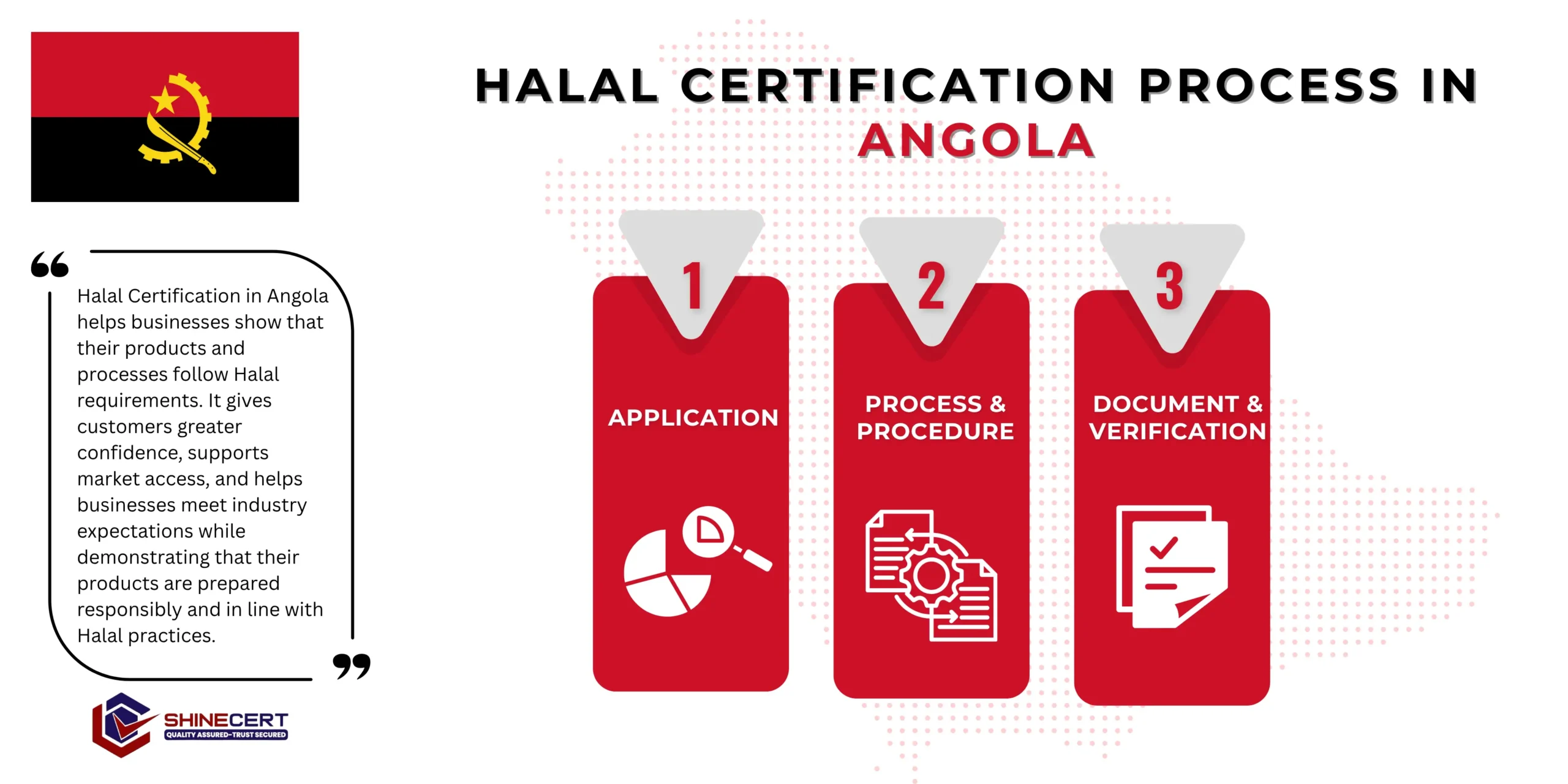
What are the steps to get Halal Certification in Angola?
our services
- ISO Certification Angola
- ISO 9001 Certification Angola
- ISO 14001 Certification Angola
- ISO 27001 Certification Angola
- ISO 22000 Certification Angola
- ISO 20000-1 Certification Angola
- ISO 45001 Certification Angola
- ISO 42001 Certification Angola
- ISO 13485 Certification Angola
- ISO 17025 Certification Angola
- ISO 31000 Certification Angola
- ISO 22301 Certification Angola
- ISO 27701 Certification Angola
- ISO 37001 Certification Angola
- ISO 50001 Certification Angola
- CE Mark Certification Angola
- GMP Certification Angola
- GDPR Certification Angola
- Halal Certification Angola
The Certification Process
Gap Assessment
Over one to two weeks, we review your current service delivery practices, incident handling, and any existing informal service level commitments against the standard's requirements. This step typically reveals which practices are already solid and which genuinely need formal structure.
Documentation Development
Over three to five weeks, we build your service management policy, service catalog, and procedures for incident, problem, and change management, reflecting your actual service portfolio rather than a generic IT framework.
Implementation and Training
Over three to six weeks, service management processes go live and staff across service delivery, support, and operations are trained on their specific roles. This phase often takes longer than expected because it requires genuine changes to how incidents and changes are actually handled day to day.
Internal Audit and Management Review
Over two to three weeks, we run an internal audit against the same criteria the real auditor will use and complete a formal management review, catching documentation and process gaps before the external audit does.
Certification Audit
Over two to four weeks, an accredited certification body audits your actual service management practices, including real incident and service level records, and issues the certificate once satisfied.
How Long Does Certification Take?
| Business Type | Typical Timeline | Why |
|---|---|---|
| Simple, single-ingredient products | 2 months | Fewer supply chain points to verify |
| Multi-ingredient processed foods | 3 months | More ingredient sourcing to trace and verify |
| Complex production with multiple suppliers | 4 months | Extensive supply chain documentation required |
- Businesses with simple, single-ingredient products (around 2 months) : Fewer ingredients and supply chain points mean a shorter traceability documentation process.
- Businesses with multi-ingredient processed foods (around 3 months) : More ingredients typically sourced from multiple suppliers mean more traceability work to verify each one meets halal requirements.
- Businesses with complex production involving multiple suppliers (around 4 months) : These operations require the most extensive supply chain documentation, since every ingredient source needs to be verified, not just the final production process.
- The variable that matters most: how well-documented your existing supplier relationships already are : A business that can already trace every ingredient to its source moves through certification considerably faster than one needing to first establish that traceability from scratch.
- A real example : A food processor we worked with used a dozen different ingredient suppliers, only half of which had ever provided formal sourcing documentation; getting the remaining suppliers to provide adequate traceability records took an additional three weeks, but this exact documentation is what determines whether the final certification is accepted in the target export market.
What Affects the Cost?
- Number of ingredients and suppliers requiring traceability verification : More complex products mean more supply chain documentation.
- Which certification body and target markets you’re pursuing : Different certifiers and markets carry different fee structures and requirements.
- Current documentation maturity : A business with organized supplier records starts from a stronger position.
- Certification body fees, separate from consulting costs, which vary by chosen certifier.
Answering the Objections Every Owner Has
- Doesn’t Angola have its own halal authority we should use? No, Angola has no domestic halal certification scheme, which is exactly why working with an internationally recognized certifier accepted in your target markets is the right approach, not a compromise.
- Isn’t this only relevant if we’re already exporting to Muslim countries? It’s specifically for businesses targeting those markets, but given how large and underexplored they are relative to Angola’s current export mix, it’s worth genuine consideration even if you haven’t targeted them yet.
- Isn’t this just paperwork? Only if it’s treated that way. Done properly, it documents ingredient sourcing and process controls that also strengthen your general food safety practices.
- Can’t we just claim our products are halal without certification? Buyers in these markets specifically require independently verified certification; an unverified claim won’t clear customs or satisfy import requirements in practice.
Benefits of Halal Certification
- Direct access to Muslim-majority export markets : Certification is typically a non-negotiable requirement for entry into Middle Eastern, North African, and Southeast Asian food markets.
- A genuinely large addressable market : Over 1.8 billion Muslims worldwide require halal-certified food, representing significant demand growth potential for Angolan exporters.
- Credibility with international halal-focused buyers and distributors : Certification from a recognized body signals your product genuinely meets requirements buyers can’t verify themselves.
- A structural improvement to production traceability : The certification process typically strengthens ingredient sourcing and process documentation regardless of the halal-specific requirements.
- Diversification away from traditional export markets : Given Angola’s broader push to diversify beyond oil and traditional trading partners, this opens a genuinely different market category.
- A foundation for pursuing ISO 22000 alongside halal certification : These standards share complementary food safety documentation structures.
Required Documentation
The scope statement defines exactly which products and production lines the certification covers. The halal policy documents your organization’s commitment to maintaining compliance across sourcing and production.
Ingredient sourcing records trace every ingredient back to a verified halal-compliant source, the single most scrutinized element of any halal certification. Supplier halal compliance declarations document that your suppliers themselves meet relevant requirements.
Production process control procedures document how cross-contamination with non-halal materials is prevented, particularly important if your facility also produces non-halal products. Equipment cleaning and segregation procedures between production runs are closely scrutinized during audits.
Staff training records prove employees handling halal-certified products understand compliance requirements. Document control procedures keep outdated sourcing or process records from circulating.
Internal review records demonstrate ongoing verification of continued compliance, since halal certification, like most credentials, requires periodic renewal and surveillance.
Standards and Requirements: What Halal Certification Actually Covers
- Ingredient Sourcing requires verifying every ingredient, including additives and processing aids, comes from a halal-compliant source, the foundational requirement underlying everything else.
- Production Process Control requires documented procedures preventing cross-contamination with non-halal materials, particularly critical for facilities producing both halal and non-halal products.
- Equipment and Facility Management requires cleaning and segregation procedures between production runs, closely audited given how easily cross-contamination can occur without proper controls.
- Traceability requires the ability to trace any finished product back through its full ingredient and production history, essential for both certification and, practically, for responding to any buyer inquiry or dispute.
- Staff Competence requires personnel handling certified products to genuinely understand compliance requirements, not just follow instructions without understanding why they matter.
- Ongoing Surveillance requires periodic re-verification that compliance is maintained, since halal certification isn’t a one-time achievement any more than other certifications are.
Case Study: An Agricultural Exporter Targeting Middle Eastern Buyers
- An agricultural processor in Angola wanted to expand beyond its traditional SADC customer base into Middle Eastern markets, where several potential buyers had specifically requested halal certification as a purchase condition.
- Our gap assessment found the processor had solid production practices but no formal ingredient traceability documentation and had never worked with a halal certifier before.
- Over three months, we helped select an internationally recognized certifier accepted across the processor’s target Middle Eastern markets, built ingredient traceability documentation, and prepared the facility for its first halal certification audit. The audit found no major nonconformities.
- The processor secured its certificate and opened negotiations with two new Middle Eastern buyers within the following quarter.
Common Mistakes We See
- Choosing a certifier without confirming acceptance in your actual target market : Not every halal certificate is recognized in every Muslim-majority market; this is the single most consequential decision in the entire process.
- Weak ingredient traceability, particularly for additives and processing aids : These are exactly what auditors scrutinize most closely, not just the primary ingredients.
- Underestimating cross-contamination risk in shared facilities : Facilities producing both halal and non-halal products need genuinely rigorous segregation procedures, not just good intentions.
- Assuming certification is a one-time task : Ongoing surveillance and periodic renewal are standard requirements across virtually all recognized halal certifiers.
Who Actually Needs This?
Agricultural exporters
Targeting Middle Eastern, North African, or Southeast Asian markets specifically.
Read moreFood processors and manufacturers
Seeking to diversify beyond traditional SADC and European export relationships.
Read moreBeverage and packaged food producers
Where halal status affects a genuinely large share of potential international buyers.
Read moreAny Angolan food business
Where a specific buyer or market has explicitly requested halal certification as a purchase condition.
Read moreWhich Certification Body Should You Choose?
Confirm the certifier’s certificate is genuinely accepted in your specific target export markets, since acceptance varies significantly by country and even by individual buyer. Ask for evidence of the certifier’s track record with exporters from Africa specifically, given regional recognition can differ from global claims. Be skeptical of any certifier that doesn’t ask detailed questions about your actual ingredient sourcing before quoting.
Choosing the Right Partner?
| DIY | Generic Consultant | ShineCert | |
|---|---|---|---|
| Certifier selection guidance | Often uninformed | Templated, generic | Matched to your specific target export markets |
| Traceability documentation | Often incomplete | Templated, generic | Mapped to your actual supply chain |
| Timeline realism | Often underestimated | Sometimes overpromised | Set to your real starting point |
| Post-certification support | None | Ends at the certificate | Supports ongoing surveillance and renewal |
Why Businesses Choose ShineCert in Angola?
Across 10 years of ISO and certification consulting worldwide, coordinated through our Riyadh and India offices, including direct experience with Middle Eastern halal market requirements from our regional base, we help Angolan exporters, with ShineCert as the best Halal consultant in Angola, choose the right internationally recognized certifier for their specific target markets, rather than a one-size-fits-all recommendation.
Ready to Get Started?
Whether you’re opening a specific Middle Eastern buyer relationship or exploring Muslim-majority export markets more broadly, we’ll help you choose the right certifier and give you a clear, honest quote. Book a free consultation or contact us to get started.
Frequently Asked Questions
No, Angola has no domestic halal certification scheme; certification is pursued through internationally recognized private certifiers.
No, it’s entirely export-driven, required by specific international buyers and markets, not by Angolan law.
It depends on product complexity, supplier count, and the specific certifier and markets targeted. We quote individually.
Usually two to four months, depending heavily on how well-documented your existing supplier relationships already are.
Agricultural exporters and food processors targeting Middle Eastern, North African, or Southeast Asian markets specifically.
Documentation development can happen remotely; the certification audit typically requires a site visit.