
Halal Certification in Lebanon
Quick Answer
Halal certification verifies that food products, ingredients, and production processes meet Islamic dietary law requirements, and for Lebanese food producers it functions primarily as an export enabler rather than a domestic legal requirement. Lebanon does not operate a single unified government Halal certification mandate the way some Gulf countries do under GSO frameworks; instead, Lebanese exporters obtain Halal certification through internationally recognized private certification bodies whose credentials are accepted by destination markets. For Lebanese food and beverage exporters targeting Gulf Cooperation Council markets, a significant and growing opportunity given Lebanon’s genuine strength in processed foods, confectionery, and packaged goods, Halal certification from a body recognized in your specific destination market is often the deciding factor in whether a shipment clears customs without delay. Budget six to ten weeks for certification depending on product complexity. Cost depends on genuine factors, product category, production facility complexity, target export market, not a flat figure we quote upfront.
Halal Certification, Explained Simply
Halal certification isn’t primarily a Lebanese domestic compliance matter, it’s a market access credential. Gulf countries and other Muslim-majority destination markets require imported food products to carry Halal certification from a body they recognize, and which specific certification bodies are accepted varies by destination country. For a Lebanese exporter, the practical question isn’t “am I required to certify domestically”, it’s “does my chosen certification body’s credential actually get accepted at my target market’s customs and retail checkpoints.”
Lebanon at a Glance: What Shapes Halal Certification Demand Here
No unified domestic mandate : Unlike Gulf countries applying GSO 2055 series standards domestically, Lebanon does not have a single government-run Halal certification scheme; certification happens through private, internationally accredited bodies.
A genuine, established food export sector : Lebanon’s processed food, confectionery, and packaged goods industries have real export traction, and Gulf markets represent one of the most significant growth opportunities for that sector.
Destination market variation : Different Gulf and Muslim-majority markets recognize different certification bodies and standards, meaning the right certification choice depends entirely on where you’re actually shipping, not a one-size-fits-all approach.
Growing competitive pressure : As more food exporters across the region pursue certification, Lebanese producers without it increasingly risk being excluded from retail and distribution opportunities that competitors with certification can access.
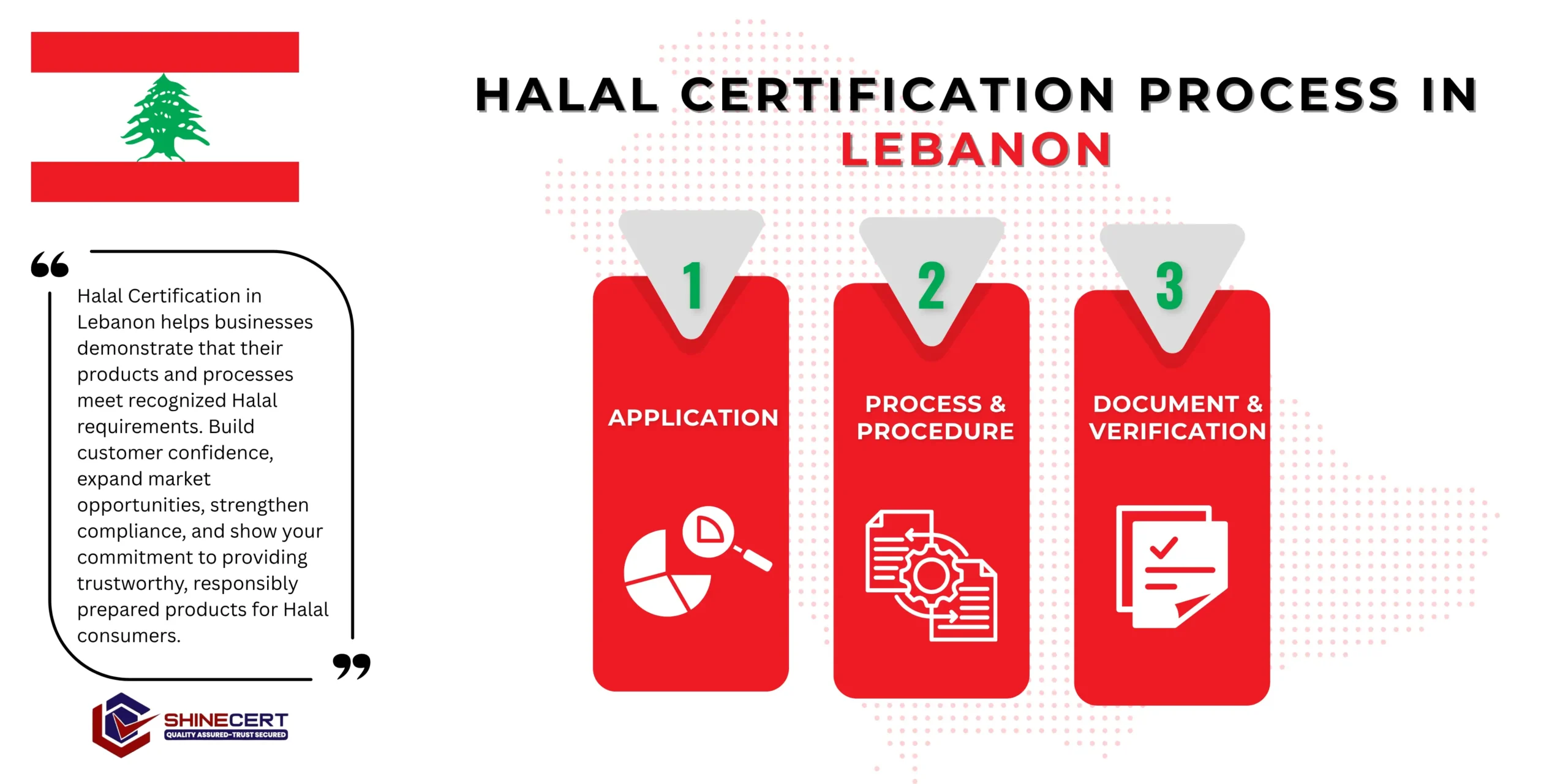
What are the steps to get Halal Certification in Lebanon?
our services
- ISO Certification Lebanon
- ISO 9001 Certification Lebanon
- ISO 14001 Certification Lebanon
- ISO 27001 Certification Lebanon
- ISO 22000 Certification Lebanon
- ISO 27701 Certification Lebanon
- ISO 45001 Certification Lebanon
- ISO 20000-1 Certification Lebanon
- ISO 13485 Certification Lebanon
- ISO 17025 Certification Lebanon
- ISO 31000 Certification Lebanon
- ISO 42001 Certification Lebanon
- ISO 37001 Certification Lebanon
- ISO 22301 Certification Lebanon
- ISO 50001 Certification Lebanon
- CE Mark Certification Lebanon
- GDPR Certification Lebanon
- GMP Certification Lebanon
- Halal Certification Lebanon
Our Process: What to Actually Expect
Target Market Assessment
Before any certification work begins, we confirm exactly which certification body your specific destination market actually recognizes, this single step prevents the costly mismatch we’ve seen other Lebanese exporters run into.
Ingredient and Supply Chain Review
We work through your complete ingredient list and supplier base, verifying Halal compliance documentation for each component, including additives and processing aids that are easy to overlook.
Facility Assessment
We review your production facility for cross-contamination risk, assessing shared equipment and storage practices against your target certification body’s specific requirements.
Certification Audit
The certification body you’ve selected conducts its formal audit, verifying your ingredient sourcing, production process, and facility controls meet their standard.
Ongoing Surveillance
Certification requires periodic re-audit to maintain validity, since ingredient sourcing and production practices need continued verification over time.
Target Market Assessment
Before any certification work begins, we confirm exactly which certification body your specific destination market actually recognizes, this single step prevents the costly mismatch we’ve seen other Lebanese exporters run into.
Ingredient and Supply Chain Review
We work through your complete ingredient list and supplier base, verifying Halal compliance documentation for each component, including additives and processing aids that are easy to overlook.
Facility Assessment
We review your production facility for cross-contamination risk, assessing shared equipment and storage practices against your target certification body’s specific requirements.
Certification Audit
The certification body you’ve selected conducts its formal audit, verifying your ingredient sourcing, production process, and facility controls meet their standard.
Ongoing Surveillance
Certification requires periodic re-audit to maintain validity, since ingredient sourcing and production practices need continued verification over time.
What Does Halal Certification Actually Help Your Organization Do?
- The core value of Halal certification for a Lebanese exporter is straightforward market access: without it, many Gulf and Muslim-majority markets simply won’t clear your shipment through customs, or major retailers won’t stock your product regardless of quality. It’s less about proving something to a domestic regulator and more about meeting a destination market’s specific import requirement.
- Practically, this helps in concrete ways. It removes a common cause of shipment delays or rejections at Gulf ports, where inadequate or unrecognized Halal documentation is a genuinely frequent hold-up. It opens retail and distribution relationships that specifically require certified products, particularly with larger Gulf retail chains that won’t carry uncertified food items. It builds consumer trust in destination markets where Halal certification is an expected, default signal on food packaging, not an unusual add-on. And choosing a certification body genuinely recognized in your specific target market avoids the costly scenario of holding a certificate that doesn’t actually satisfy your buyer’s requirements.
- Certification typically covers ingredient sourcing verification, production process review to confirm no cross-contamination with non-Halal materials, and ongoing audits to maintain the certification’s validity, not a one-time inspection.
Why This Matters So Much for Lebanon Specifically?
- Lebanon’s food and beverage export sector, processed foods, confectionery, snacks, and packaged goods, has genuine momentum, and Gulf markets are a natural, significant growth destination given geographic proximity and strong existing trade relationships. But Lebanese exporters face a specific challenge many don’t anticipate: because Lebanon has no single domestic Halal authority the way some Gulf countries do, exporters must make an active, informed choice about which private certification body to use, and that choice needs to match their actual target market, not be made generically.
- We’ve seen Lebanese exporters obtain Halal certification from a body that turned out not to be recognized by their specific target market’s customs authority, effectively wasting the certification cost and delaying market entry. Getting this choice right from the start, matching certification body to destination market before beginning the process, saves real time and cost.
What Actually Drives Your Cost?
We don’t quote a flat number, because two Lebanese exporters’ actual product complexity and target markets can look completely different. Here’s what genuinely drives cost.
A multi-ingredient processed food needs meaningfully more extensive verification than a single-ingredient product.
Certification recognized across multiple destination markets sometimes requires additional documentation or a different certification body altogether.
Shared production lines with non-Halal products require more extensive cross-contamination controls than a fully dedicated Halal facility.
Exporters with well-documented supplier relationships aren’t starting from zero, those with informal sourcing face more foundational verification work.
Different certification bodies have different audit scope and fee structures, which we help you navigate based on your target market.
A compressed timeline tied to a specific export shipment deadline sometimes needs more concentrated coordination.
Halal Benefits Businesses Don't Expect
Recognized certification substantially reduces the risk of shipment holds over inadequate or unrecognized Halal documentation.
Many larger retailers won’t stock uncertified food products, making certification a genuine prerequisite for shelf space, not just a preference.
Choosing the right certification body for your specific target market from the start avoids wasting cost on a credential your buyer won’t actually accept.
Halal certification is an expected default signal on food packaging in many markets, and its absence can be a genuine deterrent to purchase.
As more regional food exporters pursue certification, Lebanese producers without it risk falling behind on market access alone.
The ingredient verification process often surfaces broader supply chain visibility benefits beyond Halal compliance specifically.
Once certified for one Gulf market, expanding to others with recognized certification bodies is meaningfully faster.
Lebanon’s confectionery and packaged food sector can use certification to compete more directly with already-certified regional competitors.
Applicable Sectors for Halal Certification
Confectionery and snack food manufacturing
A genuine Lebanese export strength, this sector benefits significantly from Gulf market Halal certification.
Read moreProcessed and packaged foods
Producers of ready meals, sauces, and packaged goods use certification to access Gulf retail distribution.
Read moreBeverage production
Non-alcoholic beverage producers use certification to meet Gulf import requirements.
Read moreBakery and dairy products
Producers targeting Gulf grocery and retail channels use certification as a baseline market entry requirement.
Read moreHalal Certification and ISO 22000: Two Different Questions, Often Asked Together
- Lebanese exporters frequently ask whether Halal certification and ISO 22000 food safety certification cover the same ground. They don’t, and understanding the distinction helps avoid both duplicated effort and gaps. ISO 22000 verifies that your food safety hazard controls, contamination prevention, traceability, hygiene, are systematically managed and internationally recognized. Halal certification verifies something entirely different: that your ingredients, sourcing, and production process comply with Islamic dietary law, independent of general food safety performance. A product can be perfectly safe under ISO 22000 and still not be Halal-compliant, and conversely a Halal-certified product still needs genuine food safety management behind it.
- For Lebanese exporters targeting Gulf markets, pursuing both together makes practical sense, since destination markets frequently expect both credentials and the underlying production documentation overlaps meaningfully, supplier verification, process mapping, and facility review work done for one often directly supports the other. We generally recommend food exporters evaluate both together rather than treating them as sequential, separate projects, since the efficiency gained from parallel implementation is genuinely significant.
Halal Certification Requirements, Step by Step, With the Documents Each One Actually Needs
- Ingredient and Supply Chain Verification : Confirming every ingredient in your product, including additives and processing aids, meets Halal requirements and comes from verified Halal-compliant sources. Document this step requires: a full ingredient list with supplier Halal certificates or declarations for each component.
- Production Process Review : Assessing your production facility for cross-contamination risk with non-Halal materials, including shared equipment and storage considerations. Document this step requires: a documented production process map identifying any cross-contamination risk points and controls.
- Facility and Equipment Assessment : Physical review of your production facility, confirming cleaning protocols and equipment dedication or validated cleaning between non-Halal and Halal production runs where relevant. Document this step requires: facility cleaning and equipment control procedures specific to Halal production integrity.
- Documentation and Labeling Review : Ensuring product labeling accurately reflects certification status and meets your target market’s specific labeling requirements. Document this step requires: approved product labeling reflecting certification status and destination market requirements.
- Certification and Ongoing Audit : Initial certification followed by periodic surveillance audits to confirm continued compliance, since Halal certification isn’t a one-time achievement. Documenting this step requires: an audit schedule and surveillance audit records maintaining certification validity.
What Happens When a Lebanon Exporter Operates Without Certification?
- Without Halal certification recognized by your destination market, shipments face real risk of customs delay or rejection at Gulf ports, and access to major retail chains that require certified products simply isn’t available. Domestic sales aren’t affected, since Lebanon has no blanket domestic mandate, but any meaningful Gulf or Muslim-majority export ambition runs into this gap quickly. Exporters relying on informal assurances about product compliance tend to discover the gap at the worst possible moment, a shipment already in transit, held at a destination port.
- We generally recommend Lebanese food exporters with any genuine Gulf market ambition treat Halal certification as foundational export infrastructure, and to get the certification body selection right from the start rather than discovering a mismatch after the fact.
- This gap tends to compound over time rather than staying static. As more regional competitors pursue recognized certification, Gulf buyers and retailers increasingly treat it as a baseline screening criterion rather than a nice-to-have differentiator, meaning exporters who delay certification aren’t just missing an opportunity, they’re gradually losing standing against competitors who moved earlier. We’ve seen this shift happen within a single buying season for some product categories, particularly confectionery and packaged snacks where Gulf retail shelf space is genuinely competitive.
Common Pitfalls We See in Lebanon Halal Certification Projects
- Choosing a certification body without confirming destination market recognition first : This is the single most costly mistake, certification from an unrecognized body wastes both time and money.
- Assuming certification is a one-time achievement : Ongoing surveillance audits are required to maintain validity; letting certification lapse can disrupt established export relationships.
- Overlooking additives and processing aids in ingredient review : These are easy to miss but can compromise Halal status if not properly verified.
- Underestimating cross-contamination risk in shared facilities : Producers running both Halal and non-Halal lines need genuinely rigorous separation controls, not just good intentions.
Why ShineCert?
ShineCert brings 10 years of consulting and certification experience to Lebanon, backed by our own dedicated Lebanon office working alongside our Riyadh office. We deliver services remotely or on-site depending on what your project needs, facility assessments genuinely benefit from an in-person visit, while target market research and documentation can often run effectively over remote sessions. We’ve guided more than 10,000 organizations through certification globally, and as the best Halal consultant in Lebanon, we help Lebanese exporters choose the right certification body for their actual target market from the outset, avoiding the costly mismatches we’ve seen elsewhere.
Beyond the certification process itself, we also help exporters think through sequencing, for businesses pursuing both Halal certification and ISO 22000 food safety certification, coordinating the two projects together generally saves meaningful time and cost compared to running them as fully separate engagements, since much of the supplier verification and facility review work overlaps.
Choosing a Certification Body for Lebanon Exporters?
What to Check | Why It Matters |
Recognition in your specific target export market | The single most important factor, certification unrecognized by your buyer’s market has limited practical value |
International accreditation standing | Confirms the certification body meets genuine, verifiable audit standards |
Experience with your specific product category | Confectionery, processed foods, and beverages involve different verification approaches |
Track record with Lebanese exporters specifically | Confirms practical experience navigating Lebanon’s supply chain and production environment |
Ready to Get Started?
Whether you’re entering Gulf export markets for the first time or replacing a certification that turned out not to be recognized where it matters, we’ll walk through your specific products and target markets before proposing a fixed-scope plan, delivered remotely, on-site, or however genuinely fits your project. Book a free consultation or contact us directly to get started.
Frequently Asked Questions
No, Lebanon has no unified domestic Halal certification mandate. Certification is primarily relevant for export to markets that require it.
It depends entirely on your target export market, different Gulf and Muslim-majority countries recognize different certification bodies, and we help match the right one to your specific destination.
It genuinely depends on product complexity, target markets, and facility setup, we scope every project individually.
Typically six to ten weeks depending on product and ingredient complexity.
Not always, recognition varies by destination country, so we verify this specifically before beginning the process rather than assuming.
Facility assessments genuinely benefit from an in-person visit, but target market research and documentation can often run remotely, we scope this per project.
Ingredient or supplier changes generally require re-verification to maintain certification validity, we recommend notifying your certification body promptly.
No, any Lebanese food exporter targeting Gulf or Muslim-majority markets benefits, regardless of company size.
Not necessarily, but it requires more rigorous cross-contamination controls and documentation than a fully dedicated facility.
Yes, ShineCert maintains its own dedicated Lebanon office, with services delivered remotely or on-site depending on your project.