
ISO Certification in Tanzania
Quick Answer
Most Tanzanian businesses start with ISO 9001, add ISO 45001 if they’re in mining, construction, or industrial operations, and pursue ISO 22000 if they’re in Tanzania’s substantial agricultural export sector. Confirm your certification body is accredited by the Tanzania Bureau of Standards (TBS) or recognized through the Southern African Development Community Accreditation Service (SADCAS), the regional accreditation body covering Tanzania alongside several other Southern and East African states. Budget roughly TZS 2,000,000 to TZS 11,000,000 for a single standard at a small or mid-sized company, and expect three to six months from kickoff to certificate.
Why ISO Certification Matters in Tanzania?
Tanzania’s economy runs on a genuinely diverse base, gold and mineral mining, agricultural exports like cashews, coffee, and cotton, a growing tourism sector built around Serengeti and Zanzibar, and an expanding Dar es Salaam port and logistics corridor serving landlocked neighbors like Zambia, Malawi, and the Democratic Republic of Congo. Each of these sectors has developed its own certification pressure over the past several years. International mining companies and their joint venture partners increasingly expect ISO 9001 and ISO 45001 from Tanzanian contractors and suppliers, following patterns established across the broader East and Southern African mining sector. Agricultural exporters serving European and international markets face food safety and traceability expectations that make ISO 22000 close to a baseline requirement rather than a competitive advantage.
Dar es Salaam’s role as a regional port and logistics gateway has also raised certification expectations for freight forwarders, customs brokers, and logistics operators, since international shipping lines and cargo owners routing goods through Tanzania to landlocked neighbors expect the same documented reliability they’d find at any major regional port.
Tanzania’s Accreditation Landscape
The Tanzania Bureau of Standards (TBS) is Tanzania’s national standards body, developing and enforcing Tanzanian standards and overseeing conformity assessment activity domestically. For broader international recognition, Tanzania is also a member of the Southern African Development Community Accreditation Service (SADCAS), a regional accreditation body that provides internationally recognized accreditation services across multiple SADC member states, including Tanzania, Botswana, Angola, the Democratic Republic of Congo, Lesotho, Madagascar, Malawi, Mozambique, Namibia, Seychelles, Eswatini, Zambia, and Zimbabwe. SADCAS holds IAF and ILAC recognition, which means certification bodies accredited through SADCAS carry genuine international standing beyond Tanzania’s own borders, a particularly relevant consideration for Tanzanian exporters serving international markets or regional buyers across the SADC bloc.
Beyond TBS and SADCAS, sector-specific bodies matter for certain industries: the Tanzania Mining Commission oversees safety and environmental expectations for the mining sector, and the Tanzania Food and Drugs Authority references food safety frameworks in its own regulatory processes for food exporters and processors.
What are the steps to get ISO Certification in Tanzania?
our services
- ISO Certification Tanzania
- ISO 9001 Certification Tanzania
- ISO 14001 Certification Tanzania
- ISO 27001 Certification Tanzania
- ISO 22000 Certification Tanzania
- ISO 27701 Certification Tanzania
- ISO 45001 Certification Tanzania
- ISO 20000-1 Certification Tanzania
- ISO 13485 Certification Tanzania
- ISO 17025 Certification Tanzania
- ISO 31000 Certification Tanzania
- ISO 42001 Certification Tanzania
- ISO 37001 Certification Tanzania
- ISO 22301 Certification Tanzania
- ISO 50001 Certification Tanzania
- CE Mark Certification Tanzania
- GDPR Certification Tanzania
- GMP Certification Tanzania
- Halal Certification Tanzania
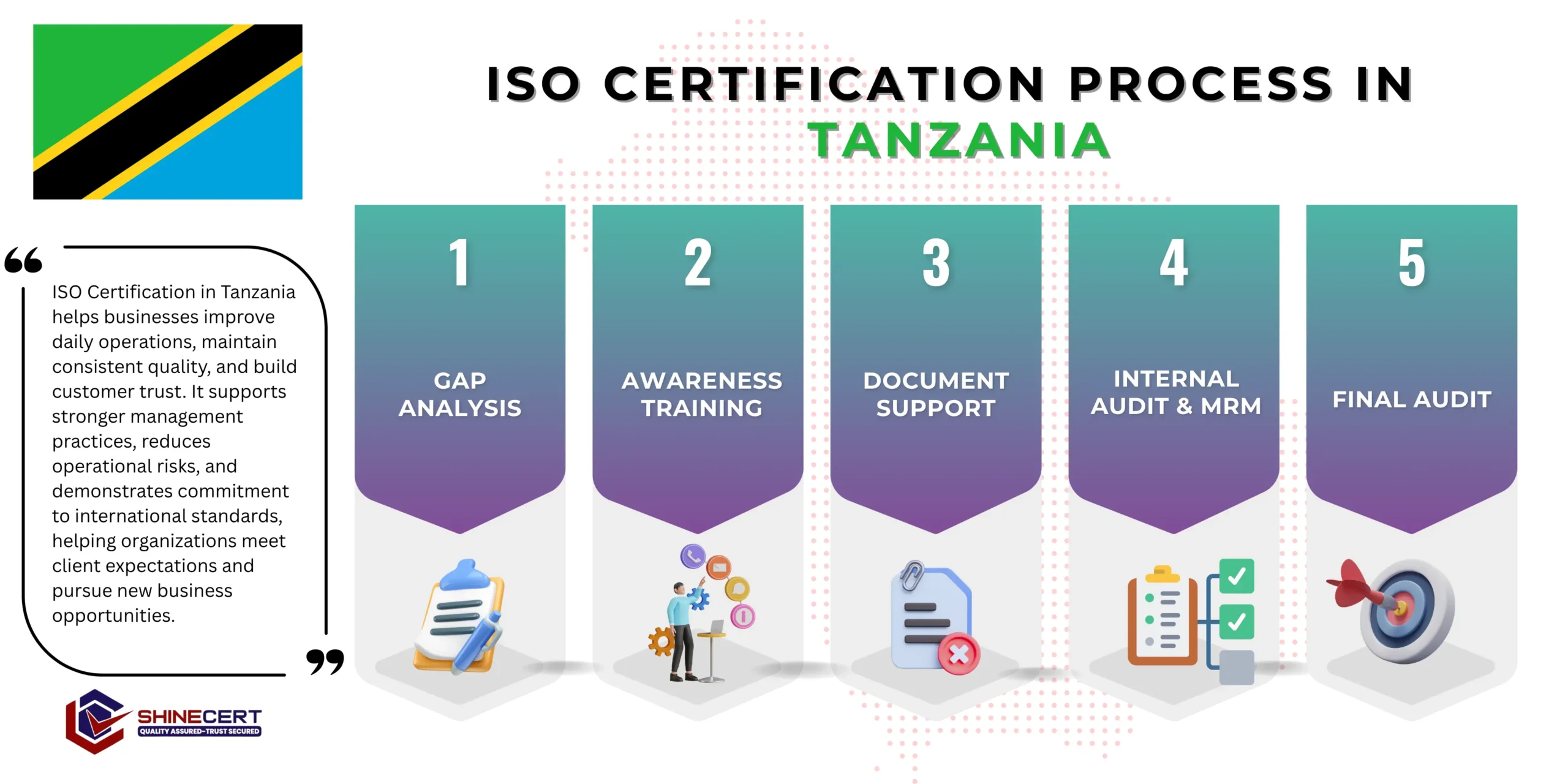
ShineCert’s Certification Process in Tanzania
Gap Analysis
We assess your operations against your target standard, with particular attention to mining sector safety expectations, agricultural export traceability, or logistics reliability requirements depending on your sector.
Documentation Development
We build your management system documentation with your team, in English and Swahili where needed, matched to your Tanzanian workforce and international buyer or partner documentation expectations.
Implementation and Training
We train staff through practical, scenario-based sessions tailored to your sector, mining safety training looks very different from agricultural export traceability training.
Internal Audit and Management Review
We run a rigorous internal audit before any external certification body is involved, followed by formal management review with documented corrective action.
Certification Audit
We coordinate Stage 1 and Stage 2 audits with a TBS or SADCAS-accredited certification body, and set up ongoing surveillance to maintain your certification's value long-term.
ISO Certification Cost in Tanzania
Expect roughly TZS 2,000,000 to TZS 11,000,000 for a single standard at a small or mid-sized company. Mining sector clients often see costs toward the higher end given the depth of safety and environmental documentation required. Company size, site count, and sector risk profile are the main cost drivers. Bundling ISO 9001 with ISO 45001 for mining and industrial clients, or ISO 9001 with ISO 22000 for agricultural exporters, is more cost-efficient than pursuing certifications separately.
Benefits of ISO Certification in Tanzania
- Mining supply chain access : International mining companies and their joint venture partners increasingly expect certified suppliers and contractors as a baseline requirement.
- Continued access to European and international food markets : Certification is frequently a hard requirement, not a differentiator, for Tanzanian cashew, coffee, and agricultural exporters.
- SADCAS’s regional and international recognition works in your favor : Certificates issued under SADCAS-accredited bodies carry genuine standing not just in Tanzania but across the broader SADC region and internationally through IAF and ILAC recognition.
- Logistics and port sector credibility : Freight forwarders and logistics operators serving Tanzania’s role as a gateway to landlocked neighbors benefit from certification that matches international shipping partner expectations.
- Tourism sector differentiation : Lodges and tour operators serving Serengeti, Ngorongoro, and Zanzibar increasingly find quality and environmental certification supports premium positioning with international travelers and tour operators.
- Government tender eligibility : Tanzanian public procurement increasingly references ISO 9001 as a prequalification factor for construction and supply contracts.
- Reduced governance risk exposure : ISO 37001 alongside ISO 9001 gives Tanzanian businesses working with international mining or development finance partners a structured way to demonstrate anti-bribery controls.
- Consolidated regulatory tracking : TBS, SADCAS, and sector-specific requirements fold into one auditable management system.
ISO Standards Most Relevant to Tanzania
ISO 9001 Quality Management
The foundational standard across every sector, checked routinely by government tenders, mining supply chains, and export buyers. It gives firms a recognized baseline, reassures procurement teams about consistent quality, and helps smaller local suppliers compete for larger contracts and international partnerships.
ISO 14001 Environmental Management
Tanzania’s mining sector and its globally significant tourism industry, built around Serengeti National Park, Ngorongoro, and Zanzibar, both face growing environmental documentation expectations, helping operators satisfy regulators, reassure investors, and protect fragile landscapes and wildlife.
ISO 45001 Occupational Health and Safety
Tanzania’s mining sector and construction industry face genuine safety scrutiny, and certification has become close to a baseline requirement for contractors working with larger international mining operators, helping firms reduce incidents, satisfy client audits, and secure long-term contracts.
ISO 27001 Information Security Management
Dar es Salaam’s growing financial services and mobile money sector, alongside government digital services expansion, has created rising demand for structured information security certification, particularly among banks, mobile operators, and vendors handling sensitive customer data and payments.
ISO 22000 Food Safety Management
Tanzania’s cashew, coffee, and broader agricultural export sector depends on this to access international food markets with increasingly strict traceability and safety requirements, helping exporters meet buyer audits, protect product quality, and build overseas trust.
ISO 37001 Anti-Bribery Management Systems
Tanzanian businesses working with international mining companies or development finance institutions increasingly encounter anti-bribery certification expectations given heightened global scrutiny of extractive sector governance, making credible compliance a clear advantage.
ISO 22301 Business Continuity Management
Tanzania’s role as a gateway for landlocked neighbors, through the Port of Dar es Salaam, makes operational resilience critical. Certification helps logistics firms, banks, and telecoms show they can maintain services through disruption, protecting customers, trade flows, and revenue.
ISO 50001 Energy Management
Tanzania relies on hydropower and natural gas, and supply interruptions and rising demand keep power costs a concern. Certification helps manufacturers, mines, and large commercial users manage consumption systematically, reduce expenses, and demonstrate sustainability.
Tanzania’s Mining Sector and International Partnership Expectations
Tanzania’s mining sector, anchored by significant gold production and a growing critical minerals sector tied to global battery and renewable energy supply chains, has attracted substantial international investment and joint venture partnerships over the past decade. Those international partners, often subject to their own home-country governance and environmental, social, and governance reporting requirements, routinely push certification expectations down through their Tanzanian supply chains as a condition of doing business, not a courtesy. A Tanzanian equipment supplier or services contractor working with an international mining joint venture increasingly finds that ISO 9001 and ISO 45001 certification, and increasingly ISO 14001 given rising environmental scrutiny of extractive industries globally, function as genuine prerequisites for securing and retaining that business, rather than differentiators that simply improve a competitive position.
Common Challenges in Tanzania
- Underestimating international mining partner documentation expectations : Contractor qualification for joint venture mining operations often expects more granular safety and quality records than a generic ISO 9001 rollout provides elsewhere.
- Agricultural traceability gaps : ISO 22000 gap analysis for cashew and coffee exporters often reveals more supply chain documentation work than expected.
- Confusing TBS domestic registration with broader international recognition : SADCAS accreditation matters specifically for exporters and businesses needing certificates recognized well beyond Tanzania’s borders.
- Treating certification as a one-time cost : Surveillance audits matter as much as the initial certificate for maintaining mining supply chain or export market access.
Tanzania’s Critical Minerals Opportunity
- Beyond its established gold sector, Tanzania holds meaningful deposits of graphite, nickel, and rare earth elements that have attracted growing international interest as global supply chains for electric vehicle batteries and renewable energy technology diversify away from more concentrated sourcing regions.
- This emerging critical minerals sector brings its own distinct certification dynamic: international battery manufacturers and renewable energy companies sourcing from Tanzania increasingly conduct supply chain due diligence that goes well beyond simple quality checks, examining environmental management, labor practices, and governance controls with a rigor that mirrors the scrutiny applied to more established mining jurisdictions. Tanzanian mining service companies and mineral processors positioning themselves to capture this emerging opportunity are increasingly finding that early investment in ISO 9001, ISO 14001, and ISO 45001 certification, built in from the start rather than bolted on after securing initial contracts, gives them a meaningful head start over competitors still treating certification as an afterthought.
Industries We Support in Tanzania
Mining
Tanzania’s gold and mineral mining sector drives consistent demand for ISO 9001 and 45001 among contractors and suppliers working with international mining operators.
Read moreAgriculture and Export
Cashew, coffee, cotton, and broader agricultural exporters rely on ISO 22000 to maintain access to international food markets.
Read moreLogistics and Trade
Dar es Salaam’s port and its role as a gateway to landlocked neighbors drive demand for certified logistics and freight-handling operations.
Read moreTourism and Hospitality
Serengeti, Ngorongoro, and Zanzibar’s globally significant tourism sector supports demand for quality and environmental certification among lodges and tour operators.
Read moreFinancial Services
Dar es Salaam’s growing mobile money and banking sector increasingly needs ISO 27001 to satisfy regulators and international partners.
Read moreISO Certification Timeline in Tanzania
Phase | Typical Duration |
Gap analysis | 2–4 weeks |
Documentation development | 5–8 weeks |
Implementation and training | 5–7 weeks |
Internal audit and management review | 1–2 weeks |
Certification audit (Stage 1 + Stage 2) | 3–5 weeks |
Total, single standard | 3–6 months |
Tanzania’s Tourism Sector and Certification Demand
- Tanzania’s tourism sector rests on an extraordinary natural asset base, the Serengeti’s annual wildebeest migration, Ngorongoro Crater, Kilimanjaro, and Zanzibar’s beaches and Stone Town heritage, and the international tour operators marketing these destinations increasingly factor operational quality and environmental credentials into which properties and operators they’re willing to work with.
- This matters most for higher-end lodges and camps operating in or near conservation areas, where demonstrating genuine environmental management alongside operational quality has become part of how these properties justify premium positioning to increasingly conservation-conscious international travelers. We’ve also seen steady interest in food safety certification among lodges and resorts serving international guests with specific dietary requirements, particularly properties working with international tour operators conducting their own supplier vetting before featuring a property in their offerings.
Where We Support Clients in Tanzania?
We coordinate Tanzania engagements from ShineCert’s Riyadh and Lebanon offices, with consultants traveling to Dar es Salaam, Arusha, Mwanza, and Tanzania’s broader mining, agricultural, and tourism regions for on-site gap analysis, training, and audit support.
Choosing a Certification Body in Tanzania?
What to Check | Why It Matters |
TBS or SADCAS accreditation | Confirms genuine recognition, with SADCAS providing broader regional and international IAF/ILAC-backed standing |
Mining sector safety experience | Matters directly for contractors and suppliers serving Tanzania’s mining industry |
Agricultural export traceability expertise | Relevant for cashew, coffee, and other food exporters navigating international buyer requirements |
Willingness to audit across multiple Tanzanian regions | Reduces logistical friction for mining and agricultural clients spread beyond Dar es Salaam |
Why Choose ShineCert in Tanzania?
We manage the full certification journey for Tanzanian businesses across mining, agriculture, logistics, and tourism. Our team has guided more than 10,000 organizations through international certification, with ShineCert as the best ISO consultant in Tanzania and specific familiarity in the international mining partnership requirements and agricultural export traceability expectations that shape certification scope for Tanzania’s most active certification-driven sectors.
Start Your ISO Certification Journey in Tanzania
ShineCert supports Tanzanian businesses end to end, from gap analysis through certification audit. Book a free consultation or contact us directly, and we’ll review your sector and target standard before proposing a fixed-scope plan.
Frequently Asked Questions
Typically TZS 2,000,000 to TZS 11,000,000 for a single standard at a small or mid-sized company.
No, it’s voluntary, though mining joint venture requirements and international food export markets increasingly make it necessary for those sectors.
TBS handles Tanzania’s domestic standards and conformity framework, while SADCAS provides broader regional and internationally recognized accreditation through IAF and ILAC signatory status.
Typically three to six months from kickoff to certificate.
Most start with ISO 9001, then add ISO 45001 given the safety expectations tied to international mining joint venture work.
We coordinate Tanzania engagements from our Riyadh and Lebanon offices, with consultants traveling on-site as needed.
It’s not required, but international tour operators increasingly factor quality and environmental credentials into which properties they feature.
Yes, international battery manufacturers and renewable energy buyers increasingly conduct supply chain due diligence that rewards early certification investment over competitors still treating it as an afterthought.