
ISO 42001 Certification in Tanzania
Quick Answer
ISO 42001 is the internationally recognized standard for artificial intelligence management systems, and in Tanzania it arrives ahead of formal regulation rather than in response to it. Tanzania has completed a National AI Readiness Assessment aligned with UNESCO’s Recommendation on the Ethics of AI, the Ministry of Information, Communication and Technology (MICIT) is leading development of a national AI strategy, and the government has signaled its intention to establish a dedicated institution to regulate AI. No binding, standalone AI law is yet in force. That makes this a genuine opportunity: organizations that build ISO 42001’s governance framework now are positioned ahead of regulation, not scrambling to retrofit it once rules take effect. Certification typically runs three to six months, and cost is shaped by real, specific factors rather than a flat quoted number.
Understanding ISO 42001: What It Actually Is, and Why It Matters in Tanzania
ISO 42001 is a standard published by the International Organization for Standardization that sets out requirements for an artificial intelligence management system, a structured way of governing how an organization develops, deploys, and monitors AI systems responsibly. It addresses AI-specific risk assessment (bias, transparency, robustness), impact assessment on individuals and society, data governance specific to AI training and operation, and ongoing monitoring of AI system performance and unintended consequences, on top of the general management system structure it shares with standards like ISO 9001 and ISO 27001. Certification means an independent, accredited body has formally verified your AI management system meets the standard’s requirements, genuine evidence of responsible AI governance, not just a stated intention to “use AI ethically.”
Why this matters specifically in Tanzania right now comes down to sequencing. Government guidance, MICIT’s ethical AI use guidelines, the Ministry of Health’s AI policy framework for healthcare, education-sector AI guidelines in draft, already exists in sector-specific pieces, and Tanzania has explicitly signaled Vision 2050 treats AI as a strategic pillar. What doesn’t yet exist is a single, binding, cross-sector AI law with defined compliance obligations. Organizations building genuine AI governance now, using ISO 42001 as the framework, are building exactly the kind of structure that a future dedicated AI regulatory institution is likely to expect, rather than waiting for a compliance deadline to force the issue.
What are the steps to get ISO 42001 Certification in Tanzania?
our services
- ISO Certification Tanzania
- ISO 9001 Certification Tanzania
- ISO 14001 Certification Tanzania
- ISO 27001 Certification Tanzania
- ISO 22000 Certification Tanzania
- ISO 27701 Certification Tanzania
- ISO 45001 Certification Tanzania
- ISO 20000-1 Certification Tanzania
- ISO 13485 Certification Tanzania
- ISO 17025 Certification Tanzania
- ISO 31000 Certification Tanzania
- ISO 42001 Certification Tanzania
- ISO 37001 Certification Tanzania
- ISO 22301 Certification Tanzania
- ISO 50001 Certification Tanzania
- CE Mark Certification Tanzania
- GDPR Certification Tanzania
- GMP Certification Tanzania
- Halal Certification Tanzania
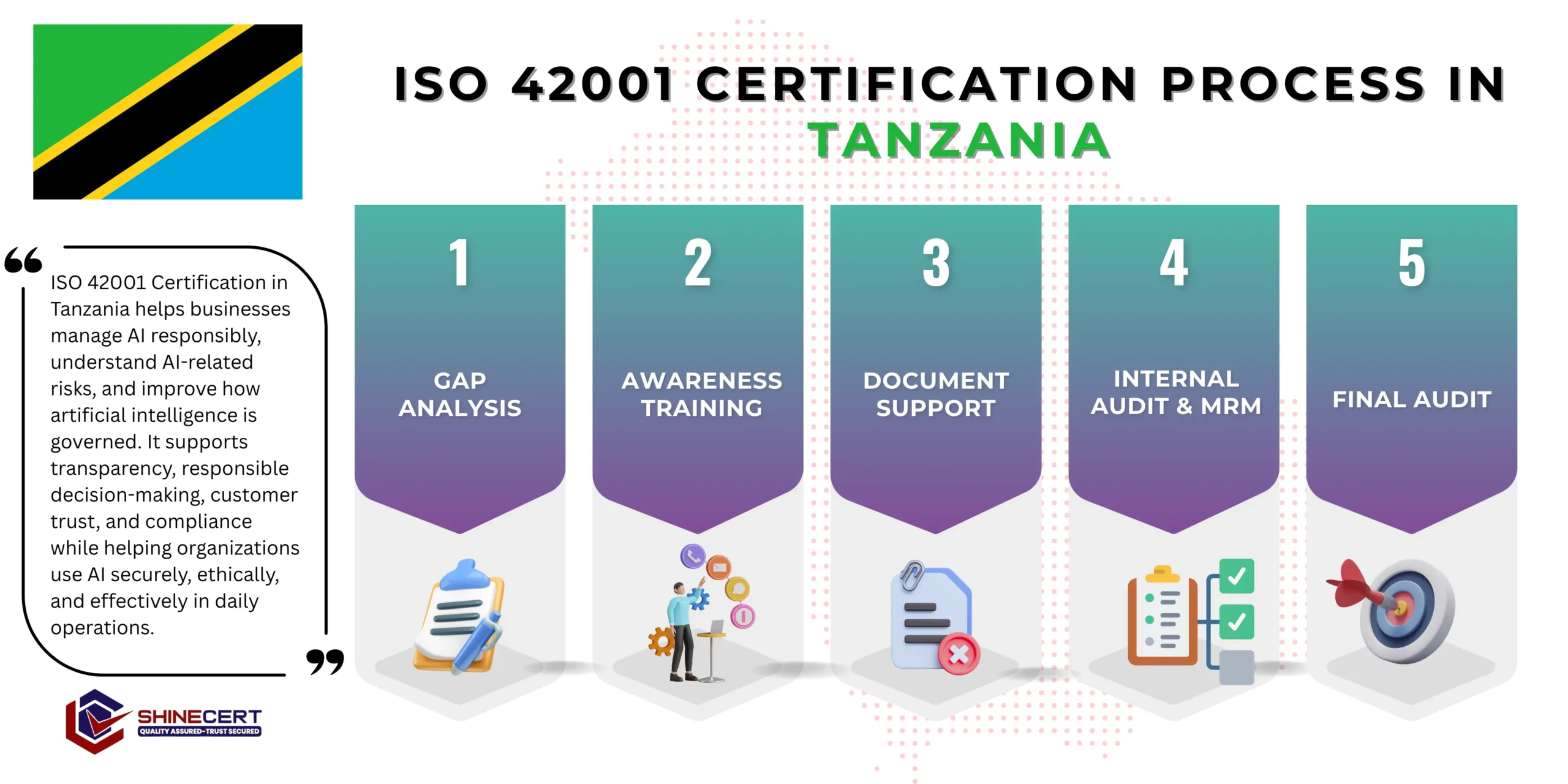
ISO 42001 Certification Process in Tanzania
The ISO 42001 certification journey in Tanzania: a five-step process from gap assessment through certification audit, with typical durations for each stage
Gap Assessment
We review your actual AI use cases, whether internally developed or third-party, mapping genuine risk exposure against ISO 42001’s requirements.
A gap report identifying your real AI governance gaps and priority areas.
Documentation
We build your AI policy, risk and impact assessments, and governance procedures around your actual AI systems and use cases.
A complete AI management system documentation set tied to your real technology environment.
Implementation
AI development procedures, monitoring practices, and third-party assessment processes move into genuine daily operational use.
A functioning AI management system with real operational evidence building up.
Internal Audit and Management Review
We audit against every clause, surfacing gaps while stakes are low.
An internal audit report and corrective actions closed out before the certification audit.
Certification Audit
Stage 1 confirms your documentation is genuinely audit-ready; Stage 2 has the auditor review your actual AI governance practices.
Your ISO 42001 certificate, valid for three years, plus a surveillance audit schedule.
Staying Certified: Surveillance and Renewal
An ISO 42001 certificate is valid for three years. During years one and two, your certification body conducts an annual surveillance audit, reviewing your AI risk assessment currency and monitoring records. Before the three-year mark, a full recertification audit confirms your AI management system has continued functioning throughout the cycle. Given how actively Tanzania’s AI policy landscape is developing, we recommend reviewing your governance framework whenever MICIT or sector ministries issue updated guidance.
ISO 42001 Certification Cost in Tanzania
There’s no flat price for ISO 42001 certification in Tanzania. Cost genuinely comes down to six factors, each worth understanding before you budget for certification:
01
How much of your AI governance is already documented
A business using AI informally, without any documented policy or risk assessment, faces a genuinely bigger task than one with existing governance practices in place.
02
Number of AI systems and use cases in scope
Each additional AI system or use case typically needs its own risk and impact assessment.
03
Existing AI governance culture and buy-in
Organizations where technical teams already think carefully about AI risk implement new procedures with considerably less friction.
04
Risk level of your AI use cases
Higher-risk applications, those affecting individuals’ financial, health, or legal outcomes, require deeper risk and impact assessment than lower-risk internal tools.
05
Certification body fees, tracked separately from our consulting fees
The certification audit itself is invoiced directly by whichever accredited body conducts your audit.
06
Whether you’re bundling with ISO 27001
Building ISO 42001 alongside ISO 27001 shares meaningful governance infrastructure, reducing combined cost.
Why It’s Becoming Essential for Tanzanian Businesses Right Now?
- Tanzania’s completed AI Readiness Assessment signals formal regulation is a genuine matter of when, not if : With the assessment aligned to UNESCO’s Ethics of AI recommendation and explicitly framed as the foundation for a forthcoming National AI Strategy, organizations building governance structures now are aligning with where policy is genuinely heading rather than guessing.
- The government’s stated intention to create a dedicated AI regulatory institution means compliance expectations will likely tighten with real speed once that body is established : Organizations without any existing AI governance framework will face a genuinely compressed timeline to build one once a regulator with actual enforcement authority exists, building ISO 42001’s framework now considerably eases that eventual transition.
- Existing sector-specific guidance, health, education, shows regulation is likely to arrive unevenly across sectors, and healthcare and fintech businesses using AI face the most immediate exposure : With the Ministry of Health already publishing an AI Policy Framework and education-sector guidelines in active development, businesses in these sectors should expect sector-specific AI compliance obligations to formalize before a single cross-sector law does.
- International partners and investors increasingly apply AI governance due diligence independent of domestic Tanzanian regulation : As Tanzania’s fintech and technology sectors attract growing international investment, foreign partners increasingly expect demonstrable AI governance as part of broader technology risk assessment, regardless of what domestic law currently requires.
Benefits of ISO 42001 Certification for Tanzanian Organizations
Certified Tanzanian organizations describe gains that go well beyond a stated AI ethics commitment. Here’s what they actually report:
A certified AI management system positions you ahead of Tanzania’s developing regulatory framework rather than scrambling to build governance once rules take effect.
Systematic bias assessment, robustness testing, and impact assessment genuinely catch problems in AI systems before they affect customers or the public.
ISO 42001 is recognized well beyond Tanzania, relevant for businesses working with international technology investors who apply AI governance due diligence.
When a client, regulator, or partner asks how you manage AI risk, a certified system gives you a genuine, documented answer.
For healthcare and education organizations, ISO 42001’s framework directly supports emerging sector-specific AI guidance from ministries.
ISO 42001 shares meaningful structure with ISO 27001, making combined certification genuinely efficient for technology-driven organizations.
The Real Challenges Organizations Face While Implementing ISO 42001
- Assuming a technically sound AI system needs no additional governance : Businesses sometimes focus entirely on model accuracy while genuinely underestimating the governance, risk, and impact assessment work ISO 42001 requires.
- Underestimating third-party AI risk : A common gap is thoroughly assessing internally built AI systems while giving considerably less scrutiny to third-party AI tools and models the organization has adopted.
- Bias and impact assessments that stay superficial : Auditors specifically probe whether impact assessments genuinely consider effects on different groups, not just aggregate performance metrics.
- Governance that doesn’t keep pace with model changes : A significant gap is when AI models are updated or retrained without the governance documentation being genuinely revisited.
Where Certification Matters Most Across Tanzania’s Economy?
Fintech and Digital Lending
ISO 42001 is close to essential given AI’s growing role in credit decisions and genuine consumer protection stakes.
Read moreHealthcare and Health Technology
ISO 42001 directly supports the Ministry of Health’s existing AI Policy Framework and emerging sector-specific expectations.
Read moreEducation Technology
ISO 42001 aligns with education-sector AI guidelines currently in development.
Read moreTelecommunications and Digital Services
ISO 42001 addresses AI-driven customer service and personalization systems increasingly common in this sector.
Read moreAgriculture Technology
ISO 42001 supports responsible governance as AI-driven agricultural tools expand across Tanzania’s agriculture sector.
Read moreA Tanzanian Business We’ve Worked With
- A Dar es Salaam-based digital lending platform using an AI-driven credit scoring model approached us after growing concerned that their model’s decision-making process couldn’t be clearly explained if a regulator or customer ever asked how a lending decision was made.
- Our gap assessment found the underlying model was technically sound, but there was no documented risk assessment addressing potential bias, no impact assessment considering effects on different borrower groups, and no formal process for monitoring model performance over time.
- We built an AI risk and impact assessment, a monitoring framework, and clear governance documentation around their existing model. Certification took just under five months, and the company now has a clear, documented answer whenever a partner or prospective regulator asks how their AI-driven decisions are governed.
- This reflects a pattern we see often, genuinely capable technical teams that hadn’t yet built the governance layer around otherwise sound AI systems, rather than a single specific engagement.
The Documentation Auditors Expect, Clause by Clause
- Clause 4 — Context of the Organization : Document: Scope of the AI Management System Statement. A written statement defining which AI systems, use cases, and stakeholders your management system covers.
- Clause 5 — Leadership : Document: AI Policy. A documented policy, signed off by top management, expressing genuine commitment to responsible AI development and use. Document: Roles and Responsibilities Matrix. Clear documentation of who owns AI governance decisions and accountability.
- Clause 6 — Planning : Document: AI Risk Assessment. A documented, actively maintained assessment of risks specific to your AI systems, bias, transparency, robustness, unintended consequences. Document: AI Impact Assessment. Documentation assessing how your AI systems affect individuals and society, not just technical performance.
- Clause 7 — Support : Document: Competence and Training Records. Evidence that staff developing or deploying AI systems have genuinely received appropriate training in responsible AI practice. Document: Data Governance Documentation. Records showing data used to train and operate AI systems are genuinely managed for quality and appropriateness.
- Clause 8 — Operation : Document: AI System Development and Deployment Procedures. Specific, written procedures for how AI systems are developed, tested, and deployed responsibly. Document: Third-Party AI Provider Assessment Records. Documentation showing external AI vendors and models are genuinely assessed for risk.
- Clause 9 — Performance Evaluation : Document: AI Performance and Impact Monitoring Records. Genuine, ongoing records showing AI system performance and real-world impact are actively tracked. Document: Internal Audit Records. Evidence of a planned internal audit schedule actually carried out. Document: Management Review Minutes. Documented leadership review of AI governance performance and genuine decisions made in response.
- Clause 10 — Improvement : Document: Corrective Action Records. A functioning system for logging AI-related incidents or issues and tracking corrective action.
Realistic Timelines for Tanzanian Businesses
| Business Profile | Typical Total Timeline | What Drives This |
|---|---|---|
| Small business, limited AI use | 2.5–3.5 months | Narrower scope and fewer AI use cases |
| Medium business, moderate AI use | 3.5–5.5 months | Broader AI use cases across more functions |
| Larger business, extensive AI deployment | 5.5–8 months | Multiple AI systems, higher-risk use cases, more extensive documentation |
Beyond company size, the single biggest timeline driver is genuinely how many distinct AI use cases and how much risk they carry.
ISO 42001 Certification Across Tanzania’s Business Hubs
Dar es Salaam
As the commercial and technology hub, AI governance here is most often driven by fintech and technology-sector AI deployment.
Arusha
With growing tourism-technology integration, AI governance here increasingly touches booking, pricing, and customer service systems.
Mwanza
As a regional commercial center, AI use here is emerging primarily in financial services and trade-related applications.
Dodoma
As the seat of government, AI governance discussions here are closely tied to public-sector AI policy development itself.
Why Businesses Choose ShineCert in Tanzania?
ShineCert brings 10 years of ISO consulting and certification experience to Tanzania’s market, coordinated through our Riyadh and India offices with services delivered remotely or on-site depending on what your engagement genuinely needs. We’ve guided more than 10,000 organizations through ISO certification worldwide, and we build every Tanzania AI governance engagement around your actual AI use cases, this is why Tanzanian businesses increasingly choose ShineCert as the best ISO 42001 consultant in Tanzania.
Choosing a Certification Body in Tanzania?
What to Check | Why It Matters |
Accreditation under a recognized international framework | Confirms genuine, internationally recognized certification |
Genuine understanding of Tanzania’s developing AI policy landscape | Ensures your governance framework anticipates where regulation is genuinely heading |
Experience with your specific AI use cases | Fintech, healthcare, and education involve genuinely different AI risk considerations |
Willingness to assess real AI systems, not just review policy documents | The value of certification comes from genuine governance, not paperwork alone |
Ready to Get Started?
Whether you’re building AI governance ahead of Tanzania’s developing regulatory framework or formalizing existing practice, we’ll walk through your specific AI use cases and cost factors before proposing a fixed-scope plan, delivered remotely, on-site, or however genuinely fits your project. Book a free consultation or contact us directly to get started.
Frequently Asked Questions
Look for genuine understanding of Tanzania’s developing AI policy landscape, sector-specific AI risk experience, and willingness to assess real systems. ShineCert scopes every Tanzania engagement individually.
Not through a single, binding cross-sector law, Tanzania has completed a National AI Readiness Assessment, MICIT is developing a national AI strategy, and sector-specific guidance exists in health and education, but comprehensive AI regulation is still developing.
It genuinely depends on your number of AI use cases, their risk level, and existing governance maturity, we scope every project individually.
Typically two and a half to eight months depending on organization size and AI use case complexity, see our detailed timeline breakdown above.
Building genuine governance now positions your organization ahead of regulation rather than scrambling to build it once a dedicated AI regulatory institution is established, which the government has already signaled its intention to create.
Documentation work runs effectively over remote sessions, but reviewing actual AI systems and model behavior genuinely benefits from in-person engagement.
ShineCert doesn’t maintain a standalone Tanzania office; we coordinate Tanzania engagements from our Riyadh and India offices, with services delivered remotely or on-site as your project requires.