
ISO 37001 Certification in Tanzania
Quick Answer
ISO 37001 is the international standard for anti-bribery management systems, and in Tanzania it speaks directly to a well-established enforcement landscape built around the Prevention and Combating of Corruption Bureau (PCCB), the body created under the Prevention and Combating of Corruption Act to investigate and prosecute corruption across both public and private dealings. Businesses supplying government contracts, working through agents in regulated sectors like mining and infrastructure, or handling public procurement face genuine, ongoing scrutiny that a documented policy alone doesn’t satisfy. ISO 37001 gives these businesses a structured, independently verified way to demonstrate that anti-bribery controls are actually functioning, not simply asserted. Certification typically takes three to five months, and cost depends on real factors like your exposure to public procurement.
Understanding ISO 37001: What It Actually Is, and Why It Matters in Tanzania
ISO 37001 is published by the International Organization for Standardization and sets out requirements for an anti-bribery management system built to help organizations prevent, detect, and respond to bribery. It requires due diligence on business associates, controls over financial transactions and gifts, a genuinely accessible whistleblowing channel, and clear leadership accountability for anti-bribery commitment. Certification means an accredited, independent auditor has confirmed these elements are real and working, not just documented in a policy binder.
The reason this matters specifically in Tanzania is the structure of the country’s economy: substantial public infrastructure investment, a mining and extractives sector operating under close government oversight, and a growing base of businesses working through local agents and intermediaries to navigate regulatory and procurement processes. PCCB’s mandate covers exactly these intersections between business and public administration, and a business operating in any of them without documented, tested anti-bribery controls is relying on good intentions in an environment where good intentions alone don’t satisfy a corruption investigation.
What are the steps to get ISO 37001 Certification in Tanzania?
our services
- ISO Certification Tanzania
- ISO 9001 Certification Tanzania
- ISO 14001 Certification Tanzania
- ISO 27001 Certification Tanzania
- ISO 22000 Certification Tanzania
- ISO 27701 Certification Tanzania
- ISO 45001 Certification Tanzania
- ISO 20000-1 Certification Tanzania
- ISO 13485 Certification Tanzania
- ISO 17025 Certification Tanzania
- ISO 31000 Certification Tanzania
- ISO 42001 Certification Tanzania
- ISO 37001 Certification Tanzania
- ISO 22301 Certification Tanzania
- ISO 50001 Certification Tanzania
- CE Mark Certification Tanzania
- GDPR Certification Tanzania
- GMP Certification Tanzania
- Halal Certification Tanzania
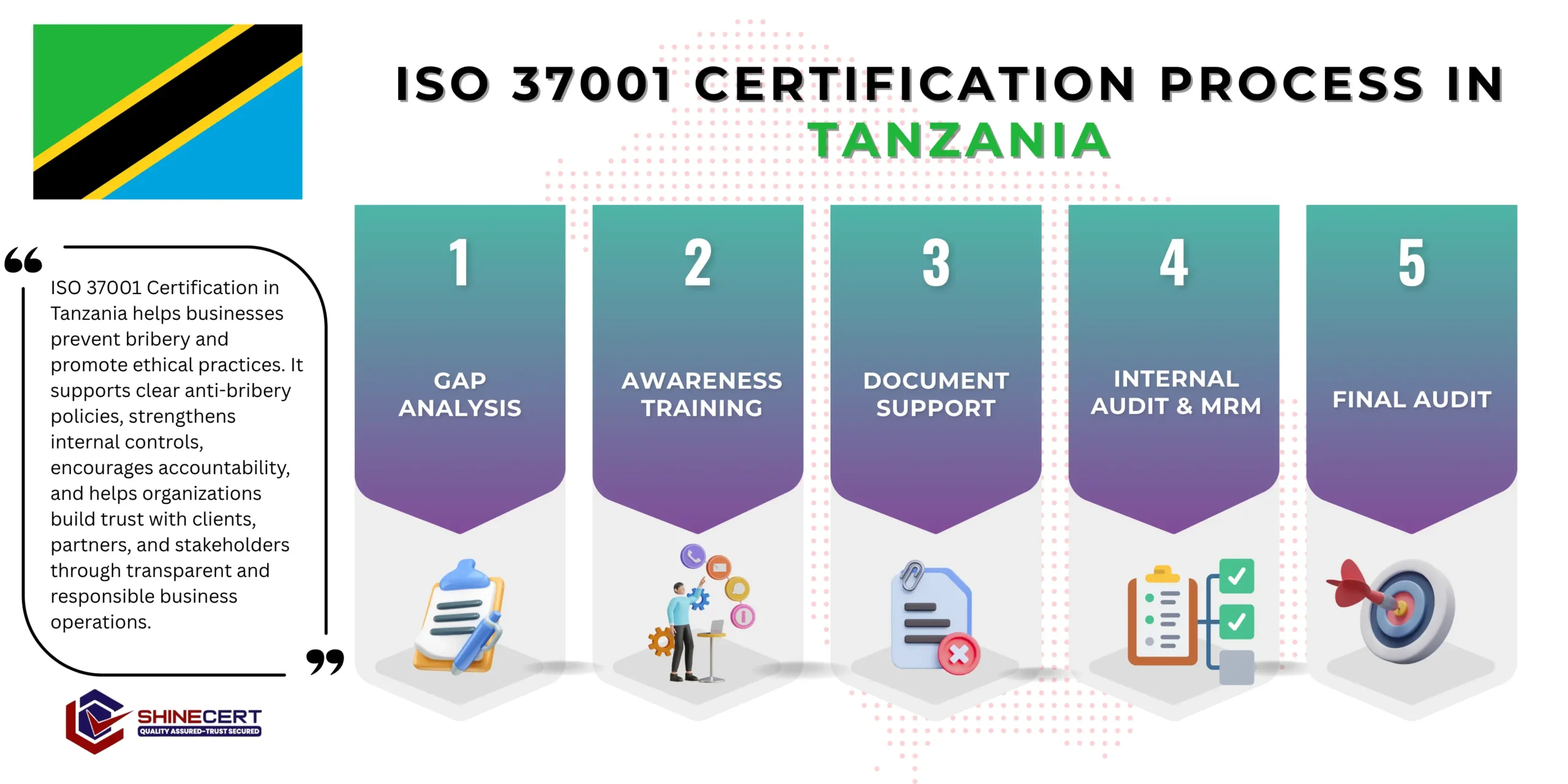
ISO 37001 Certification Process in Tanzania
The ISO 37001 certification journey in Tanzania: a five-step process from bribery risk assessment through certification audit, with typical durations for each stage
Bribery Risk Assessment
We look at your actual exposure, public procurement involvement, licensing and permitting processes, agent and distributor relationships, rather than starting from a generic checklist.
A bribery risk assessment grounded in your business and Tanzania's actual regulatory and procurement environment.
Documentation
We build your anti-bribery policy, due diligence procedures, and financial controls around your real business relationships and payment processes.
A complete anti-bribery management system documentation set tied to your actual risk exposure.
Implementation
Due diligence checks, gift and hospitality controls, and the whistleblowing mechanism move from procedure into genuine daily operational use.
A working anti-bribery management system with controls being actively used and recorded.
Internal Audit and Management Review
We test the system against every ISO 37001 clause, surfacing gaps before an external auditor does.
An internal audit report with corrective actions already closed before certification.
Certification Audit
Stage 1 confirms your documentation is genuinely ready; Stage 2 has the auditor review your actual due diligence records and speak with your team.
Your ISO 37001 certificate, valid for three years, plus a surveillance audit schedule.
Staying Certified: Surveillance and Renewal
An ISO 37001 certificate runs for three years, with annual surveillance audits in years one and two reviewing your due diligence records, whistleblowing log, and financial controls. A full recertification audit at the three-year mark confirms the system held up throughout the cycle. We recommend revisiting your bribery risk assessment whenever your business relationships change materially, a new agent relationship, entry into a new procurement category, or expansion into a new region of the country.
ISO 37001 Certification Cost in Tanzania
Six things actually shape what a Tanzania engagement costs, and none of them is company size on its own:
01
How much of your revenue runs through government contracts
A construction firm winning most of its work through public tenders needs a materially deeper risk assessment than one selling mainly to private clients.
02
How many agents or intermediaries speak for you
Every clearing agent, licensing consultant, or local partner representing your business in front of an official adds its own vetting workstream.
03
Whatever controls you’ve already built
A finance team that already reconciles gifts and hospitality spend, or an audit function that already exists, shortens the documentation phase considerably.
04
Where in the country you operate
A single-city business is a narrower assessment than one spanning Dar es Salaam, the Lake Zone, and inland regions with different local procurement dynamics.
05
The certification body’s own audit fee, which sits entirely outside our quote
That charge goes straight from you to whichever accredited body performs the audit.
06
Whether ISO 9001 or ISO 27001 is part of the same project
Shared documentation infrastructure between standards brings the combined price down versus running them as separate efforts.
Why It’s Becoming Essential for Tanzanian Businesses Right Now?
- Public infrastructure spending continues to expand across roads, energy, and port development, and each of these projects carries real procurement integrity exposure : Businesses bidding for or supplying these projects face genuine scrutiny of their own internal controls, not just the government’s procurement process itself.
- The mining and extractives sector operates under especially close oversight given its economic significance and history of contract disputes : Businesses in mining supply chains, whether direct operators or service providers, face heightened expectations to demonstrate clean dealings with both government counterparts and local intermediaries.
- Reliance on local agents and intermediaries to navigate licensing, customs, and procurement processes creates a genuine due diligence gap for many businesses, particularly international ones entering the market : Without formal vetting of these relationships, a business can be exposed to bribery risk it never directly initiated but remains accountable for under Tanzanian law.
- International development partners and lenders financing Tanzanian infrastructure and business projects increasingly require demonstrable anti-bribery controls as a condition of financing : As development finance institutions and international partners scrutinize governance more closely, businesses without certified controls risk being excluded from these funding relationships entirely.
Benefits of ISO 37001 Certification for Tanzanian Organizations
Certified Tanzanian organizations gain considerably more than a document asserting anti-bribery policy exists. Here is what certification actually delivers:
A certified anti-bribery management system gives you documented, independently verified evidence that strengthens your standing when bidding for government or institutional contracts.
Systematic due diligence on the agents and intermediaries representing your business provides genuine evidence of proactive risk management if those relationships are ever scrutinized.
ISO 37001 is recognized internationally, directly relevant for businesses seeking financing from development institutions or international lenders that apply anti-bribery due diligence as standard practice.
Certification requires a genuinely accessible reporting mechanism, catching problems internally before they become a PCCB matter.
Documented due diligence and controls provide real evidence of reasonable procedures if an employee or associate is later found to have acted improperly.
Larger operators and government counterparts increasingly expect anti-bribery certification as a genuine condition of supplier relationships in these sectors.
ISO 37001 requires defined roles and leadership accountability, removing the ambiguity of who actually owns this risk inside the organization.
ISO 37001’s due diligence and controls complement ISO 9001’s process discipline and ISO 27001’s access controls, useful for organizations building governance maturity more broadly.
The Real Challenges Organizations Face While Implementing ISO 37001
- Believing a clean reputation speaks for itself : Plenty of Tanzanian businesses run honest operations and assume that’s enough, until an auditor asks for the paper trail proving it, and there isn’t one.
- Vetting staff carefully while waving intermediaries through : It’s the person negotiating a customs clearance or a local license on your behalf, not your own accountant, who tends to carry the real bribery exposure, yet that relationship is often the least scrutinized.
- A whistleblowing line nobody actually calls : The test isn’t whether a hotline exists on paper; it’s whether a single employee has ever used it, which tells an auditor a great deal about whether staff believe their report would stay confidential.
- Facilitation payment rules that dodge the hard question : Telling staff to use “good judgment” on gifts or small payments to officials just moves the decision, and the risk, onto whoever’s standing in the room at the time.
Where Certification Matters Most Across Tanzania’s Economy?
Mining and extractives service providers
ISO 37001 is close to essential given close government oversight and the sector’s history of contract scrutiny; pair with ISO 9001 for combined quality and governance coverage.
Read moreInfrastructure and construction contractors
ISO 37001 directly addresses procurement integrity expectations tied to public infrastructure spending.
Read moreGovernment suppliers and consultants
ISO 37001 addresses the due diligence and financial control expectations increasingly scrutinized by PCCB.
Read moreImport-export and logistics businesses
ISO 37001 addresses genuine exposure given reliance on customs and licensing intermediaries.
Read moreBusinesses seeking development finance
ISO 37001 supports the anti-bribery due diligence international lenders and development institutions increasingly require as a financing condition.
Read moreA Tanzanian Business We’ve Worked With
- A Dar es Salaam-based logistics company handling customs clearance for imported industrial equipment approached us after growing uneasy about how much of their clearance process depended on informal relationships with clearing agents whose practices they couldn’t fully verify.
- Our bribery risk assessment found the company’s own internal conduct was genuinely sound, but there was no formal due diligence process for the clearing agents it relied on, and no documented policy distinguishing legitimate facilitation costs from payments that could expose the business to real liability.
- We built a due diligence procedure for agent relationships, a clear policy distinguishing acceptable facilitation costs from prohibited payments, and a whistleblowing channel giving staff a genuine way to flag concerns. Certification took just under four months, and the resulting documentation gave the company clear internal evidence of its own clean conduct when a client later asked for anti-bribery assurances as part of a new contract.
- This reflects a pattern we see repeatedly among Tanzanian logistics and trade businesses, genuinely honest operations that had never formalized how they vet the intermediaries representing them, rather than one specific client account.
The Documentation PCCB and Auditors Expect
- Anti-Bribery Policy : A policy, approved by top management, expressing genuine commitment to preventing bribery across the organization’s operations, procurement relationships, and dealings with public officials.
- Bribery Risk Assessment : A documented analysis of bribery risks specific to your operations, genuinely reflecting your exposure to public procurement, licensing processes, and agent relationships.
- Due Diligence Records on Business Associates : Documentation showing agents, distributors, and intermediaries are actually assessed for bribery risk before and during the relationship, not just onboarded on trust.
- Financial and Commercial Controls : Documented controls over payments, gifts, hospitality, and facilitation payments, designed specifically to prevent them being used to conceal bribery.
- Whistleblowing Procedure : A documented, genuinely trusted mechanism for employees and others to report suspected bribery without fear of retaliation.
- Training Records : Evidence that employees exposed to bribery risk, particularly those interfacing with government officials or agents, have received training appropriate to that exposure.
- Investigation and Response Procedure : A documented process describing how a suspected bribery report is actually investigated and addressed.
- Internal Audit and Management Review Records : A planned internal audit schedule and documented management review decisions on anti-bribery priorities.
Realistic Timelines for Tanzanian Businesses
| Business Profile | Typical Total Timeline | What Drives This |
|---|---|---|
| Limited public procurement exposure | 2.5–3.5 months | Narrower bribery risk landscape and simpler due diligence scope |
| Moderate public sector or agent-based sales | 3.5–5.5 months | Broader due diligence requirements across business relationships |
| Heavy public procurement or multi-region operations | 5.5–8 months | Extensive due diligence and financial control documentation |
What actually stretches a Tanzania engagement isn’t headcount, it’s how many third-party relationships sit between your business and a government decision-maker. A company selling directly, with no agents involved, moves through documentation quickly; one relying on intermediaries to navigate licensing or customs adds a genuinely separate due diligence workstream for every relationship in that chain.
ISO 37001 Certification Across Tanzania’s Business Hubs
Dar es Salaam
As the commercial and port hub, businesses here concentrate the widest exposure to import licensing, customs processes, and public procurement.
Arusha
With growing infrastructure and tourism-linked development activity, businesses here increasingly interact with regional government procurement processes.
Mwanza
Serving the Lake Zone’s mining and trade sector, businesses here carry meaningful exposure to both mining-sector oversight and regional procurement relationships.
Dodoma
As the seat of government, businesses here operate closest to national procurement decision-making and face correspondingly close scrutiny.
Why Businesses Choose ShineCert in Tanzania?
A decade of ISO consulting work across more than 10,000 organizations sits behind every Tanzania engagement we take on, running out of our Riyadh and India offices with people on the ground here whenever the project genuinely calls for it. We don’t hand you a template with “Tanzania” swapped in, we start from your actual procurement exposure and the specific agents or intermediaries in your supply chain, which is the reason businesses here keep coming back to ShineCert, the best ISO 37001 consultant in Tanzania, for anti-bribery work.
Choosing a Certification Body in Tanzania?
What to Check | Why It Matters |
Accreditation under a recognized international accreditation framework | Confirms genuine, internationally recognized certification |
Real understanding of Tanzania’s public procurement and PCCB enforcement environment | Ensures your risk assessment and controls reflect actual, not generic, corruption risk |
Experience with your specific sector’s exposure | Mining, infrastructure, and logistics carry meaningfully different bribery risk profiles |
Willingness to test whether controls genuinely work, not just review documents | The real value of certification comes from tested, trusted controls, not paperwork alone |
Ready to Get Started?
If public procurement, agent relationships, or a partner’s due diligence request is what’s bringing you to ISO 37001, tell us about your specific exposure and we’ll come back with a scoped, fixed-price plan, remote, on-site, or a mix of both. Book a free consultation or reach out directly to begin.
Frequently Asked Questions
Someone who has actually sat across from PCCB’s expectations before, knows your specific sector’s exposure, and will stress-test your controls rather than just check boxes on a form. ShineCert prices every Tanzania project after that conversation, not before it.
No. What it does is hand you documented, third-party-verified proof of clean practice, a genuine asset in a bid evaluation, but not a substitute for winning on merit.
There isn’t a set figure, the quote reflects how exposed your business is to public procurement, how many outside agents represent you, and how far along your existing controls already are.
Somewhere between two and a half and eight months in most cases, shaped by how many procurement relationships and intermediaries need vetting, the table above breaks this down by profile.
Yes. Bribery risk travels through agents, distributors, and international partners just as easily as through a government contract, and the standard is built to cover all of it.
Certification won’t erase the incident, but documented due diligence and controls give you real, demonstrable grounds to argue you took reasonable steps, how much that argument holds up depends on the specifics.
The policy writing and documentation travel fine over a screen; the risk assessment and staff interviews are where being in the room actually helps.
No physical office there, our Tanzania work runs out of Riyadh and India, with on-site visits scheduled whenever the engagement calls for them.