
ISO 50001 Certification in Tanzania
Quick Answer
Electricity in Tanzania is priced under tariffs set by the Energy and Water Utilities Regulatory Authority (EWURA), the body responsible for regulating electricity, water, and petroleum pricing, with TANESCO as the national distributor billing most commercial and industrial customers. As generation costs shift with fuel prices and hydrological conditions feeding the grid’s hydropower component, tariff structures for higher-consumption industrial and commercial customers periodically move, and businesses running energy-intensive operations feel that movement directly on their bottom line. ISO 50001 gives these businesses a structured, internationally recognized way to understand exactly where their energy goes and reduce genuine waste, rather than treating every tariff review as an unplanned cost shock. Certification typically takes three to five months.
Understanding ISO 50001: What It Actually Is, and Why It Matters in Tanzania
Picture two manufacturers standing side by side, both hit with the same EWURA-approved tariff adjustment. One has spent months mapping exactly which machines consume the most power and why; the other has never looked past the total on the monthly bill. ISO 50001, published by the International Organization for Standardization, is what separates those two positions, a defined set of requirements for building an energy management system: an energy baseline against which future consumption gets measured, performance indicators tracking whether things are actually improving, and a genuine cycle of review and correction built into daily operations. Certification means an accredited auditor has confirmed that cycle is real, not simply described in a binder nobody opens.
Tanzania’s situation makes this distinction concrete rather than academic. TANESCO’s generation mix still leans on hydropower whose output shifts with rainfall, supplemented by natural gas-fired plants drawing on domestic gas fields. That mix means the underlying cost of producing electricity isn’t static, and EWURA’s tariff-setting process periodically passes cost changes through to industrial and commercial customers. A business that has never systematically tracked its own energy use has no real way to tell which of its costs are genuinely fixed and which are opportunities waiting to be found.
What are the steps to get ISO 50001 Certification in Tanzania?
our services
- ISO Certification Tanzania
- ISO 9001 Certification Tanzania
- ISO 14001 Certification Tanzania
- ISO 27001 Certification Tanzania
- ISO 22000 Certification Tanzania
- ISO 27701 Certification Tanzania
- ISO 45001 Certification Tanzania
- ISO 20000-1 Certification Tanzania
- ISO 13485 Certification Tanzania
- ISO 17025 Certification Tanzania
- ISO 31000 Certification Tanzania
- ISO 42001 Certification Tanzania
- ISO 37001 Certification Tanzania
- ISO 22301 Certification Tanzania
- ISO 50001 Certification Tanzania
- CE Mark Certification Tanzania
- GDPR Certification Tanzania
- GMP Certification Tanzania
- Halal Certification Tanzania
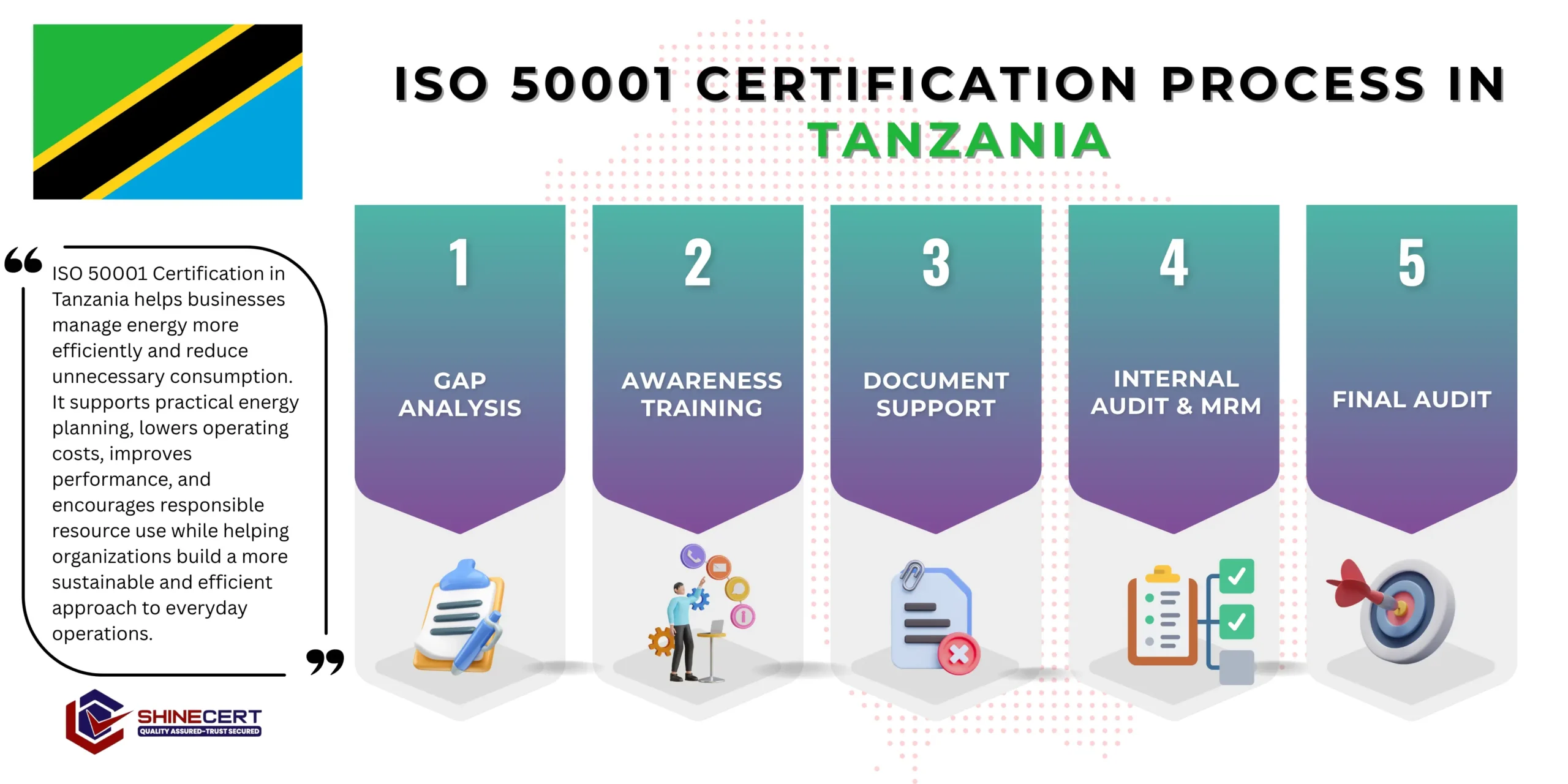
ISO 50001 Certification Process in Tanzania
The ISO 50001 certification journey in Tanzania: a five-step process from energy review through certification audit, with typical durations for each stage
Energy Review
We walk your facility, review historical billing against your EWURA tariff category, and pinpoint the equipment and processes actually driving your consumption.
An energy review identifying your baseline and where the real improvement opportunities sit.
Documentation
We build your energy policy, baseline, and performance indicators around your specific equipment, not a generic industry template.
A complete energy management documentation set tied to your genuine consumption patterns.
Implementation
Monitoring, maintenance practices, and operational controls for your significant energy uses move from procedure into daily practice.
A functioning system with real monitoring actively tracked and recorded.
Internal Audit and Management Review
We test the system against every clause, surfacing gaps before an external auditor does.
An internal audit report with corrective actions already closed before certification.
Certification Audit
Stage 1 confirms your documentation is ready; Stage 2 has the auditor visit your facility and review your actual monitoring data.
Your ISO 50001 certificate, valid for three years, plus a surveillance schedule.
Staying Certified: Surveillance and Renewal
An ISO 50001 certificate runs for three years, with annual surveillance audits in years one and two checking your energy performance data against the established baseline. A full recertification audit at the three-year mark confirms genuine improvement continued throughout the cycle. We recommend revisiting your baseline whenever EWURA adjusts tariff structures materially, or whenever you add or replace significant equipment.
ISO 50001 Certification Cost in Tanzania
A flat quote doesn’t exist for this certification anywhere, and Tanzania is no exception. Six things genuinely move the number:
01
How much power your equipment actually pulls
A facility running continuous heavy machinery needs a deeper review than one where energy use is mostly lighting and office equipment.
02
How many sites are in scope
Each facility typically has its own mix of significant energy uses, meaning separate baseline work for every location.
03
Whatever monitoring already exists
A plant that already tracks consumption by production line isn’t starting from a blank page the way one relying purely on the monthly utility bill is.
04
Gaps in your metering setup
Without sub-metering on key equipment, some baseline data has to be gathered through direct measurement, which adds time and, sometimes, modest equipment cost.
05
The certification body’s own audit fee, invoiced separately from our work
That charge is set and billed by whichever accredited body actually performs your audit.
06
Whether this runs alongside ISO 14001
Combining the two shares real environmental and energy data groundwork, which brings the combined cost down versus two standalone projects.
Why It’s Becoming Essential for Tanzanian Businesses Right Now?
- Generation costs tied to a hydropower-and-gas mix mean tariff stability isn’t something businesses can simply assume : When rainfall or gas supply conditions shift the underlying cost of generation, EWURA’s periodic tariff reviews can pass some of that change through to industrial and commercial rate classes, and businesses without a baseline have no way to distinguish a real cost increase from an efficiency problem they could actually fix.
- Manufacturing growth across Dar es Salaam and other industrial zones is pushing more businesses into higher-consumption tariff brackets : As production scales, energy costs often grow faster than output unless a business is actively tracking where consumption is going, which is precisely the discipline ISO 50001 requires.
- International buyers sourcing from Tanzanian manufacturers increasingly ask about energy and carbon performance as part of supplier evaluation : Exporters selling into markets with sustainability-conscious buyers find that documented energy management supports these conversations directly, rather than leaving the business unable to answer basic efficiency questions.
- Equipment maintenance and energy performance turn out to be closely linked, and Tanzanian manufacturers running aging machinery have real room to benefit from that connection : Motors and equipment operating inefficiently due to deferred maintenance often show up first as unexplained energy consumption, long before they show up as a breakdown.
Benefits of ISO 50001 Certification for Tanzanian Organizations
Certified Tanzanian organizations gain considerably more than a policy document confirming energy management exists. Here is what certification actually changes:
A structured energy management system surfaces genuine efficiency opportunities that directly offset the cost pressure of periodic tariff adjustments.
Instead of reacting to each new bill, a certified system gives you an established consumption baseline and a concrete improvement plan to work against.
ISO 50001 is recognized internationally, directly relevant for Tanzanian manufacturers and exporters whose buyers increasingly factor energy and sustainability performance into supplier decisions.
Genuine efficiency improvements reduce emissions in a way that’s traceable and defensible, increasingly relevant as buyers and financiers apply sustainability screens.
Systematic energy monitoring routinely surfaces underperforming motors or poorly maintained equipment well before they fail outright.
Institutional buyers and sustainability-linked financing programs increasingly favor suppliers who can demonstrate structured energy practice.
ISO 50001’s monitoring and continual improvement approach shares real ground with ISO 14001’s broader environmental management framework.
The Real Challenges Organizations Face While Implementing ISO 50001
- Assuming the monthly bill tells the whole story : A single total on an invoice hides which specific machines or processes are actually driving consumption, and businesses without sub-metering often discover this gap only once they start the baseline work.
- Setting energy goals that sound good but can’t be measured : “Use less electricity” isn’t a target an auditor can verify, it needs to become a specific number tied to a specific process before it means anything.
- Equipment changes outpacing the paperwork : When a facility replaces or adds machinery, the significant energy uses register often doesn’t get updated to match, leaving monitoring focused on the wrong priorities.
- Energy data that never reaches the people buying new equipment : The biggest missed opportunity is often simple: performance data sits in a spreadsheet nobody consults when a capital purchase decision is being made.
Where Certification Matters Most Across Tanzania’s Economy?
Manufacturing and industrial processing
ISO 50001 is close to essential given direct exposure to tariff movement; pair with ISO 14001 for broader environmental management.
Read moreCold chain and refrigeration-dependent businesses
ISO 50001 addresses the continuous, energy-intensive refrigeration load these operations carry.
Read moreHospitality and large commercial buildings
ISO 50001 addresses meaningful savings potential in HVAC, lighting, and water heating systems.
Read moreTextile and agro-processing
ISO 50001 supports genuine cost competitiveness given energy-intensive processing steps.
Read moreMining and mineral processing
ISO 50001 addresses substantial power consumption tied to extraction and processing equipment.
Read moreA Tanzanian Business We’ve Worked With
- A Dar es Salaam-based plastics manufacturer running injection molding equipment across two shifts came to us after a tariff adjustment tightened margins on products already priced competitively against imports, with management unsure where in the operation energy costs could realistically be trimmed.
- Our energy review turned up several molding machines running well below their efficient operating range, alongside a compressed air system with detectable leaks that had never been formally inspected, both quietly driving up consumption without anyone noticing on a bill that only showed a total.
- We built an energy baseline, an improvement plan prioritizing the compressed air repairs and machine scheduling first, and a monitoring dashboard giving management real visibility into consumption by shift. Certification took just over four months, and the company saw a measurable drop in energy cost per unit produced within the first several months of monitoring.
- This reflects a pattern common among Tanzanian manufacturers we’ve worked with, real efficiency sitting in plain sight, simply never measured closely enough to notice.
The Documentation Auditors Expect
- Energy Policy : A policy, signed off by top management, expressing genuine commitment to improving energy performance across operations.
- Energy Baseline and Review : A documented analysis of current energy consumption patterns, establishing the reference point future improvement is measured against.
- Energy Performance Indicators : Measurable indicators tracking energy performance specific to your actual operations and equipment, not generic industry benchmarks.
- Significant Energy Uses Register : A documented list of the facility’s highest energy-consuming processes and equipment, ranked for improvement priority.
- Energy Objectives and Action Plans : Specific, owned plans for achieving measurable improvement, with clear timelines rather than open-ended intentions.
- Operational Control Procedures : Documentation showing how energy-significant equipment is actually operated and maintained to sustain efficiency gains over time.
- Monitoring and Measurement Records : Evidence that energy performance is tracked against the baseline on an ongoing basis, not estimated periodically after the fact.
- Internal Audit and Management Review Records : A working internal audit schedule and management review decisions showing energy priorities are genuinely being tracked.
Realistic Timelines for Tanzanian Businesses
| Business Profile | Typical Total Timeline | What Drives This |
|---|---|---|
| Small business, single facility | 2.5–3.5 months | Narrower scope of significant energy uses to analyze |
| Medium business, energy-intensive operations | 3.5–5.5 months | Broader review across multiple significant energy uses |
| Larger manufacturer or multi-site operation | 5.5–8 months | Extensive review across sites and equipment categories |
The clock mostly runs on how much equipment actually needs measuring, not on staff count, a facility running continuous heavy machinery takes noticeably longer to review than an office-based operation with a handful of air conditioners and lighting circuits.
ISO 50001 Certification Across Tanzania’s Business Hubs
Dar es Salaam
As the country’s primary industrial base, businesses here carry the widest concentration of energy-intensive manufacturing and processing activity.
Arusha
With hospitality, agro-processing, and light manufacturing all active locally, energy cost management here spans a genuinely varied mix of facility types.
Mwanza
Serving the Lake Zone’s mining and processing industry, energy-intensive operations here have real room to benefit from structured management.
Dodoma
As the seat of government with growing public and commercial building stock, energy management here increasingly ties into broader facility cost control.
Why Businesses Choose ShineCert in Tanzania?
A decade of ISO consulting across more than 10,000 organizations backs every Tanzania engagement we run, coordinated from our Riyadh and India offices with people on-site whenever the project genuinely calls for it. We don’t hand you a repackaged template, every energy review starts with your actual equipment, your actual bills, and your actual tariff category, which is why Tanzanian manufacturers keep bringing us their energy management work, with ShineCert as the best ISO 50001 consultant in Tanzania.
Choosing a Certification Body in Tanzania?
What to Check | Why It Matters |
Accreditation under a recognized international accreditation framework | Confirms your certificate carries genuine international recognition |
Real understanding of Tanzania’s electricity tariff and generation structure | Ensures your baseline and targets reflect actual, not generic, cost pressures |
Experience with your specific facility type | Manufacturing, cold chain, and commercial buildings carry meaningfully different energy profiles |
Willingness to verify real performance improvement, not just review documents | The genuine value of certification is measured savings, not paperwork alone |
Ready to Get Started?
Whether rising tariffs are already squeezing margins or you’re planning ahead of the next adjustment, tell us about your facility and we’ll come back with a scoped, fixed-price plan, remote, on-site, or a mix of both. Book a free consultation or contact us directly to get started.
Frequently Asked Questions
Someone who understands EWURA’s tariff structure and your specific facility type, and who will actually verify improvement rather than just file documentation. ShineCert prices every Tanzania project after walking your facility, not before.
Certification doesn’t set tariffs lower, but the energy management system behind it routinely finds real consumption to cut, which does lower the bill over time.
It depends on how energy-intensive your operation is, how many sites you’re certifying, and how much monitoring infrastructure already exists, we quote after understanding your facility specifically.
Most Tanzanian businesses finish somewhere between two and a half and eight months, depending mainly on how much equipment needs to be reviewed, see the table above for specifics.
Yes, a mature energy management system gives you the consumption data needed to evaluate any alternative supply arrangement on real numbers rather than guesswork.
No. Any business with a real energy bill, hospitality, commercial buildings, smaller processing operations, can find genuine savings, with the certification scope sized to match.
The paperwork can be built remotely, but the energy review itself requires someone physically walking the facility and looking at the actual equipment.
Not a standalone office, our Tanzania work is coordinated from Riyadh and India, with visits scheduled whenever the engagement needs them.