
ISO 22000 Certification in Tanzania
Quick Answer
ISO 22000 is the internationally recognized standard for food safety management systems, and in Tanzania it works within a regulatory structure that shifted meaningfully in 2019: responsibility for regulating food and cosmetics moved from the former Tanzania Food and Drugs Authority to the Tanzania Bureau of Standards (TBS), while the successor body, the Tanzania Medicines and Medical Devices Authority (TMDA), retained oversight of medicines and medical devices. TBS develops Tanzania’s food standards using a risk-based approach built on Codex Alimentarius and ISO standards, covering everything from contaminants and hygienic practice to labelling and sampling methods. ISO 22000 builds a systematic food safety management system that goes beyond baseline TBS compliance, particularly relevant for businesses pursuing export markets. Certification typically runs three to six months, and cost is shaped by real, specific factors rather than a flat quoted number.
Understanding ISO 22000: What It Actually Is, and Why It Matters in Tanzania
ISO 22000 is a standard published by the International Organization for Standardization that sets out requirements for a food safety management system, a structured way of identifying and controlling food safety hazards throughout your operation, from raw material sourcing through processing, packaging, and distribution. It combines Hazard Analysis and Critical Control Points principles with the broader management system structure shared by standards like ISO 9001, addressing food safety as an organizational discipline rather than a purely technical hygiene checklist. Certification means an independent, accredited body has formally verified your food safety management system meets the standard’s requirements, genuine, third-party evidence of systematic food safety practice.
Why this matters specifically in Tanzania comes down to how TBS’s food safety framework is genuinely built: it already references Codex Alimentarius and international standards as its foundation, which means ISO 22000 certification aligns naturally with the same underlying food safety science TBS’s own standards are based on. For businesses that only interact with TBS through basic product registration and labelling compliance, ISO 22000 adds the systematic hazard analysis and continual improvement discipline that goes considerably further than baseline regulatory compliance, and that international buyers specifically look for.
What are the steps to get ISO 22000 Certification in Tanzania?
our services
- ISO Certification Tanzania
- ISO 9001 Certification Tanzania
- ISO 14001 Certification Tanzania
- ISO 27001 Certification Tanzania
- ISO 22000 Certification Tanzania
- ISO 27701 Certification Tanzania
- ISO 45001 Certification Tanzania
- ISO 20000-1 Certification Tanzania
- ISO 13485 Certification Tanzania
- ISO 17025 Certification Tanzania
- ISO 31000 Certification Tanzania
- ISO 42001 Certification Tanzania
- ISO 37001 Certification Tanzania
- ISO 22301 Certification Tanzania
- ISO 50001 Certification Tanzania
- CE Mark Certification Tanzania
- GDPR Certification Tanzania
- GMP Certification Tanzania
- Halal Certification Tanzania
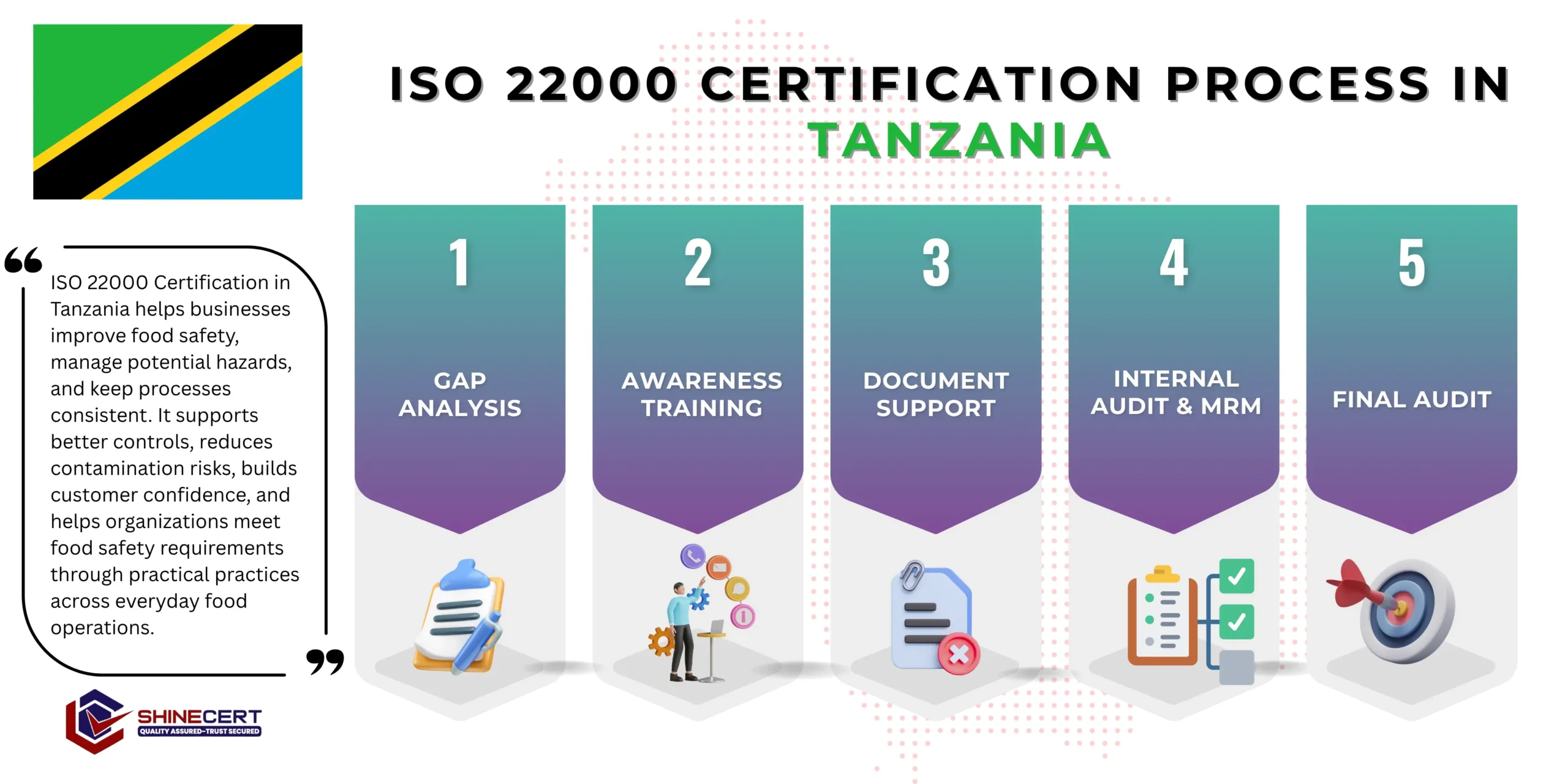
ISO 22000 Certification Process in Tanzania
The ISO 22000 certification journey in Tanzania: a five-step process from gap assessment through certification audit, with typical durations for each stage
Gap Assessment
Before we write anything, we walk the actual production floor and pull your TBS registration history, so the gap analysis reflects what’s genuinely happening on site rather than what a policy document claims.
A gap report that lines your real practices up against ISO 22000, clause by clause, next to your current TBS standing.
Documentation
Every procedure we draft is built around your actual product line and processing steps — not a generic HACCP template with your company name inserted.
A full FSMS documentation set where every critical control point is tied to something that genuinely happens in your production process.
Implementation
This is the stage where hygiene practices, monitoring routines, and traceability actually start running day to day, rather than sitting in a binder.
A live food safety system generating real monitoring evidence week over week.
Internal Audit and Management Review
We run the internal audit hard, checking every clause the way an external auditor eventually will, so surprises surface now instead of during the real thing.
Corrective actions already closed before the certification body ever walks in.
Certification Audit
Stage 1 checks if your paperwork is genuinely ready; Stage 2 has the auditor physically on your production floor, checking your actual monitoring logs against what happened.
Your ISO 22000 certificate, good for three years, plus a clear surveillance schedule.
Staying Certified: Surveillance and Renewal
An ISO 22000 certificate runs for three years, with an annual surveillance audit in years one and two sampling your critical control point records to confirm the system is still genuinely operating, not just filed away. A full recertification audit at the three-year mark determines whether the certificate continues. Because TBS periodically revises its food standards, it’s worth revisiting your compliance documentation whenever new or updated TBS food standards are published.
ISO 22000 Certification Cost in Tanzania
There’s no flat price for ISO 22000 certification in Tanzania, cost genuinely comes down to six factors worth understanding before you try to budget:
01
How wide your product portfolio actually is
A single, well-understood product line is a genuinely smaller hazard-analysis task than a business juggling several distinct product categories at once.
02
How many facilities are in scope
Every additional production site brings its own hazard profile and generally needs its own dedicated assessment work.
03
How mature your TBS compliance already is
Businesses that already run solid Good Hygiene and Good Manufacturing Practice aren’t starting the documentation exercise from a blank page.
04
Whether export markets are driving the project
Export-focused certification sometimes needs extra documentation tailored to specific destination-market expectations.
05
Certification body fees, which sit apart from our consulting fees entirely
Whichever accredited body actually audits you invoices that fee directly, separate from anything we charge for the consulting work.
06
Whether you’re building more than one standard at once
Pairing ISO 22000 with ISO 9001 shares real implementation groundwork, which brings the combined cost down versus running them as two separate projects.
Why It’s Becoming Essential for Tanzanian Businesses Right Now?
- TBS’s Codex-aligned, risk-based standards framework makes ISO 22000 a genuinely efficient way to demonstrate compliance depth : Because TBS already builds its food standards on the same international frameworks ISO 22000 draws from, businesses that build a certified food safety management system find it considerably reinforces, rather than duplicates, their existing TBS compliance work.
- The 2019 regulatory restructuring means food safety oversight is now concentrated under a single standards body, giving businesses a clearer regulatory relationship to build systematic practice around : With TBS now handling both general standards and food-specific safety requirements, businesses have a genuinely more coherent regulatory relationship than under the previous split structure, making it easier to build an ISO 22000 system that speaks directly to what TBS itself expects.
- Tanzania’s district-based industrial development strategy is pushing real growth in agro-processing, and export buyers in this space expect more than domestic registration : As government strategy channels investment into value-added food processing tied to specific district agricultural resources, businesses further up these value chains face genuine international buyer scrutiny that TBS registration alone doesn’t fully satisfy.
- Tanzania’s record foreign direct investment inflow is bringing new international food and beverage partnerships that expect certified food safety management as standard practice : As FDI continues flowing into joint ventures, particularly in agro-processing and food manufacturing, certified food safety management increasingly functions as a baseline expectation for partnership, not a differentiator.
Benefits of ISO 22000 Certification for Tanzanian Organizations
Certified Tanzanian organizations describe gains that go well beyond baseline TBS food registration. Here’s what they actually report:
Because TBS’s own standards draw on Codex Alimentarius, a certified food safety management system directly strengthens, rather than duplicates, your existing regulatory compliance work.
Where a TBS registration certificate is understood domestically, ISO 22000 is a credential international retailers and distributors already recognize without needing it explained to them.
A working hazard analysis plan, paired with genuinely monitored control points, catches problems at the production stage rather than after a batch has already shipped.
Retail chains and food service buyers abroad routinely treat ISO 22000 as table stakes for a supply conversation, not a nice-to-have add-on.
Should a recall question ever arise, a documented, actively used food safety system is genuine proof you were managing the risk proactively, not reacting after the fact.
Larger buyers, hospitality groups, large retailers, government catering contracts, increasingly write certified food safety management into their supplier requirements.
Because ISO 22000 shares real structural DNA with ISO 9001, a business already holding one finds the other considerably quicker and cheaper to add.
The Real Challenges Organizations Face While Implementing ISO 22000
- Treating TBS registration as the finish line : Holding valid TBS registration feels like enough until an international buyer asks a very different, much more specific question about your food safety system.
- Hazard analysis that only catches the obvious : It’s easy to document the contamination risks everyone already talks about and quietly miss subtler ones, like allergen carryover between production runs.
- Monitoring paperwork that doesn’t match reality : Auditors will cross-reference your monitoring logs against your actual production schedule, and gaps between the two are one of the most common findings.
- Discipline that fades once the certificate is issued : The hardest part isn’t building the system, it’s keeping the same rigor going through shift changes and staff turnover months after the audit is done.
Where Certification Matters Most Across Tanzania’s Economy?
Agro-processing and packaged foods
ISO 22000 is close to essential given the district-based value chain government strategy is actively prioritizing; pair with ISO 9001 for overall quality management.
Read moreDairy and beverage processing
ISO 22000 addresses genuine microbiological and contamination risk specific to perishable products.
Read moreCoffee and cashew processing for export
ISO 22000 supports the quality and safety consistency international buyers expect for Tanzania’s key agricultural export commodities.
Read moreFisheries and aquaculture processing
ISO 22000 addresses genuine food safety hazards specific to perishable, export-oriented seafood products.
Read moreHospitality and large-scale catering
ISO 22000 addresses food safety risk in food preparation and service.
Read moreA Tanzanian Business We’ve Worked With
- A cashew processing operation based near Mtwara, selling into both domestic markets and a growing export line, came to us after a prospective international buyer asked, quite directly, whether the company held a certified food safety management system before they’d finalize a supply deal.
- Walking the site, we found genuinely careful day-to-day practice, but nothing written down as a formal hazard analysis specific to their actual processing steps, and traceability that depended on staff memory rather than a real system connecting a finished bag of cashews back to its source batch.
- We built the HACCP plan and traceability procedure around what the team was already doing right, just formalizing habits that existed informally. Certification landed in just under four months, and the paperwork itself is what closed the export deal.
- We see this pattern often enough that it’s worth naming: solid, careful operators who’ve simply never had reason to write any of it down, this describes a recurring situation, not one specific client.
The Documentation TBS and Auditors Expect, Clause by Clause
- Clause 4 — Context of the Organization : Document: Scope of the FSMS Statement. Spell out in writing exactly which products, processing steps, and physical sites your food safety system covers, keeping it aligned with what’s already on your TBS registration.
- Clause 5 — Leadership : Document: Food Safety Policy. Top management puts its name to a written commitment that food safety and TBS’s Codex-aligned requirements are genuinely non-negotiable, not just words on a wall.
- Clause 6 — Planning : Document: Hazard Analysis and Critical Control Point Plan. This is the living core of the system, a working document identifying every biological, chemical, and physical hazard your specific products and process steps could realistically introduce. Document: Food Safety Objectives. Concrete, measurable targets that trace directly back to your policy statement, not vague ambitions.
- Clause 7 — Support : Document: Prerequisite Program Documentation. Your Good Hygiene Practice and Good Manufacturing Practice procedures, the operational foundation everything else in the HACCP plan is built on top of. Document: Competence and Training Records. Proof that the people actually handling food have been trained for the specific tasks they perform, not a generic induction session.
- Clause 8 — Operation : Document: Operational Control Procedures. Step-by-step instructions for controlling each hazard identified in your HACCP plan during real production runs. Document: Traceability Procedure. A working system that can trace any finished product batch back through processing to its raw material source, genuinely tested, not theoretical. Document: Supplier Evaluation Records. Evidence that the businesses supplying your raw materials and packaging are actually vetted for food safety risk before you rely on them.
- Clause 9 — Performance Evaluation : Document: Monitoring and Verification Records. The paper trail proving critical control points are checked during actual production, on the actual schedule, not filled in retroactively. Document: Internal Audit Records. Evidence your internal audit schedule was genuinely followed, clause by clause, rather than existing only as an aspiration in the quality manual. Document: Management Review Minutes. A record that leadership actually sat down, looked at food safety performance, and made real decisions off the back of it.
- Clause 10 — Improvement : Document: Corrective Action Records. A functioning log tracking every food safety nonconformity from discovery through to a genuinely closed-out fix.
Realistic Timelines for Tanzanian Businesses
| Business Profile | Typical Total Timeline | What Drives This |
|---|---|---|
| Small, single-product operation | 2.5–3.5 months | Narrower hazard profile and simpler HACCP plan |
| Medium, multiple-product operation | 3.5–5.5 months | Broader hazard analysis across a wider product range |
| Larger, multi-site or export-focused operation | 5.5–8 months | Extensive hazard analysis, traceability complexity, export documentation |
Company size matters, but the single biggest swing factor is genuinely how mature your existing TBS-aligned hygiene practices already are before we start.
ISO 22000 Certification Across Tanzania’s Business Hubs
Dar es Salaam
As the commercial and port hub, food safety certification here is often driven by export logistics and international buyer requirements.
Arusha
Given its agricultural export base, particularly coffee and horticultural products, food safety certification here directly supports export market access.
Mwanza
With strong fisheries activity tied to Lake Victoria, food safety certification here frequently centers on seafood processing hazards.
Dodoma
As a growing agricultural processing center, food safety certification here increasingly supports domestic and regional distribution requirements.
Why Businesses Choose ShineCert in Tanzania?
ShineCert brings 10 years of ISO consulting and certification experience to Tanzania’s market, coordinated through our Riyadh and India offices with services delivered remotely or on-site depending on what your engagement genuinely needs. We’ve guided more than 10,000 organizations through ISO certification worldwide, and we build every Tanzania food safety engagement around your actual products and facilities, this is why Tanzanian food exporters increasingly choose ShineCert as the best ISO 22000 consultant in Tanzania.
Choosing a Certification Body in Tanzania?
What to Check | Why It Matters |
Accreditation under a recognized international framework | Confirms the certificate carries genuine international standing |
Genuine familiarity with TBS’s food safety framework | Means your FSMS connects sensibly to obligations you already have |
Experience with your specific product category | Dairy, fisheries, and agro-processing each carry meaningfully different food safety realities |
Recognition by your target export markets, if relevant | Some destination markets have their own certification body preferences worth checking early |
Ready to Get Started?
Whether you’re reinforcing existing TBS compliance or chasing a new international retail relationship, we’ll walk through your specific products and cost factors before proposing a fixed-scope plan, delivered remotely, on-site, or however genuinely fits your project. Book a free consultation or contact us directly to get started.
Frequently Asked Questions
Someone genuinely familiar with TBS’s food safety framework, with real sector-specific hazard experience and transparent scoping upfront. ShineCert scopes every Tanzania engagement individually.
No. TBS registration stays a separate, mandatory obligation, a certified FSMS simply gives you the systematic documentation that makes both ongoing compliance and export buyer conversations considerably easier.
It comes down to your product range, how many facilities you’re running, and how mature your existing hygiene practices already are. We scope every project individually rather than quoting blind.
Usually two and a half to eight months, depending on your organization’s size and how complex your product line is, the detailed breakdown is above.
Not universally by law, but it’s frequently a genuine practical requirement once you’re talking to international retail chains and export-focused buyers.
Documentation work runs fine over remote sessions, but the hazard analysis and facility verification genuinely need someone physically on site.
Not a standalone one, we coordinate Tanzania work from our Riyadh and India offices, with delivery remote, on-site, or a mix, depending on what the project actually needs.