
ISO 22301 Certification in Tanzania
Quick Answer
ISO 22301 is the international standard for business continuity management, and in Tanzania it addresses a very specific structural reality: a national grid, operated by TANESCO, that still depends heavily on hydropower generated from dams along the Rufiji river system, including the long-established Mtera and Kidatu stations and the newer Julius Nyerere Hydropower Project. When rainfall in the catchment areas feeding those reservoirs runs below normal, generation capacity tightens and load shedding becomes a real operational risk for businesses across the country, not a distant possibility. For businesses running cold chains, continuous production, or IT infrastructure, ISO 22301 turns that exposure into a structured, tested response plan rather than a repeated scramble. Certification typically takes three to five months, with cost shaped by real operational factors.
Understanding ISO 22301: What It Actually Is, and Why It Matters in Tanzania
ISO 22301 is published by the International Organization for Standardization and lays out what a business needs to have in place to keep operating, or bounce back quickly, when something disrupts it. The standard’s requirements walk through figuring out what could go wrong, ranking which functions genuinely can’t afford downtime, and turning that into strategies and plans your team has actually rehearsed. Certification means an accredited, independent auditor has confirmed all of that is real and working, not simply written down somewhere and forgotten.
In Tanzania, that distinction carries real weight because of how the national grid is structured. Hydropower remains a substantial part of the generation mix, and hydropower output is directly tied to rainfall feeding the Rufiji and other river basins. Years with below-average rainfall have historically forced TANESCO into managed load shedding to protect the grid overall, even as gas-fired generation and newer hydropower capacity work to diversify that exposure over time. A business that treats power reliability as background noise, rather than a planned-for risk, is building its operations on an assumption that doesn’t hold up during a dry season.
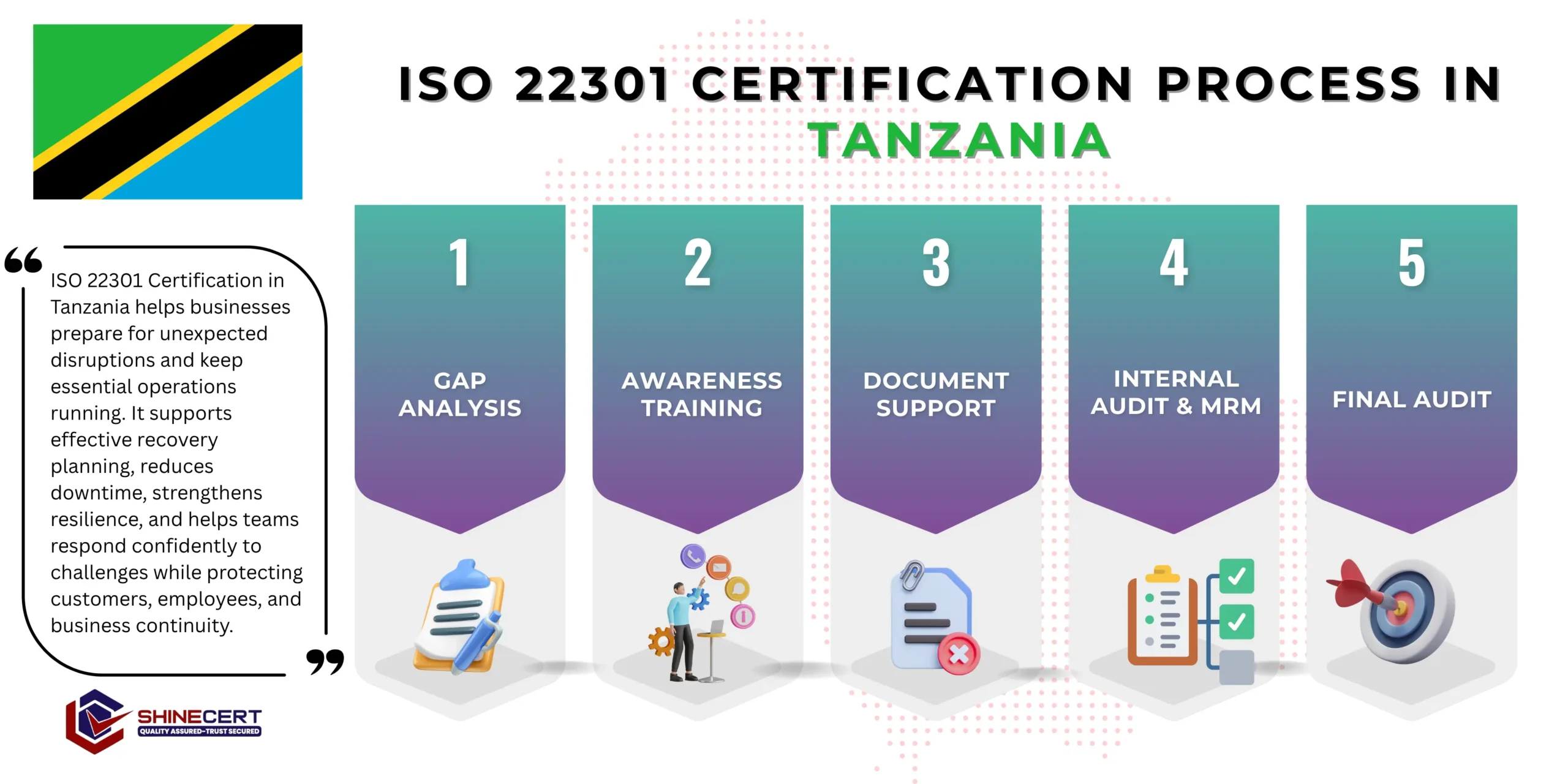
What are the steps to get ISO 22301 Certification in Tanzania?
our services
- ISO Certification Tanzania
- ISO 9001 Certification Tanzania
- ISO 14001 Certification Tanzania
- ISO 27001 Certification Tanzania
- ISO 22000 Certification Tanzania
- ISO 27701 Certification Tanzania
- ISO 45001 Certification Tanzania
- ISO 20000-1 Certification Tanzania
- ISO 13485 Certification Tanzania
- ISO 17025 Certification Tanzania
- ISO 31000 Certification Tanzania
- ISO 42001 Certification Tanzania
- ISO 37001 Certification Tanzania
- ISO 22301 Certification Tanzania
- ISO 50001 Certification Tanzania
- CE Mark Certification Tanzania
- GDPR Certification Tanzania
- GMP Certification Tanzania
- Halal Certification Tanzania
ISO 22301 Certification Process in Tanzania
The ISO 22301 certification journey in Tanzania: a five-step process from gap assessment through certification audit, with typical durations for each stage
Gap Assessment
We review your current continuity arrangements against your actual exposure to grid disruption, transport interruption, and any other risks specific to your location and sector.
A gap report tying your existing practices to your real disruption profile, not a generic industry checklist.
Business Impact Analysis
We work with your team to determine which functions are genuinely time-critical, how long each can tolerate disruption, and what each one depends on, grid power, backup generation, connectivity, suppliers.
A business impact analysis that ranks your functions by real recovery priority.
Plan Development
We build continuity strategies specific to your critical functions, including grid-disruption measures like generator failover triggers and cold chain protection protocols where relevant.
A complete set of continuity plans tied directly to your actual operations.
Testing and Internal Audit
We run genuine exercises, tabletop scenarios or live failover tests, to confirm your plans hold up, then audit against every clause of the standard.
Documented exercise results and an internal audit report with any gaps already closed.
Certification Audit
Stage 1 confirms your documentation is ready; Stage 2 has the auditor review your actual testing records and speak directly with your team.
Your ISO 22301 certificate, valid for three years, plus a surveillance audit schedule.
Staying Certified: Surveillance and Renewal
An ISO 22301 certificate runs for three years, with annual surveillance audits in years one and two checking whether your plans have genuinely been kept current and tested. A full recertification audit at the three-year mark confirms the system held up throughout the cycle, including through any real disruptions your business actually experienced, which, given Tanzania’s grid profile, is a meaningful test most certified organizations end up facing at least once before renewal.
ISO 22301 Certification Cost in Tanzania
There’s no flat price for ISO 22301 certification in Tanzania, cost genuinely comes down to six factors:
01
Number of critical functions your business impact analysis identifies
A business with several genuinely time-sensitive functions, such as cold storage and production-line systems, requires broader analysis than one with fewer critical dependencies.
02
Number of sites
Each additional location typically carries its own disruption profile, requiring its own business impact analysis and recovery planning.
03
Existing continuity practice maturity
Businesses that already run generator backup or informal fallback procedures aren’t starting the documentation process from nothing.
04
Depth of testing required
Live failover exercises take considerably more time and coordination to plan and run than tabletop exercises.
05
Certification body fees, invoiced entirely separately from our consulting work
Whichever accredited body conducts your certification audit bills that fee directly.
06
Whether you’re bundling with ISO 27001
Combining ISO 22301 with ISO 27001 shares meaningful risk assessment and incident response groundwork, which brings the combined cost down.
Why It’s Becoming Essential for Tanzanian Businesses Right Now?
- Hydropower’s continued weight in the generation mix ties grid stability directly to rainfall patterns businesses cannot control : Even as gas-fired plants and newer hydropower capacity add diversification, a below-average rainy season feeding the Rufiji basin’s reservoirs can still tighten available generation, and businesses without a tested response plan absorb that risk directly through lost production time.
- Growing industrial and commercial demand is placing more pressure on a grid that wasn’t built for today’s load : As manufacturing, processing, and commercial activity expand across Dar es Salaam and other hubs, the margin between available generation and actual demand narrows, making disruption a more frequent operational consideration than it once was.
- Cold chain-dependent export sectors face a genuinely acute version of this risk : Fishing, horticulture, and agro-processing businesses supplying international buyers depend on continuous refrigeration; an extended outage doesn’t just pause production, it can destroy inventory outright, exactly the kind of process-specific exposure a formal business impact analysis is designed to catch.
- International buyers and investors increasingly expect documented continuity planning as a condition of doing business : As Tanzanian exporters and manufacturers deepen ties with international supply chains, buyers conducting supplier audits look for evidence of tested continuity arrangements, not just backup generators sitting in a corner.
Benefits of ISO 22301 Certification for Tanzanian Organizations
Certified Tanzanian organizations gain considerably more than a document confirming continuity planning exists. Here is what certification actually delivers:
Instead of improvising each time load shedding hits, a certified business continuity management system gives your team a structured, already-tested plan to follow.
Business impact analysis identifies exactly which processes, cold storage, production lines, IT systems, need the fastest recovery, so protective measures go where they matter most.
Organizations with tested plans consistently restore critical operations faster than those working out a response mid-crisis.
Certification is a real differentiator when international buyers or larger domestic institutions are evaluating supplier reliability.
Documented, tested continuity practice tends to be viewed favorably when insurers and financial institutions assess risk exposure.
Businesses operating in more than one location gain a shared continuity framework instead of each site improvising its own response independently.
Institutional buyers and international supply chains increasingly list continuity certification as a genuine prerequisite for larger contracts.
ISO 22301’s risk assessment overlaps meaningfully with ISO 31000’s risk framework and ISO 27001’s incident response planning, useful for organizations building resilience across multiple fronts.
The Real Challenges Organizations Face While Implementing ISO 22301
- Treating backup generation as a complete answer on its own : Businesses with generator capacity sometimes stop there, without formally working out how long that capacity actually lasts under real load or what happens if fuel runs low mid-outage.
- Missing supporting dependencies in the business impact analysis : It’s common to identify the obviously critical function, like production, while overlooking supporting systems, inventory tracking software, communication tools, that production quietly depends on.
- Plans that exist on paper but have never actually been rehearsed : Auditors specifically look for exercise records, and a well-written plan that’s never been tested is one of the most common findings during certification audits.
- Lessons from real incidents not making it back into the plan : A frequent gap is a genuine disruption occurring, being handled reasonably well in the moment, but the specific lessons never getting folded back into an updated continuity plan.
Where Certification Matters Most Across Tanzania’s Economy?
Fishing, horticulture, and agro-processing exporters
ISO 22301 is close to essential given direct cold-chain spoilage risk during extended outages; pair with ISO 22000 for combined food safety and continuity coverage.
Read moreManufacturing with continuous production lines
ISO 22301 addresses real production-halt risk from extended grid disruption; pair with ISO 45001 given safety considerations during disrupted operations.
Read moreData centers and technology businesses
ISO 22301 addresses uptime and service continuity expectations that are core to the business model; pair with ISO 27001 for combined security and continuity coverage.
Read moreFinancial services and banking
ISO 22301 supports regulatory and customer trust expectations around uninterrupted service.
Read moreHospitality and healthcare facilities
ISO 22301 addresses genuine patient and guest safety considerations tied to power and systems continuity.
Read moreA Tanzanian Business We’ve Worked With
- A Mwanza-based fish processing business supplying export markets around Lake Victoria approached us following an extended grid outage that forced a shutdown of refrigerated storage long enough to compromise a full day’s catch before backup generation could be brought fully online.
- When we sat down with their operations team, the picture that emerged was a business with a generator already installed, yet with nothing written down about activation speed, fuel reserves for a multi-day event, or which cold rooms took priority if the generator couldn’t cover the full site.
- We built a continuity plan addressing generator activation timing, fuel logistics for multi-day outages, and a documented priority order for cold storage during partial-capacity scenarios. Certification took just under four months, and the company weathered a subsequent extended outage with no reported product loss.
- This reflects a pattern we see repeatedly among Tanzanian processors, real backup infrastructure that had simply never been stress-tested against a realistic worst-case duration, rather than one specific client account.
The Documentation Auditors Expect
- Business Continuity Policy : A statement, signed off by top management, of genuine commitment to continuity planning and its place in how the organization operates.
- Business Impact Analysis : A documented assessment identifying critical functions, their maximum tolerable disruption period, and dependencies, grid power, backup generation, IT, and supply chain among them.
- Risk Assessment : A documented analysis of the specific threats your operations face, reflecting Tanzania’s grid reliability profile alongside other relevant risks like flooding or transport disruption.
- Business Continuity Strategy and Plans : Concrete, actionable plans for maintaining or recovering each critical function your business impact analysis identified.
- Incident Response and Communication Procedures : A documented process for how your organization detects a disruptive event, responds to it, and communicates internally and with clients throughout.
- Exercise and Testing Records : Evidence that continuity plans have been rehearsed through actual exercises, not simply drafted and filed away untested.
- Recovery and Resumption Records : A record of how normal operations were genuinely restored after a real disruption, including what was learned from the experience.
- Internal Audit and Management Review Records : A documented internal audit schedule and management review decisions on where continuity priorities stand.
Realistic Timelines for Tanzanian Businesses
| Business Profile | Typical Total Timeline | What Drives This |
|---|---|---|
| Small business, single location | 2.5–3.5 months | Narrower scope of critical functions to analyze |
| Medium business, moderate complexity | 3.5–5.5 months | Broader business impact analysis across more functions |
| Larger or multi-site business | 5.5–8 months | Extensive analysis across sites plus coordinated planning |
Beyond company size, the single biggest timeline driver is how many genuinely time-sensitive functions your business impact analysis turns up, cold chain and IT-dependent operations extend the process compared to simpler continuity needs.
ISO 22301 Certification Across Tanzania’s Business Hubs
Dar es Salaam
As the country’s commercial and industrial center, businesses here carry the widest concentration of grid-dependent production and cold chain export activity.
Arusha
With tourism, horticulture export, and agro-processing all active locally, continuity planning here needs to account for both grid reliability and seasonal transport considerations.
Mwanza
Serving the Lake Zone’s fishing and processing industry, cold chain continuity is a particularly direct concern for businesses exporting from this region.
Dodoma
As the seat of government with growing public-sector-linked commercial activity, continuity planning here increasingly intersects with service-delivery expectations for institutional clients.
Why Businesses Choose ShineCert in Tanzania?
ShineCert brings 10 years of ISO consulting and certification experience to Tanzania’s market, coordinated through our Riyadh and India offices with services delivered remotely or on-site depending on what your engagement genuinely needs. We’ve guided more than 10,000 organizations through ISO certification worldwide, and we build every Tanzania continuity engagement around your real disruption exposure, this is why Tanzanian businesses increasingly choose ShineCert as the best ISO 22301 consultant in Tanzania.
Choosing a Certification Body in Tanzania?
What to Check | Why It Matters |
Accreditation under a recognized international accreditation framework | Confirms your certificate carries genuine international recognition |
Real understanding of Tanzania’s grid reliability profile | Ensures your business impact analysis reflects actual, not generic, disruption scenarios |
Experience with your specific sector’s continuity risks | Cold chain, manufacturing, and technology carry meaningfully different continuity considerations |
Willingness to run genuine testing exercises, not just review documents | The real value of certification lies in tested plans, not paperwork alone |
Ready to Get Started?
Whether you’re protecting a cold chain, a production line, or critical IT infrastructure from Tanzania’s grid reliability challenges, we’ll walk through your specific operations and cost factors before proposing a fixed-scope plan, delivered remotely, on-site, or however genuinely fits your project. Book a free consultation or contact us directly to get started.
Frequently Asked Questions
Look for real understanding of Tanzania’s grid reliability profile, sector-specific continuity experience, and willingness to run actual testing exercises. ShineCert scopes every Tanzania engagement individually.
No, it guarantees a tested, structured plan for responding to and recovering from disruption, which meaningfully reduces impact even though it cannot prevent the outage itself.
It depends on how many critical functions your business impact analysis identifies, your number of sites, and existing continuity maturity, we scope every project individually.
Typically two and a half to eight months depending on organization size and operational complexity, see the timeline breakdown above.
No, smaller businesses with genuine time-sensitive dependencies, like cold storage, benefit just as much, with the certification scope scaling down to match.
It covers business continuity broadly, including cyber-related disruption, though ISO 27001 addresses information security specifically in more depth, many businesses pursue both together.
Documentation and planning work runs effectively over remote sessions, but genuine testing exercises and site-specific business impact analysis benefit from in-person engagement.
Not a standalone one, we coordinate Tanzania engagements from our Riyadh and India offices, with services delivered remotely or on-site as your project requires.