
ISO 20000-1 Certification in Tanzania
Quick Answer
Tanzania’s economy runs increasingly on mobile infrastructure, mobile money platforms processing millions of daily transactions, telecom operators regulated by the Tanzania Communications Regulatory Authority (TCRA), and a growing base of BPO and software companies serving both domestic and international clients out of Dar es Salaam. All of it depends on IT services actually working, consistently, at scale. ISO 20000-1 is the international standard that certifies a provider has a genuinely structured way of planning, delivering, and improving IT services, rather than keeping the operation running on institutional memory and good luck. For Tanzanian tech, BPO, and infrastructure providers competing for larger or international contracts, that certification answers a question procurement teams ask before they’ll even take a call. Certification typically takes three to five months.
Understanding ISO 20000-1: What It Actually Is, and Why It Matters in Tanzania
Ask a growing Tanzanian IT provider how they track incidents, and the honest answer is often “WhatsApp and a spreadsheet.” ISO 20000-1, published by the International Organization for Standardization, exists to replace that answer with something an outside client can actually verify. The standard sets requirements for an IT service management system spanning service level management, incident and problem handling, change control, and capacity planning, the operational backbone behind delivering a service that does what it says it will, consistently. Certification means an accredited auditor has confirmed this backbone is genuinely in place and working, not simply that a well-meaning team is doing its best informally.
Why this carries real weight in Tanzania specifically comes down to where the digital economy is heading. Mobile money and fintech platforms need service continuity that a bank or telecom regulator would recognize as mature. International clients outsourcing software development or back-office work to Dar es Salaam-based providers increasingly run vendor due diligence that specifically probes for structured service management, not just technical skill. A provider with strong engineers but no documented incident process looks, on paper, indistinguishable from one with neither, and that gap is exactly what ISO 20000-1 closes.
What are the steps to get ISO 20000-1 Certification in Tanzania?
our services
- ISO Certification Tanzania
- ISO 9001 Certification Tanzania
- ISO 14001 Certification Tanzania
- ISO 27001 Certification Tanzania
- ISO 22000 Certification Tanzania
- ISO 27701 Certification Tanzania
- ISO 45001 Certification Tanzania
- ISO 20000-1 Certification Tanzania
- ISO 13485 Certification Tanzania
- ISO 17025 Certification Tanzania
- ISO 31000 Certification Tanzania
- ISO 42001 Certification Tanzania
- ISO 37001 Certification Tanzania
- ISO 22301 Certification Tanzania
- ISO 50001 Certification Tanzania
- CE Mark Certification Tanzania
- GDPR Certification Tanzania
- GMP Certification Tanzania
- Halal Certification Tanzania
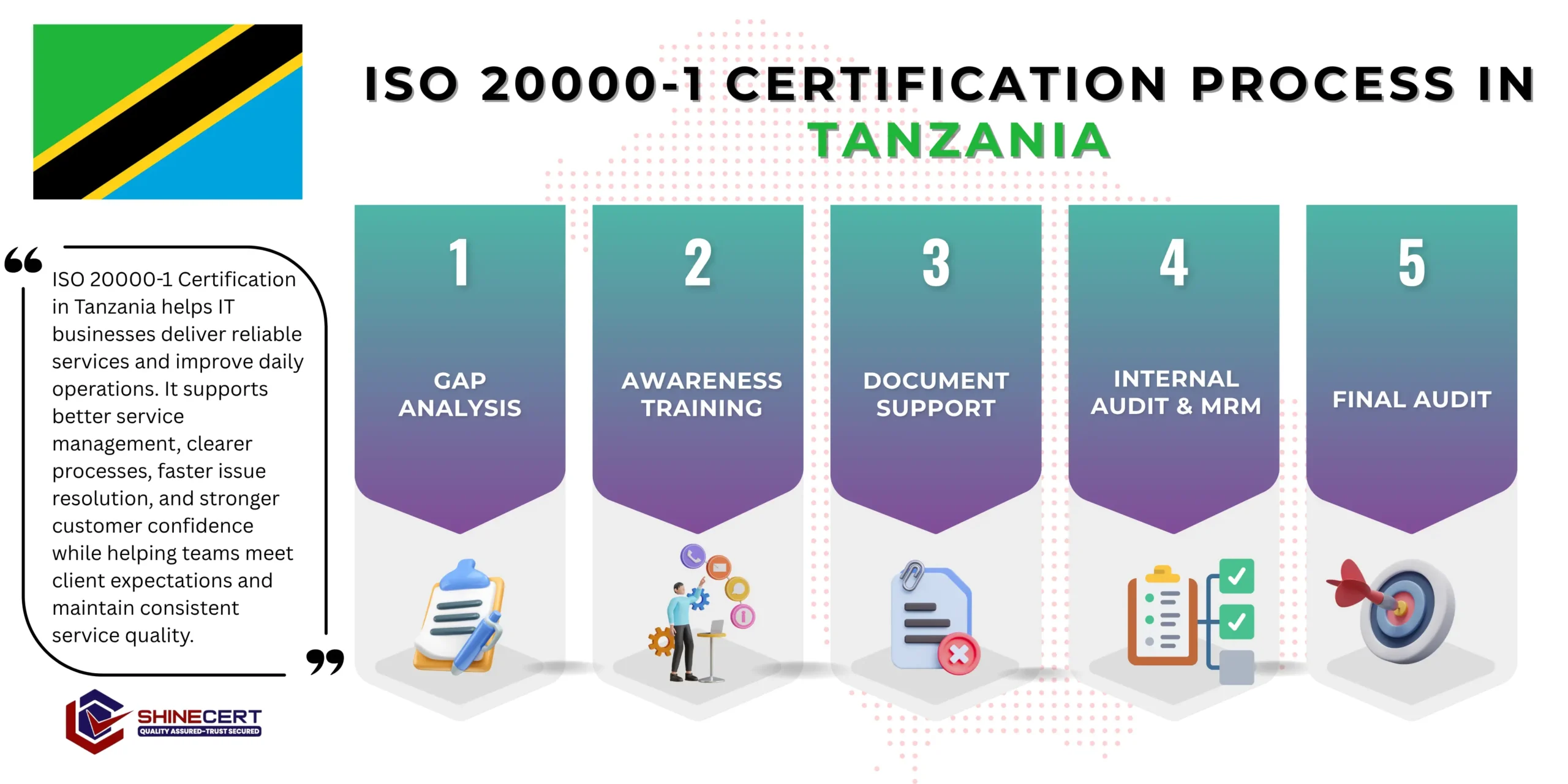
ISO 20000-1 Certification Process in Tanzania
The ISO 20000-1 certification journey in Tanzania: a five-step process from gap assessment through certification audit, with typical durations for each stage
Gap Assessment
We look at how your team actually handles incidents, changes, and client agreements today, not how a process diagram says it should work.
A gap report tying your real service delivery practices to what ISO 20000-1 actually requires.
Documentation
We build your service catalogue, SLAs, and management procedures around the services you genuinely deliver and the clients you actually serve.
A complete IT service management documentation set matched to your real operations.
Implementation
Incident handling, change control, and capacity planning move out of chat threads and spreadsheets into a system your team actually uses daily.
A working service management system generating real operational records.
Internal Audit and Management Review
We test the system against every clause, catching gaps before an external auditor does.
An internal audit report with corrective actions already closed before certification.
Certification Audit
Stage 1 confirms your documentation is ready; Stage 2 has the auditor review real service records and speak with your team directly.
Your ISO 20000-1 certificate, valid for three years, plus a surveillance schedule.
Staying Certified: Surveillance and Renewal
An ISO 20000-1 certificate runs for three years, with annual surveillance audits in years one and two reviewing incident logs, change records, and service level performance. A full recertification audit at the three-year mark confirms the system genuinely held up. Given how quickly Tanzania’s tech and mobile money sectors are evolving, we recommend revisiting your service catalogue and SLAs whenever you take on a significant new client or launch a new service line.
ISO 20000-1 Certification Cost in Tanzania
There’s no standard price tag for this certification, and six specific things determine where a Tanzania quote actually lands:
01
How many distinct services you’re certifying
A provider running several service lines needs broader documentation than one delivering a single, tightly defined service.
02
How many client SLAs you’re juggling, and how different they are from each other
Managing five clients with five different performance terms takes more coordination to document than five clients on one standard agreement.
03
Whatever’s already working informally
A team with a genuinely solid, if undocumented, incident process isn’t starting from zero the way a team with no consistent process at all would be.
04
How large and how structured your technical team is
Bigger teams generally mean broader process rollout and more training to get everyone working the same way.
05
The certification body’s audit fee, which we don’t touch
That’s billed directly by whichever accredited body performs your audit, separate from our consulting fee.
06
Whether you’re pairing this with ISO 27001
The two standards share real process ground, which brings the combined cost below what two separate projects would run.
Why It’s Becoming Essential for Tanzanian Businesses Right Now?
- Mobile money’s central role in daily commerce means the IT services underneath it can’t afford to be run informally : As more of the population and more merchants transact through mobile platforms, the providers building and maintaining that infrastructure face rising expectations for service reliability that match the platforms’ actual economic importance.
- Dar es Salaam’s growing pool of software and BPO companies means genuine differentiation increasingly comes from process maturity, not just talent : As more providers enter the market chasing the same pool of international outsourcing contracts, a certified service management system gives a specific, verifiable reason for a client to choose one provider over an equally skilled competitor.
- International outsourcing clients run vendor due diligence that specifically checks for structured service delivery, not just a portfolio of past work : Enterprise procurement processes increasingly ask pointed questions about incident response times and change management discipline before a contract is even discussed, and providers without documented answers lose ground before technical evaluation even starts.
- TCRA-regulated telecom and connectivity providers operate under service quality expectations that a certified management system directly supports : As Tanzania’s regulator continues focusing on service quality standards across the telecom sector, providers with a genuinely mature IT service management system are better positioned to meet those expectations consistently.
Benefits of ISO 20000-1 Certification for Tanzanian Organizations
Certified Tanzanian organizations gain considerably more than paperwork proving processes exist on paper. Here is what actually changes:
A certified system gives prospective clients documented, independently verified proof of service maturity, exactly the evidence enterprise procurement teams look for.
Structured incident and problem management catches recurring issues and addresses root causes instead of firefighting the same problem repeatedly.
Formal service level agreements give both your team and your clients the same yardstick for measuring performance, removing ambiguity from difficult conversations.
As Dar es Salaam’s tech and BPO sector grows more competitive, certification is a concrete way to stand apart from providers competing purely on price.
Disciplined change management materially reduces the number of incidents caused by deployments and updates gone wrong.
A growing number of larger institutional and international clients list ISO 20000-1 as a non-negotiable line item in their vendor requirements.
Structured processes give engineering and support teams defined workflows, which genuinely helps retention in a competitive local tech talent market.
ISO 20000-1’s operational structure overlaps meaningfully with ISO 27001’s security controls, useful for providers building a broader credibility story.
The Real Challenges Organizations Face While Implementing ISO 20000-1
- Believing strong engineering speaks for itself : Technically excellent teams sometimes assume good delivery is self-evident, without realizing how much formal documentation ISO 20000-1 actually expects on top of that.
- Incident tracking that lives in a chat app : It’s extremely common for incident and problem tracking to run through WhatsApp groups or informal messaging rather than a structured, auditable system an auditor can actually review.
- Change discipline that’s real but invisible : Teams often genuinely review changes carefully before deploying them, but without written approval records, there’s nothing an auditor can verify actually happened.
- A service catalogue that’s stopped matching reality : A frequent finding is a service description written months or years ago that no longer reflects what the business actually delivers today.
Where Certification Matters Most Across Tanzania’s Economy?
IT service providers and managed service companies
ISO 20000-1 is close to essential given direct service delivery obligations; pair with ISO 27001 for combined service and security credentials.
Read moreBusiness process outsourcing
ISO 20000-1 addresses the service quality assurances international clients increasingly demand as a contractual condition.
Read moreSoftware development and SaaS companies
ISO 20000-1 supports the service reliability expectations enterprise clients apply when evaluating vendor maturity.
Read moreMobile money and fintech infrastructure providers
ISO 20000-1 addresses the uptime and incident-response expectations tied to platforms handling daily consumer transactions.
Read moreTelecom and connectivity providers
ISO 20000-1 supports the service quality standards TCRA continues to emphasize across the sector.
Read moreA Tanzanian Business We’ve Worked With
- A Dar es Salaam-based software development company building custom applications for international clients came to us after losing out on a promising contract when the client’s procurement process specifically asked for evidence of formal incident and change management practice that the company simply didn’t have documented.
- Our gap assessment found the development team’s actual technical work was strong and client relationships were genuinely good, but incidents were tracked through a shared messaging group, and there was no formal process for reviewing or approving changes before they went live.
- We built a proper incident and change management procedure around the team’s existing workflow, formalized a service catalogue defining what each engagement actually included, and set up service level reporting giving clients real visibility into delivery performance. Certification took just under four months, and the company used the resulting certificate to directly address the exact gap that had cost them the earlier contract.
- This reflects a pattern we see often among Tanzanian tech companies, genuinely strong technical delivery that had simply never been documented in a way an outside client could verify.
The Documentation Auditors Expect
- Service Management Policy : A policy, approved by top management, expressing genuine commitment to structured service delivery and continual improvement.
- Service Catalogue : A documented list of the services actually delivered, with clear boundaries defining what each engagement includes and excludes.
- Service Level Agreements : Documented agreements with clients defining expected performance and exactly how that performance gets measured.
- Incident and Problem Management Procedures : A working, actually-used process for detecting, responding to, and resolving incidents, with genuine root cause analysis for anything recurring.
- Change Management Procedure : A documented process for assessing, approving, and rolling out changes without introducing avoidable disruption.
- Capacity and Availability Plans : Documentation showing real planning for service capacity against actual and projected demand, not guesswork.
- Continual Service Improvement Register : An actively maintained log of improvement opportunities identified and genuinely acted on.
- Internal Audit and Management Review Records : A working internal audit schedule and management review decisions showing service priorities are actually being tracked.
Realistic Timelines for Tanzanian Businesses
| Business Profile | Typical Total Timeline | What Drives This |
|---|---|---|
| Small IT provider, limited service scope | 2.5–3.5 months | Narrower service catalogue and simpler processes |
| Medium IT provider or BPO operation | 3.5–5.5 months | Broader service catalogue across multiple client relationships |
| Larger provider, multiple service lines | 5.5–8 months | Extensive service catalogue and complex client SLA management |
What actually sets the pace isn’t team size, it’s how many genuinely distinct services and client agreements need documenting. A provider running one well-defined service for a handful of clients moves faster than one juggling several service lines with different SLA terms for each.
ISO 20000-1 Certification Across Tanzania’s Business Hubs
Dar es Salaam
As the country’s technology and BPO center, businesses here concentrate the widest range of IT service delivery and client relationships.
Arusha
With a growing base of digital services supporting tourism and regional trade, IT service reliability here increasingly matters to cross-border business operations.
Mwanza
Serving the Lake Zone’s expanding digital and mobile money activity, service management maturity is becoming a genuine differentiator for local providers.
Dodoma
As the seat of government with expanding digital public services, IT service delivery here increasingly intersects with public-sector reliability expectations.
Why Businesses Choose ShineCert in Tanzania?
A decade of ISO consulting across more than 10,000 organizations backs every Tanzania engagement we run, coordinated from our Riyadh and India offices with people on the ground whenever the project genuinely needs it. Rather than a repackaged template, every service management engagement starts from your actual client relationships and how your team really works day to day, which is the reason Tanzanian tech and BPO providers keep bringing their certification work to ShineCert, the best ISO 20000-1 consultant in Tanzania.
Choosing a Certification Body in Tanzania?
What to Check | Why It Matters |
Accreditation under a recognized international accreditation framework | Confirms your certificate carries genuine weight with international clients |
Real familiarity with Tanzania’s IT, BPO, and fintech operating environment | Ensures the auditor understands service delivery realities specific to your sector |
Experience with your specific service type | Managed IT, BPO, and SaaS involve meaningfully different service management considerations |
Recognition by international clients, if relevant | Some international clients maintain specific certification body preferences worth confirming early |
Ready to Get Started?
Whether you’re chasing your first international contract or formalizing service management across a growing team, tell us about your services and clients and we’ll come back with a scoped, fixed-price plan, remote, on-site, or a mix of both. Book a free consultation or contact us directly to get started.
Frequently Asked Questions
Someone with genuine familiarity with the local tech and BPO sector, experience with your specific service type, and a track record that international clients recognize. ShineCert prices every Tanzania project after understanding your actual services and clients.
Increasingly it’s asked for directly, enterprise procurement processes for outsourced IT and BPO work frequently list it as a requirement before a contract even reaches the negotiating table.
It comes down to how many services you’re certifying, how complex your client SLAs are, and how mature your existing processes already are, we quote after that conversation, not before.
Most Tanzanian providers finish somewhere between two and a half and eight months, depending mainly on how many services and client agreements are in scope.
No, smaller providers competing for the same international contracts benefit just as much, with the certification scope sized to match a smaller service catalogue.
It depends on what your clients are actually asking for, though many Tanzanian providers end up pursuing both together given how much process overlap exists between them.
Documentation work runs well remotely, but verifying your actual processes and speaking with your team benefits from being there in person.
Not a standalone office, our Tanzania work is coordinated from Riyadh and India, with on-site visits arranged whenever the engagement calls for it.