
ISO 13485 Certification in Tanzania
Quick Answer
Getting a medical device onto the Tanzanian market runs through the Tanzania Medicines and Medical Devices Authority (TMDA), which classifies devices into four risk categories, A, B, C, and D, under its Control of Medical Devices Regulations, and issues market authorization valid for five years before renewal. ISO 13485 sits alongside that process rather than replacing it: TMDA approval confirms a specific device meets Tanzania’s safety and performance requirements, while ISO 13485 certifies the quality management system behind how your organization designs, manufactures, or distributes devices in the first place. Foreign manufacturers can’t register directly in Tanzania, they need a Local Technical Representative holding the marketing authorization on their behalf, which makes a certified quality system a genuinely practical asset for distributors playing that role. Certification typically takes three to six months, with cost shaped by real, specific factors rather than a flat number.
Understanding ISO 13485: What It Actually Is, and Why It Matters in Tanzania
ISO 13485 is published by the International Organization for Standardization specifically for organizations involved in designing, manufacturing, distributing, or servicing medical devices. It borrows its overall skeleton from ISO 9001 but layers on requirements unique to devices, risk management woven through the entire product lifecycle, design controls, sterile manufacturing environment considerations, and full traceability from raw material to end customer. A certificate means an accredited, independent auditor has confirmed your quality system genuinely satisfies those requirements, which is a different question entirely from whether a specific device has TMDA market authorization.
The distinction matters in Tanzania because TMDA’s regulatory model puts real weight on the entity holding the marketing authorization, often a Local Technical Representative rather than the original manufacturer. That LTR is effectively vouching for the device on TMDA’s registry, and a certified quality management system gives them (and the manufacturer relying on them) documented proof that the handling, storage, and distribution processes behind that vouching are genuinely sound, not just a registration filing.
What are the steps to get ISO 13485 Certification in Tanzania?
our services
- ISO Certification Tanzania
- ISO 9001 Certification Tanzania
- ISO 14001 Certification Tanzania
- ISO 27001 Certification Tanzania
- ISO 22000 Certification Tanzania
- ISO 27701 Certification Tanzania
- ISO 45001 Certification Tanzania
- ISO 20000-1 Certification Tanzania
- ISO 13485 Certification Tanzania
- ISO 17025 Certification Tanzania
- ISO 31000 Certification Tanzania
- ISO 42001 Certification Tanzania
- ISO 37001 Certification Tanzania
- ISO 22301 Certification Tanzania
- ISO 50001 Certification Tanzania
- CE Mark Certification Tanzania
- GDPR Certification Tanzania
- GMP Certification Tanzania
- Halal Certification Tanzania
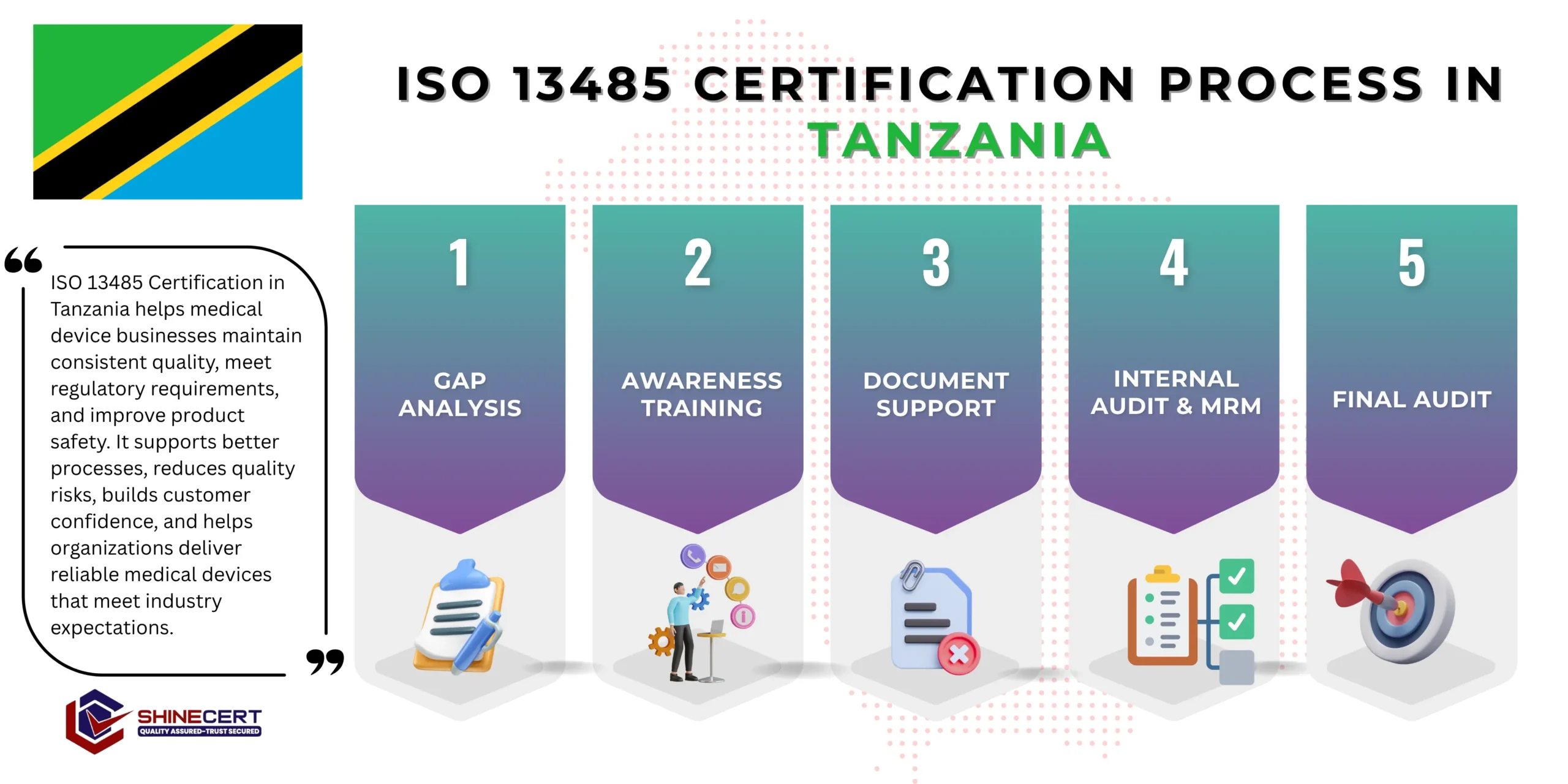
ISO 13485 Certification Process in Tanzania
The ISO 13485 certification journey in Tanzania: a five-step process from gap assessment through certification audit, with typical durations for each stage
Gap Assessment
We start with your actual TMDA classification and registration history, then compare real current practice against what ISO 13485 genuinely requires.
A gap report tying your quality practices directly to your TMDA standing, not a generic industry checklist.
Documentation
Every procedure and record we draft reflects your actual device categories, whether you manufacture, distribute, or both.
A full QMS documentation set with risk controls genuinely tied to your real device portfolio.
Implementation
Design controls, traceability, and complaint handling move from paper into genuine day-to-day operation.
A functioning quality system generating real operational evidence week over week.
Internal Audit and Management Review
We test the system hard against every clause and your TMDA obligations together, before an external auditor ever sees it.
Corrective actions already closed before the certification audit begins.
Certification Audit
Stage 1 confirms your documentation is genuinely ready; Stage 2 has the auditor on site reviewing your actual operational records.
Your ISO 13485 certificate, valid for three years, plus a clear surveillance schedule.
Staying Certified: Surveillance and Renewal
An ISO 13485 certificate runs for three years, with annual surveillance audits in years one and two reviewing your design controls, risk management file, and complaint records. A full recertification audit at the three-year mark determines whether the certificate continues, running on its own separate clock from your five-year TMDA registration cycle, even though a well-run quality system makes both considerably easier to manage together.
ISO 13485 Certification Cost in Tanzania
There’s no flat price for ISO 13485 certification in Tanzania, cost genuinely comes down to six factors:
01
Whether you manufacture or just distribute
Manufacturing brings design control and production validation requirements a pure distribution business never touches, which meaningfully affects scope.
02
Where your devices sit in TMDA’s risk classification
Higher-risk categories under TMDA’s Class A through D system typically demand deeper risk documentation than lower-risk classifications.
03
How many device categories you’re registering
Each distinct category may need its own risk management file and design records.
04
How mature your existing TMDA registration practice already is
Businesses with organized, current registration and renewal records aren’t starting the QMS documentation from zero.
05
Certification body fees, invoiced entirely separately from our consulting work
Whichever accredited body actually conducts your audit sets and bills that fee directly.
06
Whether you’re building this alongside ISO 9001
Combining ISO 13485 with ISO 9001 shares real documentation groundwork, bringing the combined cost down compared to two separate projects.
Why It’s Becoming Essential for Tanzanian Businesses Right Now?
- TMDA’s shift toward digital registration infrastructure signals a regulator investing in more rigorous oversight, not less : The April 2026 integration between TMDA’s TANCIS customs system and its Regulatory Information Management System points toward tighter, more data-driven scrutiny of what enters the Tanzanian device market, exactly the environment where a documented quality system pays off.
- The five-year registration cycle means device businesses need durable, ongoing quality practices, not a one-time compliance push : Renewal isn’t a formality, it’s a genuine checkpoint, and organizations with an active ISO 13485 system walk into that renewal with records already assembled rather than scrambling to reconstruct five years of history.
- The Local Technical Representative model puts distributors in a position of real regulatory exposure on behalf of manufacturers they don’t control : Because TMDA holds the LTR accountable for the device it’s registered with, distributors taking on that role have genuine reason to formalize their own quality practices independent of whatever the manufacturer does elsewhere.
- Tanzania’s growing private healthcare and diagnostics sector is pulling in international device partners who expect certified quality management as standard : As private hospitals, clinics, and diagnostic labs expand and increasingly source directly or through local distributors, international manufacturers evaluating those relationships routinely treat ISO 13485 as baseline evidence of a serious partner.
Benefits of ISO 13485 Certification for Tanzanian Organizations
Here’s what certified Tanzanian device businesses actually report gaining, beyond a certificate on the wall:
Structured design and risk records make both initial registration and the five-year renewal considerably less of a scramble.
Manufacturers evaluating potential LTR partners look for exactly this kind of documented quality discipline before handing over regulatory responsibility.
Formal design controls and risk management genuinely catch issues before a device reaches a clinic or hospital.
Foreign device manufacturers increasingly require distribution partners to already hold recognized quality certification before agreeing to work together.
A working complaint-intake and investigation process means problems get traced and resolved instead of quietly accumulating.
Larger healthcare providers and public procurement processes increasingly list certified quality management as a genuine supplier requirement.
Businesses handling both devices and general products often find ISO 9001 considerably faster to add once ISO 13485 documentation already exists.
The Real Challenges Organizations Face While Implementing ISO 13485
- Assuming TMDA registration proves your quality system is adequate : Registration confirms a specific device meets requirements at a point in time, it says nothing about the ongoing quality system behind how you handle, store, or manufacture.
- Design control gaps for manufacturers new to formal documentation : Manufacturers sometimes underestimate how much design verification and validation paperwork ISO 13485 genuinely expects beyond informal product development.
- Traceability that breaks down after the warehouse door : Distributors often track incoming shipments carefully but lose the thread once devices reach individual customers, exactly what auditors probe hardest.
- Complaint records that fade once certification is achieved : The discipline of logging and investigating complaints tends to slip once the pressure of the initial audit passes, particularly when complaint volume is genuinely low.
Where Certification Matters Most Across Tanzania’s Economy?
Medical device distribution and import
ISO 13485 is close to essential here given the Local Technical Representative model’s regulatory exposure.
Read moreDiagnostics and in-vitro diagnostic device businesses
ISO 13485 directly supports TMDA’s IVD registration pathway.
Read moreMedical device manufacturing
ISO 13485 is genuinely core given direct design control and risk management obligations; pair with ISO 9001 for broader product lines.
Read moreHospital and clinical equipment suppliers
ISO 13485 supports the quality consistency institutional healthcare buyers increasingly expect.
Read morePharmaceutical distributors expanding into devices
ISO 13485 provides a natural quality framework as product lines diversify beyond pharmaceuticals alone.
Read moreA Tanzanian Business We’ve Worked With
- A Dar es Salaam-based distributor acting as Local Technical Representative for a European diagnostics manufacturer approached us after the manufacturer indicated that continuing the LTR relationship would depend on demonstrable quality management, not just a track record of successful registrations.
- We found the company’s actual storage and handling practices were genuinely solid, but there was no formal device master record tracing specific shipments to specific customers, and complaint handling ran informally through direct phone calls rather than a documented process.
- We built the traceability system and complaint procedure around their existing warehouse operations. Certification took just under four months, and the resulting quality system directly satisfied the manufacturer’s requirement, securing the continued LTR relationship.
- We see this pattern often enough to name it directly: genuinely competent distributors who’d simply never formalized what they were already doing correctly, this describes a recurring situation, not one specific client.
The Documentation TMDA and Auditors Expect, Clause by Clause
- Clause 4 — Context of the Organization : Document: Scope of the QMS Statement. A written boundary defining exactly which device categories, sites, and activities your quality system covers, matched to your TMDA-registered portfolio.
- Clause 5 — Leadership : Document: Quality Policy. Top management’s signed commitment to device quality and regulatory compliance, including TMDA’s classification and registration requirements.
- Clause 6 — Planning : Document: Risk Management File. A device-by-device record of identified risks, how each is evaluated, and what controls address them, genuinely tailored to your risk classifications, not generic. Document: Quality Objectives. Specific, measurable targets tied to your policy, not aspirational statements.
- Clause 7 — Support : Document: Design and Development Records. For manufacturers, the paper trail shows how device specifications were developed, verified, and validated before release. Document: Competence and Training Records. Evidence staff handling design, manufacturing, or distribution genuinely have the training their role requires.
- Clause 8 — Operation : Document: Device Master Record. Full traceability linking raw materials or incoming devices through to final distribution, the record you’d actually need in a recall scenario. Document: Supplier and Distributor Evaluation Records. Proof that upstream suppliers and downstream distribution partners are genuinely assessed for quality and regulatory reliability. Document: Complaint Handling Procedure. A working process for capturing device complaints and feeding them into corrective action, not an informal email trail.
- Clause 9 — Performance Evaluation : Document: Internal Audit Records. Evidence your internal audit schedule was actually carried out clause by clause, not just written into a manual. Document: Management Review Minutes. A record that leadership genuinely reviewed quality performance and made real decisions in response.
- Clause 10 — Improvement : Document: Corrective Action Records. A functioning log tracking device quality issues from discovery through to a genuinely closed corrective action.
Realistic Timelines for Tanzanian Businesses
| Business Profile | Typical Total Timeline | What Drives This |
|---|---|---|
| Distributor, no manufacturing | 3–4 months | Narrower scope focused on storage, handling, and traceability |
| Small manufacturer, single device category | 4–6 months | Design control and risk management documentation for one device line |
| Larger manufacturer, multiple device categories | 6–9 months | Broader design control scope and more extensive risk management files |
Beyond company size, the single biggest timeline driver is whether you manufacture or simply distribute, manufacturing brings design control obligations distribution alone doesn’t carry.
ISO 13485 Certification Across Tanzania’s Business Hubs
Dar es Salaam
As the primary port and commercial hub, most device import and distribution activity, and the LTR relationships that come with it, concentrate here.
Arusha
With a growing private healthcare sector serving both domestic patients and medical tourism, device quality expectations here are rising alongside that growth.
Mwanza
As a regional healthcare hub for Tanzania’s Lake Zone, device distribution here increasingly serves a wider network of clinics and hospitals.
Dodoma
As the seat of government and a growing public healthcare infrastructure center, device procurement here is closely tied to public-sector quality expectations.
Why Businesses Choose ShineCert in Tanzania?
ShineCert brings 10 years of ISO consulting and certification experience to Tanzania’s market, coordinated through our Riyadh and India offices with services delivered remotely or on-site depending on what your engagement genuinely needs. We’ve guided more than 10,000 organizations through ISO certification worldwide, and we build every Tanzania medical device engagement around your actual portfolio and TMDA obligations, this is why Tanzanian device businesses increasingly choose ShineCert as the best ISO 13485 consultant in Tanzania.
Choosing a Certification Body in Tanzania?
What to Check | Why It Matters |
Accreditation under a recognized international framework | Confirms the certificate carries genuine weight with TMDA and international manufacturers alike |
Genuine familiarity with TMDA’s classification and registration process | Ensures the auditor understands how your QMS connects to your actual regulatory obligations |
Experience with your specific device category | Diagnostics, general equipment, and consumables carry genuinely different regulatory considerations |
Recognition by international manufacturer partners, if relevant | Some manufacturer relationships have specific certification body preferences worth confirming early |
Ready to Get Started?
Whether you’re strengthening a Local Technical Representative relationship or preparing for your first TMDA device registration, we’ll walk through your specific portfolio and cost factors before proposing a fixed-scope plan, delivered remotely, on-site, or however genuinely fits your project. Book a free consultation or contact us directly to get started.
Frequently Asked Questions
Look for genuine familiarity with TMDA’s classification and registration process, device-category-specific experience, and honest scoping. ShineCert scopes every Tanzania engagement individually.
No, TMDA registration remains a separate, mandatory requirement for each device, but a certified quality system gives you the documentation that makes registration and renewal considerably smoother.
It depends on whether you manufacture or distribute, your device risk classification, and how many categories you handle, we scope every project individually.
Typically three to nine months depending on your organization type and device complexity, see the timeline breakdown above.
Not by TMDA regulation directly, but manufacturers increasingly require it as a genuine condition of the LTR relationship.
Documentation work runs fine remotely, but facility audits and risk management verification genuinely need in-person site visits.
Not a standalone one, we coordinate Tanzania engagements from our Riyadh and India offices, with services delivered remotely or on-site as your project requires.