
CE Mark Certification in UAE
Quick Answer
CE Marking is not a certification issued by any UAE authority, it’s a legal conformity marking required under EU/EEA law for specific product categories being placed on the European market, and it exists entirely outside ESMA’s UAE regulatory framework. UAE manufacturers exporting machinery, electronics, medical devices, construction products, or other regulated categories to the EU or EEA need to complete CE conformity assessment before those products can legally enter that market, regardless of what UAE domestic compliance already exists. ShineCert helps UAE manufacturers navigate this process end to end. Budget AED 15,000 to AED 70,000 depending on product category and conformity assessment route, and plan for two to six months from kickoff to compliant product.
What CE Marking Actually Is?
CE Marking indicates that a product complies with the relevant EU health, safety, and environmental protection requirements for its specific product category, it is a legal requirement for placing covered products on the EU/EEA market, not a voluntary quality mark and not a certification of general excellence. Different product categories fall under different EU directives or regulations (Machinery Directive, Low Voltage Directive, Medical Device Regulation, Construction Products Regulation, and others), each with its own specific technical requirements and conformity assessment procedures. For lower-risk products, manufacturers can often self-declare conformity after completing the required technical assessment; higher-risk product categories require assessment by an EU-recognized Notified Body before the CE mark can legally be applied.
Why UAE Exporters Need to Understand This Specifically?
- The UAE’s manufacturing sector, spanning machinery, electronics, construction products, and increasingly medical devices, has genuine and growing export interest in European markets, and CE Marking functions as a hard legal gate for market entry in these categories, there is no substitute for it, and no UAE-issued certification, including ESMA approval or SASO-equivalent GCC standards compliance, satisfies CE Marking requirements. This is a point of genuine, common confusion: some UAE manufacturers assume that strong domestic compliance, or even ISO 9001 certification, provides some kind of equivalence or shortcut into the EU market. It doesn’t. CE Marking assesses specific product safety and performance requirements defined by EU law, entirely separate from ESMA’s UAE domestic regulatory framework or any general quality management system certification.
- For UAE manufacturers genuinely serious about European market access, understanding this distinction early avoids a common and costly mistake: assuming domestic UAE compliance work translates directly into EU market readiness, then discovering during an actual export attempt that it doesn’t.
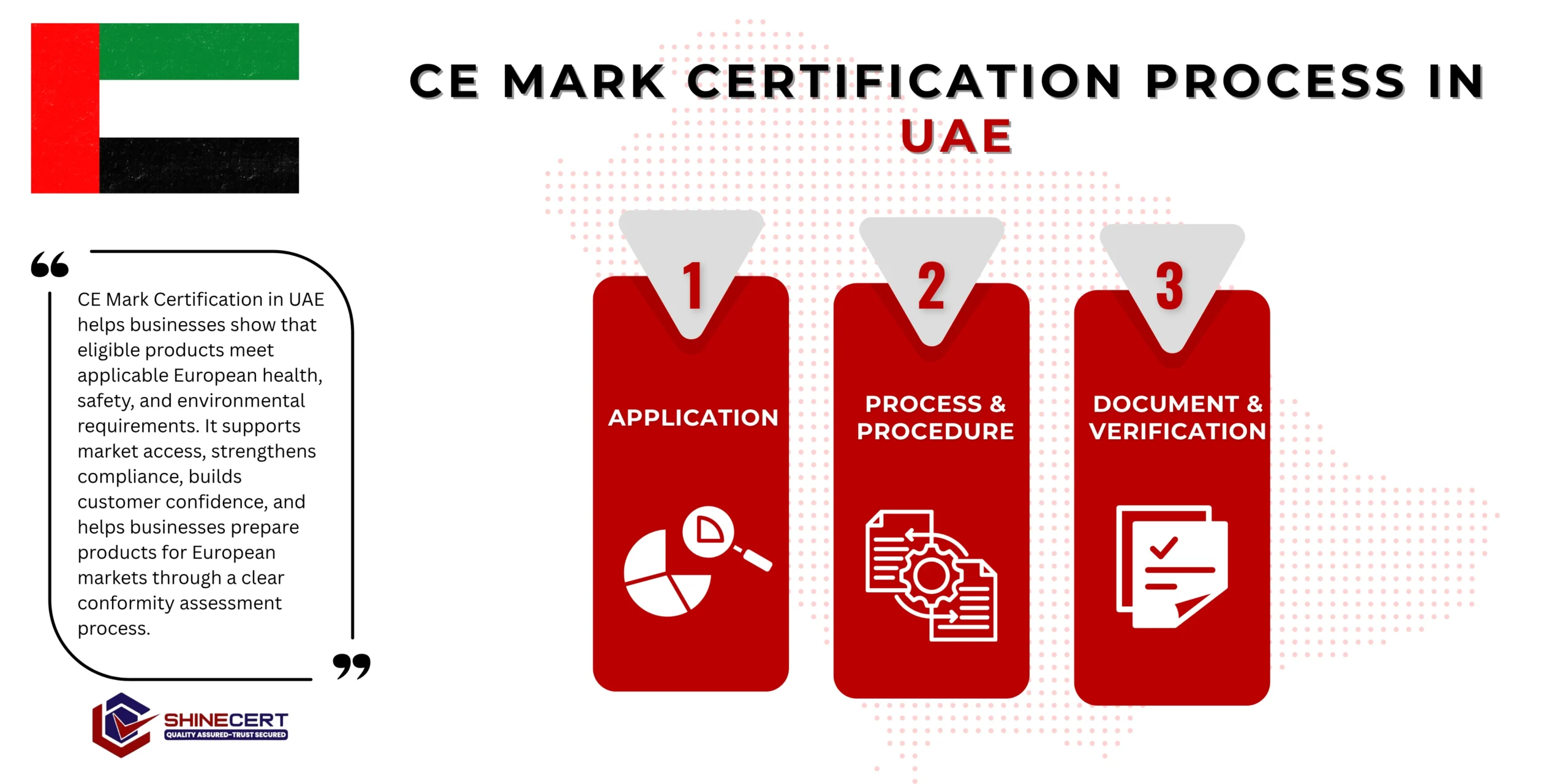
What are the steps to get CE Mark Certification in UAE?
our services
- ISO Certification UAE
- ISO 9001 Certification UAE
- ISO 14001 Certification UAE
- ISO 27001 Certification UAE
- ISO 22000 Certification UAE
- ISO 27701 Certification UAE
- ISO 45001 Certification UAE
- ISO 20000-1 Certification UAE
- ISO 13485 Certification UAE
- ISO 17025 Certification UAE
- ISO 31000 Certification UAE
- ISO 42001 Certification UAE
- ISO 37001 Certification UAE
- ISO 22301 Certification UAE
- ISO 50001 Certification UAE
- CE Mark Certification UAE
- GDPR Certification UAE
- GMP Certification UAE
- Halal Certification UAE
How We Handle This?
Product classification and route determination
We identify the applicable EU directive or regulation for your specific product and determine whether self-declaration or Notified Body assessment applies.
A conformity assessment route determination specific to your product.
Technical file development
Your technical documentation, risk assessments, and test planning get built around the actual applicable requirements for your product category.
A complete technical file supporting your CE Marking declaration.
Testing coordination
Where required, we coordinate product testing with appropriately accredited laboratories against relevant harmonized standards.
Test reports and verification results supporting your technical file.
Notified Body coordination
For higher-risk product categories, we coordinate the assessment process with an appropriate EU-recognized Notified Body.
Notified Body assessment results and, where applicable, certification supporting your CE declaration.
Declaration and post-market support
We support preparation of your formal Declaration of Conformity and provide guidance on post-market obligations.
Your Declaration of Conformity and ongoing post-market compliance guidance.
What You Actually Get?
- Legal market access to the EU/EEA for your specific product category, without this, the product simply cannot be legally sold in these markets, regardless of quality.
- A structured technical file that, beyond satisfying the immediate CE requirement, often strengthens your product documentation more broadly, supporting other export markets with similar technical requirements.
- Reduced legal and liability risk, since properly documented conformity assessment provides genuine protection if a product safety question arises after the product is in the EU market.
- A credible foundation for working with EU distributors and importers, who typically require verified CE compliance before agreeing to represent a UAE manufacturer’s products.
- Clarity distinguishing genuine EU market readiness from UAE domestic compliance, avoiding a costly and common category of mistake among first-time UAE exporters to Europe.
CE Marking as Genuine Export Infrastructure for UAE Manufacturers
The UAE’s manufacturing base, growing steadily across machinery, electronics, and industrial products, increasingly looks toward European markets as a genuine growth opportunity, not just Gulf and regional trade. We’ve generally recommended that UAE manufacturers serious about this positioning treat CE Marking as core export infrastructure investment, built in during product development rather than retrofitted after a product is already designed and in production, since design decisions made without EU requirements in mind can be considerably more expensive to correct later than to address from the start.
What It Costs?
Quick answer: CE Marking for UAE exporters typically runs AED 15,000 to AED 70,000, with product risk category and conformity assessment route as the main cost drivers.
Higher-risk product categories requiring third-party assessment carry substantially higher costs.
Testing against multiple harmonized standards for complex products increases scope.
Manufacturers with strong existing quality and design documentation need less foundational work.
Each meaningfully different product configuration may need its own assessment.
Notified Body fees are separate, and vary considerably based on product category and complexity.
Where UAE Exporters Usually Trip Up?
- Assuming ESMA approval or ISO 9001 certification substitutes for CE Marking : They don’t, CE Marking is an entirely separate legal requirement under EU law.
- Misidentifying the applicable directive or conformity route : Getting this wrong early can mean redoing substantial technical work later.
- Affixing the CE mark before genuine compliance is established : This carries real legal risk and can result in products being pulled from the EU market.
- Treating CE Marking as a one-time task rather than an ongoing obligation : Post-market surveillance and documentation maintenance responsibilities continue after the initial marking.
Where This Shows Up Most?
Machinery and Industrial Equipment Manufacturers
A substantial UAE export category with detailed Machinery Directive requirements.
Read moreElectronics and Electrical Equipment
Products falling under Low Voltage and EMC Directives, common across UAE’s growing electronics manufacturing sector.
Read moreConstruction Products
Building materials and components exported to EU markets face specific Construction Products Regulation requirements.
Read moreMedical Devices
UAE medical device manufacturers targeting EU markets face particularly rigorous conformity assessment given the health-critical nature of these products.
Read moreToys and Consumer Products
Consumer goods manufacturers exporting to the EU face specific safety directive requirements.
Read moreDon’t Forget the UK: CE Marking Doesn’t Cover UKCA
- A specific point of confusion we see regularly among UAE exporters is assuming that CE Marking automatically covers the United Kingdom market as well as the EU. It doesn’t, and hasn’t since the UK’s post-Brexit regulatory framework fully separated from the EU system. The UK now operates its own UKCA (UK Conformity Assessed) marking for most product categories that previously required only CE Marking, with its own separate technical requirements, its own UK-recognized conformity assessment bodies, and its own distinct legal framework, even though the underlying safety and performance requirements often overlap substantially with the EU’s.
- For UAE manufacturers targeting both EU and UK markets, this means genuinely separate compliance work is required, not a single CE assessment that happens to also satisfy the UK, and we’ve generally recommended manufacturers scope both markets explicitly from the outset if UK sales are part of the plan, rather than discovering the gap after products are already CE-marked and ready for what was assumed to be a UK-inclusive European launch. In practice, because the underlying technical requirements for many product categories remain closely aligned between the UK and EU frameworks, pursuing CE and UKCA together is often considerably more efficient than treating them as two entirely separate projects run months apart, since testing and technical file work frequently transfers between the two with only incremental additional effort.
What CE Marking Compliance Actually Involves?
- Identifying the Applicable Directive or Regulation : The specific EU legal framework covering your product category, since requirements differ meaningfully between, say, machinery and electronics.
- Determining the Conformity Assessment Route : Lower-risk products often permit manufacturer self-declaration after internal assessment; higher-risk categories require third-party assessment by an EU-recognized Notified Body.
- Technical File Development : A comprehensive technical dossier demonstrating how the product meets applicable requirements, design specifications, risk assessments, test reports, and technical drawings, genuinely substantive documentation, not a marketing brochure.
- Testing and Verification : Product testing against relevant harmonized European standards, conducted by appropriately accredited testing laboratories where required.
- Declaration of Conformity : A formal legal document, signed by the manufacturer, declaring the product meets all applicable EU requirements, this carries genuine legal weight and liability.
- Affixing the CE Mark : Only after genuine compliance is established and documented, affixing the mark prematurely or without proper substantiation carries serious legal risk in EU markets.
- Post-Market Obligations : Ongoing responsibilities including maintaining technical documentation, addressing any safety issues that emerge, and cooperating with EU market surveillance authorities if questions arise.
CE Marking vs ISO 9001 Certification
These get confused by UAE manufacturers relatively often, and the distinction matters considerably. ISO 9001 certifies your organization’s quality management system, how you manage processes, documentation, and continual improvement across your operations generally. CE Marking is a legal, product-specific conformity requirement under EU law, assessed against the safety and performance requirements of a specific product category, not your broader organizational quality practices. A UAE manufacturer can hold ISO 9001 certification and still have zero CE-compliant products if the specific technical conformity assessment hasn’t been completed for those products. That said, a well-functioning ISO 9001 quality management system genuinely supports CE Marking work, since strong design control and documentation practices required under ISO 9001 make building a compliant CE technical file considerably more straightforward.
Timeline
Quick answer: CE Marking for UAE exporters typically takes two to six months, with higher-risk products requiring Notified Body assessment taking longer.
Phase | Typical Duration |
Product classification and route determination | 1–2 weeks |
Technical file development | 4–8 weeks |
Testing and verification | 3–6 weeks |
Notified Body assessment (where required) | 4–10 weeks |
Declaration and finalization | 1–2 weeks |
Total | 2–6 months |
Documentation You’ll Need
Quick answer: CE Marking requires a technical file (design specifications, risk assessment, test reports), a signed Declaration of Conformity, and, for higher-risk products, Notified Body certification.
Comprehensive documentation of design, risk assessment, and applicable standards compliance.
Documented analysis of product hazards and mitigations, specific to the applicable EU directive.
Verification of compliance with relevant harmonized European standards.
A formal, signed legal document declaring compliance.
For higher-risk product categories requiring third-party assessment.
Compliant with applicable EU language and content requirements.
Evidence of structured investigation and corrective action.
Why ShineCert?
We coordinate UAE engagements from ShineCert’s Riyadh and Lebanon offices, with direct experience guiding UAE manufacturers through EU CE Marking requirements across machinery, electronics, and construction product categories. Our team has guided more than 10,000 organizations through ISO certification and international compliance globally, with ShineCert as the best CE Mark consultant in UAE.
Choosing a CE Marking Advisor?
What to Check | Why It Matters |
Genuine EU regulatory expertise | CE Marking requirements are EU law, and advisors need real familiarity with the specific applicable directives |
Access to accredited testing and Notified Body relationships | Essential for coordinating the actual conformity assessment process |
Honest guidance on self-declaration vs. Notified Body routes | An advisor should tell you accurately which route your product requires, not default to the more expensive one unnecessarily |
Understanding of UAE manufacturing context | Helps bridge UAE production realities with EU documentation expectations |
Ready to Get Certified?
ShineCert supports UAE manufacturers end to end through CE Marking conformity assessment, from product classification through technical file completion, with direct experience across machinery, electronics, and construction products. Book a free consultation or contact us directly, and we’ll review your product before proposing a fixed-scope plan.
Frequently Asked Questions
No, the UK operates its own separate UKCA marking system since Brexit, and UAE manufacturers targeting both the EU and UK need genuinely separate, though often efficiently combined, compliance work.
Typically AED 15,000 to AED 70,000, depending on product risk category and whether Notified Body assessment is required.
No, ESMA governs UAE domestic compliance, entirely separate from CE Marking, which is a legal requirement under EU law for products entering the EU/EEA market.
Typically two to six months, with higher-risk products requiring Notified Body assessment taking longer.
No, ISO 9001 certifies your organization’s quality management system, while CE Marking is a legal, product-specific conformity requirement under EU law.
No, lower-risk product categories often permit manufacturer self-declaration after internal technical assessment; only higher-risk categories require third-party Notified Body involvement.
For lower-risk product categories, yes, through manufacturer self-declaration, though this still requires a genuine, substantive technical file and testing, not just a signed statement.
We coordinate UAE engagements from our Riyadh and Lebanon offices, with consultants traveling on-site as needed.