
GMP Certification in Qatar
Quick Answer
Good Manufacturing Practice (GMP) certification verifies that a pharmaceutical manufacturing facility meets defined quality and safety standards, and it’s a mandatory requirement for any drug product registered in Qatar, the Ministry of Public Health’s Pharmacy and Drug Control Department (PDCD) requires a legalized, valid GMP certificate for every manufacturing site involved in producing the finished product, plus valid GMP certificates for all API suppliers. As of 2026, Qatar’s requirements have tightened further, mandating GMP and Good Distribution Practice alignment with the latest WHO guidelines plus stability testing conducted specifically under Qatar’s climatic conditions. Budget QAR 25,000 to QAR 120,000 depending on facility scope and product complexity, and plan for four to eight months.
What Is GMP Certification?
GMP certification confirms that a pharmaceutical manufacturing facility follows Good Manufacturing Practice, a quality system covering personnel qualification, facility design, equipment validation, production process control, quality control testing, documentation, and product recall procedures. Unlike a product-specific quality test, GMP certification addresses the manufacturing system as a whole, verifying that every batch produced meets consistent quality and safety standards, not just the specific batch submitted for registration testing.
Why This Matters So Much in Qatar Specifically?
Qatar’s Pharmacy and Drug Control Department is the sole regulatory authority for pharmaceutical product registration, and it requires an original, valid, and legalized GMP certificate from the health authority in the country of manufacture for every site involved in producing a registered drug product, along with GMP certificates for all active pharmaceutical ingredient suppliers. This isn’t a formality reviewed once and forgotten, PDCD’s registration process treats manufacturing site GMP status as a genuine, ongoing prerequisite for market access.
2026 has brought a meaningful tightening of these requirements: new regulations mandate that GMP and Good Distribution Practice align with the latest World Health Organization guidelines, and manufacturers must now conduct stability testing specifically under Qatar’s climatic conditions, rather than relying solely on stability data generated under different climate zone assumptions. For manufacturers accustomed to registering products across multiple markets with a single generic stability dataset, this Qatar-specific climatic testing requirement represents a genuinely new compliance step that can’t be satisfied by documentation already on file for other jurisdictions.
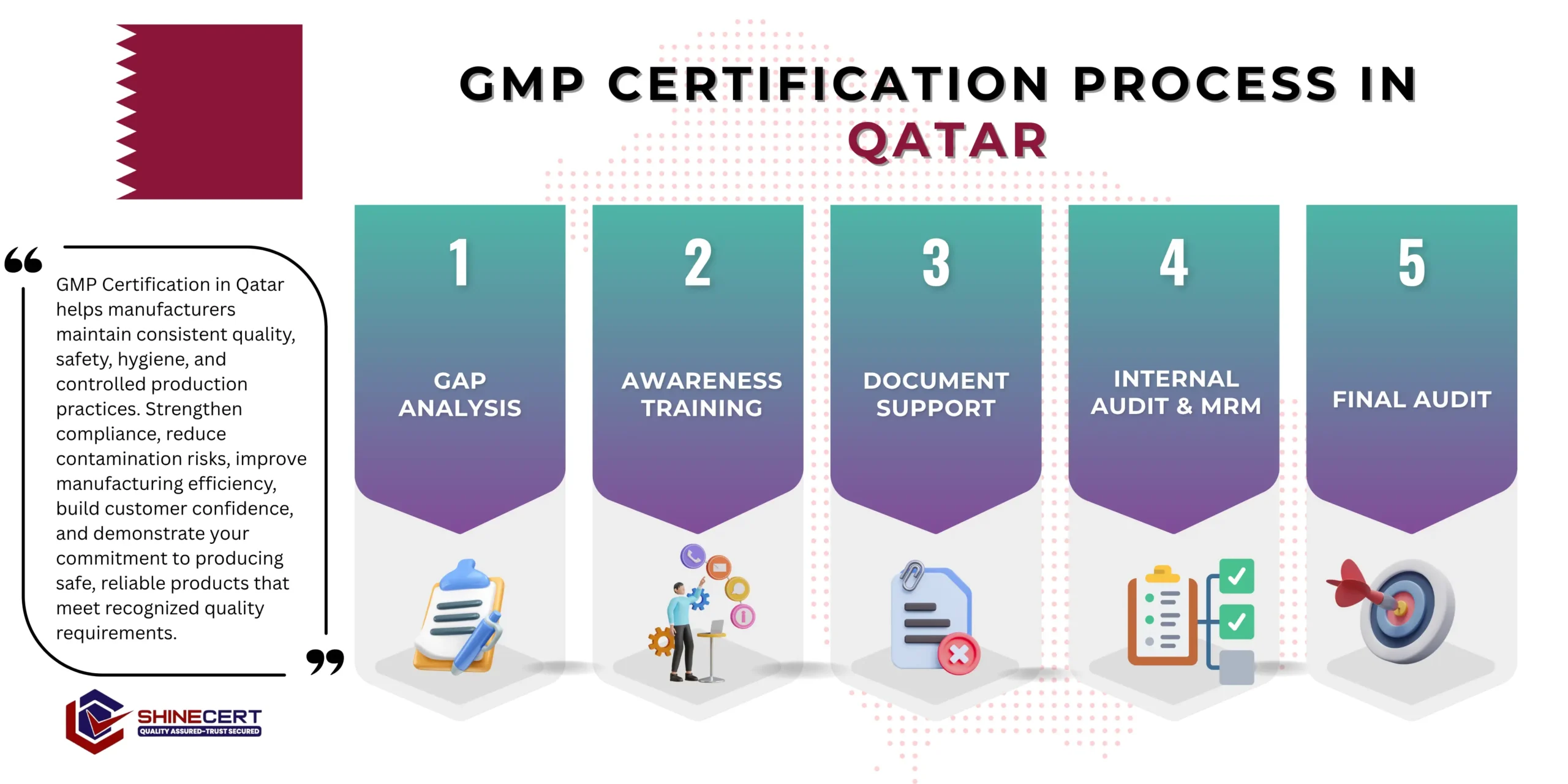
What are the steps to get GMP Certification in Qatar?
our services
- ISO Certification Qatar
- ISO 9001 Certification Qatar
- ISO 14001 Certification Qatar
- ISO 27001 Certification Qatar
- ISO 22000 Certification Qatar
- ISO 27701 Certification Qatar
- ISO 45001 Certification Qatar
- ISO 20000-1 Certification Qatar
- ISO 13485 Certification Qatar
- ISO 17025 Certification Qatar
- ISO 31000 Certification Qatar
- ISO 42001 Certification Qatar
- ISO 37001 Certification Qatar
- ISO 22301 Certification Qatar
- ISO 50001 Certification Qatar
- CE Mark Certification Qatar
- GDPR Certification Qatar
- GMP Certification Qatar
- Halal Certification Qatar
Our Five-Step GMP Certification Process
Manufacturing Site Gap Assessment
We assess your facility, equipment, and quality systems against current GMP requirements, including the 2026 WHO-aligned and climatic stability testing expectations specific to Qatar registration.
A gap assessment report identifying exactly what's needed for your specific facility and product category.
Quality System Documentation Development
Your quality manual, standard operating procedures, and batch documentation systems get built or updated to address identified gaps.
A complete GMP quality system documentation set.
Facility and Process Validation
Equipment qualification, process validation, and, where needed, Qatar-specific climatic stability testing get planned and executed.
Validation and stability data supporting your product's registration submission.
Internal Audit and Readiness Review
We test whether your GMP system genuinely functions as documented, identifying any remaining gaps before the formal certification or inspection process.
An internal audit report and a documented readiness assessment.
GMP Certification and Registration Support
We coordinate with the relevant health authority for GMP certification and support your PDCD registration submission with complete, current documentation.
Your GMP certificate and a registration-ready documentation package for PDCD submission.
What It Costs: The Factors That Actually Drive GMP Certification Price
- Number of manufacturing sites : Products manufactured across multiple sites need GMP certification and documentation for each site individually.
- Existing GMP maturity : Facilities already GMP certified for other markets typically need considerably less foundational work than those building a quality system from scratch.
- Climatic stability testing requirements : The 2026 requirement for Qatar-specific climatic stability testing adds meaningful cost and timeline where this data doesn’t already exist.
- Product complexity : Biologics and complex formulations typically need more extensive validation and testing than simple, well-characterized formulations.
- Number of API suppliers : Products sourcing active ingredients from multiple suppliers need GMP certification verification for each supplier individually.
- Quick answer : Budget QAR 25,000 to QAR 120,000, with the low end reflecting a facility already GMP certified for other markets needing Qatar-specific documentation and stability testing, and the high end reflecting a facility building GMP compliance from scratch across multiple sites.
What Happens When a Registration Submission Arrives With Incomplete GMP Documentation?
- This is worth walking through concretely, because it’s the single most common source of avoidable registration delay ShineCert encounters. When a pharmaceutical registration submission arrives at PDCD with a GMP certificate that’s expired, unlegalized, or missing for one of several manufacturing sites involved in the product, the review doesn’t simply proceed with a note, the submission stalls until the missing documentation is provided, often adding months to a timeline that could have been avoided with upfront verification. This is particularly costly for products with multiple manufacturing sites or API suppliers, since a single missing or outdated certificate among several can hold up the entire registration.
- Manufacturers who verify every relevant GMP certificate’s current validity and legalization status before submission, rather than assuming existing documentation from a prior registration cycle remains current, avoid this entirely. We generally recommend building a documented GMP certificate tracking system for any product with multiple manufacturing sites, since certificates expire on different cycles and it’s genuinely easy to lose track of which site’s certification needs renewal before the next submission.
Benefits: What Certification Actually Changes
GMP certification for every relevant manufacturing site is a genuine prerequisite for PDCD product registration, not an optional quality credential.
Submitting complete, current GMP documentation the first time avoids the registration delays that come from PDCD requesting missing or outdated certificates mid-review.
Facilities that proactively address the new stability testing expectations avoid scrambling to generate this data under registration deadline pressure.
GMP certification aligned with WHO guidelines and accepted under the Gulf Central Committee for Drug Registration framework supports registration efforts beyond Qatar alone.
A properly implemented GMP system produces consistently safe, effective products, which is the actual public health purpose behind the certification requirement, not merely a registration checkbox.
Mandatory Documents Required for Implementation
Original, valid, legalized certificate from the health authority in the country of manufacture, for every site involved in producing the finished product.
Valid GMP certificates for all active pharmaceutical ingredient suppliers used in the product.
Documented, including, under 2026 requirements, data from testing conducted under Qatar’s specific climatic conditions.
Documented, traceable records for representative production batches.
Documented testing results supporting product specification compliance.
A documented overview of the manufacturing site’s operations, equipment, and quality systems.
Applicable Standards by Industry
Pharmaceutical manufacturing
Drug manufacturers face the core, mandatory application of GMP certification for PDCD product registration.
Read moreBiologics and biosimilars
Manufacturers face additional GMP complexity given the more sensitive production processes involved in biological products.
Read moreActive pharmaceutical ingredient (API) suppliers
API manufacturers need GMP certification supporting every finished-product registration that relies on their ingredients.
Read moreContract manufacturing organizations
CMOs producing on behalf of pharmaceutical brand owners need GMP certification covering the specific products manufactured at their facility.
Read moreNutraceuticals and dietary supplements
Depending on classification, certain products may need GMP alignment even outside strict pharmaceutical registration requirements.
Read moreGMP vs ISO 13485: Two Different Certifications for Two Different Product Categories
- This distinction matters because pharmaceutical and medical device companies sometimes confuse the two certifications, and they address genuinely different regulatory pathways. GMP certification applies to pharmaceutical manufacturing, drugs, biologics, and related products, and is required as part of PDCD’s drug registration process. ISO 13485, by contrast, is the quality management system standard specific to medical devices, required for MoPH-PDCD’s separate medical device registration pathway, which became mandatory in Qatar as of July 2026.
- We generally recommend companies manufacturing both pharmaceutical and medical device products maintain clarity about which certification applies to which product line from the earliest planning stages, since a company assuming Good Manufacturing Practice (GMP) certification alone covers a combination drug-device product, or vice versa, risks a registration submission that’s incomplete for the actual product category. Where a company genuinely manufactures both categories, the two certifications share meaningful quality system infrastructure, documentation discipline, batch traceability, quality control testing, even though the specific standards and registration pathways differ.
GMP Requirements, Covering the Full Manufacturing System
- Personnel qualification and training : Documented competence for staff involved in production, quality control, and quality assurance, with training records demonstrating genuine, ongoing competence rather than a one-time onboarding session.
- Facility design and environmental control : Manufacturing areas designed to prevent contamination and mix-ups, with environmental monitoring appropriate to the product category being manufactured.
- Equipment qualification and validation : Documented evidence that manufacturing and testing equipment performs consistently and as intended, verified through installation, operational, and performance qualification.
- Production process control : Documented, validated manufacturing processes with in-process controls verifying that each batch is produced consistently according to approved specifications.
- Quality control testing : Documented testing of raw materials, in-process samples, and finished products against approved specifications before release.
- Stability testing : Documented stability data supporting the product’s shelf life, now including, for the Qatar market specifically, testing conducted under Qatar’s climatic conditions.
- Documentation and batch records : Complete, traceable batch production records for every lot manufactured, supporting genuine product traceability and recall capability if ever needed.
A Scenario: How a Pharmaceutical Manufacturer Might Approach the 2026 Climatic Stability Requirement
- Concrete examples clarify what this new requirement actually means in practice. Picture a pharmaceutical manufacturer with an established product already registered and selling successfully in several markets, holding stability data generated under standard international climate zone assumptions, now preparing to register the same product in Qatar for the first time. Under the pre-2026 framework, this existing stability data might have been sufficient; under the 2026 requirements, PDCD now expects stability testing conducted specifically under Qatar’s climatic conditions, meaning the manufacturer’s existing dataset alone is no longer adequate for a complete submission.
- Rather than treating this as a last-minute obstacle discovered mid-registration, we generally recommend manufacturers targeting the Qatar market build climatic stability testing into their registration timeline from the outset, since this testing takes real time to generate and cannot be compressed under submission deadline pressure. Manufacturers who plan for this requirement early, rather than assuming existing multi-market stability data will transfer automatically, avoid the registration delays we’ve seen catch companies unprepared for Qatar’s specific 2026 update.
Two Myths About GMP Certification for the Qatar Market
- Our product is already GMP certified for the EU or US market, so Qatar registration should be automatic : GMP certification is genuinely valuable evidence, but PDCD’s 2026 requirements now specifically expect climatic stability testing conducted under Qatar’s own conditions, existing GMP certification and stability data from other markets, however rigorous, doesn’t automatically satisfy this Qatar-specific requirement.
- GMP certification only concerns the finished product manufacturer : This significantly undersells the requirement’s scope. PDCD requires valid GMP certificates for every API supplier as well as the finished-product manufacturing site, meaning a registration submission can stall over a single supplier’s outdated documentation even when the finished-product facility’s own certification is entirely current.
Why the Gulf Central Committee for Drug Registration Framework Matters Beyond Qatar Alone?
- Qatar’s PDCD registration process operates alongside the broader Gulf Central Committee for Drug Registration (GCC-DR), part of the Gulf Health Council, which coordinates a centralized approach to pharmaceutical registration and manufacturing site accreditation across GCC member states. For manufacturers planning market entry across multiple Gulf countries rather than Qatar alone, understanding how GCC-DR’s centralized procedure interacts with PDCD’s specific national requirements, including the 2026 climatic stability testing update, can meaningfully streamline a multi-market registration strategy rather than treating each Gulf country as an entirely separate, disconnected submission.
- We generally recommend manufacturers with genuine multi-Gulf ambitions build their GMP documentation and stability testing strategy with this centralized framework in mind from the outset, since data and certifications that satisfy both Qatar’s specific requirements and the broader GCC-DR framework reduce duplicated effort considerably compared to building each national submission in isolation.
Why ShineCert?
We coordinate Qatar engagements from ShineCert’s Riyadh and Lebanon offices, with direct familiarity with PDCD’s registration requirements and genuine experience helping pharmaceutical manufacturers navigate the 2026 WHO-alignment and climatic stability testing updates without registration delays. Our team has guided more than 10,000 organizations through certification globally, and as the best GMP consultant in Qatar, we build every registration support package around your specific product category and manufacturing footprint.
Choosing a GMP Consultant or Certification Partner for Qatar Registration?
What to Check | Why It Matters |
Genuine familiarity with PDCD’s specific registration documentation requirements | Qatar’s requirements, including the 2026 climatic stability testing update, differ from generic multi-market GMP submissions |
Experience with GCC-DR centralized registration framework | Helps position your registration for recognition across additional Gulf markets, not just Qatar alone |
Track record with your specific product category | Biologics, generics, and API manufacturing each involve meaningfully different GMP audit and validation scope |
Understanding of WHO GMP guideline alignment | Confirms your quality system genuinely meets the international benchmark PDCD’s 2026 requirements now reference |
Ready to Get Started?
ShineCert supports pharmaceutical manufacturers navigating PDCD’s GMP and registration requirements, including the 2026 climatic stability testing update, from gap assessment through registration submission. Book a free consultation or contact us directly, and we’ll review your product category before proposing a fixed-scope plan.
Frequently Asked Questions
It confirms that a pharmaceutical manufacturing facility follows Good Manufacturing Practice, covering personnel, facilities, equipment, production control, and quality testing.
Typically QAR 25,000 to QAR 120,000, depending on facility scope and existing GMP maturity.
Yes, PDCD requires a legalized, valid GMP certificate for every manufacturing site involved in producing a registered product.
Typically four to eight months, longer where new climatic stability testing is required.
New regulations mandate GMP and Good Distribution Practice alignment with the latest WHO guidelines plus stability testing conducted under Qatar’s specific climatic conditions.
No, GMP applies to pharmaceutical manufacturing, while ISO 13485 is the quality management standard specific to medical devices.
Yes, PDCD requires valid GMP certificates for all active pharmaceutical ingredient suppliers, not just the finished-product manufacturing site.
Not fully, PDCD now expects stability testing conducted specifically under Qatar’s climatic conditions, in addition to any existing data.
No, since 2026’s climatic stability testing requirement is Qatar-specific and isn’t automatically satisfied by certification or stability data from other markets.
Yes, through the Gulf Central Committee for Drug Registration’s centralized procedure, manufacturers targeting multiple Gulf markets can factor into their overall registration strategy.
We coordinate Qatar engagements from our Riyadh and Lebanon offices, with consultants traveling on-site as needed.