
Halal Certification in Qatar
Quick Answer
Halal certification in Qatar is governed by a combination of national and Gulf-wide frameworks, the Ministry of Public Health’s Port Health and Food Control Section maintains the authorized list of approved Islamic certification bodies and Halal centers worldwide (updated as recently as December 2025), while the Qatar General Organization for Standards and Metrology (QGOSM) enforces conformity against GSO 2055-1 (general halal food requirements), GSO 993 (Islamic slaughtering requirements), and GSO 2055-2/2055-3 (certification and accreditation body requirements). Get certified through a Halal certification body that appears on MoPH’s current authorized list, or that holds accreditation aligned with GSO 2055-3. Budget QAR 12,000 to QAR 60,000 depending on product category and facility complexity, and plan for two to five months.
What Is Halal Certification?
Halal certification verifies that food, meat, pharmaceutical, and cosmetic products meet Islamic dietary and preparation law, covering permissible ingredients, prohibited substances, and, for meat and poultry, Islamic slaughtering methods. Certification extends beyond the product itself to the full supply chain, sourcing, processing, packaging, storage, and transportation, since cross-contamination with non-halal materials at any stage can compromise a product’s halal status. For companies selling into or exporting to Qatar, halal certification from a body on MoPH’s authorized list is what allows products to clear customs and reach retail shelves.
Why This Matters So Much in Qatar Specifically?
Qatar operates one of the more structured halal compliance frameworks in the Gulf, built on close coordination between the Ministry of Public Health, the Ministry of Municipality, and QGOSM. All imported meat, poultry, and products containing animal-origin ingredients require both a health certificate from the country of export and a halal slaughter certificate issued by an Islamic center appearing on MoPH’s authorized list, a list that currently includes roughly 75 associations across 46 countries and was most recently updated in December 2025, reflecting how actively MoPH manages which certification bodies it recognizes.
This matters considerably for exporters and local producers alike: a shipment accompanied by a halal certificate from a body not currently on MoPH’s list faces rejection at the port regardless of the product’s actual compliance, making the choice of certification body every bit as important as the certification process itself. QGOSM’s enforcement of GSO 2055-1 and GSO 993 additionally means halal claims are assessed against a defined technical standard, not a general impression of compliance, and that enforcement discipline is exactly what gives a Qatar halal certificate genuine credibility with consumers and retailers alike.
What are the steps to get Halal Certification in Qatar?
our services
- ISO Certification Qatar
- ISO 9001 Certification Qatar
- ISO 14001 Certification Qatar
- ISO 27001 Certification Qatar
- ISO 22000 Certification Qatar
- ISO 27701 Certification Qatar
- ISO 45001 Certification Qatar
- ISO 20000-1 Certification Qatar
- ISO 13485 Certification Qatar
- ISO 17025 Certification Qatar
- ISO 31000 Certification Qatar
- ISO 42001 Certification Qatar
- ISO 37001 Certification Qatar
- ISO 22301 Certification Qatar
- ISO 50001 Certification Qatar
- CE Mark Certification Qatar
- GDPR Certification Qatar
- GMP Certification Qatar
- Halal Certification Qatar
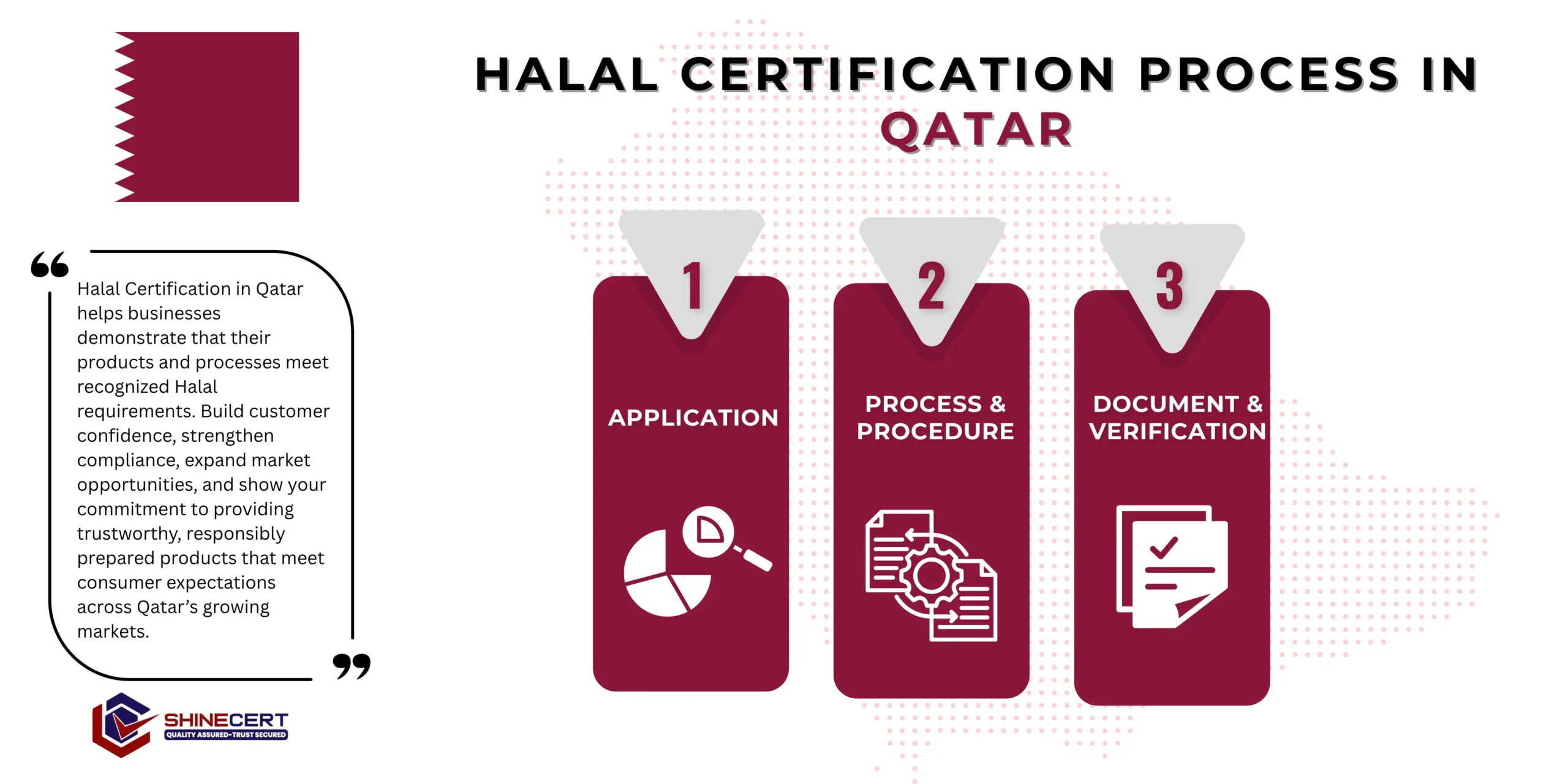
Our Five-Step Halal Certification Process
Certification Body Selection and Scope Assessment
We help you select a Halal certification body currently on MoPH's authorized list, matched to your product category and target market.
A confirmed certification body and a defined certification scope for your product line.
Supply Chain and Ingredient Review
We review your ingredients, processing aids, and supply chain for compliance with GSO 2055-1 and, where applicable, GSO 993 slaughtering requirements.
A documented ingredient and supply chain compliance assessment.
Facility Preparation and Segregation Controls
Processing facilities implement genuine segregation and cross-contamination controls between halal and non-halal production, where applicable.
Documented facility procedures and segregation controls ready for certification body assessment.
Certification Body Audit
The selected certification body conducts its facility and documentation audit, verifying compliance with GSO standards and its own accreditation requirements.
Audit findings and, upon successful completion, your halal certificate.
MoPH Recognition and Ongoing Compliance
We confirm your certificate is recognized for Qatar market entry and establish the ongoing compliance discipline needed to maintain certification.
Confirmed market access and a clear recertification and surveillance schedule.
What It Costs: The Factors That Actually Drive Halal Certification Price
- Product category : Meat and poultry products requiring slaughter certification typically involve more extensive audit scope than shelf-stable processed foods with simpler ingredient profiles.
- Facility complexity : Facilities producing both halal and non-halal products need more extensive segregation controls and documentation than dedicated halal-only facilities.
- Certification body selection : Costs vary meaningfully between certification bodies, and selecting one already on MoPH’s current authorized list avoids the cost of a rejected certification requiring a second attempt.
- Number of product lines : Companies certifying multiple distinct product lines need broader scope assessment and documentation than single-product certification.
- Export market breadth : Companies seeking certification recognized across multiple GCC markets, not just Qatar, need broader GSO-alignment verification.
- Quick answer : Budget QAR 12,000 to QAR 60,000, with the low end reflecting a single processed-food product line and the high end reflecting a meat-processing facility with multiple product categories and slaughter certification requirements.
What Happens If a Shipment Arrives With a Halal Certificate From a Body Not on MoPH’s List?
- This is worth understanding clearly, because it’s one of the most common and costly mistakes exporters make. Halal compliance of the underlying product is not, on its own, sufficient for Qatar market entry, the certifying body itself must appear on MoPH’s currently authorized list at the time of import. An exporter using a legitimate, well-regarded certification body in its own country can still face shipment rejection at a Qatari port if that specific body isn’t on MoPH’s list, regardless of how rigorous its actual certification process was.
- Because MoPH updates this list periodically, most recently in December 2025, a certification body’s status can also change over time, meaning a certificate that cleared customs eighteen months ago isn’t automatically still valid today. We generally recommend exporters verify their certification body’s current MoPH listing status before each significant shipment, not just at the point of initially selecting a certifier, since this single verification step prevents the majority of halal-related shipment rejections we see.
Benefits: What Certification Actually Changes
Halal certification from an MoPH-recognized body is what actually clears customs, rather than a general assurance that products are prepared appropriately.
Products certified by a body currently on MoPH’s authorized list avoid the costly disruption of a rejected shipment at the port of entry.
Since GSO standards apply across Gulf Cooperation Council countries, halal certification aligned with GSO 2055-1 and GSO 993 supports market access beyond Qatar alone.
Certified halal status is a genuine purchasing factor for Qatari and regional consumers, not just a regulatory formality.
Local distributors increasingly require documented, verifiable halal certification before agreeing to carry a product line.
Mandatory Documents Required for Implementation
Documented, covering every ingredient and processing aid used in the product.
Documented for any halal-sensitive raw materials sourced from third parties.
Documented evidence of compliance with GSO 993’s Islamic slaughtering requirements.
Documented controls preventing cross-contamination between halal and non-halal production.
Documented, particularly where shared equipment or facilities are used.
Documentation confirming the certifying body’s current standing on MoPH’s authorized list or its GSO 2055-3 accreditation.
Applicable Standards by Industry
Meat and poultry processing
Facilities need certification addressing both GSO 993 slaughtering compliance and GSO 2055-1 general halal food requirements.
Read moreProcessed and packaged foods
Manufacturers need ingredient and formulation verification against GSO 2055-1, particularly for additives and processing aids.
Read morePharmaceuticals and nutraceuticals
Products containing gelatin, animal-derived excipients, or alcohol-based components need careful halal status verification specific to pharmaceutical formulation.
Read moreCosmetics and personal care
Products marketed as halal-compliant need ingredient verification addressing animal-derived components and alcohol content in formulations.
Read moreHospitality and food service
Hotels and restaurants serving halal menus need supply chain verification confirming their ingredient sourcing genuinely traces back to certified halal suppliers.
Read moreA Scenario: How a Food Exporter Might Navigate the MoPH Approved List Before a First Shipment
- Concrete examples clarify what this process looks like in practice. Picture a mid-sized processed food manufacturer preparing its first shipment of a snack product line to a Qatari distributor, holding a halal certificate from a certification body well-regarded in its home market but never previously verified against MoPH’s specific requirements. Without checking MoPH’s authorized list first, the manufacturer risks preparing and shipping an entire container only to have it rejected at the Qatari port because its certifying body, however legitimate elsewhere, doesn’t appear on the current list.
- A manufacturer that verifies MoPH’s authorized list before finalizing its certification body selection avoids this entirely, and in cases where an existing certifier isn’t currently listed, has the option of either transitioning to a listed body or requesting that its existing certifier pursue MoPH recognition, a process worth starting well before a shipment is time-sensitive. We generally recommend exporters treat this verification step as a mandatory first move, not a formality to check after certification is already complete, since the cost of getting it wrong is a rejected shipment rather than a simple paperwork delay.
Halal Certification Requirements, Covering the Full Supply Chain
- Ingredient and sourcing verification : Every ingredient, including additives, processing aids, and packaging materials that contact the product, must be verified free of prohibited substances.
- Islamic slaughtering compliance (for meat and poultry) : Slaughter must follow GSO 993’s requirements, a Muslim slaughterer, a specific cutting method severing the trachea, esophagus, and jugular veins, and the animal facing Qibla where practicable.
- Segregation and cross-contamination prevention : Halal and non-halal products must be genuinely segregated throughout processing, storage, and transportation, not merely labeled differently on a shared line.
- Facility and equipment requirements : Processing equipment used for halal products must be free of non-halal residue, with documented cleaning procedures where shared equipment is unavoidable.
- Labeling and traceability : Halal claims on packaging must be accurate and traceable back to the certifying body and the specific certification scope.
- Certification body and accreditation status : The certifying body itself must appear on MoPH’s current authorized list, or hold accreditation consistent with GSO 2055-2 and GSO 2055-3.
Halal Certification vs QGOSM’s General Certificate of Conformity: Two Separate Requirements
- This distinction trips up first-time exporters more often than almost any other aspect of the Qatar food import process, and it’s worth addressing directly. Food shipments into Qatar generally need a Certificate of Conformity (CoC), issued by an MoPH-FSD-approved certification body, covering general food safety conformance against Qatar’s broader food import requirements. This is a separate requirement from halal certification, which specifically addresses Islamic dietary compliance and, for meat and poultry, slaughtering methods.
- For meat, poultry, and products containing animal-origin ingredients, both documents are typically required together, a CoC covering general food safety conformance, and a halal certificate from an MoPH-authorized Islamic center or certification body covering religious compliance. We generally recommend exporters new to the Qatar market map both requirements early in their export planning, since assuming a CoC alone satisfies halal requirements, or vice versa, is a genuinely common and costly misunderstanding that surfaces only when a shipment is already in transit.
Two Myths About Halal Certification for the Qatar Market
- A halal certificate is a halal certificate, anywhere in the world : This is the single most common and costly misunderstanding among first-time exporters. MoPH maintains a specific authorized list, and a shipment certified by a body not currently on that list can be rejected regardless of the certificate’s legitimacy elsewhere, the certifying body’s Qatar-specific recognition matters as much as the underlying product compliance.
- Halal certification covers general food safety too : It doesn’t, or at least not comprehensively. Halal certification addresses Islamic dietary and preparation compliance specifically, while general food safety conformance for Qatar import typically requires a separate Certificate of Conformity from an MoPH-FSD-approved body, treating the two as interchangeable is a genuine and avoidable source of shipment delays.
Why ShineCert?
We coordinate Qatar engagements from ShineCert’s Riyadh and Lebanon offices, with direct familiarity with MoPH’s authorized Halal bodies list and QGOSM’s enforcement of GSO 2055-1 and GSO 993, and genuine experience helping exporters avoid the costly mistake of shipping against an unrecognized certification. Our team has guided more than 10,000 organizations through certification globally, and as the best Halal consultant in Qatar, we build every certification pathway around your specific product category rather than a generic export checklist.
Choosing a Halal Certification Body for the Qatar Market?
What to Check | Why It Matters |
Current listing on MoPH’s authorized Halal bodies list | This is the single determining factor for whether your certificate will be recognized at Qatari customs |
Accreditation aligned with GSO 2055-2 and GSO 2055-3 | Confirms the certification body itself meets Gulf-wide accreditation standards, not just a general halal claim |
Genuine experience with your specific product category | Meat, processed food, pharma, and cosmetics each involve meaningfully different audit scope and technical requirements |
Recognition across broader GCC markets, if relevant | Useful where you’re targeting Qatar alongside other Gulf markets under the same GSO framework |
Ready to Get Started?
ShineCert supports food, meat, pharma, and cosmetics businesses securing Halal certification that actually clears Qatari customs, from certification body selection through ongoing compliance. Book a free consultation or contact us directly, and we’ll review your product category before proposing a fixed-scope plan.
Frequently Asked Questions
It verifies that food, meat, pharmaceutical, and cosmetic products meet Islamic dietary and preparation law, covering ingredients, processing, and, for meat, Islamic slaughtering methods.
Typically QAR 12,000 to QAR 60,000, depending on product category and facility complexity.
The Ministry of Public Health maintains the authorized list of Halal certification bodies, while QGOSM enforces conformity against GSO 2055-1 and GSO 993.
Typically two to five months, depending on product category and certification body selected.
No, the certifying body itself must appear on MoPH’s current authorized list, a legitimate halal certificate from a body not on that list can still result in shipment rejection.
Periodically, with the most recent update in December 2025, which is why verifying current listing status before each significant shipment matters.
Often, since GSO standards apply Gulf-wide, though it’s worth confirming recognition in each specific target market.
A health certificate from the country of export plus a halal slaughter certificate issued by an Islamic center on MoPH’s approved list, meeting GSO 993’s slaughtering requirements.
No, a CoC covers general food safety conformance, while a Halal certificate specifically addresses Islamic dietary compliance, most meat and animal-origin shipments need both.
Both local Qatari manufacturers pursuing halal certification for domestic retail follow the same GSO 2055-1 and, where applicable, GSO 993 requirements as importers, though they work directly with an MoPH-recognized body rather than needing a foreign Islamic center’s slaughter certificate.
We coordinate Qatar engagements from our Riyadh and Lebanon offices, with consultants traveling on-site as needed.