
ISO 50001 Certification in Qatar
Quick Answer
ISO 50001 is the international standard for energy management systems, and it arrives in Qatar alongside genuine national momentum on energy performance, Kahramaa, the Qatar General Electricity and Water Corporation, is currently executing the 2026-2030 “Leading Practices Phase” of its long-term strategy, and its Tarsheed conservation program has already delivered hundreds of gigawatt-hours in verified electricity savings. Get certified through a body accredited by the Global Accreditation Bureau (GAB) or another body recognized under the new Global Accreditation Cooperation (GAC) framework. Budget QAR 20,000 to QAR 95,000 depending on facility complexity and energy consumption profile, and plan for four to six months.
What Is ISO 50001?
ISO 50001 is the international standard for energy management systems (EnMS), providing a structured framework for organizations to systematically improve energy performance, including energy efficiency, use, and consumption. It requires establishing an energy baseline, identifying significant energy uses, setting measurable energy performance indicators and targets, and implementing a continuous improvement cycle grounded in real consumption data rather than one-off efficiency projects. Unlike a single energy audit, which captures a snapshot in time, ISO 50001 builds an ongoing management discipline around energy data.
Why This Matters So Much in Qatar Specifically?
Kahramaa’s Tarsheed program, mandated under electricity and water consumption Law No. 20 of 2015, has become one of the most visible national conservation efforts in the Gulf, spanning residential, commercial, industrial, government, sports, and hospitality building categories, and delivering measurable results, 548.3 GWh of electricity savings and roughly 638,275 tonnes of avoided CO2 emissions in a single recent year alone. Kahramaa has now moved into the third strategic phase of its long-term roadmap, the 2026-2030 “Leading Practices Phase,” building on two earlier phases focused on institutional readiness and strategic culture, and running alongside the Qatar National Renewable Energy Strategy’s target of roughly 4 GW of large-scale renewable generation and a 27 percent reduction in carbon intensity per unit of electricity produced by 2030.
For industrial and large commercial facilities, this creates a genuinely favorable environment for ISO 50001 certification: Tarsheed already expects measurable conservation performance, and an ISO 50001 energy management system gives you the internationally recognized, independently verified structure to demonstrate exactly that kind of performance, rather than relying on ad hoc efficiency initiatives that are hard to measure or sustain.
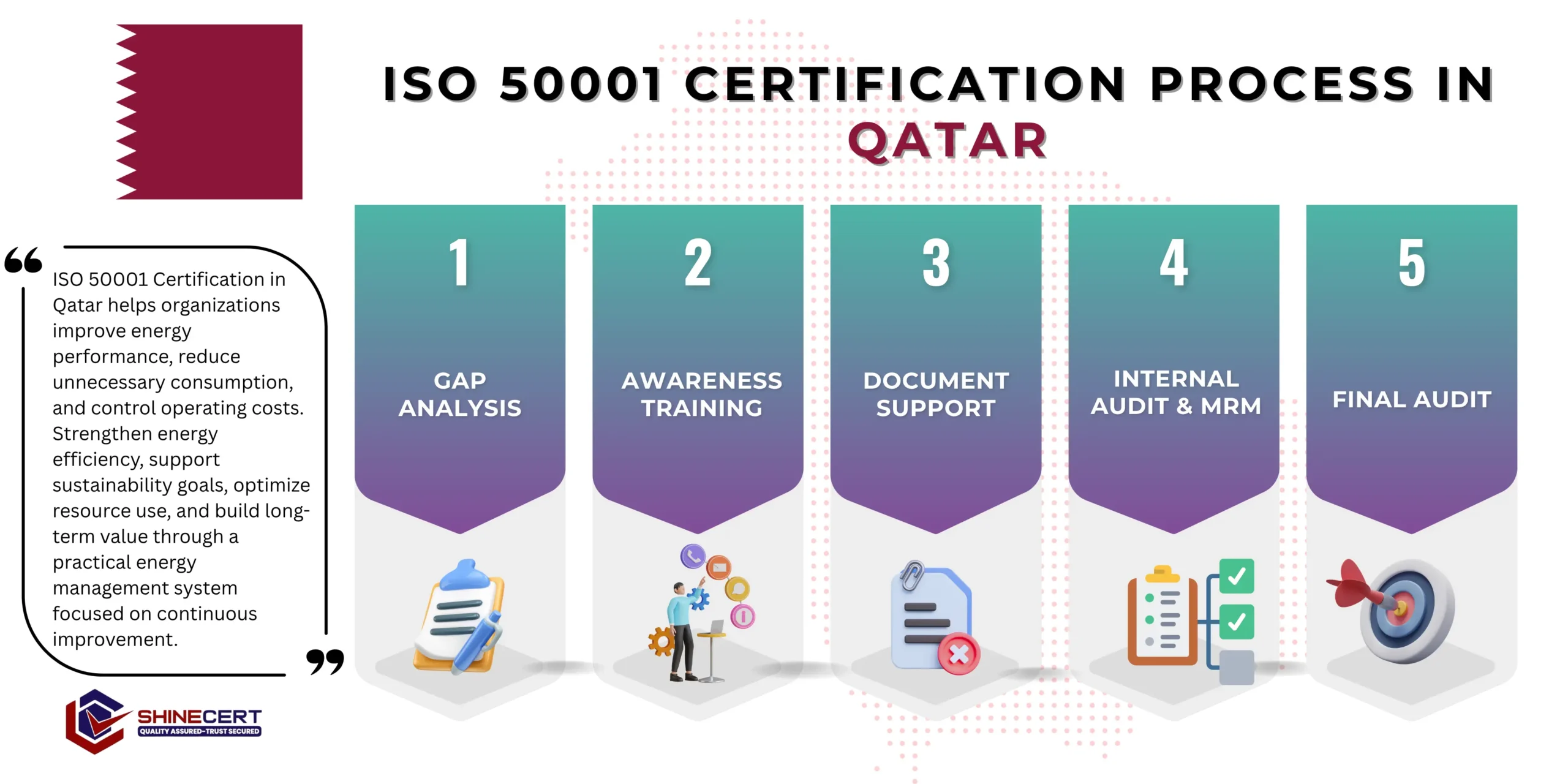
What are the steps to get ISO 50001 Certification in Qatar?
our services
- ISO Certification Qatar
- ISO 9001 Certification Qatar
- ISO 14001 Certification Qatar
- ISO 27001 Certification Qatar
- ISO 22000 Certification Qatar
- ISO 27701 Certification Qatar
- ISO 45001 Certification Qatar
- ISO 20000-1 Certification Qatar
- ISO 13485 Certification Qatar
- ISO 17025 Certification Qatar
- ISO 31000 Certification Qatar
- ISO 42001 Certification Qatar
- ISO 37001 Certification Qatar
- ISO 22301 Certification Qatar
- ISO 50001 Certification Qatar
- CE Mark Certification Qatar
- GDPR Certification Qatar
- GMP Certification Qatar
- Halal Certification Qatar
Our Five-Step ISO 50001 Certification Process
Energy Review and Baseline Establishment
We identify your significant energy uses, establish a genuine consumption baseline, and determine the energy performance indicators most relevant to your operations.
An energy review report and a documented energy baseline specific to your facility.
Documentation Development
Your energy policy, objectives, targets, and operational control procedures get built around your actual significant energy uses, not a generic template.
A complete ISO 50001 documentation set aligned to your energy baseline.
Implementation and Training
Energy monitoring and operational controls roll out across your facility, with staff trained on data collection and their role in significant energy uses.
Training records and evidence of functioning energy monitoring in daily operations.
Internal Audit and Management Review
We test whether your energy management system genuinely produces measurable performance improvement, with findings feeding into a management review where leadership commits to specific improvement actions.
An internal audit report and management review minutes demonstrating genuine engagement with energy performance data.
Certification Audit
We coordinate Stage 1 and Stage 2 with a GAB-accredited or GAC-recognized certification body experienced in industrial and commercial energy management audits.
Your ISO 50001 certificate and a clear surveillance audit schedule.
What It Costs: The Factors That Actually Drive ISO 50001 Price
- Facility energy consumption complexity : Facilities with more significant energy uses, multiple production lines, HVAC systems, and process equipment, need more extensive energy review and monitoring infrastructure.
- Existing metering and data infrastructure : Facilities with sub-metering and existing energy monitoring systems already in place need less foundational investment than those building data collection from scratch.
- Number of sites : Multi-site organizations need energy baselines and performance indicators established for each significant facility.
- Industry sector : Industrial and manufacturing facilities typically need more extensive operational control documentation than commercial or hospitality facilities with simpler energy profiles.
- Bundling with ISO 14001 : Meaningful cost efficiency is available for facilities pursuing environmental and energy management certification together, given shared monitoring and improvement infrastructure.
- Quick answer : Budget QAR 20,000 to QAR 95,000, with the low end reflecting a smaller commercial facility with existing metering and the high end reflecting a larger industrial facility building comprehensive energy monitoring from scratch.
What Happens When a Facility Tracks Energy Spend Instead of Energy Performance?
- This distinction is worth walking through concretely, because it’s the single most common gap ShineCert finds in facilities that believe they already manage energy well. Many organizations closely track their monthly Kahramaa utility bill, a genuinely useful number, but one that reflects total spend, not performance. A facility that adds a new production line, or simply runs longer hours to meet demand, will see its bill rise even if every individual piece of equipment is operating exactly as efficiently as before, and a facility watching only the bill has no way to distinguish “we got less efficient” from “we produced more.”
- An ISO 50001 energy management system solves this by normalizing consumption against relevant variables, production volume, occupancy, weather conditions, so that genuine performance changes are visible independent of activity level changes. Without that normalized view, it’s genuinely difficult to know whether a conservation initiative worked, whether a piece of equipment is degrading, or whether Tarsheed evaluation results reflect real improvement or just a quieter production quarter.
Benefits: What Certification Actually Changes
A certified energy management system produces exactly the measurable, verified energy performance data that Tarsheed’s conservation objectives are built around.
Unlike one-off efficiency projects, an ongoing EnMS captures savings systematically and sustains them, since performance is continuously monitored rather than measured once and left alone.
Facility owners and project sponsors increasingly view demonstrable energy management maturity as a genuine differentiator, not just a compliance checkbox.
Companies facing QCB or QFCRA sustainability disclosure obligations find the energy consumption data an EnMS produces directly supports broader ESG reporting requirements.
As Kahramaa’s strategy phases progressively raise conservation expectations, an established EnMS makes adapting to stricter future requirements considerably easier than starting from scratch.
Multinational groups increasingly expect demonstrable energy management at the facility level, and ISO 50001 is the most widely recognized way to provide that evidence.
Mandatory Documents Required for Implementation
Genuine leadership commitment addressing your specific significant energy uses and improvement objectives.
Documented, specific to your operations, identifying significant energy uses and establishing a measurable starting point.
Documented, measurable, and tied directly to your baseline.
Documented controls for significant energy uses, including maintenance and procurement criteria.
Documented approach to tracking energy performance data on an ongoing basis.
Evidence of genuine, ongoing oversight of energy performance.
Applicable Standards by Industry
Manufacturing and Industrial
Facilities with significant process energy use face the greatest opportunity for measurable EnMS-driven savings and the most direct alignment with Tarsheed’s industrial category expectations.
Read moreHospitality
Hotels and resorts, a Tarsheed-recognized building category, benefit from EnMS discipline addressing HVAC and guest-facility energy loads specific to the sector.
Read moreCommercial Real Estate
Office and retail facility owners increasingly need demonstrable energy performance for both regulatory alignment and tenant sustainability expectations.
Read moreOil, Gas, and Petrochemicals
Energy-intensive operations face both significant cost-saving opportunities and alignment with QatarEnergy’s own sustainability commitments.
Read moreGovernment and Government-Adjacent Facilities
Public buildings face direct exposure to Tarsheed’s government building category evaluation criteria.
Read moreISO 50001 vs Kahramaa’s Tarsheed Program: How They Fit Together
- This distinction matters because organizations sometimes assume Tarsheed compliance and ISO 50001 certification are the same thing, and they’re meaningfully different, even though they’re highly complementary. Tarsheed is Kahramaa’s national conservation program, mandated under Law No. 20 of 2015, focused on driving measurable reductions in electricity and water consumption across building categories through public campaigns, competitions, and sector-specific guidance. ISO 50001 is an internationally recognized management system standard, independently audited and certified by a third-party body, that gives your organization a structured, ongoing discipline for managing energy performance specifically.
- We generally recommend Qatar facilities treat ISO 50001 as the management system that makes strong, sustained Tarsheed performance considerably easier to achieve, rather than as a separate, competing initiative. A functioning EnMS gives you the baseline data, monitoring discipline, and improvement cycle that turns one-off conservation gestures into genuine, measurable, year-over-year performance, exactly what distinguishes facilities that consistently perform well under Tarsheed’s building competitions and evaluations from those that make a single visible effort and then plateau.
Energy Management Requirements, Clause by Clause
- Context of the Organization : Understand your genuine energy profile, including significant energy uses, consumption patterns, and the interested parties, Kahramaa, customers, regulators, who care about your energy performance.
- Leadership : Top management commitment to energy performance improvement, with resources genuinely allocated to data collection, monitoring, and improvement projects, not treated as a compliance afterthought.
- Planning : An energy review identifying significant energy uses and establishing an energy baseline, plus energy performance indicators that let you measure improvement against that baseline over time.
- Support : Energy management competence and training for staff responsible for significant energy uses, calibrated to their actual role in consumption and control.
- Operation : Operational controls for significant energy uses, plus a genuine process for evaluating energy performance in procurement and design decisions, not just existing equipment.
- Performance Evaluation : Monitoring, measurement, and analysis of energy performance against your baseline and targets, with internal audits testing whether the system produces genuine improvement, not just paperwork.
- Improvement : A structured response to energy performance gaps and audit findings, feeding real corrective action back into the management system.
A Scenario: How an Industrial Facility Might Approach Its First Energy Baseline
- Concrete examples clarify what genuine energy management looks like in practice. Picture a mid-sized manufacturing facility in Qatar’s industrial zone with several production lines, compressed air systems, and significant HVAC load, currently participating in Tarsheed’s industrial category but without a structured way to measure whether its conservation efforts are actually working year over year. Without an EnMS, the facility’s energy data typically lives in scattered utility bills, with no clear picture of which specific equipment or process drives the majority of consumption.
- Building an ISO 50001 energy review changes this considerably: sub-metering identifies that a specific compressed air system, running continuously even during low-production periods, accounts for a disproportionate share of total consumption, a finding that would likely have gone unnoticed without structured data collection. The facility can now set a measurable target for that specific significant energy use, track progress against a genuine baseline, and demonstrate real, verifiable improvement in its next Tarsheed evaluation cycle, rather than relying on general efficiency gestures that are difficult to quantify or sustain.
Two Myths About Energy Management in Qatar
- We already track our Kahramaa bill closely, so we don’t need a formal EnMS : Bill tracking captures total spend, not normalized performance, a facility can look efficient simply because it produced less that month, or look inefficient because it expanded, and a bill alone can’t tell the difference. An EnMS normalizes consumption against relevant variables so genuine performance changes are actually visible.
- Energy management certification is only worthwhile for heavy industry : This significantly undersells the standard’s relevance. Hospitality, commercial real estate, and government facilities all fall within Tarsheed’s recognized building categories and face genuine, measurable conservation expectations, the standard’s value comes from structured energy discipline itself, not from operating a particular type of facility.
Why ShineCert?
We coordinate Qatar engagements from ShineCert’s Riyadh and Lebanon offices, with direct familiarity with Kahramaa’s Tarsheed program and the practical realities of building measurable energy performance data in Qatar’s industrial and commercial facilities. Our team has guided more than 10,000 organizations through ISO certification globally, and as the best ISO 50001 consultant in Qatar, we build every EnMS around your facility’s actual significant energy uses rather than a generic industry template.
Choosing a Certification Body in Qatar?
What to Check | Why It Matters |
GAB accreditation, or another GAC-recognized body | Confirms genuine, internationally recognized certification |
Genuine industrial or commercial energy management audit experience | Energy management auditing requires distinct competence in metering, baseline verification, and performance data analysis |
Familiarity with Kahramaa’s Tarsheed program and building categories | Helps ensure certification genuinely supports your Tarsheed performance, not just a standalone credential |
Experience with facilities of comparable energy consumption profile | Sector-specific energy patterns, like continuous process loads or seasonal HVAC demand, need auditors who understand the practical risk profile |
Ready to Get Started?
ShineCert supports Qatar facilities building energy management systems that deliver genuine, measurable performance improvement, from energy baseline through certification audit. Book a free consultation or contact us directly, and we’ll review your facility’s energy profile before proposing a fixed-scope plan.
Frequently Asked Questions
It’s the international standard for energy management systems, providing a structured framework for systematically improving energy performance over time.
Typically QAR 20,000 to QAR 95,000, depending on facility complexity and existing metering infrastructure.
It’s not universally legally mandatory, but it aligns closely with Kahramaa’s Tarsheed program and is increasingly valued for industrial and large commercial facilities.
Typically four to six months.
No, Tarsheed is Kahramaa’s national conservation program, while ISO 50001 is an independently certified management system that makes strong, sustained Tarsheed performance considerably easier to achieve.
Not necessarily, the energy review process helps identify what metering and data collection you need, though facilities with existing infrastructure typically implement faster.
No, an energy audit captures a snapshot in time, while ISO 50001 builds an ongoing management discipline around continuous energy performance improvement.
Yes, and we generally recommend it where both are relevant, since energy and environmental management share overlapping monitoring and improvement infrastructure.
No, a bill reflects total spend and doesn’t account for changes in production or occupancy, while an EnMS normalizes consumption so genuine performance changes are actually visible.
Not directly, but the baseline consumption data an EnMS produces gives facilities a genuine way to measure how renewable generation or efficiency investments actually affect their energy performance over time, which supports both Tarsheed evaluation and broader national targets under the Qatar National Renewable Energy Strategy.
We coordinate Qatar engagements from our Riyadh and Lebanon offices, with consultants traveling on-site as needed.