
ISO 37001 Certification in Qatar
Quick Answer
ISO 37001 is the international standard for anti-bribery management systems, and it matters in Qatar because the country has no single standalone anti-bribery law, bribery offenses instead sit within the Penal Code (Law No. 11/2004), enforced primarily by the Administrative Control and Transparency Authority (ACTA) and the State Audit Bureau, leaving companies to build their own structured prevention framework rather than follow a dedicated statute. Get certified through a body accredited by the Global Accreditation Bureau (GAB) or another body recognized under the new Global Accreditation Cooperation (GAC) framework. Budget QAR 18,000 to QAR 75,000 depending on organizational size and exposure to public contracting, and plan for three to five months.
What Is ISO 37001?
ISO 37001 is the international standard for anti-bribery management systems (ABMS), providing a structured framework for preventing, detecting, and responding to bribery risk across an organization’s own operations, its personnel, and its business associates, including agents, contractors, and joint venture partners. It covers due diligence on third parties, gift and hospitality controls, financial and non-financial controls, whistleblowing procedures, and a defined process for investigating concerns raised. Certification doesn’t guarantee bribery will never occur, but it does provide independently verified evidence that reasonable, systematic prevention measures are genuinely in place.
Why This Matters So Much in Qatar Specifically?
Qatar scored 58 out of 100 on Transparency International’s 2025 Corruption Perceptions Index, ranking 41st out of 182 countries, among the strongest scores in the Middle East and North Africa region, alongside the UAE and Saudi Arabia, but a result that reflects perception and relative regional standing rather than an absence of bribery risk for individual companies operating here. Because Qatar has no single, consolidated anti-bribery statute, obligations are spread across the Penal Code’s bribery provisions, sector-specific procurement rules, and the oversight mandate of ACTA, which makes a structured, independently certified prevention framework considerably more valuable than in jurisdictions with one clear compliance target to build toward.
This matters most acutely for companies bidding on government and semi-government contracts, Ashghal infrastructure projects, QatarEnergy supply chains, and the ongoing pipeline of major national development projects, where tender evaluators increasingly look for genuine governance maturity, not just technical and financial qualification, when assessing large or long-term contractors and their subcontractor networks.
What are the steps to get ISO 37001 Certification in Qatar?
our services
- ISO Certification Qatar
- ISO 9001 Certification Qatar
- ISO 14001 Certification Qatar
- ISO 27001 Certification Qatar
- ISO 22000 Certification Qatar
- ISO 27701 Certification Qatar
- ISO 45001 Certification Qatar
- ISO 20000-1 Certification Qatar
- ISO 13485 Certification Qatar
- ISO 17025 Certification Qatar
- ISO 31000 Certification Qatar
- ISO 42001 Certification Qatar
- ISO 37001 Certification Qatar
- ISO 22301 Certification Qatar
- ISO 50001 Certification Qatar
- CE Mark Certification Qatar
- GDPR Certification Qatar
- GMP Certification Qatar
- Halal Certification Qatar
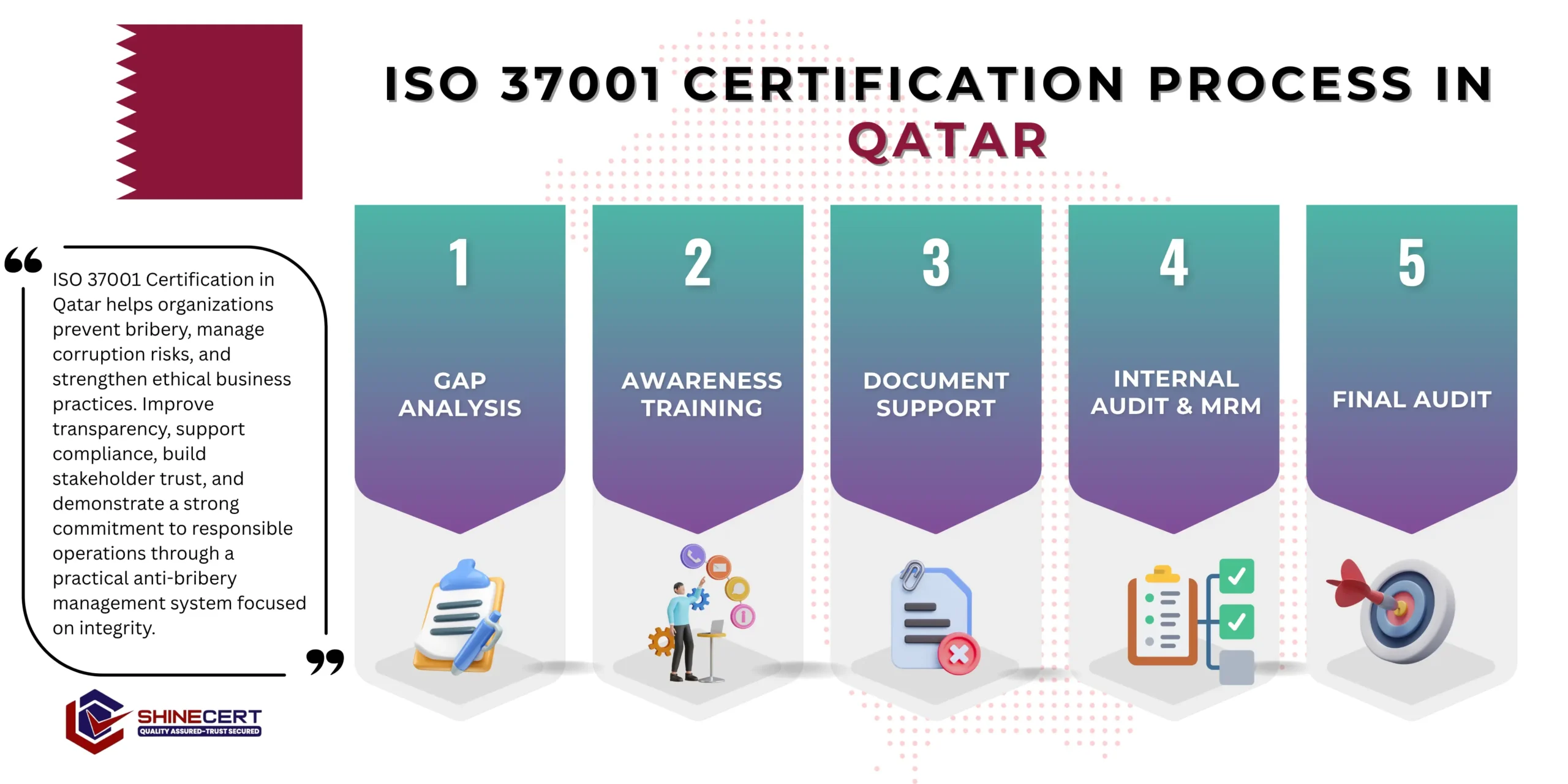
Our Five-Step ISO 37001 Certification Process
Bribery Risk Assessment
We map your genuine exposure, which contracts, geographies, and relationships carry meaningful bribery risk, rather than applying a generic checklist.
A bribery risk assessment specific to your operations and contracting profile.
Documentation Development
Your anti-bribery policy, due diligence procedures, gift and hospitality controls, and whistleblowing procedures get built around your actual risk profile.
A complete ABMS documentation set.
Implementation and Training
Controls roll out across your organization, with staff trained by role, including genuine due diligence training for procurement and business development functions.
Training records and evidence of functioning due diligence and financial controls.
Internal Audit and Management Review
We test whether your controls genuinely function, including sample due diligence file reviews, with findings feeding into a management review.
An internal audit report and management review minutes demonstrating genuine leadership engagement.
Certification Audit
We coordinate Stage 1 and Stage 2 with a GAB-accredited or GAC-recognized certification body experienced in anti-bribery audits for government contractors.
Your ISO 37001 certificate and a clear surveillance audit schedule.
What It Costs: The Factors That Actually Drive ISO 37001 Price
- Exposure to government and public-sector contracting : Companies bidding regularly on Ashghal, QatarEnergy, or other government-linked tenders need more extensive due diligence and risk assessment work than purely private-sector businesses.
- Number and complexity of business associates : Organizations working through numerous agents, subcontractors, or joint venture structures need more extensive third-party due diligence procedures.
- Existing governance maturity : Companies with informal but functioning compliance practices already in place need less foundational work than those building a system from scratch.
- Cross-border operations : Companies operating across multiple jurisdictions need due diligence and controls addressing genuinely varied local bribery risk profiles.
- Bundling with ISO 9001 or other management systems : Meaningful cost efficiency is available for companies pursuing multiple certifications together, given shared management system infrastructure.
- Quick answer : Budget QAR 18,000 to QAR 75,000, with the low end reflecting a smaller, primarily private-sector business and the high end reflecting a larger contractor with significant public-sector exposure and a complex third-party network.
What Happens If a Bribery Allegation Surfaces During a Major Government Tender Without an ABMS in Place?
- This is worth walking through concretely, because the consequences extend well beyond the individual involved. When an allegation surfaces against a company bidding on a major Ashghal or QatarEnergy-linked contract, and that company has no documented due diligence, no financial controls addressing the specific payment, and no evidence of prevention measures, ACTA and procurement evaluators are left with essentially nothing to distinguish the company from one that had no governance framework at all. The tender itself is at risk, and so, often, is the company’s standing for future bids, since procurement teams tend to remember contractors associated with governance failures.
- A company with a certified ABMS, by contrast, has documented due diligence on file for the relevant business associate, financial controls that would have flagged an unusual payment structure, and a whistleblowing channel through which the concern may have already surfaced internally before it became a public issue. We generally recommend that companies actively bidding on public-sector work treat ISO 37001 not as a defensive afterthought but as a genuine competitive input into how procurement teams evaluate long-term contractor relationships.
Benefits: What Certification Actually Changes
A certified ABMS gives evaluators independently verified evidence of governance maturity, increasingly relevant for Ashghal, QatarEnergy, and other major public-sector procurement.
Structured due diligence and financial controls genuinely reduce the likelihood that an employee or associate’s individual misconduct exposes the organization itself.
Independently verified prevention measures give you genuine evidence of good-faith compliance efforts, materially different from having no documented framework at all.
A structured ABMS gives you a repeatable way to assess third-party risk, rather than relying on informal judgment call by call.
Multinational partners, lenders, and export credit agencies increasingly expect demonstrable anti-bribery governance as a condition of doing business.
Mandatory Documents Required for Implementation
Genuine leadership commitment, communicated across the organization and to relevant business associates.
Documented, specific to your operations, contracts, and geographies.
Documented process for assessing business associates, agents, and joint venture partners before and during engagement.
Documented thresholds and approval requirements addressing this genuinely sensitive area.
Documented controls limiting cash payments, off-book transactions, and unusual payment structures.
Documented, confidential channel for raising concerns, with protection against retaliation.
Documented process for investigating concerns raised and taking corrective action.
Applicable Standards by Industry
Construction and Infrastructure
Contractors bidding on Ashghal and other government infrastructure projects face the most direct exposure to procurement-linked bribery risk.
Read moreEnergy
Companies in QatarEnergy’s supply chain need ABMS controls addressing both prequalification requirements and ongoing contractor relationships.
Read moreProfessional and Consulting Services
Firms advising on government-linked projects face reputational and legal exposure disproportionate to their contract size if governance failures surface.
Read moreImport, Export, and Logistics
Companies navigating customs and licensing processes face facilitation-payment risk requiring specific due diligence and financial controls.
Read moreFinancial Services
Banks and QFC-regulated firms need ABMS controls addressing both their own operations and anti-bribery due diligence on corporate clients.
Read moreA Genuine Qatar-Specific Nuance: Gift-Giving Custom vs Bribery Risk
- This is a distinction worth handling directly, because it comes up in nearly every ABMS implementation across the Gulf region and Qatar is no exception. Genuine hospitality and gift-giving are a normal, valued part of Gulf business culture, and a rigid, one-size-fits-all “no gifts, ever” policy tends to be both culturally tone-deaf and, in practice, quietly ignored. The Penal Code’s bribery provisions, meanwhile, don’t turn on the existence of a gift itself but on whether it was intended to improperly influence an official act or business decision.
- We generally recommend Qatar-based organizations build gift and hospitality thresholds that are specific and documented, rather than either banning gifts outright or leaving the matter to individual judgment. A clear monetary threshold, a requirement to log and disclose gifts above that threshold, and an explicit prohibition on any gift connected to an active tender, decision, or approval gives staff a workable, culturally sensible standard while still providing the documented control an ISO 37001 auditor, and ACTA, would expect to see.
Anti-Bribery Management Requirements, Clause by Clause
- Context of the Organization : Understand your genuine bribery risk exposure, including where your operations interact with public officials, government tenders, or high-risk third parties.
- Leadership : Top management commitment to anti-bribery, including a documented policy and a named person with authority to oversee the ABMS, a genuine “tone from the top” that survives contact with a lucrative but risky deal.
- Planning : A structured bribery risk assessment covering your operations, geographies, and relationships, identifying where genuine exposure is highest.
- Support : Anti-bribery training is calibrated by role, since sales and procurement staff face meaningfully different risks than back-office functions.
- Operation : Due diligence procedures for business associates, financial controls limiting cash and off-book payments, and clear gift, hospitality, and facilitation payment controls.
- Performance Evaluation : Monitoring and internal audit of the ABMS, testing whether due diligence and financial controls actually function, not merely exist on paper.
- Improvement : A structured response to concerns raised, including genuine investigation procedures and corrective action, feeding lessons back into the system.
A Scenario: How a Construction Contractor Might Approach Due Diligence Before a Major Ashghal Bid
- Concrete examples clarify what genuine due diligence looks like in practice, rather than as an abstract requirement. Picture a mid-sized construction contractor preparing a bid for a major Ashghal infrastructure package, planning to work through a local agent to help navigate the tender process and a handful of subcontractors for specialized scopes. Without a structured ABMS, the contractor’s due diligence on the agent would likely amount to little more than a personal recommendation and a signed contract, with no documented risk assessment of the agent’s fee structure, no verification of the agent’s genuine role in the process, and no financial controls flagging whether the agent’s compensation is proportionate to the actual services provided.
- A contractor with a certified ABMS approaches this differently, because the due diligence procedure already requires documented verification of the agent’s business legitimacy, a clear written scope of the agent’s actual services, and a compensation structure reviewed against that scope before the relationship is finalized. The same discipline applies to subcontractor selection, with documented criteria rather than informal relationships driving who gets included in the bid. Given how closely Ashghal and other public-sector evaluators now scrutinize the governance maturity of major bidders, contractors who can demonstrate this kind of genuine, documented due diligence increasingly find it becomes a meaningful differentiator, not just a defensive measure, when competing for repeat public-sector work.
Two Myths About Anti-Bribery Compliance in Qatar
- We already have a code of conduct, so we don’t need ISO 37001 : A code of conduct is a policy statement; ISO 37001 requires a functioning management system behind it, documented risk assessment, due diligence procedures, financial controls, and independent audit evidence that the code is actually followed, not just distributed and filed away. Many organizations with a genuine, well-written code of conduct still fail an ISO 37001 gap assessment because the operational controls behind the policy were never built.
- Anti-bribery certification is only relevant for companies dealing directly with government officials : This significantly undersells the standard’s scope. Bribery risk extends through agents, subcontractors, and joint venture partners, meaning a company with no direct government contact can still carry meaningful exposure through a business associate acting on its behalf, which is exactly the exposure ISO 37001’s due diligence requirements are built to address.
Why ShineCert?
We coordinate Qatar engagements from ShineCert’s Riyadh and Lebanon offices, with direct familiarity with the governance expectations attached to major Ashghal and QatarEnergy-linked tenders, and genuine experience building anti-bribery frameworks as the best ISO 37001 consultant in Qatar that reflect both Qatar’s regulatory landscape and the realities of Gulf business culture. Our team has guided more than 10,000 organizations through ISO certification globally.
Choosing a Certification Body in Qatar?
What to Check | Why It Matters |
GAB accreditation, or another GAC-recognized body | Confirms genuine, internationally recognized certification |
Genuine anti-bribery and government-contracting audit experience | ABMS auditing requires distinct competence in due diligence and financial control evaluation, not general management system review |
Familiarity with Qatar’s Penal Code bribery provisions and ACTA’s role | Helps ensure certification genuinely supports your legal risk position, not just a generic checklist |
Experience with construction, energy, or public-sector contractor audits | Sector-specific tender and subcontracting patterns need auditors who understand the practical risk profile |
Ready to Get Started?
ShineCert supports Qatar businesses building anti-bribery management systems that hold up under real tender scrutiny, from risk assessment through certification audit. Book a free consultation or contact us directly, and we’ll review your contracting profile before proposing a fixed-scope plan.
Frequently Asked Questions
It’s the international standard for anti-bribery management systems, providing a structured framework for preventing, detecting, and responding to bribery risk.
No, bribery offenses sit within the Penal Code (Law No. 11/2004), enforced primarily by ACTA and the State Audit Bureau, rather than a single dedicated statute.
Typically QAR 18,000 to QAR 75,000, depending on organizational size and exposure to public-sector contracting.
It’s not universally mandatory, but it’s an increasingly valuable governance signal for evaluators assessing contractors on major public projects.
Typically three to five months.
No, but it provides independently verified evidence of genuine, systematic prevention measures, which matters significantly if an allegation ever surfaces.
Not automatically, the law turns on whether a gift was intended to improperly influence an official act or decision, which is why documented gift and hospitality thresholds matter.
The Administrative Control and Transparency Authority is one of the main bodies responsible for investigating and combating bribery and corruption in Qatar, alongside the State Audit Bureau.
No, a code of conduct is a policy statement, while ISO 37001 requires a functioning management system with documented risk assessment, due diligence, and independent audit evidence behind it.
No, risk extends through agents, subcontractors, and joint venture partners acting on your behalf, which is why third-party due diligence is central to the standard.
We coordinate Qatar engagements from our Riyadh and Lebanon offices, with consultants traveling on-site as needed.